
If your Samsung TV is too dark, turn off Brightness Optimization and Energy Saving Solution, then raise Brightness in Picture > Expert Settings. If one half, one side or a band stays dark, run Picture Test and contact Samsung if the test picture shows it too.
Samsung's recent-model pages put both in General & Privacy > Power and Energy Saving, while 2021 models have Ambient Light Detection under General > Eco Solution instead, plus a separate Backlight control in Expert Settings. Picture Test is in Support > Device Care > Self Diagnosis. These are Samsung's own first steps for a dim screen, and the sections below run from the quickest change to the last resort.
The short version
- Whole screen dim, or dimming with the room: turn off Brightness Optimization, Motion Lighting and Energy Saving Solution or Brightness Reduction, whichever your TV shows.
- Always too dark: try Standard or Dynamic Picture Mode, then raise Brightness in Expert Settings, or Backlight on 2021 and older models.
- Brightness jumps between scenes: set Contrast Enhancer to Off.
- Only HDR looks dark: check that the source is sending HDR, since supported HDR controls may stay grayed out without it and availability varies by model.
- Top half, one side or a band dark: run Picture Test and contact Samsung if the test picture shows it too.
Find the pattern before you change anything
Look at where and when the picture is dark before you touch a setting. A screen that dims with the room or between scenes points to an automatic brightness feature, one that is always dim points to Picture Mode and Brightness, and a dark area that never moves points to the source or the TV itself.
| What you see | Check first | Then try |
|---|---|---|
| Whole screen darker in a dim room or at night | Brightness Optimization | Adaptive Picture and EyeComfort |
| Brightness drops in dark or fast scenes | Contrast Enhancer and Motion Lighting | Energy Saving Solution |
| Always too dim on every source | Picture Mode, then Brightness | Reset Picture |
| A new TV looks dim | Shipping film over the bottom edge | Power and Energy Saving |
| Only HDR movies or games look dark | Whether the source is sending HDR | Input Signal Plus and Game HDR |
| Only one HDMI device looks dark | That device, its cable and its port | Another HDMI input |
| Top half, one side or a band stays dark | The TV's own menu and Picture Test | Samsung service if the test shows it |
Two problems look similar but have their own fixes. A screen that stays fully black, with no picture and no menu, needs the Samsung TV black screen guide, and a tinted or washed out picture belongs with Samsung TV color problems.
Samsung moves menu items between model years, so it helps to check the model of your Samsung TV before you follow a path. The paths below come from Samsung's TV support pages and manuals, with older names where Samsung gives them.
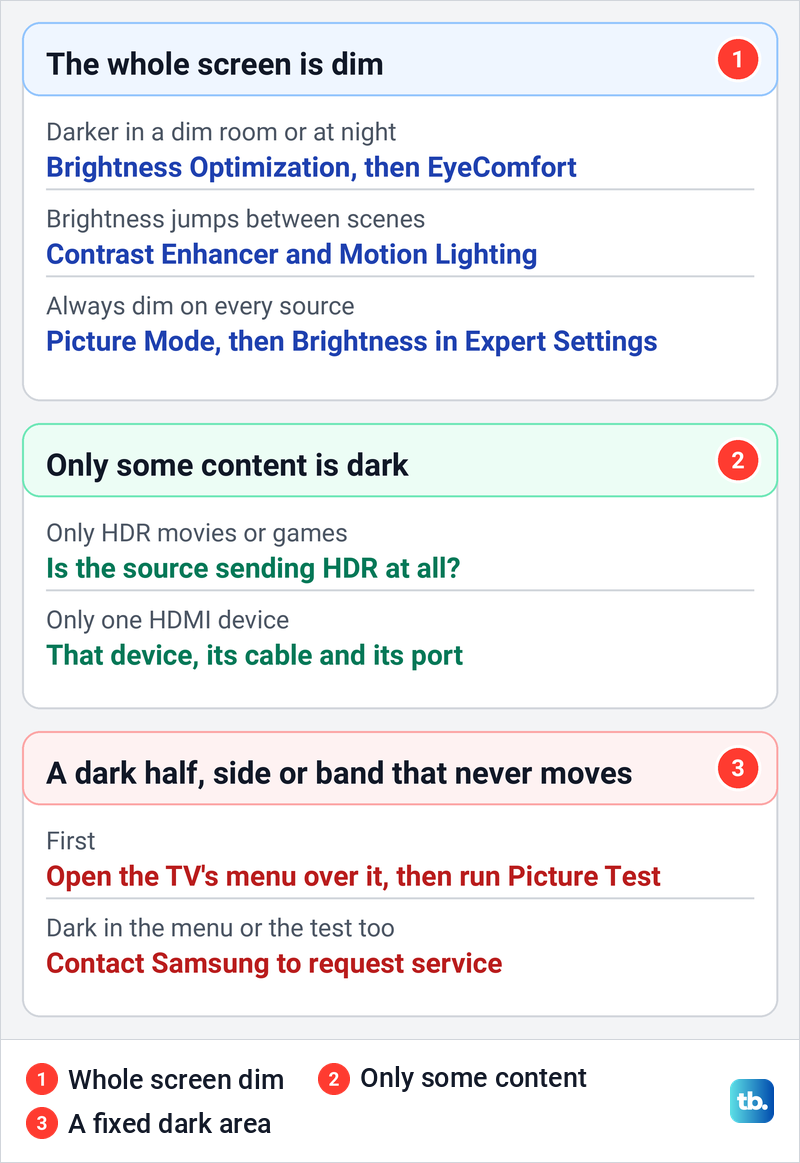
Start with Brightness in quick settings
Samsung's TV instructions say you can select Brightness and Picture Mode in quick settings as well as through Settings > All Settings, and on its 2023 QLED TVs you open quick settings by pressing and holding Home on the remote. If Brightness is well below the top of its range, raise it and look at the same scene again.
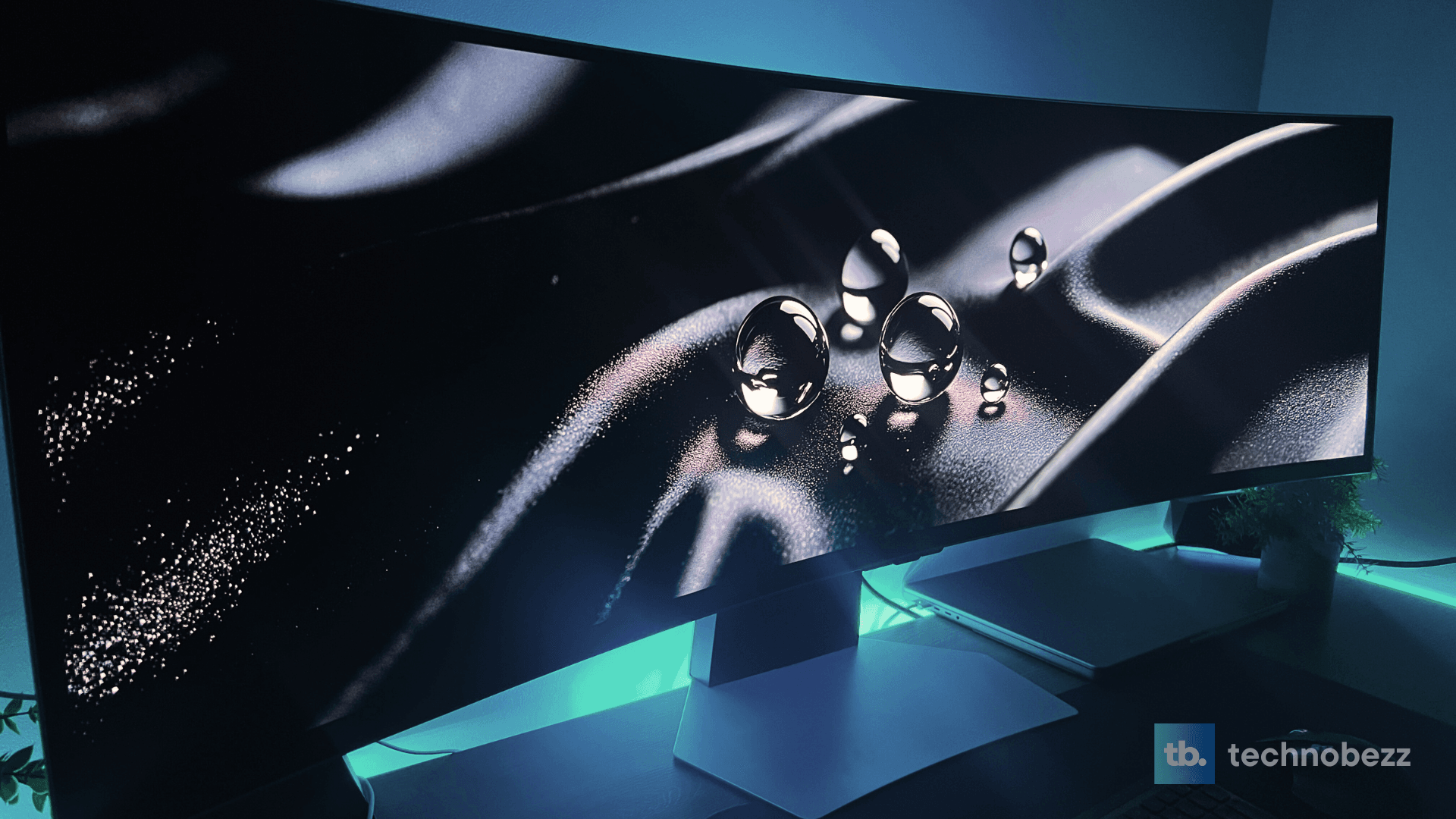
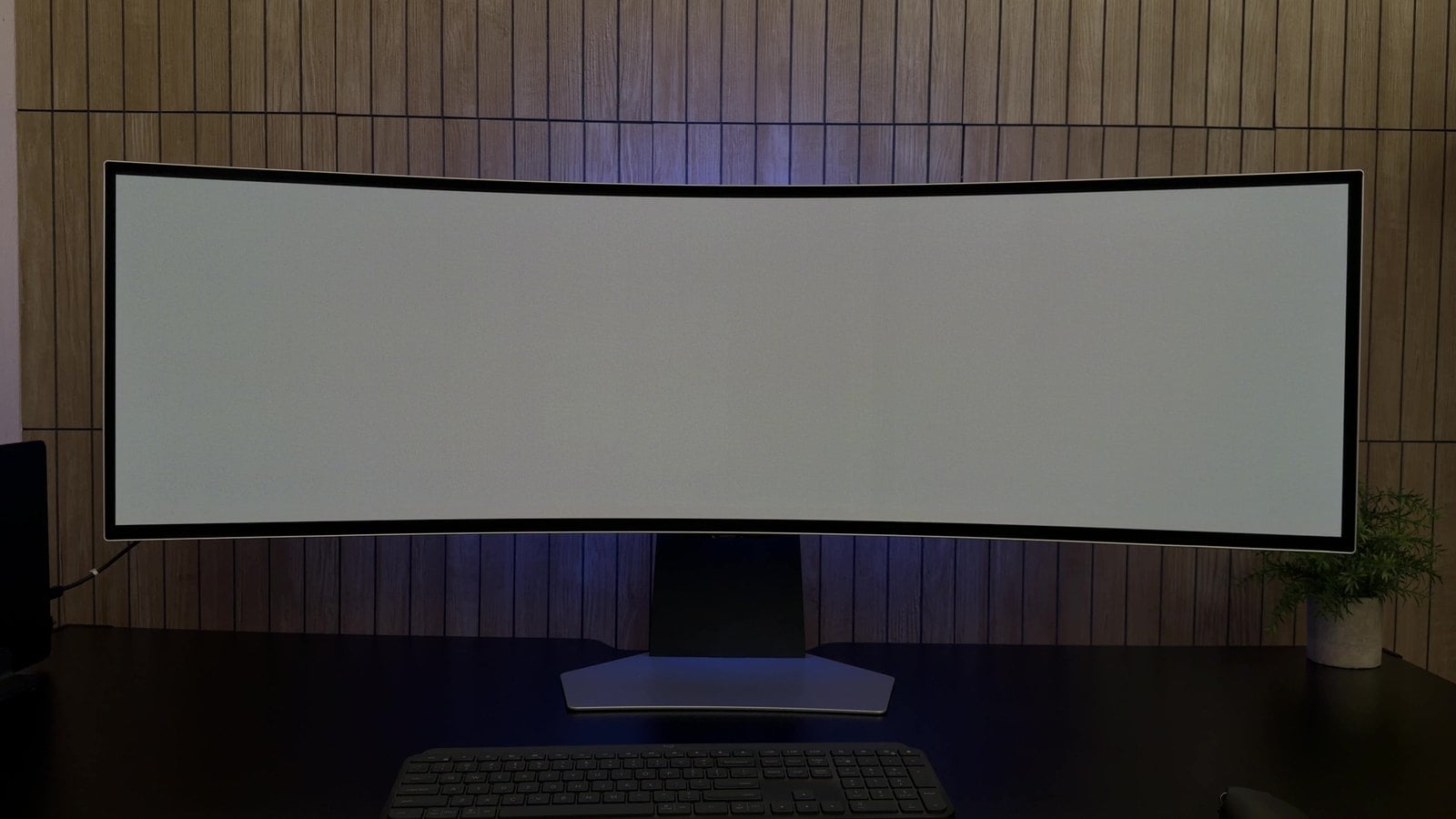
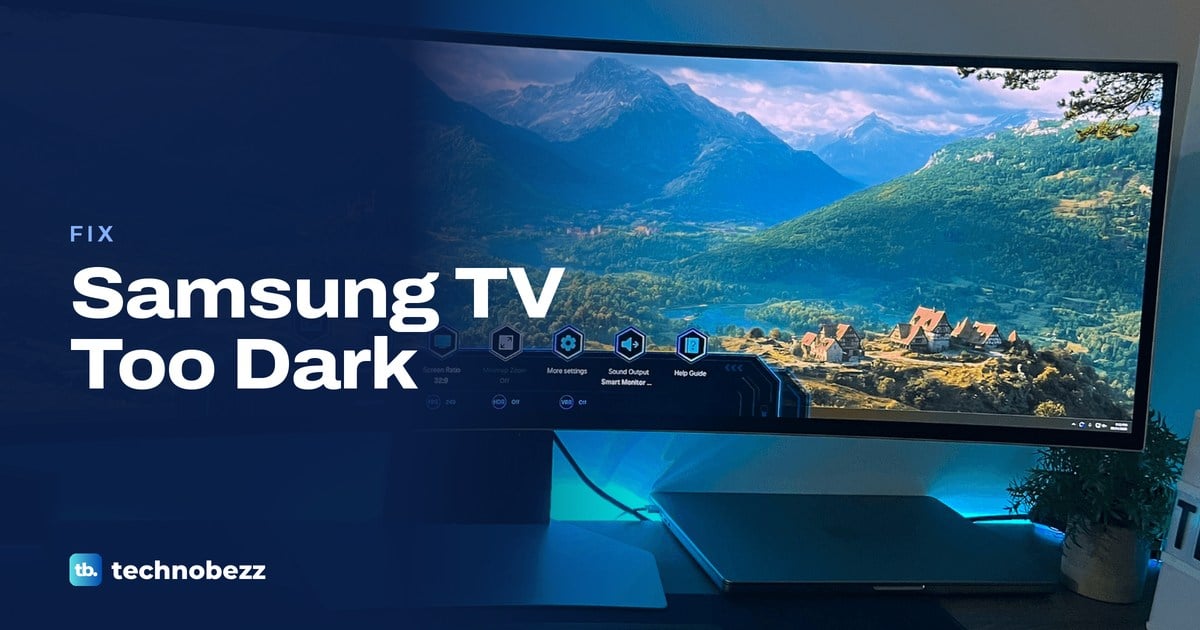
Our photos come from our Samsung Odyssey OLED G9, a smart monitor that runs the same Tizen software as Samsung's smart TVs. On it the quick settings panel opened from Settings in the Home menu, with All Settings, Brightness and Picture Mode as tiles. If your remote cannot open Settings at all, pair your Samsung remote again before you try the picture checks.
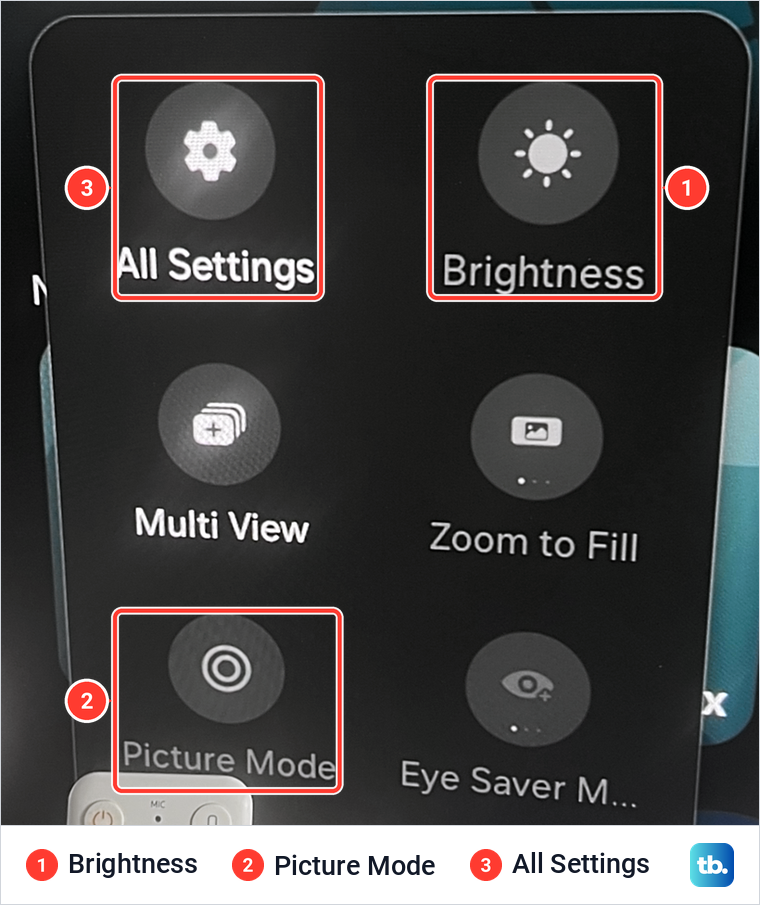
Turn off Brightness Optimization
Brightness Optimization is Samsung's automatic brightness. Samsung says it "adjusts screen brightness based on ambient light," and its fix for unwanted brightness changes is Settings > All Settings > General & Privacy > Power and Energy Saving, then turning Brightness Optimization off. Samsung says disabling it "can prevent sudden brightness changes."
Older models use other names. On 2021 TVs Samsung lists Ambient Light Detection under General > Eco Solution, and its 2018 Q9FN manual warns that a screen that is "too dark while you are watching TV in a dark environment" may be down to that function.
On our monitor the switch sits in the same place, under General & Privacy, with the note "Automatically adjust the picture brightness based on the ambient light level." When we switched it on, the Minimum Brightness slider below it went from grayed out to available, still at 2. Samsung says Minimum Brightness can only be adjusted while Brightness Optimization is on, which matches what our screen did.
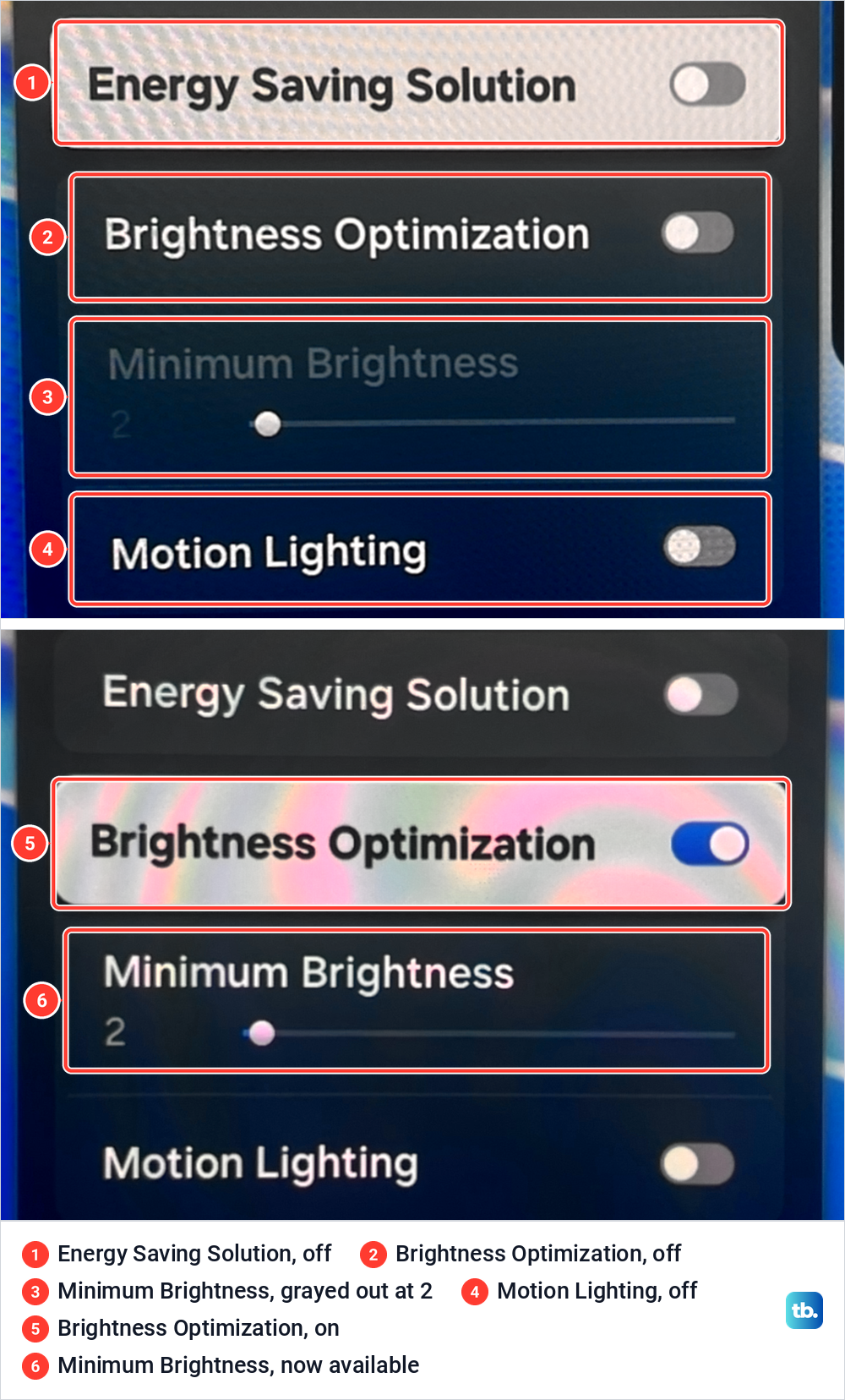
If you like automatic brightness but find it too dark at night, keep it on and raise Minimum Brightness instead. Samsung says it only works when its value is less than Brightness in Picture > Expert Settings, so a floor set above your Brightness value does nothing. Our monitor's note calls that setting Backlight, though its menu shows Brightness.
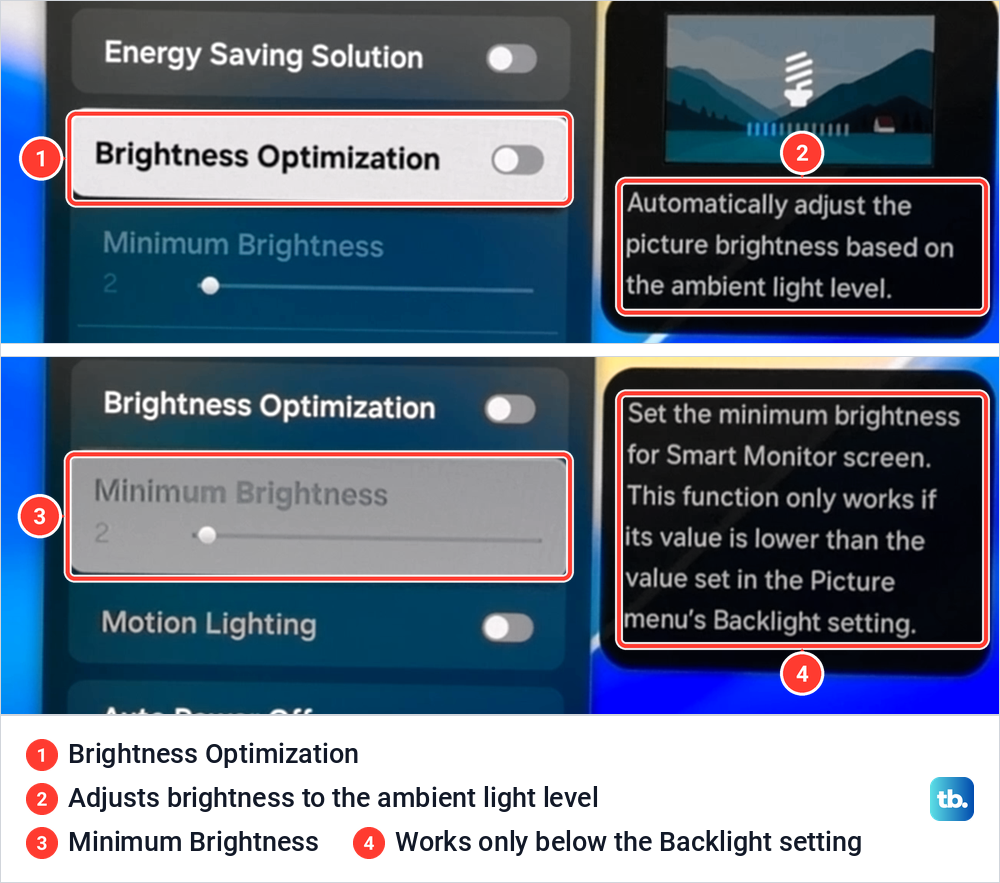
If the Brightness Optimization switch is grayed out, check Adaptive Picture. Samsung says Brightness Optimization "is disabled when Intelligent Mode (Adaptive Picture) is turned on," and the Adaptive Picture section below shows where to switch it off.
Turn off Energy Saving Solution and Motion Lighting
Samsung documents two more power-saving switches that lower brightness. Samsung Singapore describes Brightness Reduction as "Reduces power consumption by adjusting brightness settings," and Samsung's TV e-Manual and our monitor describe Energy Saving Solution as "Reduce power consumption by adjusting brightness settings." Turn off the one your TV shows, or both if it has both.
Motion Lighting dims the picture to save power when the image moves. Samsung's wording is "Adjusts the brightness in response to on-screen movements to reduce power consumption," and Samsung Gulf says turning it off "prevents brightness changes during fast-moving scenes." Samsung's Malaysian TV page names Brightness Optimization, Energy Saving Solution, Motion Lighting and Contrast Enhancer together as the features to disable when a TV is "flickering or dimming sporadically," so work through all four.
On our monitor Energy Saving Solution and Motion Lighting were both off. If the picture flashes or pulses rather than just looking dim, the steps to troubleshoot a flickering Samsung TV screen go further than this guide.
Keep the light sensor clear
Automatic brightness depends on a light sensor that measures the room. Samsung's 2018 Q9FN manual puts that model's eco sensor at the bottom of the TV and warns "Do not block the sensor with any object. This can decrease picture brightness." Sensor positions differ by model, so check your own TV's manual rather than guessing, and move a soundbar or decoration that sits in front of the bottom edge.
The same manual says "The screen may dim if the protective film on the SAMSUNG logo or the bottom of the TV is not detached," so a new TV can look dim from day one for that reason alone. Peel off any shipping film that is still on the frame.
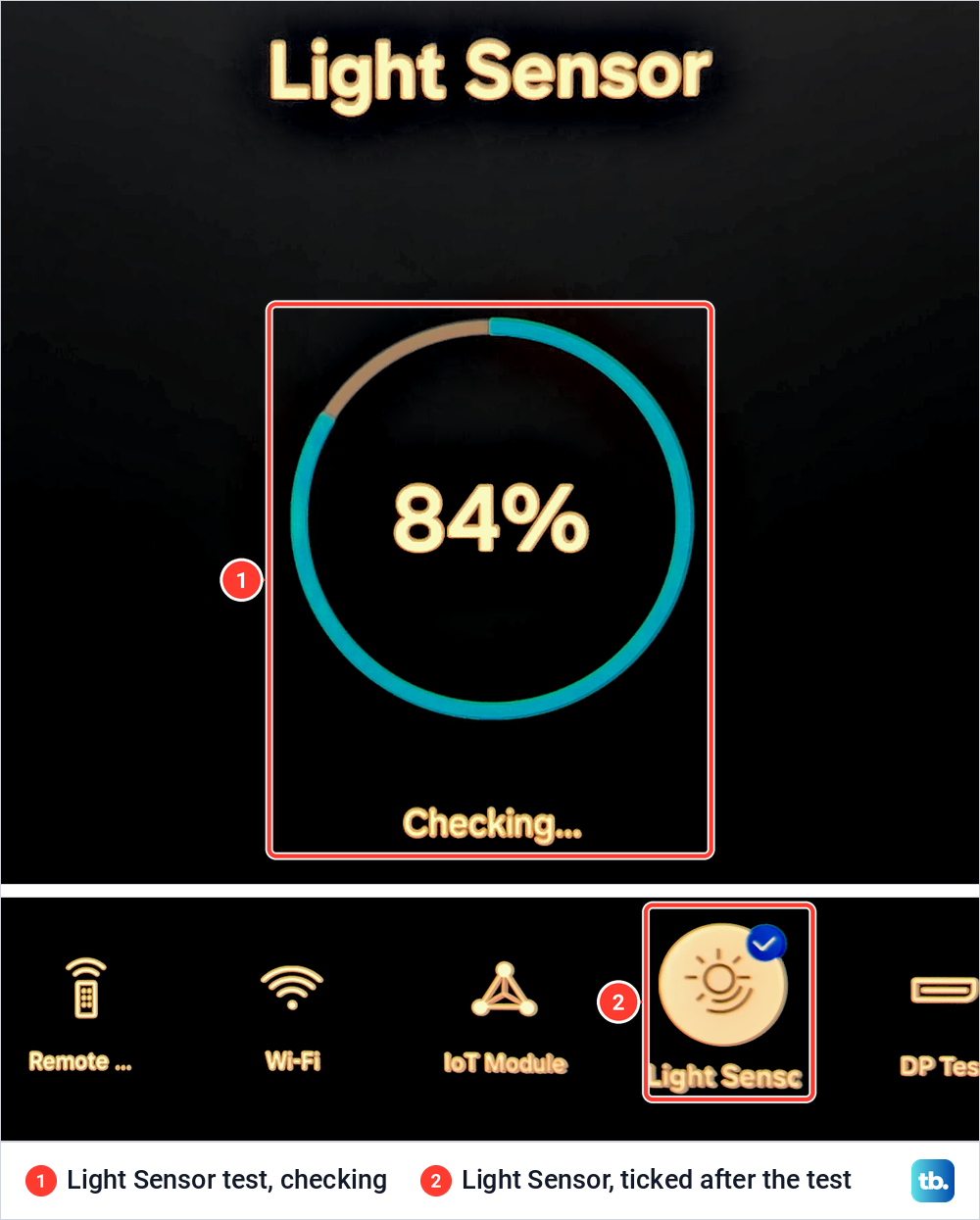
Our monitor's Self Diagnosis has a Light Sensor test. We ran it, and Self Diagnosis then counted it as normal, with 3 of 15 tests done and no action required. If your TV's Self Diagnosis screen shows the same tile, it is a quick way to check the sensor before you blame it.
Pick a brighter Picture Mode
Picture Mode changes several settings at once. Samsung's path is Settings > All Settings > Picture > Picture Mode. It describes Dynamic as "brighter and clearer in bright viewing environments" and Standard as the default mode, "suitable for most viewing environments."
Other modes trade brightness for something else. Samsung says Movie is "Suitable for watching TV or movies in a dark room," Eco reduces power consumption, and "FILMMAKER MODE may appear darker than other picture modes." If the picture is dim in a bright room, switch to Standard or Dynamic and compare the same scene.
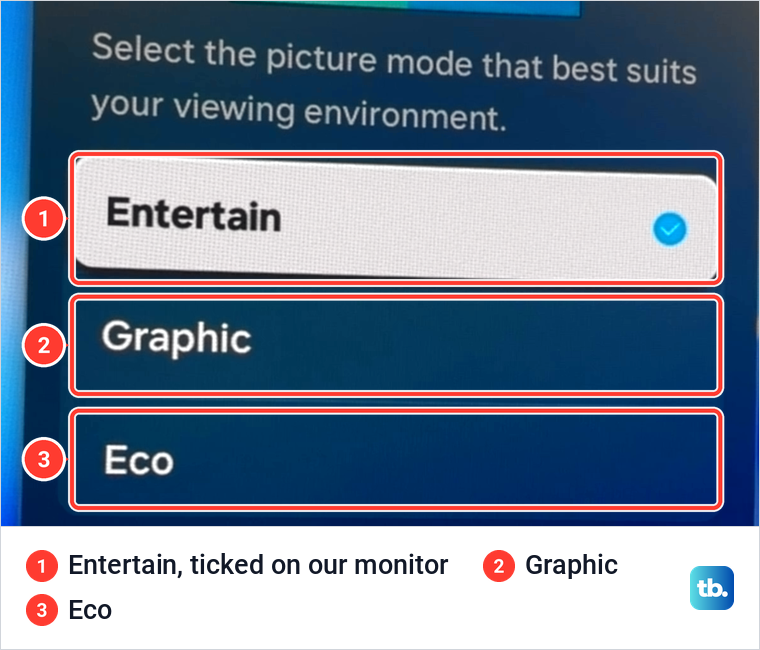
Mode names vary. Our monitor listed only Entertain, Graphic and Eco, with Entertain ticked, and Samsung's TV page notes that Entertain and Graphic "are only supported when changing the external device name to 'PC' in PC mode." Our monitor was showing a PC source at the time. On a TV, Samsung's note ties those two modes to a connected device that is named PC.
Raise Brightness and Contrast in Expert Settings
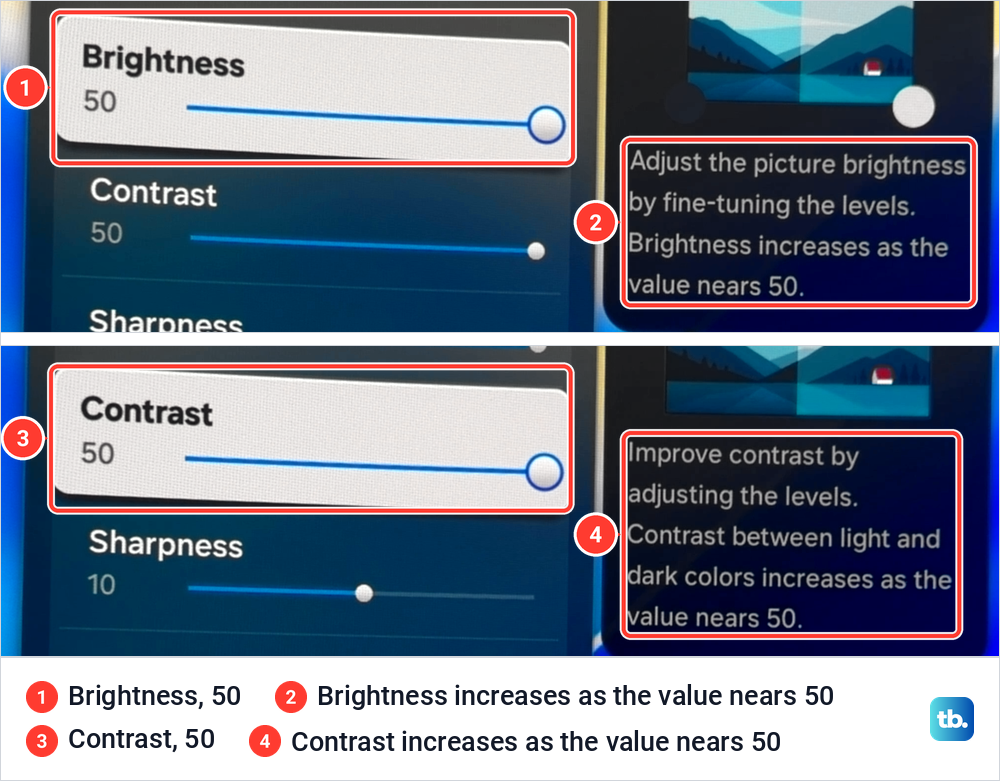
If the picture is still dim in a bright mode, open Settings > All Settings > Picture > Expert Settings. On 2022 and newer models Samsung says Brightness adjusts "the overall picture brightness" and that "A higher value, closer to 50, increases the brightness." Its US page gives the range on a Neo QLED as 0 to 50.
Contrast is a separate control. Samsung says it adjusts "the difference between the darkest and brightest parts of the image," so it is not a substitute for Brightness. Move each one a few steps at a time and check both a dark scene and a bright one, so you do not lose detail at either end.
On our monitor both sat at 50, with the slider at its right end. Their notes read "Brightness increases as the value nears 50" and "Contrast between light and dark colors increases as the value nears 50," so neither had any headroom left. When Brightness is already at the top and the screen is still dim, the cause lies elsewhere: a power feature, the mode, the source or the hardware.
On 2021 and older TVs, Samsung lists Backlight in Expert Settings next to Brightness and says it "Adjusts the screen's light output," to be increased for brightly lit rooms. On those sets raise Backlight as well as Brightness, since Backlight is the control Samsung ties to light output. Samsung also warns that LED Clear Motion or Clear Motion under Picture Clarity Settings "can make the screen appear darker," so switch them off if the picture dimmed after a motion change.
Check Contrast Enhancer and Shadow Detail
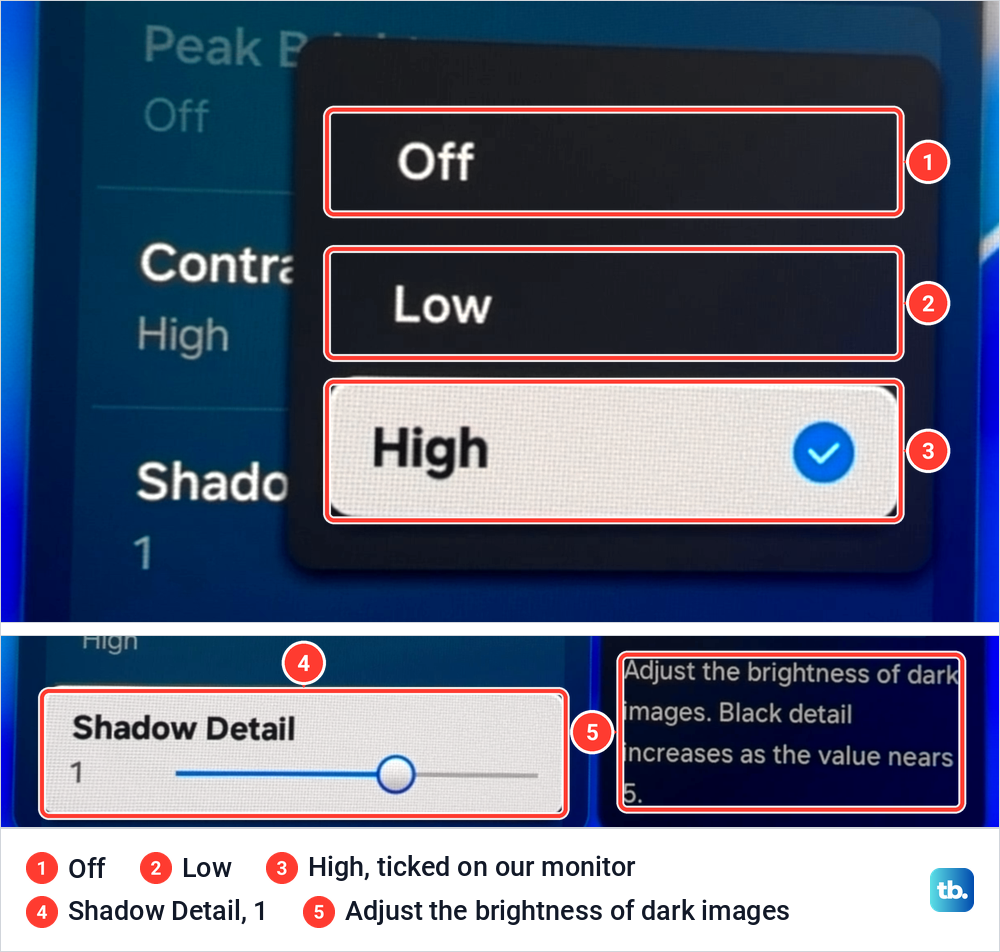
If the brightness changes from scene to scene, set Contrast Enhancer in Picture > Expert Settings to Off. Samsung says it "adjusts the brightness to balance dark and bright areas on the screen," and that disabling it "can help maintain consistent brightness." On our monitor the list offered Off, Low and High, with High ticked, so check yours rather than assuming it is already off.
If the overall level is fine but shadows look crushed, Shadow Detail is the targeted control. Samsung says it adjusts "the visibility of details in dark areas of the picture," with higher values, closer to 5, brightening them. Our monitor showed it at 1 with the note "Adjust the brightness of dark images. Black detail increases as the value nears 5."
Check Adaptive Picture and EyeComfort
Some Samsung TVs manage brightness for you through Intelligent Mode. Samsung says Adaptive Picture "Optimizes the brightness of the TV and provides the best picture quality based on the surrounding lighting and content you're viewing." On its 2024 QLED TVs the path is Settings > All Settings > General & Privacy > Intelligent Mode Settings, and while Adaptive Picture is on, Samsung says the Power and Energy Saving switches above are not available.
That cuts both ways. For a steady picture, turn Adaptive Picture off so the manual switches come back, and if you prefer automatic brightness, Samsung's Singapore page offers Adaptive Picture as the alternative to the Power and Energy Saving features.
A picture that turns darker and warmer after sunset can be EyeComfort Mode. Samsung says it works by "limiting brightness and having warm colours," following "a built-in light sensor and sunset/sunrise information," on select TVs from 2022 on. On 2025 models it is in Picture > EyeComfort Mode Settings, and on 2022 to 2024 models it runs only when Adaptive Picture is set to EyeComfort.
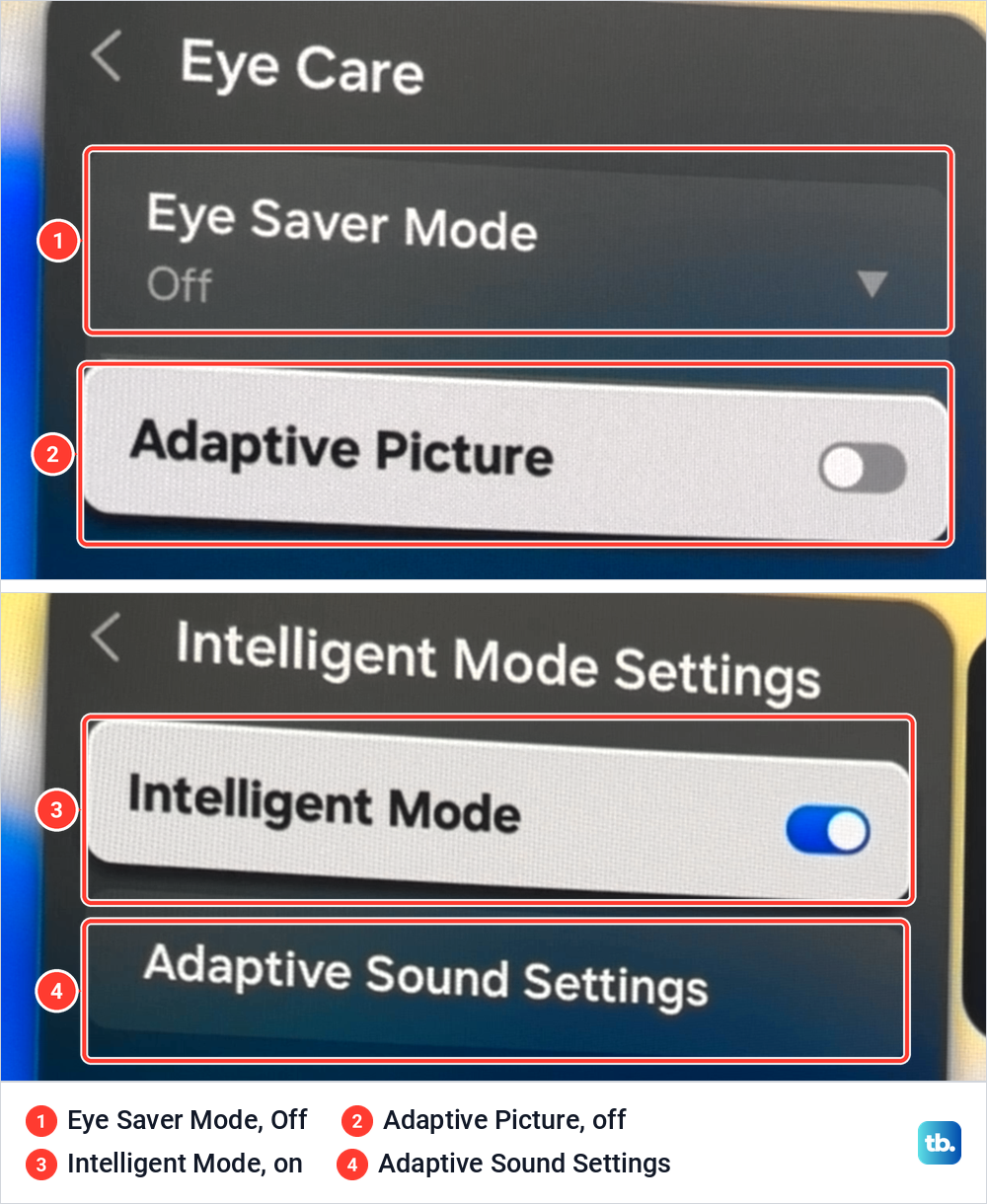
Our monitor places these differently. Adaptive Picture sits next to Eye Saver Mode under Picture > Eye Care, and both were off, while Intelligent Mode is under Advanced Features, where it was on and held only Adaptive Sound Settings. If your menus do not match Samsung's path, look in both places.
When only HDR movies or games look dark
If ordinary video looks fine and only HDR films or games are dark, look at the HDR controls while HDR is actually playing. Samsung's HDR Tone Mapping "Adjusts screen brightness and tone based on HDR content information," and its availability varies by model and region.
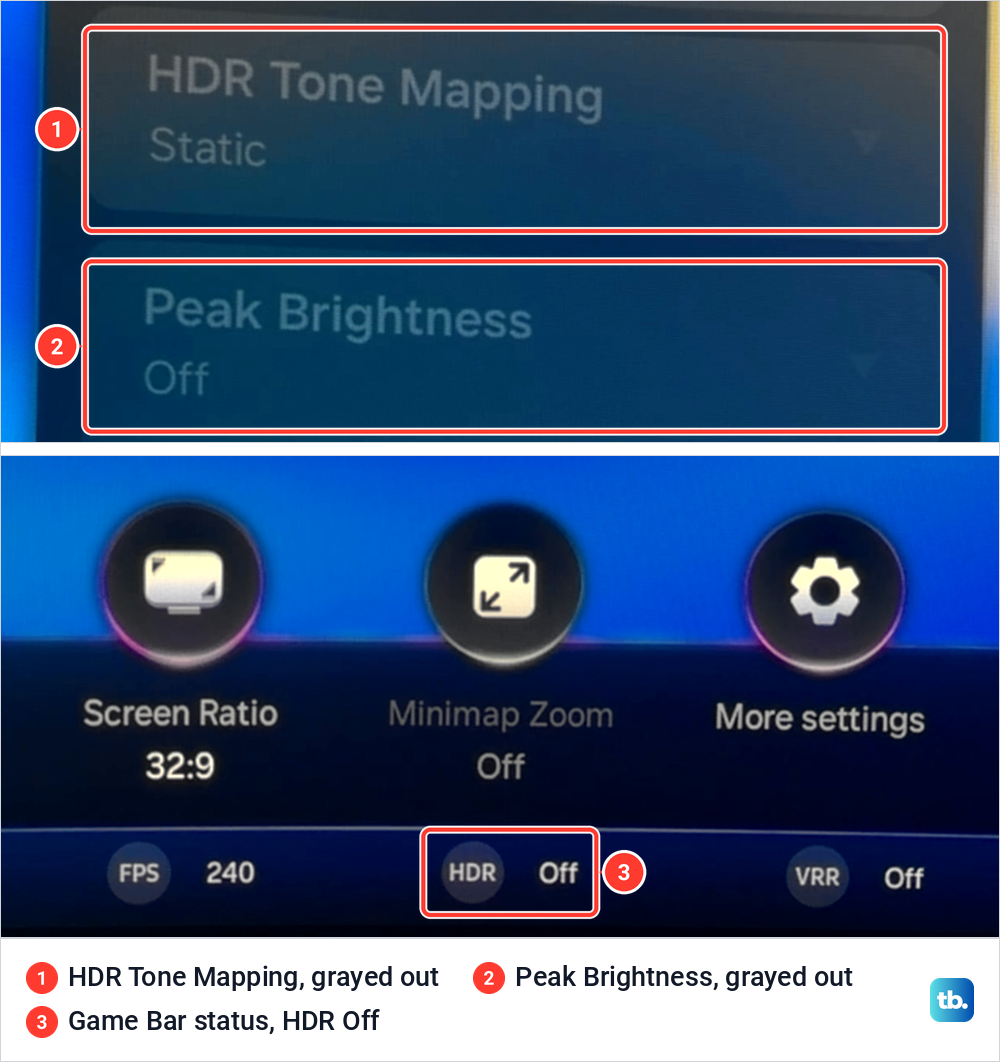
On our monitor HDR Tone Mapping (Static) and Peak Brightness (Off) were grayed out while a desktop without HDR was on screen. Samsung explains that a grayed-out setting is "not available based on the current source, setting, or connections," which is not a fault, so check them again once an HDR source is playing.
For games, Samsung's e-Manual says Game HDR sets the picture "according to the brightness information of the contents," and that the menu becomes active when HDR sources are input in Game Mode. On its 2023 and 2024 TVs, the Game Bar's status display shows "HDR (indicating when an HDR game is running)," which tells you whether the console is sending HDR at all.
Our monitor's Game Bar showed that status line with Game Mode on, reading HDR Off with a computer as the source. If yours reads HDR Off during an HDR game, check the console's HDR output and Input Signal Plus in External Device Manager for that HDMI port. Samsung says that with it off, "HDR signals sent from an external device cannot be received."
When only one source looks dark
If the built-in apps look fine and one device is dark, the device or its connection is the place to look. To compare, change the Samsung TV input and play something similar, then check the device's own brightness and HDR settings. Samsung's rule is simple: "If the TV can display a picture in any other setup, then the TV is not the cause of the issue."
Next, check the cable and the port. Samsung lists an HDMI test for 2022 and later models under Support > Device Care > Self Diagnosis > HDMI Troubleshooting, designed for cables under 2 meters, but says certain models only get it after a software update and older ones may not have it at all.
If the test reports a problem, replace the cable, and if your TV has no test, swap the cable and try another port directly. The guide to fix Samsung HDMI connection problems covers the rest, and a port that fails with every cable needs the steps for Samsung TV HDMI ports that are not working.
If only one streaming app looks dark, try another title in the same app first, then restart an app on a Samsung TV if that app alone misbehaves. If menu values seem stuck after you switch inputs, restart your Samsung TV and check the same scene again before you change more settings.
Run Picture Test if one half or a band stays dark
A darker top half, a dark side or a band that never moves needs a different check from a dim picture. First open the TV's menu so that it sits over the dark area. Samsung's rule for part of the screen going black is "If the menu is cut off by the black part of the screen, visit the Support Center to request service," and for a dim area the Picture Test is the second check.
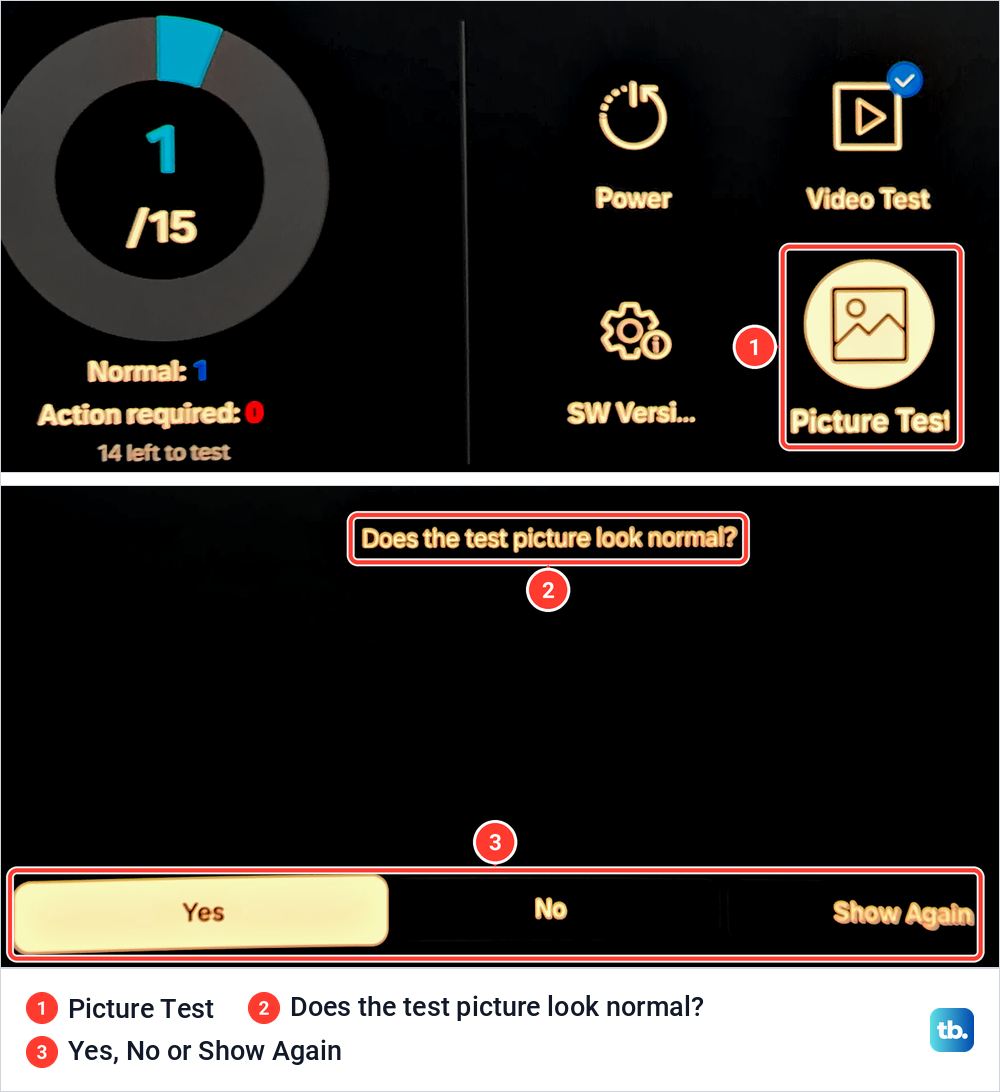
Then run the Picture Test. On 2022 and later TVs the path is Settings > All Settings > Support > Device Care > Self Diagnosis > Picture Test, then OK, and older models use Settings > Support > Self Diagnosis > Picture Test. Watch the test picture, then answer Yes, No or Show Again.
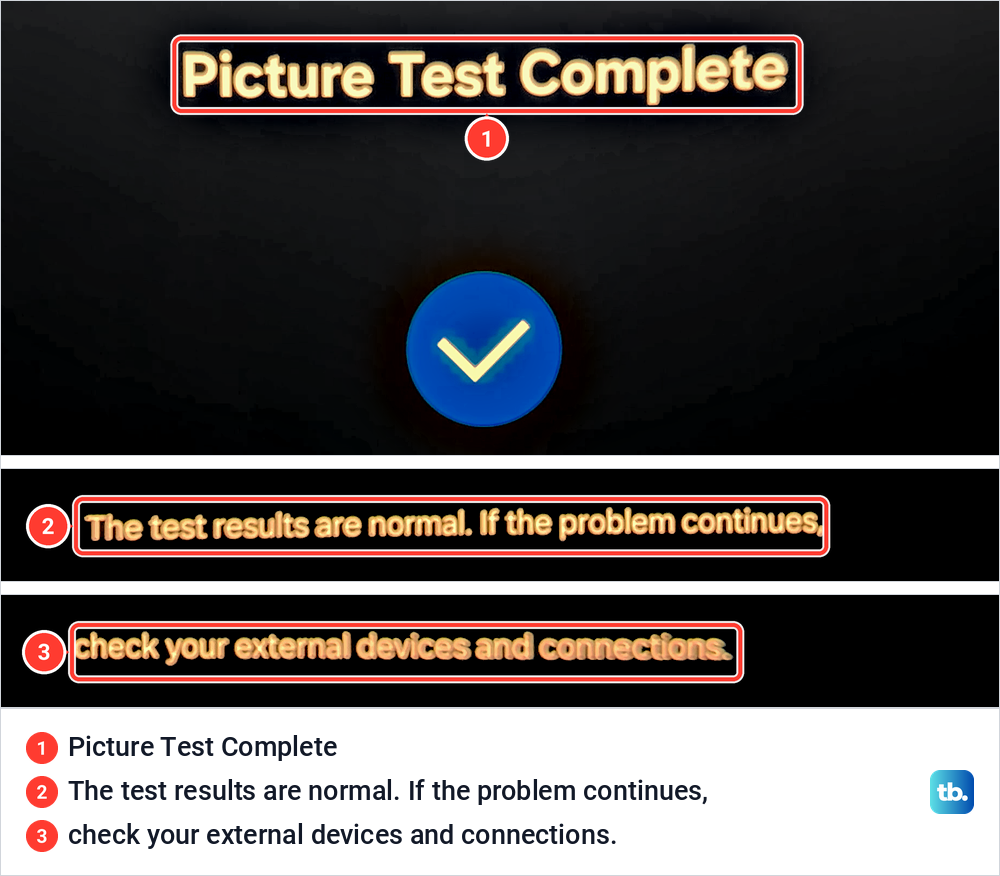
We ran it on our monitor. It asked us to "look carefully at the screen for the next 5 seconds," played the test picture and asked "Does the test picture look normal?" The result screen then read "The test results are normal. If the problem continues, check your external devices and connections," and the Self Diagnosis counter moved from 1 to 2 of 15 tests, both counted normal.
Samsung's picture-problem steps, written for lines, flicker, wrong colors and a black area, send a defect that shows in the test to service, with the TV's model code, software version and serial number ready. In its black-area steps Samsung adds that "If the issue does not appear in the picture test," it "is being caused by a bad cable or a connected device." This guide applies the same split to a dark area.
LED and QLED TVs are lit by an LED backlight. Samsung says OLED TVs "have individual pixels that produce their own light, with no separate backlight," so a fixed dark area is not the same fault on both kinds of TV, and only Samsung service can say which part has failed.
Forum posts suggest service-menu codes or blame the way the TV dims its light for dark scenes, but Samsung's public steps never go there. They stop at the user menus, the Picture Test and a service request. A single dark dot is a different check, covered in how to troubleshoot a stuck pixel on a Samsung TV.
Reset only the picture settings
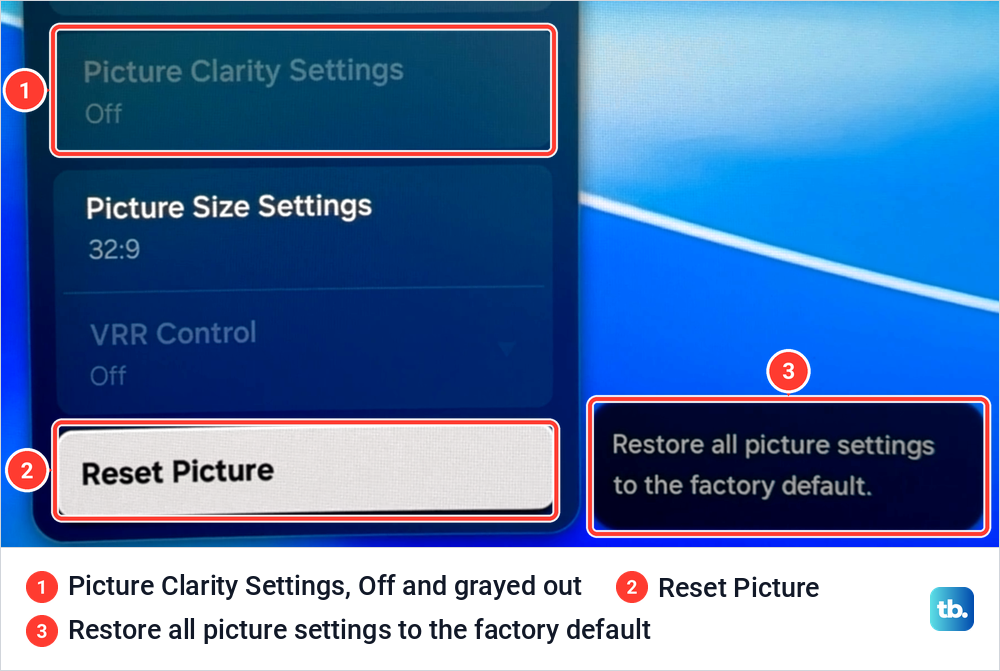
If you have changed several controls and the picture is still wrong, reset them. Samsung's path is Settings > All Settings > Picture > Expert Settings > Reset Picture, at the very bottom of the list, and you confirm with Reset on 2022 and newer models or Yes on 2021 and older ones. Samsung's Malaysian page offers it first for a screen that "appears too dim."
Reset Picture restores "all picture settings to their factory default values," so it also undoes any Brightness and Contrast changes you made. It covers picture settings only, which makes it far smaller than a full Samsung TV factory reset. Our monitor's note beside the row reads "Restore all picture settings to the factory default."
Update the software or contact Samsung
A software update is worth checking once the settings above have not helped. Samsung's path on 2022 and later models is Settings > All Settings > Support > Software Update > Update Now, and Samsung Gulf says updates "may include fixes for brightness-related bugs." Samsung also warns that video and audio settings may be reset to their defaults after an update, so check Power and Energy Saving and Picture Mode again afterwards.
If the picture is still too dark after all of the above, contact Samsung to request service. Do it straight away if the dark area shows in the Picture Test or cuts across the menu, and have the model code, software version and serial number ready.
How we tested this guide
We tested this on a Samsung Odyssey OLED G9 smart monitor, which runs the same Tizen software as Samsung TVs, switching Brightness Optimization on and running the Light Sensor test.
Frequently Asked Questions
Why is my Samsung TV darker at night?
Brightness Optimization follows the light in the room, and EyeComfort Mode on select 2022 and later TVs limits brightness after sunset. Turn off Brightness Optimization in Power and Energy Saving, or raise Minimum Brightness if you want to keep it.
Why does my Samsung TV keep changing brightness?
Contrast Enhancer, Motion Lighting and Brightness Optimization can all change brightness while you watch. Turn them off one at a time, starting with Contrast Enhancer in Expert Settings, to find the one you notice.
Why is the top half of my Samsung TV darker?
Open the TV's menu over the dark area and run the Picture Test. If the menu or the test picture shows the dark area too, Samsung's advice is to request service, and if the test picture is clear, check the cable and the connected device.
Why is only HDR content dark on my Samsung TV?
HDR controls such as HDR Tone Mapping may need an HDR signal, and Samsung says a grayed-out setting can also depend on the model, other settings and connections. Check that the source is sending HDR and that Input Signal Plus is on for its HDMI port, and for games, look for Game HDR in Game Mode.
Should I use the service menu to stop my Samsung TV dimming?
No. Samsung's own steps use the Power and Energy Saving and Picture settings, then the Picture Test, then a service request if the test shows a fault.
Why is one side of my Samsung TV dark?
Check whether the dark side also covers the TV's own menu and the Picture Test. If it shows only on one HDMI source and the test picture is clean, Samsung points to the cable or the connected device, and if it shows in the test, request service.