An emergency radio has one job when the power and the cell network go down: keep weather warnings and local news coming in. The right one depends on how long it has to run, how you plan to power it, and whether it lives in a kit, on a nightstand or in a pocket.
Technobezz is supported by its audience. We may get a commission from retail offers.
5 Best Emergency Radios in 2026
Compare 5 emergency radios for US homes, led by the Jensen JEP-900 with hand crank, solar, NOAA weather alert, an 8000mAh battery and a USB port for phones.
T
Technobezz
Editorial Team
Updated November 11, 2026Nov 11, 2026
•12 min read

Get Deals Like These in Your Inbox
The best prices, straight to your inbox.
Add Technobezz on Google:Preferred SourceGoogle Discover
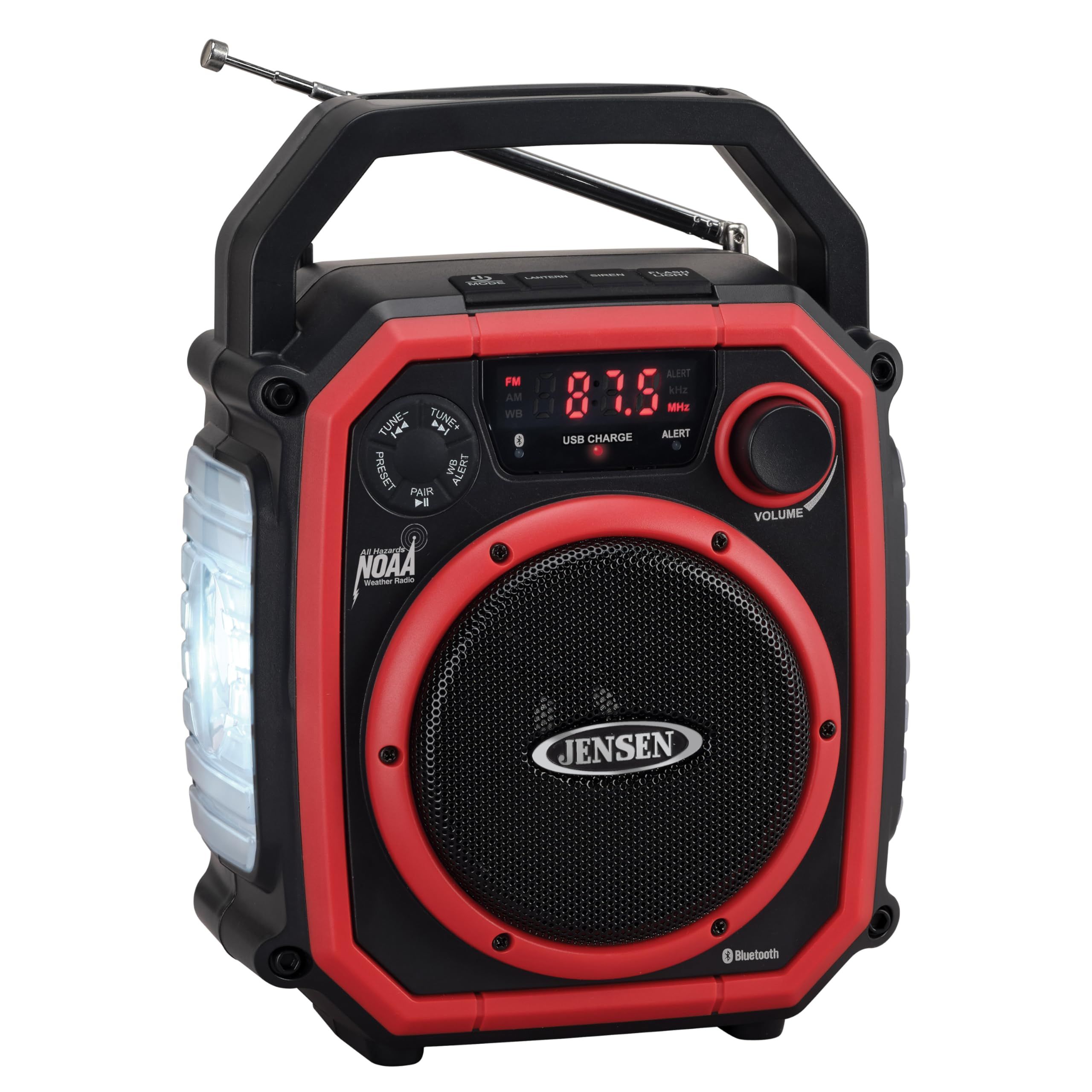
The Jensen JEP-900 is the best overall pick. It pairs AM/FM and the NOAA weather band with a weather alert, and it can run from a hand crank, a solar panel, USB Type-C or 3 AA batteries, backed by a built-in 8000mAh battery and a 2 Amp USB port for phones.
This page is for US households putting together a storm or outage kit. The other picks cover a compact crank radio, long-range shortwave listening, strong AM reception at home and a pocket-size alert radio.
At a Glance
| Category | Product | Why We Picked It |
|---|---|---|
| Best overall | Jensen JEP-900 | Four power options, NOAA weather alert and an 8000mAh battery |
| Best compact crank radio | Sangean MMR-88 | Solar and hand crank power in a rubber-cornered body under a pound |
| Best for shortwave | C. Crane CC Skywave SSB 2 | Shortwave with SSB, NOAA alert and aviation band in 6 ounces |
| Best for home AM reception | C. Crane CCRadio 3 | Twin-Coil ferrite antenna, weather alert and long D-battery run time |
| Best pocket alert radio | Sangean DT-800 | Automatic NOAA alert and a built-in battery charger in a 0.29 lb radio |
How we chose
We compared each maker's published specifications, looking at radio bands, NOAA weather alert support, power sources, battery details and extras such as lights and phone charging. We also checked that each pick is sold new on Amazon.
The best Emergency Radios right now
Jensen JEP-900 - Best overall
The Jensen JEP-900 covers the most ground for a home emergency kit in this group. It pairs a digital AM/FM tuner with 15 AM and 15 FM presets and the NOAA weather band on all 7 frequencies. Jensen says the weather alert switches the radio over to the broadcast when a warning is issued.
Power is where it stands out. Jensen lists a dynamo hand crank, a solar panel, a USB Type-C charging port or 3 AA batteries, along with a built-in 8000mAh lithium-ion battery. A 2 Amp USB port can charge a smartphone, and two side-mounted LED flashlights, an emergency siren, Bluetooth 5.0 and an IPX4 water resistance rating round out the feature list.
Key highlights
- Digital AM/FM tuner with 15 AM and 15 FM presets
- NOAA weather band on all 7 frequencies, with weather alert
- Hand crank, solar, USB Type-C or 3 AA batteries
- Built-in 8000mAh lithium-ion battery
- 2 Amp USB port for phone charging
- Two LED flashlights with high, low and flashing modes
- IPX4 water resistant
Pros
- Four ways to keep it running during a long outage
- Far larger listed battery than the MMR-88's 850mAh cell
- 2 Amp USB output is the strongest phone charging output on this list
- Bluetooth 5.0 lets it play audio from a phone
Cons
- No shortwave band listed
- Jensen does not publish dimensions or weight on its product page
- IPX4 covers splashes, not submersion
- No SAME area coding listed for alerts
Who it is for: Households that want one radio to cover alerts, light and phone charging in a storm kit.
Skip if
You want shortwave reception or a radio small enough for a pocket.
Sangean MMR-88 - Best compact crank radio
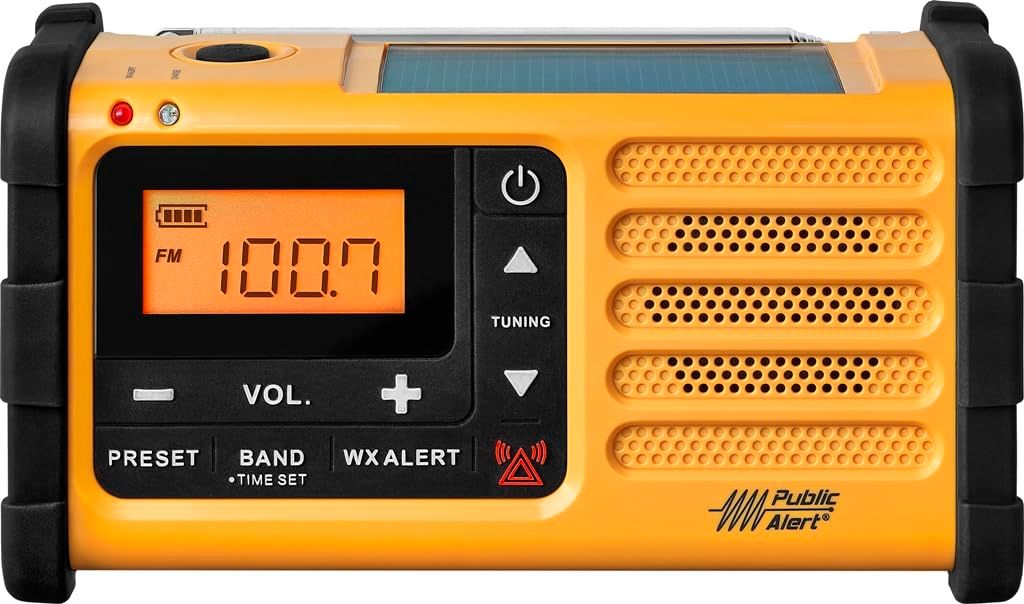
The Sangean MMR-88 is a small multi-powered radio for a go-bag or glove box. It measures 5.99 x 3.34 x 2.72 inches and weighs 0.83 lb, and Sangean protects all four corners with shock-resistant rubber.
It receives AM, FM and all 7 NOAA weather frequencies, with 19 station presets. Power comes from a solar panel, a hand crank generator or a rechargeable 18350 lithium battery rated at 3.7V and 850mAh, which charges over Micro USB. Sangean rates playtime at 14 hours. A USB Type-A port provides 5V/0.3A for phone charging, and a triple LED light offers low, high, blinking and SOS patterns alongside a siren. Sangean offers it in yellow and white.
Key highlights
- AM, FM and all 7 NOAA weather frequencies
- Solar panel and hand crank generator
- 18350 lithium battery, 3.7V/850mAh
- 14 hour rated playtime
- USB Type-A output, 5V/0.3A
- Triple LED light with SOS pattern, plus siren
- 5.99 x 3.34 x 2.72 inches, 0.83 lb
Pros
- Solar and crank power need no spare batteries
- Rubber-protected corners for rough handling
- Light enough for a go-bag
- Headphone jack and backlit LCD
Cons
- Sangean lists weather band reception but no automatic alert function
- 0.3A USB output makes phone charging slow
- Small 850mAh battery
- No shortwave
Who it is for: Anyone who wants a compact radio that can keep running from sunlight or a crank.
Skip if
You need a radio that sounds an alert on its own while you sleep.
C. Crane CC Skywave SSB 2 - Best for shortwave
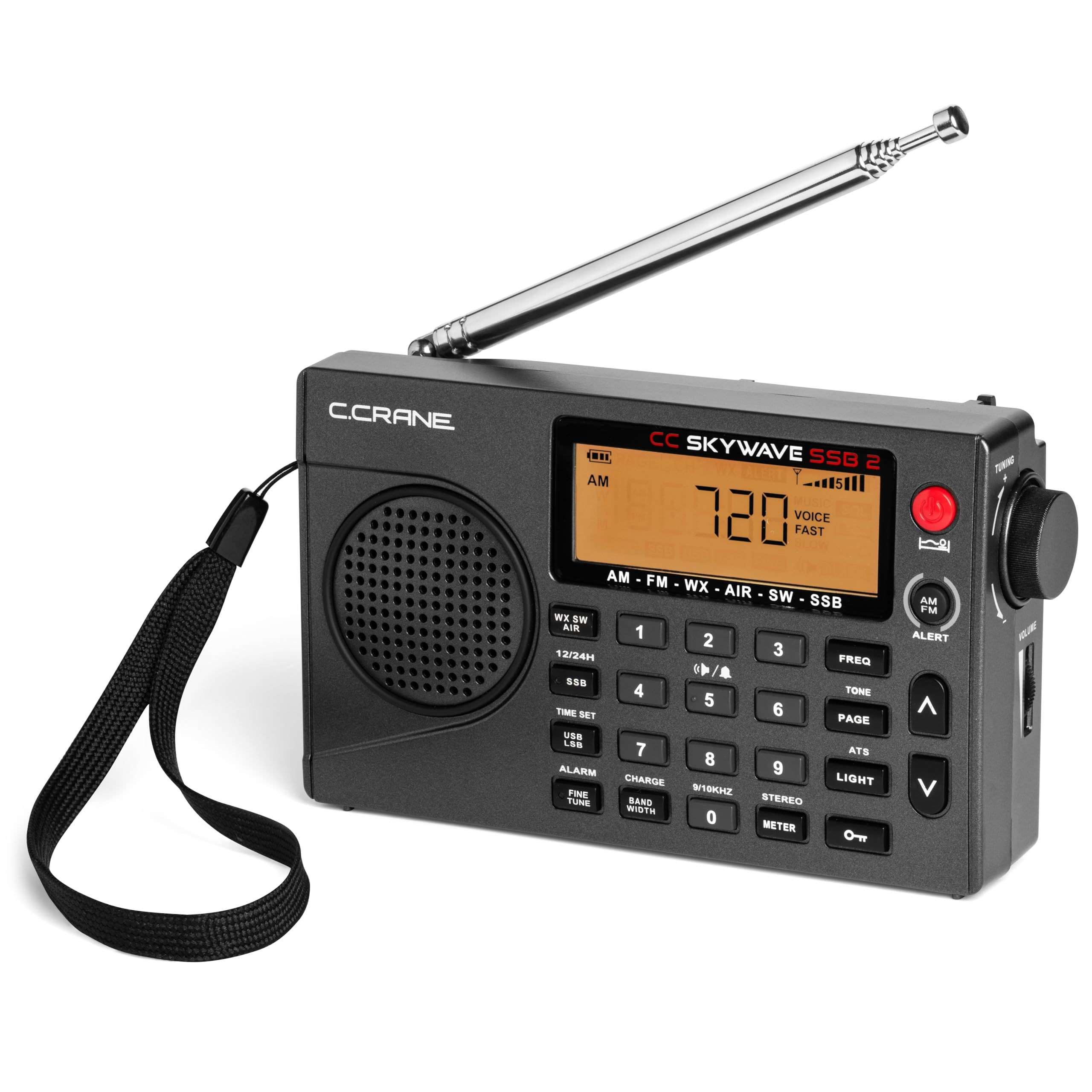
The C. Crane CC Skywave SSB 2 is the pick for listening beyond local stations. Alongside AM, FM and NOAA weather with alert, it covers shortwave from 1711 to 29999 kHz with single side band and the VHF aviation band from 118 to 137 MHz, with 10 aviation memories that can be scanned for activity.
It is a travel-size radio at 4.8 x 3 x 1 inches and 6 ounces without batteries. It runs on 2 AA batteries, which are not included, and C. Crane rates alkaline run time at about 60 hours on the built-in speaker and 70 hours on earbuds. The box includes earbuds, a shortwave reel antenna, a carry case and a SW wire antenna adapter, and there is a clock with an alarm.
Key highlights
- AM, FM, shortwave with SSB, NOAA weather with alert
- VHF aviation band, 118 to 137 MHz
- 2 AA batteries, not included
- About 60 hours on speaker, 70 hours on earbuds (alkaline)
- Shortwave reel antenna, earbuds and carry case included
- 4.8 x 3 x 1 inches, 6 oz without batteries
Pros
- Only pick here with shortwave and SSB
- Under 6.5 oz without batteries
- Weather alert included
- Useful accessories in the box
Cons
- No hand crank, solar panel or phone charging output
- Charging optional NiMH AA batteries needs an AC adapter sold separately
- Batteries not included
Who it is for: Listeners who want long-range shortwave news and weather alerts in a radio that fits a pocket.
Skip if
You need a radio that can power itself without spare batteries.
C. Crane CCRadio 3 - Best for home AM reception
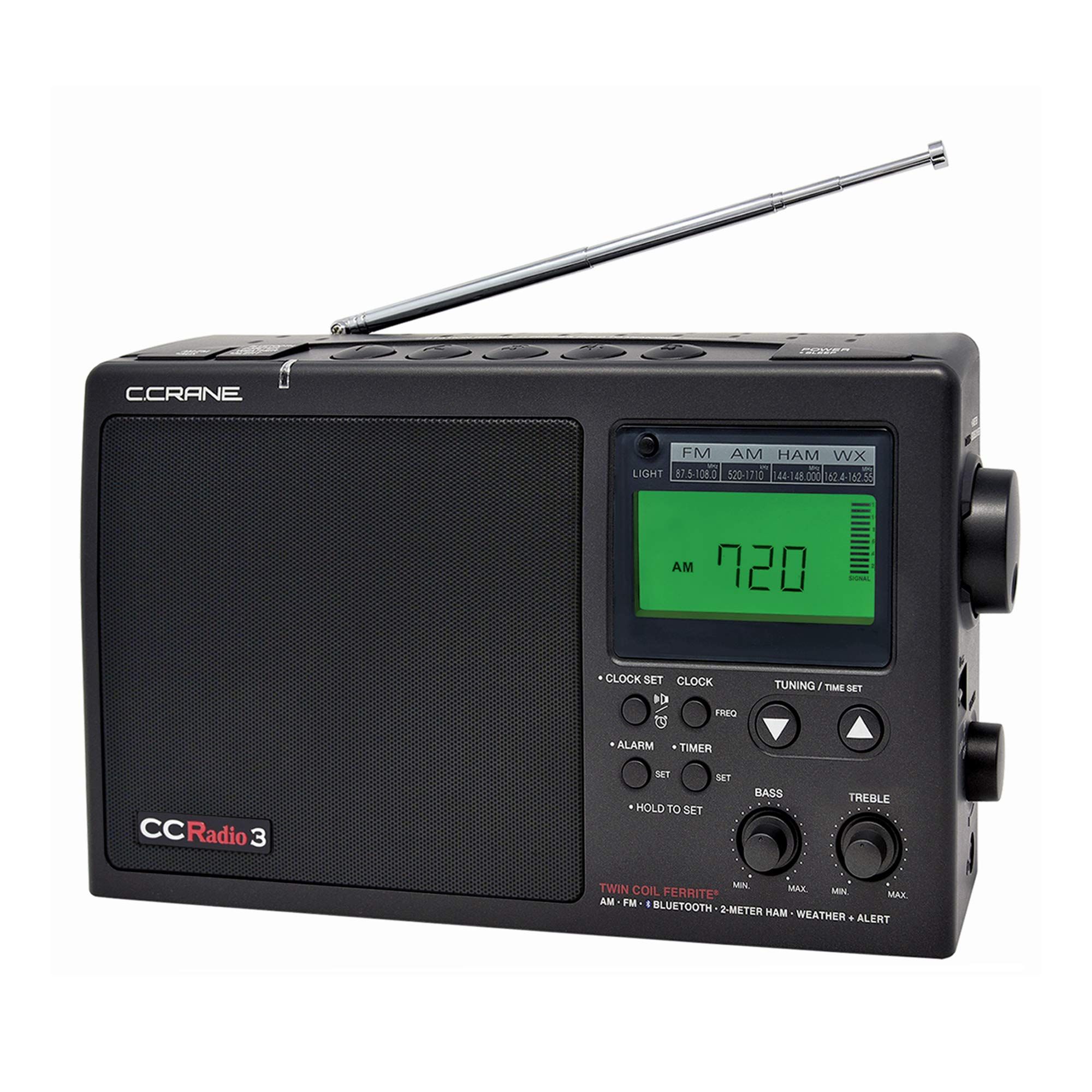
The C. Crane CCRadio 3 is a tabletop radio built around AM reception. C. Crane pairs its Twin-Coil ferrite antenna with AM from 520 to 1710 kHz, FM, the NOAA weather band on 7 channels with weather alert, and the 2-meter ham band from 144 to 148 MHz.
It runs on 4 D batteries, which are not included, or a 120V AC cord. C. Crane rates run time at about 170 hours at moderate volume with the display light and weather alert off, so expect less with those features on. A 5-inch, 6 watt speaker, Bluetooth receiving for streaming from a phone, and headphone and line out jacks round it out. It measures 11 x 6.5 x 4 inches and weighs about 3.8 pounds without batteries.
Key highlights
- AM, FM, NOAA weather with alert, 2-meter ham band
- Twin-Coil ferrite antenna for AM
- 4 D batteries or 120V AC
- About 170 hours at moderate volume, display light and alert off
- 5-inch, 6 watt speaker
- Bluetooth receiving, headphone and line out jacks
Pros
- Long rated run time on D batteries
- 5-inch, 6-watt speaker
- 2-meter ham band for listening to local amateur traffic
- Works from wall power day to day
Cons
- 3.8 pounds without batteries, so not for a go-bag
- No hand crank, solar panel, shortwave or phone charging output
- Only 5 memory presets per band
- D batteries not included
Who it is for: Homes that want a kitchen or bedside radio with strong AM reception and a weather alert that runs a long time on batteries.
Skip if
You need something portable or self-powered.
Sangean DT-800 - Best pocket alert radio
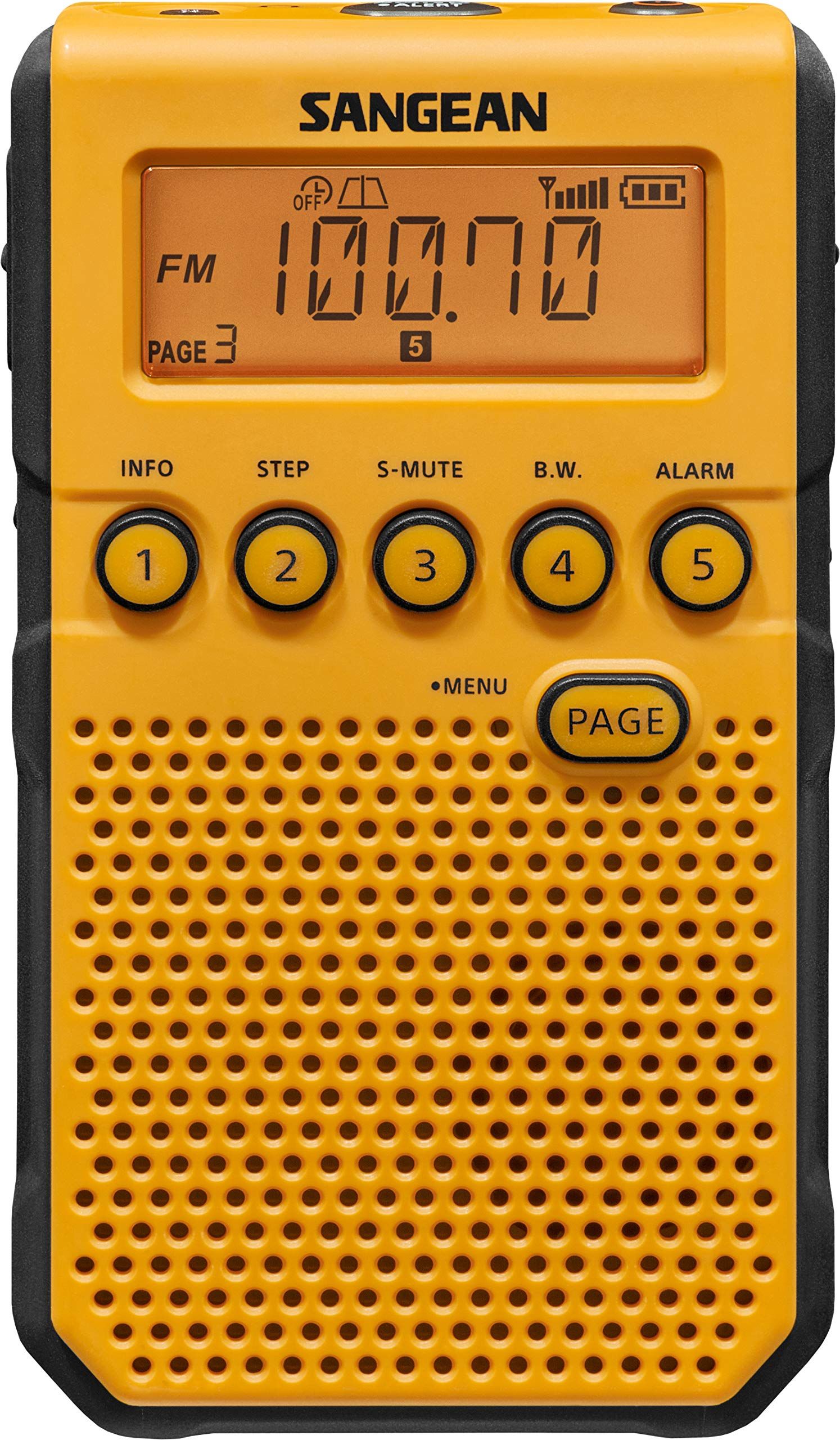
The Sangean DT-800 is a pocket radio that still carries a proper NOAA alert. It receives all 7 NOAA weather channels, and Sangean says the alert plays a very loud tone for imminent extreme weather, police emergencies, child abductions and other critical public alerts. To save battery, you can choose when alerts are active, and the backlight flashes to remind you the alert is on.
It runs on 2 AA batteries, and a built-in charger lets you charge them inside the radio. AM and FM with RDS, 45 presets split across AM, FM and weather, an alarm timer, an AC adapter and a removable belt clip are part of the package. It measures 2.69 x 4.54 x 1.04 inches and weighs 0.29 lb, and comes in dark gray or yellow.
Key highlights
- AM, FM with RDS, NOAA weather on all 7 channels
- Automatic public alert weather radio function
- 45 presets: 20 AM, 20 FM, 5 weather
- 2 AA batteries with built-in charger
- AC adapter and belt clip included
- 2.69 x 4.54 x 1.04 inches, 0.29 lb
Pros
- Automatic alert in a radio that fits a pocket
- Selectable alert times help save battery
- Plenty of presets
- Runs on common AA batteries
Cons
- No flashlight, hand crank, solar panel or phone charging
- 1-inch, 100mW speaker is small
- Sangean does not say which rechargeable AA type the charger supports
Who it is for: People who want weather alerts on a walk, on a job site or at a campsite without carrying a large radio.
Skip if
You want the radio to double as a light or a phone charger.
How to Choose
- Plan for how it gets power. Crank and solar radios like the JEP-900 and MMR-88 keep going without spare batteries, while the Skywave SSB 2, CCRadio 3 and DT-800 depend on AA or D cells or wall power.
- Look for an alert, not just the weather band. A weather band lets you listen to NOAA broadcasts, but an alert function is what sounds a warning when you are not listening. Check that the maker lists one.
- Check phone charging output. A USB port is only as useful as its output. The JEP-900 lists 2 Amps, while the MMR-88 lists 0.3A, which suits small top-ups.
- Add shortwave for distance. If local stations go off the air, shortwave with SSB, as on the CC Skywave SSB 2, can pick up broadcasts from much farther away.
- Match size to where it lives. A 3.8 lb tabletop radio suits a home shelf, while a sub-pound radio is easier to keep in a go-bag, a car or a pocket.
FAQ
What is NOAA Weather Radio?
It is a network of stations broadcasting weather and hazard information on seven VHF frequencies. Every radio on this list can receive all seven.
Do I need a hand crank on an emergency radio?
Not always. A crank or solar panel helps in a long outage when spare batteries run out, but a battery radio with a long rated run time can work well if you keep fresh batteries on hand.
Can an emergency radio charge my phone?
Some can. The JEP-900 and MMR-88 both have USB output ports, but their listed outputs differ a lot, so check the amp rating if phone charging matters to you.
What is SSB and do I need it?
Single side band is a shortwave mode used for long-range voice traffic. Most households do not need it, but it adds another source of information if local stations are down.
Should I leave the weather alert on all the time?
On wall power, yes. On batteries, an always-on alert uses more power, which is why C. Crane rates the CCRadio 3's longest run time with the alert off and Sangean lets you choose when the DT-800's alerts are active.
Published November 11, 2026 Last updated November 11, 2026
Add Technobezz on Google:Preferred SourceGoogle Discover
More buying guides
Buying guide
6 Best Short Throw Projectors in 2026

Buying guide
5 Best Wireless Keyboard and Mouse Combos 2026
Buying guide
7 Best Laptops for Video Editing in 2026
Buying guide
5 Best Laptops for Engineering Students in 2026
Buying guideTop 6 High-End Laptops for 2026Buying guide6 Best Pet Cameras in 2026Buying guide7 Best Wi-Fi 7 Routers in 2026Buying guide5 Best 1440p Gaming Monitors in 2026Buying guide7 Best Curved Gaming Monitors in 2026Buying guide5 Best Studio Headphones in 2026Buying guide5 Best 4K Monitors in 2026Buying guide5 Best Foldable Phones in 2026