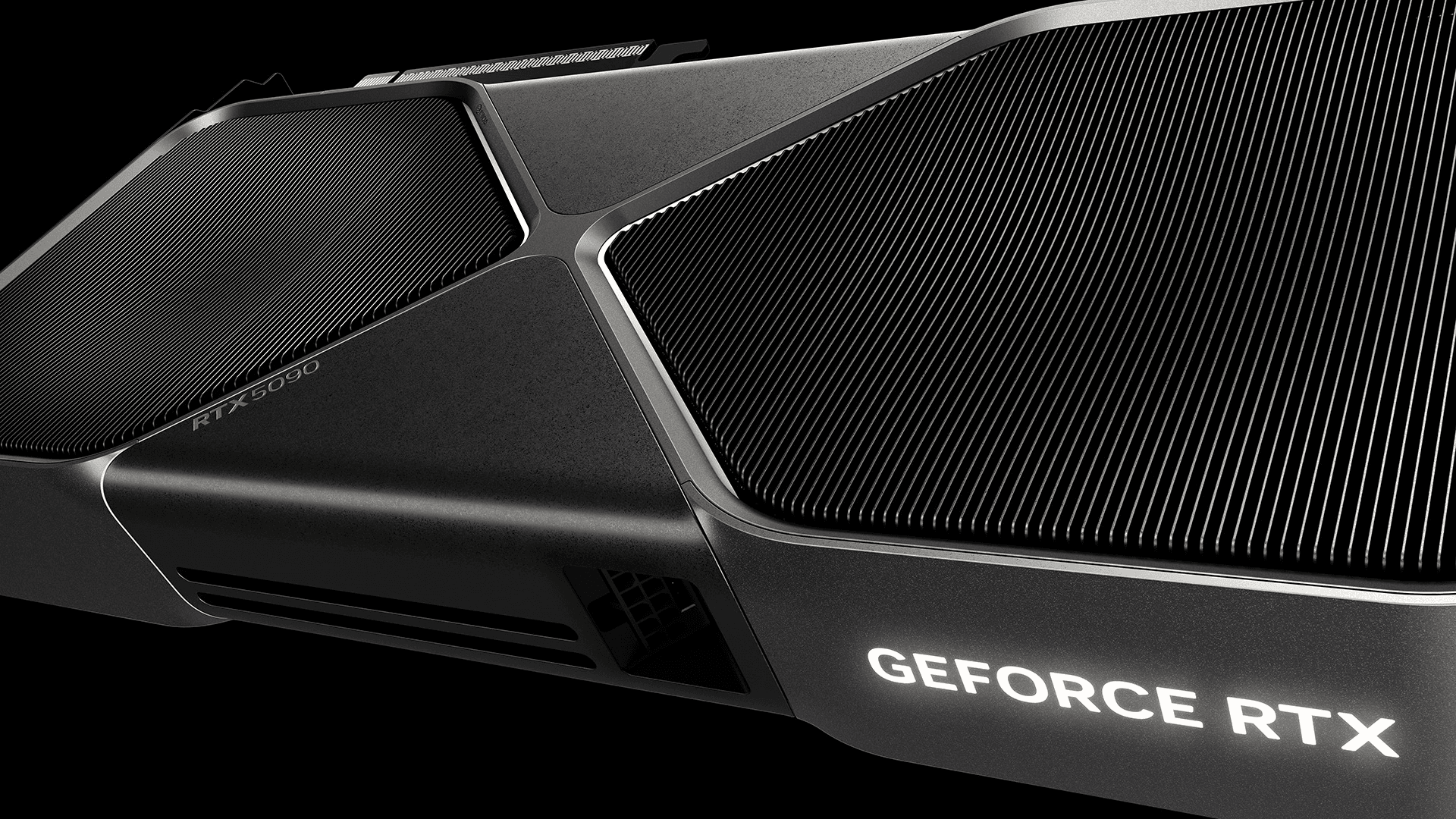
As of November 2026, NVIDIA lists 32 GB of memory for the GeForce RTX 5090 against 16 GB for the RTX 5080. The RTX 5090 also lists roughly twice the CUDA cores and 575 W of total graphics power against 360 W. NVIDIA's January 2025 launch price was about double too, at $1,999 against $999.
What NVIDIA charged at launch
NVIDIA announced both cards on January 6, 2025, with availability set for January 30, 2025. Its launch prices were $1,999 for the RTX 5090 and $999 for the RTX 5080, in US dollars.
RTX 5080 vs RTX 5090 at a glance
- CUDA cores: 10,752 on the RTX 5080, 21,760 on the RTX 5090.
- Boost clock: 2.62 GHz on the RTX 5080, 2.41 GHz on the RTX 5090.
- Memory: 16 GB GDDR7 on the RTX 5080, 32 GB GDDR7 on the RTX 5090.
- Memory interface: 256-bit on the RTX 5080, 512-bit on the RTX 5090.
- Total graphics power: 360 W on the RTX 5080, 575 W on the RTX 5090.
- Required system power: 850 W for the RTX 5080, 1,000 W for the RTX 5090.
- NVIDIA's launch price: $999 for the RTX 5080, $1,999 for the RTX 5090 (January 2025).
Memory and cores
The RTX 5090 lists 32 GB of GDDR7 on a 512-bit interface, while the RTX 5080 lists 16 GB of GDDR7 on a 256-bit interface. Both numbers double from one card to the other.
NVIDIA lists 21,760 CUDA cores for the RTX 5090 and 10,752 for the RTX 5080. The listed boost clock is higher on the RTX 5080, at 2.62 GHz against 2.41 GHz for the RTX 5090.
Power supply and cables
NVIDIA lists 360 W of total graphics power for the RTX 5080 and a required system power of 850 W. It bases that minimum on a system with a Ryzen 9 9950X and says requirements vary with configuration.
The RTX 5090 lists 575 W of total graphics power, and its full specification table gives 1,000 W as the required system power, also based on a Ryzen 9 9950X system. One section of the same product page displays an 850 W minimum instead. NVIDIA's RTX 5090 user guide specifies a minimum 1,000 W power supply, which matches the specification table.
Both Founders Edition cards have one PCIe Gen 5 16-pin power connector. With the included NVIDIA adapter, the RTX 5080 user guide calls for at least three PCIe 8-pin cables, and the RTX 5090 guide calls for at least four. The alternative is a single PCIe Gen 5 16-pin cable, rated for 450 W or greater on the RTX 5080 and 600 W or greater on the RTX 5090.
What is the same on both
The Founders Edition of each card is a 2-slot design that measures 304 mm long. Both have three DisplayPort 2.1b outputs with UHBR20 and one HDMI 2.1b output. Both use a PCI Express x16 slot, and NVIDIA lists PCIe Gen 5 for the two cards.
Each spec table carries a DLSS 4 label, and NVIDIA's DLSS page lists the same features for the RTX 50 Series: 3D-Guided Neural Rendering, Multi Frame Generation, Dynamic Multi Frame Generation, Frame Generation, Ray Reconstruction, Super Resolution and DLAA. NVIDIA says DLSS 4.5 introduced Dynamic Multi Frame Generation and that DLSS 5 introduces 3D-Guided Neural Rendering. See What Is DLSS? and How to Set Up and Use NVIDIA DLSS 5.
Which one fits
If your PC has an 850 W power supply, that matches the required system power NVIDIA lists for the RTX 5080, and the RTX 5080 user guide calls for at least three PCIe 8-pin cables with the included adapter. NVIDIA's RTX 5090 specification table and user guide give 1,000 W, and the guide calls for at least four 8-pin cables or a 16-pin cable rated for 600 W or greater. NVIDIA says power requirements vary with system configuration.
If the software you run needs more than 16 GB of graphics memory, the RTX 5090 is the only one of the two that lists 32 GB. If 16 GB covers what you do, the RTX 5080 fits because NVIDIA lists the same display outputs, the same DLSS feature list and the same Founders Edition length and slot width for it, and its launch price was about half that of the RTX 5090. See also How to Check Your GPU on Windows and NVIDIA vs AMD Graphics Cards, Which One Fits Your PC?