
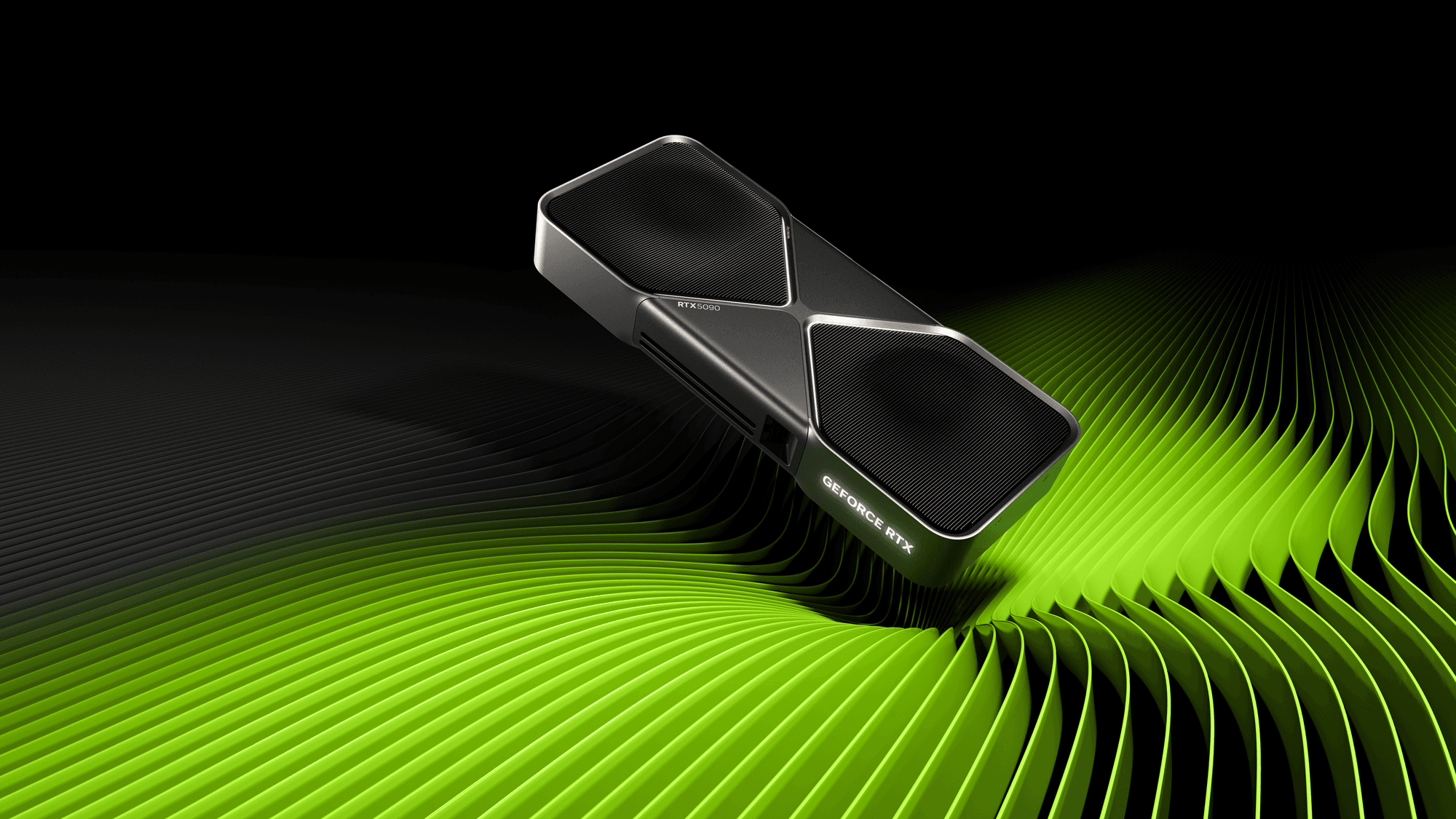
DLSS stands for Deep Learning Super Sampling. NVIDIA describes it as a suite of AI neural rendering technologies, powered by the Tensor Cores in GeForce RTX graphics cards, designed to increase frame rates and reconstruct high-quality images. As of November 16, 2026, NVIDIA lists DLSS 5 alongside its DLSS 4.5 technologies, and what you can use depends on the feature, the GPU generation and the game.
How DLSS works
DLSS is a set of separate features, and NVIDIA tracks game support for each one separately.
- Super Resolution: reconstructs a higher-resolution image from frames rendered at a lower resolution, using motion data and information from previous frames.
- Frame Generation: uses AI to create an additional frame between traditionally rendered frames.
- Multi Frame Generation: in DLSS 4.5, generates up to five frames for each traditionally rendered frame on RTX 50 Series GPUs. That is the 6X multiplier, one rendered frame plus five generated ones.
- Dynamic Multi Frame Generation: changes the multiplier automatically during play to approach a target frame rate or the display's refresh rate.
- Ray Reconstruction: replaces traditional hand-tuned ray tracing denoisers with an AI network. NVIDIA says it combines denoising and Super Resolution to rebuild higher-quality output from sparsely sampled ray-traced data.
- DLAA: Deep Learning Anti-Aliasing applies the Super Resolution technology as AI anti-aliasing at native resolution.
DLSS versions, from 2 to 5
NVIDIA announced DLSS 2.0 on March 23, 2020 as an improved neural network for AI Super Resolution. DLSS 3 followed on September 20, 2022 and added Frame Generation with the GeForce RTX 40 Series generation. DLSS 3.5, announced on August 22, 2023, introduced Ray Reconstruction.
DLSS 4, announced on January 6, 2025, introduced Multi Frame Generation for RTX 50 Series, at first with up to three additional frames per rendered frame. It also brought transformer models to Super Resolution, Ray Reconstruction and DLAA. DLSS 4.5 Super Resolution, with second-generation transformer models, rolled out to all NVIDIA app users on January 14, 2026. DLSS 4.5 Ray Reconstruction followed through an NVIDIA app update announced on August 25, 2026.
DLSS 5 introduces what NVIDIA calls 3D-Guided Neural Rendering. NVIDIA describes it as a final rendering stage that uses the frame rendered by the game engine, plus associated buffers, to enhance lighting and materials, with developers controlling the result. As of November 16, 2026, NVIDIA reports DLSS 5 available in NBA 2K27, Hogwarts Legacy and War Thunder.
Which RTX cards support which features
NVIDIA's DLSS compatibility table splits support by GPU generation.
- RTX 20 and 30 Series: Super Resolution, Ray Reconstruction and DLAA. The table excludes them from Frame Generation, Dynamic Multi Frame Generation and DLSS 5.
- RTX 40 Series: Super Resolution, Ray Reconstruction, DLAA and Frame Generation. The table excludes it from Dynamic Multi Frame Generation and DLSS 5.
- RTX 50 Series: all of the above, plus Multi Frame Generation, Dynamic Multi Frame Generation and DLSS 5, subject to game support.
NVIDIA also says RTX 20 and 30 Series lack native FP8 support, which makes DLSS 4.5 Super Resolution Models M and L more demanding on those GPUs, and it suggests some users may prefer the DLSS 4 Model K.
How to turn DLSS on
You enable the DLSS feature you want in a supported game's settings, and NVIDIA documents Quality, Balanced and Performance modes that adjust the rendering resolution Super Resolution works from. In NBA 2K27, NVIDIA's instructions for DLSS 5 are to install the newest Game Ready Driver, open Video Settings and turn on DLSS Neural Rendering.
The NVIDIA app can upgrade those features through overrides. On its Graphics tab, pick a detected game or Global Settings, open DLSS Override Model Presets and choose Recommended, the option NVIDIA advises. NVIDIA says to enable the underlying feature in the game first, then exit to the desktop before configuring the override. On an RTX 50 Series system, the DLSS Override Frame Generation Mode setting offers Fixed, where you choose a multiplier, and Dynamic, where you choose Max refresh rate or enter a custom target. For the full steps, see how to set up and use NVIDIA DLSS 5.
How AMD and Intel describe their alternatives
AMD describes FSR Redstone as an ML-powered suite made up of Upscaling, Frame Generation, Ray Regeneration and Radiance Caching. AMD lists the full suite for Radeon RX 9000 Series and above.
Intel describes XeSS Super Resolution as AI-based temporal supersampling and anti-aliasing. Its XeSS 3 suite adds Frame Generation, with Multi Frame Generation on Intel hardware, and Xe Low Latency. Intel also provides a cross-vendor Super Resolution implementation for GPUs that support Shader Model 6.4 or above.
What to check before you rely on it
On an RTX 20 or 30 Series card, NVIDIA's table gives you Super Resolution, Ray Reconstruction and DLAA. If Dynamic Multi Frame Generation or DLSS 5 is the reason you are shopping, the same table lists both only for RTX 50 Series.
Check the game as well as the card, feature by feature, on NVIDIA's RTX games list. For the lighting technique Ray Reconstruction works on, see What Is Ray Tracing?