
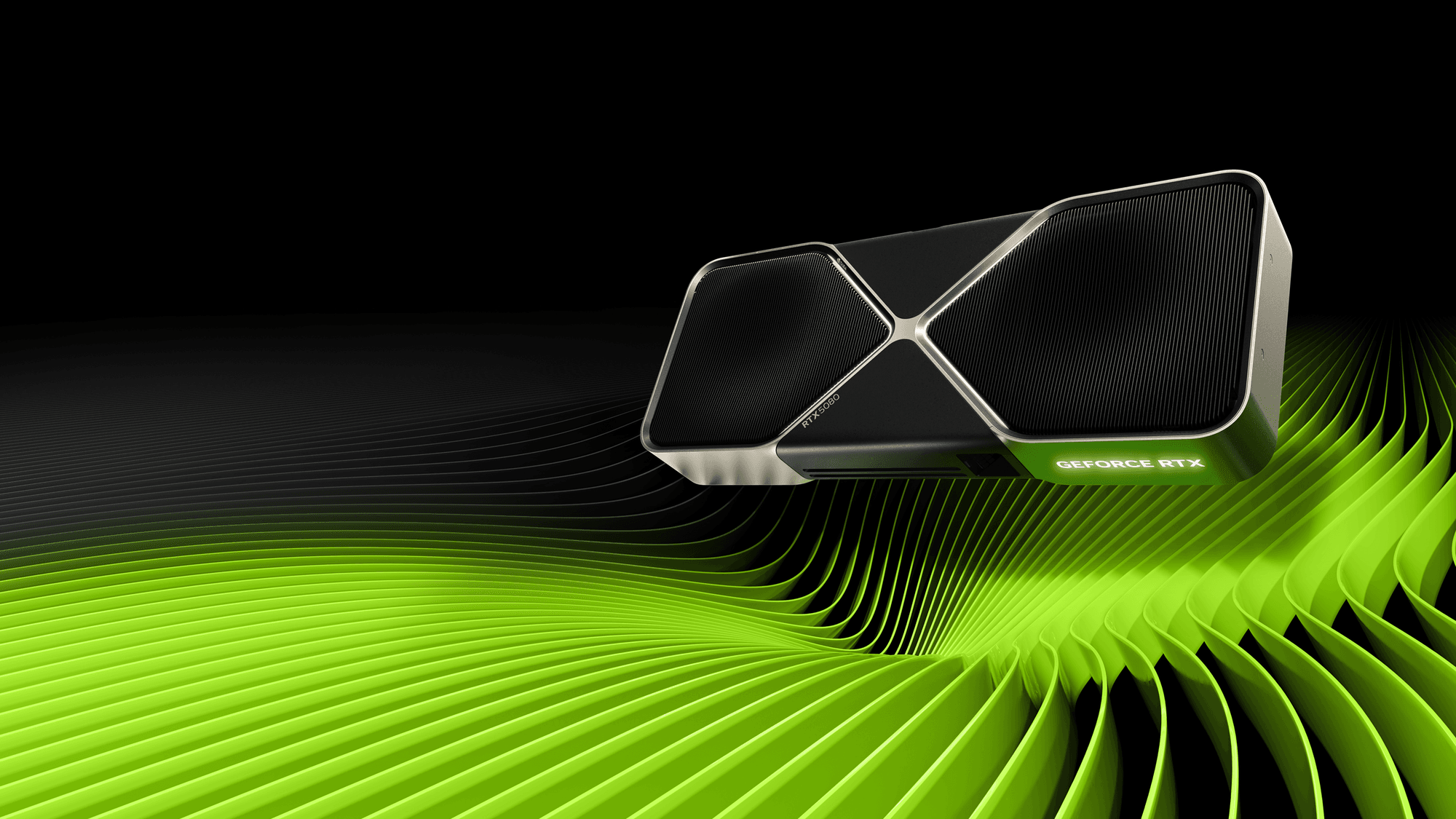
NVIDIA's current desktop graphics cards are the GeForce RTX 50 series, and AMD's are the Radeon RX 9000 series. NVIDIA's announced launch prices run from $249 for the RTX 5050 to $1,999 for the RTX 5090, while the launch prices in AMD's press releases run from $299 for the RX 9060 XT 8GB to $599 for the RX 9070 XT.
NVIDIA vs AMD lineups at a glance
The memory figures below come from each maker's spec pages, and the prices are the launch prices each maker announced. The lineups are as the makers list them as of November 2026, and a catalog listing does not confirm US stock. NVIDIA gives "starting at" prices, and AMD gives a suggested etail price (SEP).
- RTX 5090: 32GB GDDR7, starting at $1,999.
- RTX 5080: 16GB GDDR7, starting at $999.
- RTX 5070 Ti: 16GB GDDR7, starting at $749.
- RTX 5070: 12GB GDDR7, starting at $549.
- RTX 5060 Ti: 16GB or 8GB GDDR7, starting at $429 and $379.
- RTX 5060: 8GB GDDR7, starting at $299.
- RTX 5050: 8GB GDDR6, starting at $249.
- RX 9070 XT: 16GB GDDR6, SEP of $599.
- RX 9070: 16GB GDDR6, SEP of $549.
- RX 9070 GRE: 12GB GDDR6.
- RX 9060 XT: 16GB GDDR6 at an SEP of $349, or 8GB at $299.
- RX 9060 XT LP: 16GB GDDR6.
- RX 9060: 8GB GDDR6.
- RX 9050: 8GB or 4GB GDDR6.
NVIDIA set availability for the RTX 5090 and RTX 5080 from January 30, 2025, and for the RTX 5060 Ti from April 16, 2025. AMD set availability for the RX 9070 XT and RX 9070 from March 6, 2025, and announced the RX 9060 XT prices on May 20, 2025.
DLSS vs FSR
NVIDIA groups its upscaling and frame generation features under DLSS. It names Super Resolution, Ray Reconstruction, DLAA, Frame Generation, Multi Frame Generation, Dynamic Multi Frame Generation and 3D-Guided Neural Rendering. NVIDIA lists Super Resolution, Ray Reconstruction and DLAA for RTX 20 through RTX 50 cards, and Frame Generation for RTX 40 and RTX 50. Dynamic Multi Frame Generation and 3D-Guided Neural Rendering are listed for RTX 50 only, and NVIDIA says Multi Frame Generation on RTX 50 creates up to five frames per rendered frame.
AMD's counterpart is FSR. AMD says FSR 4 has been renamed FSR Upscaling, and that FSR Redstone is made up of FSR Upscaling, FSR Frame Generation, FSR Ray Regeneration and FSR Radiance Caching. It lists the Redstone suite for Radeon RX 9000 Series cards and above, with upscaling-only support for RX 6000 and RX 7000. AMD also offers Fluid Motion Frames 2.1, a frame generation feature built into its Adrenalin software, with support listed for DirectX 11, DirectX 12, Vulkan and OpenGL games.
Both makers also name ray tracing hardware. NVIDIA lists fourth-generation Ray Tracing Cores on the RTX 50 series, and AMD lists third-generation ray tracing on the RX 9000 series.
Video encoders
NVENC is NVIDIA's hardware video encoder, and it covers H.264, HEVC (H.265) and AV1. NVIDIA's comparison page lists ninth-generation NVENC across the RTX 50 desktop cards. The RTX 5090 has three encoders, the RTX 5080 and RTX 5070 Ti have two, and the RTX 5070, RTX 5060 Ti, RTX 5060 and RTX 5050 have one.
On the AMD side, the Advanced Media Framework (AMF) is AMD's developer kit for video encoding. The RX 9070 spec page lists 4K H.264 encoding, H.265/HEVC encoding and AV1 encoding.
Drivers and software
NVIDIA App handles driver updates, game and GPU settings, an in-game overlay, and recording tools including ShadowPlay. NVIDIA offers GeForce Game Ready Drivers for games and NVIDIA Studio Drivers for creative applications. For the update steps, see How to Download and Update NVIDIA GPU Drivers.
AMD Software Adrenalin Edition provides driver updates, game statistics, graphics features, game management and media capture. As a snapshot, AMD's download page for the RX 9070 GRE lists Adrenalin 26.10.1 WHQL as Recommended, released October 20, 2026, and Adrenalin 26.11.1 as Optional, released November 12, 2026. AMD's Radeon catalog has the spec tables for the RX 9000 cards listed here.
Which one fits
If your budget stops at $300, three of the cards priced above come in under that line, all with 8GB of memory, the RTX 5050 at $249 and the RTX 5060 and RX 9060 XT 8GB at $299. If 16GB matters more, the RX 9060 XT 16GB carries the lowest announced launch price among the 16GB cards listed here with a price, at $349, against $429 for the 16GB RTX 5060 Ti.
If you want more than 16GB, the RTX 5090 fits because its 32GB is the largest memory figure on either maker's list. If you record or stream and want more than one hardware encoder, NVIDIA lists two on the RTX 5070 Ti and RTX 5080 and three on the RTX 5090. If you plan to use DLSS features on an RTX 50 card, see How to Set Up and Use NVIDIA DLSS 5.