Thermal paste is a small purchase, but it decides how well heat moves from a CPU or GPU into its cooler. The right tube depends on the job: a first PC build, a graphics card repaste, a console refresh, or a high-power desktop chip that runs hot under load.
Technobezz is supported by its audience. We may get a commission from retail offers.
6 Best Thermal Pastes in 2026
ARCTIC MX-7 leads our picks of the best thermal pastes in 2026, with options for long-term stability, high-TDP CPUs, first-time builders and liquid metal.
T
Technobezz
Editorial Team
Updated November 13, 2026Nov 13, 2026
•13 min read

Get Deals Like These in Your Inbox
The best prices, straight to your inbox.
Add Technobezz on Google:Preferred SourceGoogle Discover
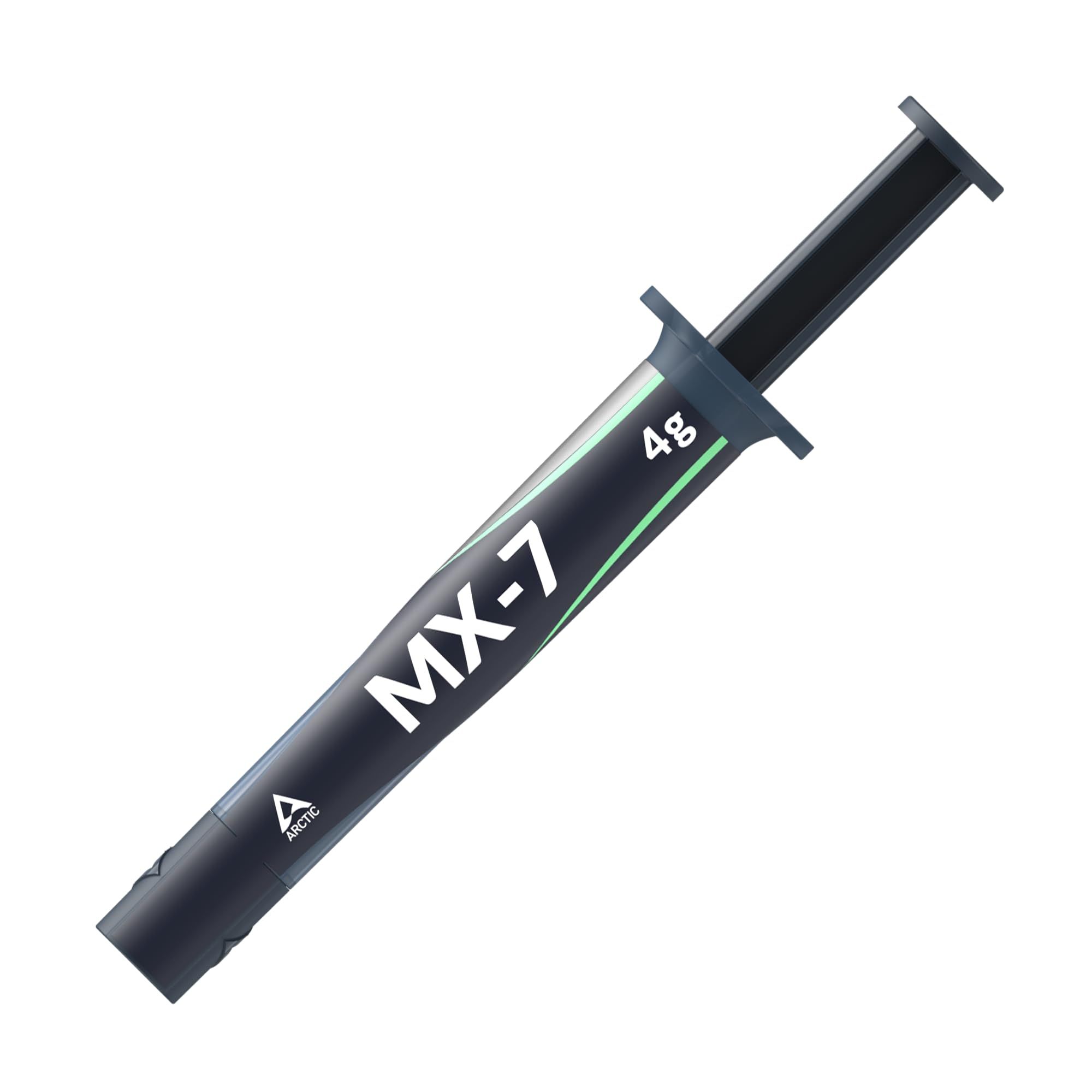
The ARCTIC MX-7 (4 g) is the best overall pick because it is non-capacitive and electrically non-conductive, goes on with a simple cross pattern, and is rated by ARCTIC for CPUs, GPUs, laptops and console processors. It is the easiest choice to recommend for most builders and upgraders.
This page is for US PC builders, upgraders and repair-minded console owners. The other picks cover long-term stability, high-TDP processors, a published conductivity rating, first-time application and liquid metal for experienced users.
At a Glance
| Category | Product | Why We Picked It |
|---|---|---|
| Best overall | ARCTIC MX-7 (4 g) | Non-conductive, non-capacitive paste with a simple cross-pattern application |
| Best for long-term stability | Thermal Grizzly Duronaut Pro (2 g) | Built to minimize pump-out, with two spatulas included |
| Best for high-TDP CPUs | Corsair XTM70 (3 g) | Aimed at high TDP chips, with an applicator kit and three wipes |
| Best with a published conductivity rating | Thermalright TFX (2 g) | Published 14.3 W/m-K rating and no curing time |
| Best for beginners | ARCTIC MX-4 (4 g) | Metal-free, non-conductive and easy to apply |
| Best liquid metal | Thermal Grizzly Conductonaut Extreme (1 g) | Gallium-based liquid metal for very thin layers, for experienced users only |
How we chose
We compared each maker's published specifications and product information for these thermal compounds. We then checked that each pick is sold new on Amazon.
The best Thermal Pastes right now
ARCTIC MX-7 (4 g) - Best overall
The ARCTIC MX-7 is the best overall pick because it covers the widest range of uses on this list without adding electrical risk. ARCTIC describes a dense, viscous consistency that comes from a high filler content, and says the paste is suitable for CPUs, GPUs, laptops, console processors and more.
It is non-capacitive and electrically non-conductive, and ARCTIC says its high cohesion "guarantees long-lasting, consistent performance without drying out." Application is a simple cross pattern, with the cooler's contact pressure spreading the paste across the surface. MX-7 is sold in 2 g, 4 g and 8 g sizes, with or without six MX Cleaner packets, so the contents vary by version; this pick is the 4 g tube.
Key highlights
- 4 g tube (MX-7 is also sold in 2 g and 8 g)
- Non-capacitive and electrically non-conductive
- Dense, viscous consistency with a high filler content
- Cross-pattern application spread by cooler pressure
- Rated for CPUs, GPUs, laptops and console processors
- MX Cleaner packets included only in some versions
Pros
- No short-circuit risk if paste reaches nearby components
- Simple application method suits first builds and repastes
- ARCTIC says it does not dry out
- One tube covers desktop, laptop and console use
Cons
- The product page publishes no thermal conductivity, viscosity or temperature figures
- The dense, viscous paste is meant to be spread by cooler pressure rather than by hand
- Cleaning packets depend on the version, so this listing may not include them
Who it is for: Builders and upgraders who want one non-conductive paste for a CPU, GPU, laptop or console.
Skip if
You want a published thermal conductivity number to compare against, or you are set on liquid metal.
Thermal Grizzly Duronaut Pro (2 g) - Best for long-term stability
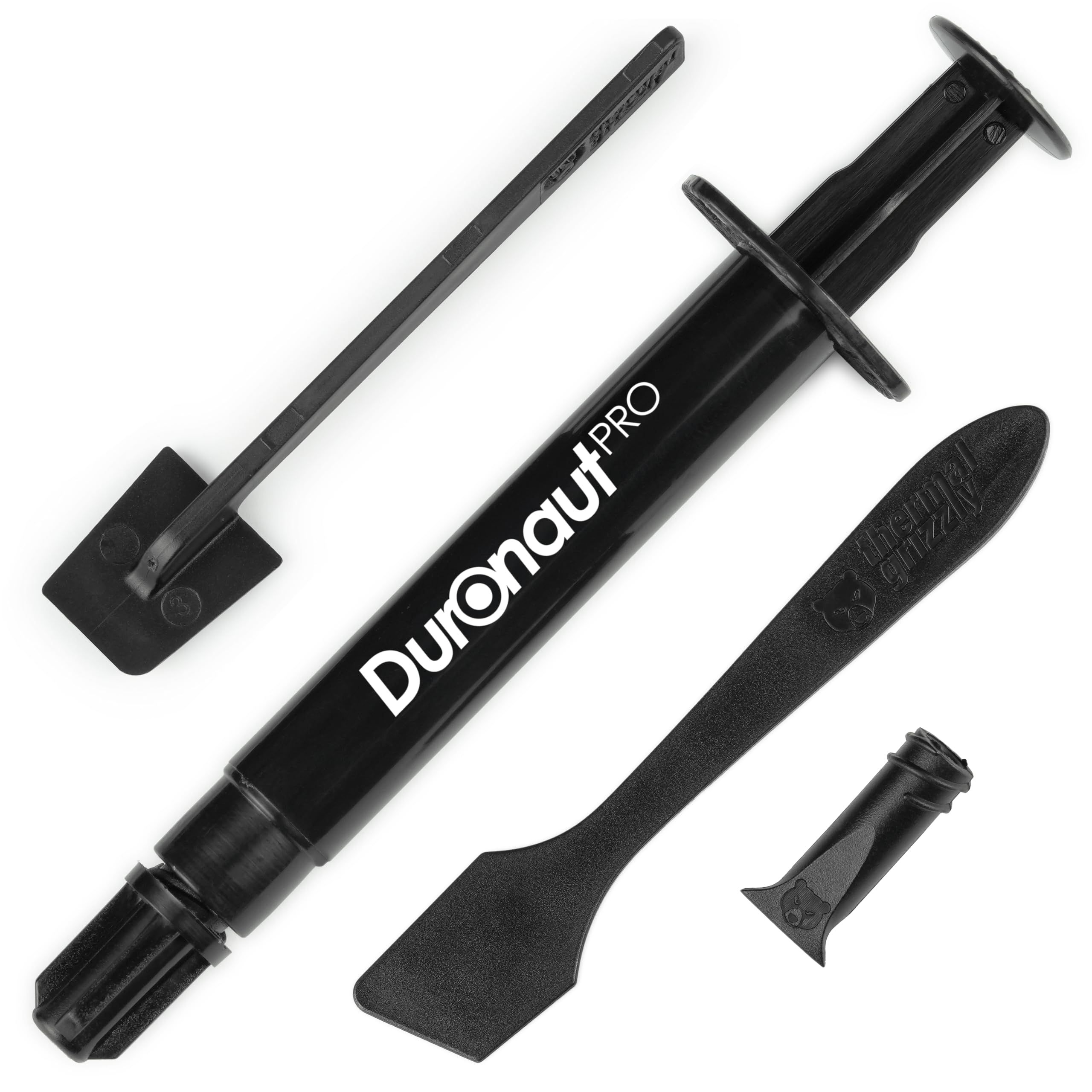
Duronaut Pro is Thermal Grizzly's paste built around long-term stability. The maker says its optimized particle shape and size "minimize the so-called pump-out effect" and help the paste adhere to the surface, and it states there is no hardening over time. The formula combines a specially developed silicone oil with aluminum micropowder and zinc oxide nanopowder.
Thermal Grizzly says the thick consistency is necessary for long-term stability, and asks users to spread it slowly into a thin layer with the included spatula. The 2 g pack includes an applicator, a TG Spatula and a TG Spatula Pro. It is electrically non-conductive at 0 pS/m, suits consoles designed to use thermal paste, and is also positioned for extreme overclocking with liquid nitrogen or dry ice. It is also sold in 6 g and 30 g.
Key highlights
- 2 g pack (also sold in 6 g and 30 g)
- Designed to minimize the pump-out effect
- No hardening over time
- Electrical conductivity of 0 pS/m
- Silicone oil base with aluminum and zinc oxide fillers
- Applicator, TG Spatula and TG Spatula Pro included with the 2 g pack
Pros
- Long-term stability is the core design goal
- Two spatulas included for an even, thin layer
- Non-conductive
- Suits CPUs, GPUs and consoles designed to use paste
Cons
- Thick consistency needs slow, careful spreading
- Thermal Grizzly publishes no W/(m·K) rating
- 2 g is the smallest size, which limits how many repastes one pack covers
Who it is for: Anyone repasting a GPU, console or work PC who wants a paste designed to stay in place over time.
Skip if
You want a quick apply-and-mount paste with no spreading, where the MX-7 cross pattern is simpler.
Corsair XTM70 (3 g) - Best for high-TDP CPUs
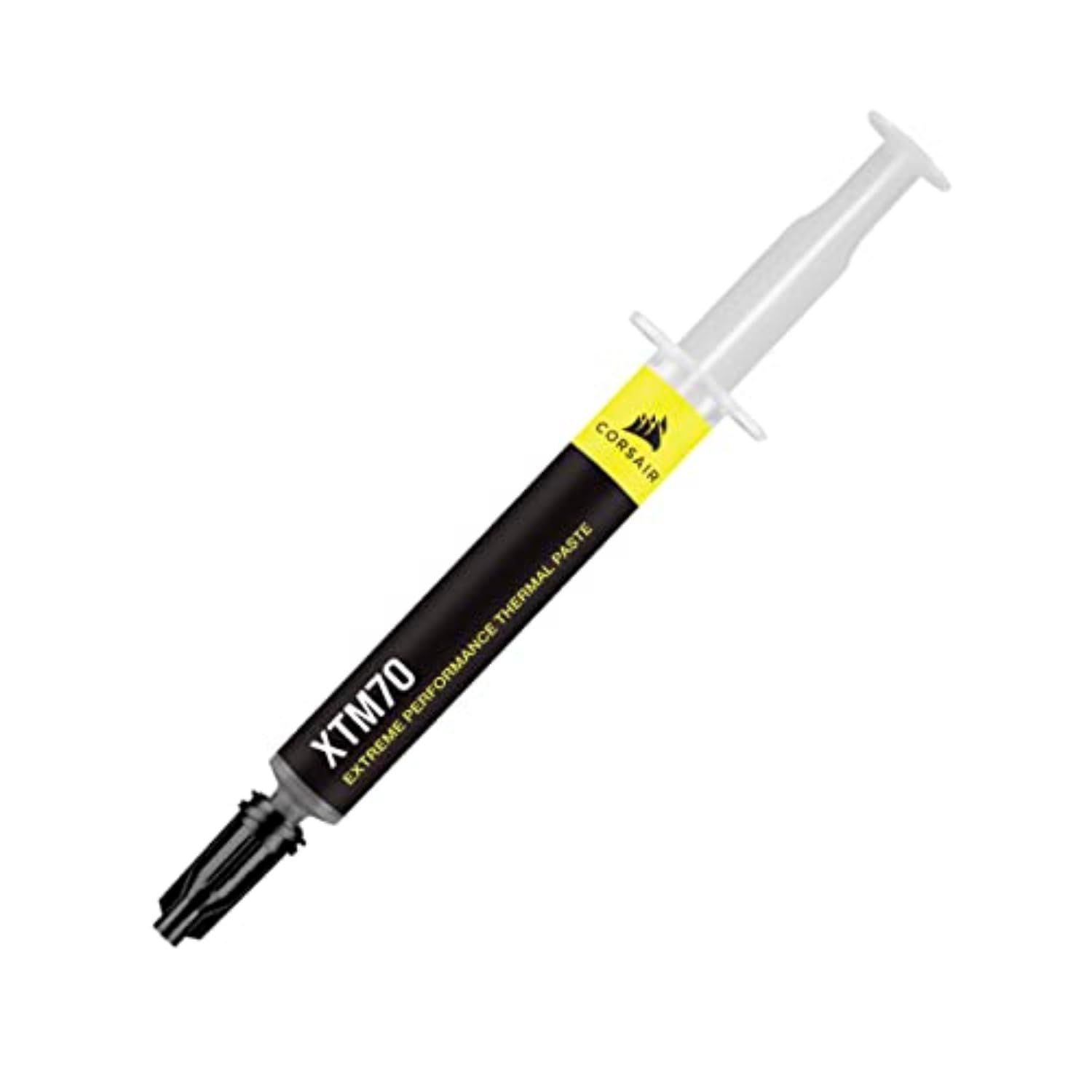
Corsair aims the XTM70 at the highest performing, high TDP CPUs and GPUs, where it says every fraction of a degree matters. The tube holds 3 g of gray, non-electrically conductive paste that Corsair says will not dry or crack.
The box is built for desktop builders. It includes an applicator kit with a stencil that Corsair says works on most Intel LGA 115x, 1200 and 1700 and AMD AM4 and AM5 CPUs, plus three cleaning wipes. That makes it a tidy all-in-one kit for someone installing a new cooler on a powerful desktop chip.
Key highlights
- 3 g of thermal paste
- Non-electrically conductive
- Corsair says it does not dry or crack
- Applicator kit for most Intel LGA 115x, 1200, 1700 and AMD AM4, AM5 CPUs
- Three cleaning wipes included
- Gray color
Pros
- Positioned for high TDP processors
- Stencil helps apply an even layer on a cold plate
- Cleaning wipes included in the box
- Non-conductive
Cons
- Corsair's page lists no thermal conductivity, viscosity or temperature range
- Stencil compatibility is listed only for LGA 115x, 1200, 1700, AM4 and AM5
- The applicator kit is for CPUs, so GPU application is done without it
Who it is for: Desktop builders fitting a cooler to a high-power Intel or AMD processor who want wipes and a stencil in the same box.
Skip if
Your CPU socket is not on Corsair's stencil list, or you mainly repaste laptops and consoles.
Thermalright TFX (2 g) - Best with a published conductivity rating
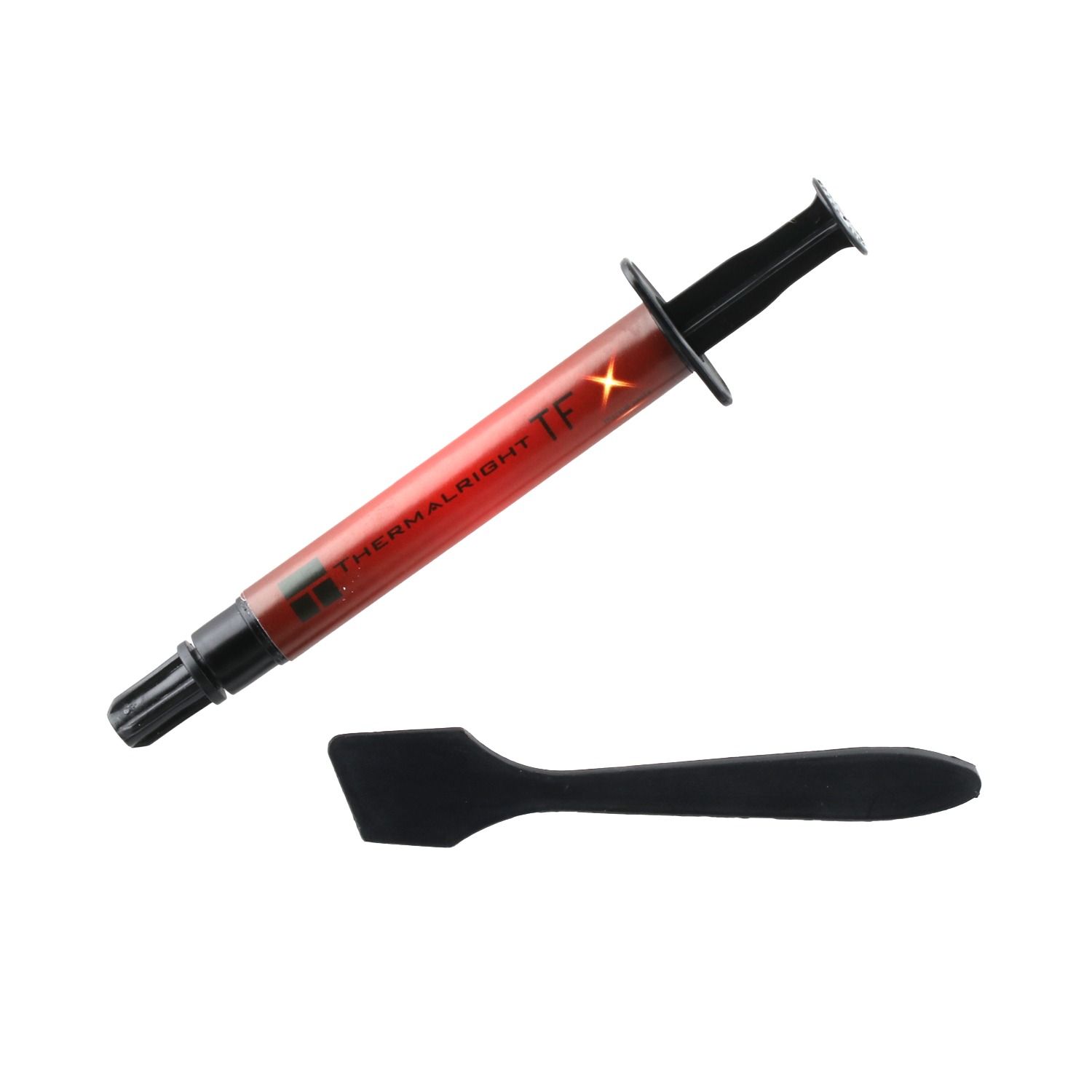
Thermalright's TFX is the only paste on this list whose product page gives a thermal conductivity figure: 14.3 W/m-K, with thermal impedance listed as under 0.0028 °C-cm²/W. For shoppers who want a number on the box, it is the clearest spec sheet here.
The 2 g tube holds a gray paste with a specific gravity of 2.6. Thermalright says it is not electrically conductive, has no curing time and offers long life. Keep in mind that conductivity ratings are published by each maker under its own methods, so this figure cannot be lined up directly against brands that do not publish one.
Key highlights
- Thermal conductivity of 14.3 W/m-K
- Thermal impedance under 0.0028 °C-cm²/W
- Specific gravity of 2.6 at 25 °C
- Not electrically conductive
- No curing time
- 2 g tube, gray color
Pros
- Publishes a specific conductivity rating
- Non-conductive, so no short-circuit worry
- No curing time before full performance
- Small tube suits a single build or repaste
Cons
- The product page gives no viscosity or application guidance
- The usable temperature range is printed as "250 °C / 300 °C" with no explanation
- 2 g covers fewer applications than the 3 g and 4 g picks
Who it is for: Builders who want a paste with a stated conductivity rating for a CPU or GPU.
Skip if
You want detailed application guidance or a larger tube for several machines.
ARCTIC MX-4 (4 g) - Best for beginners
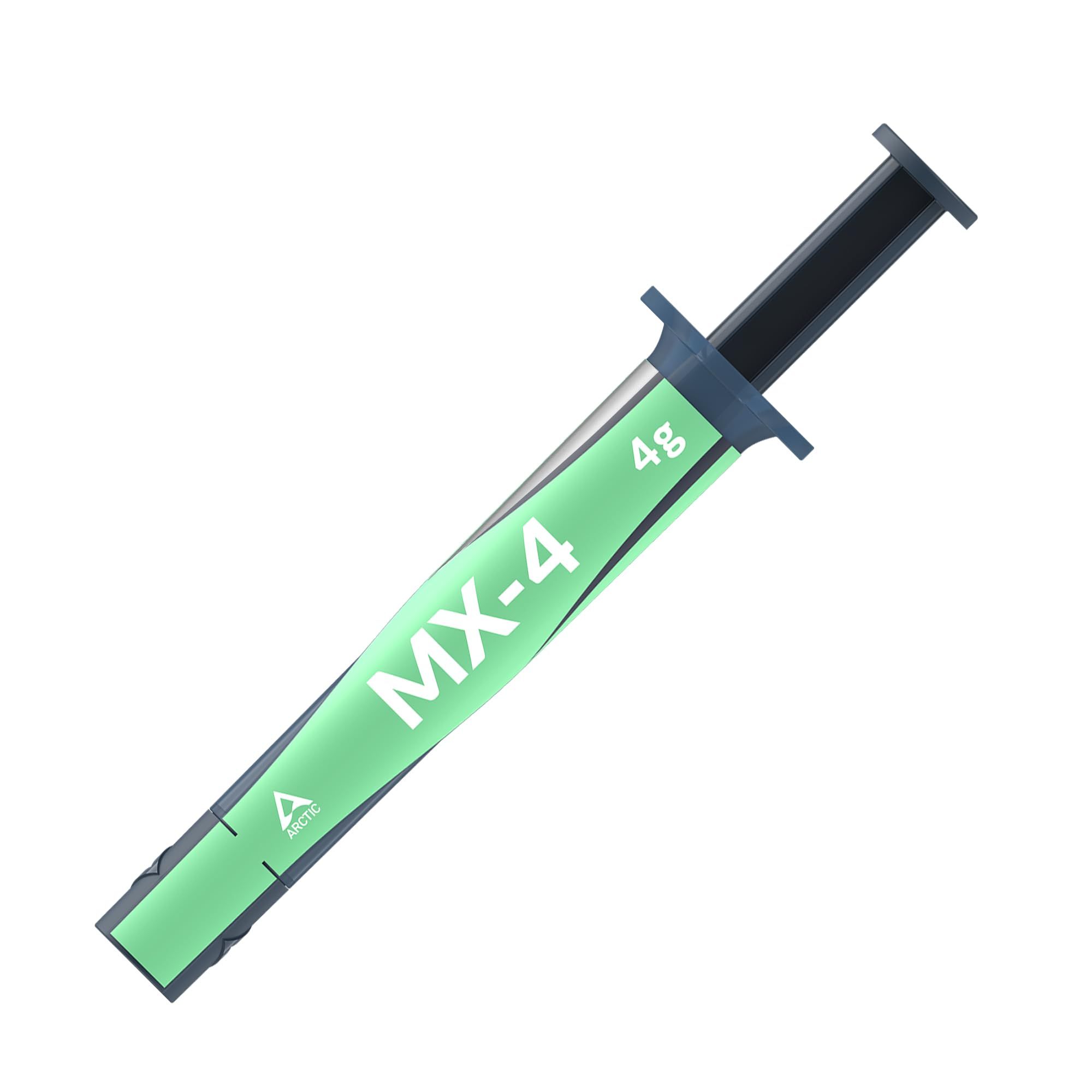
ARCTIC's MX-4 is the beginner pick because the maker says that, thanks to its consistency, it is "easy to apply, even for beginners." It is metal-free and not electrically conductive, and ARCTIC says its microparticles fill microscopic cavities between the chip and cooler.
The spec table lists a density of 2.50 g/cm³, viscosity of 31,600 poise, volume resistivity of 3.8 x 10^13 ohm-cm, and a continuous use temperature of -50 to 150 °C. Resealable packaging is meant to stop the paste drying out between uses. MX-4 comes in 2 g, 4 g, 8 g, 20 g and 45 g, with or without a spatula, so the contents vary by version; this pick is the 4 g tube.
Key highlights
- 4 g tube (MX-4 also comes in 2 g, 8 g, 20 g and 45 g)
- Metal-free and not electrically conductive
- Density of 2.50 g/cm³ and viscosity of 31,600 poise
- Continuous use temperature of -50 to 150 °C
- Resealable packaging
- Spatula included only in some versions
Pros
- ARCTIC rates it easy to apply for first-timers
- Non-conductive, metal-free formula
- Resealable tube helps keep leftover paste usable
- Full spec table published
Cons
- The product page gives no thermal conductivity number and points to an FAQ instead
- Rated for continuous use up to 150 °C
- A spatula depends on the version, so this listing may not include one
Who it is for: First-time builders and anyone doing a simple CPU repaste who wants an easy, non-conductive paste.
Skip if
You are repasting a GPU or console and want a paste designed specifically against pump-out, such as Duronaut Pro.
Thermal Grizzly Conductonaut Extreme (1 g) - Best liquid metal
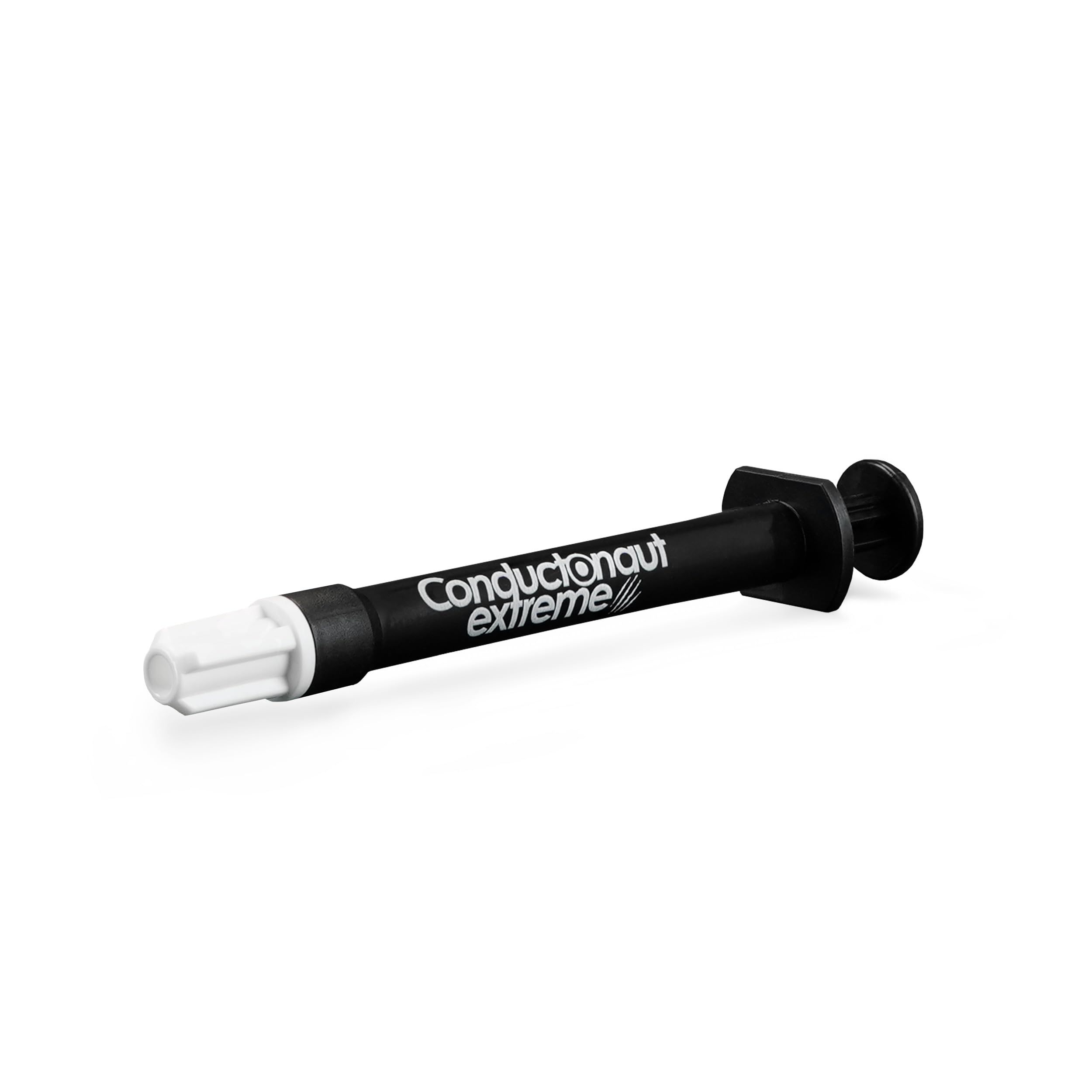
Conductonaut Extreme is not a conventional paste. It is a gallium-based alloy that is liquid at room temperature, which Thermal Grizzly says enables a minimum layer thickness because it contains no large particles. Its viscosity is listed at 0.0021 Pa·s and its density at 6.29 g/cm³, with an operating range of -50 to +200 °C.
The tradeoffs are serious, and the maker states them plainly: "Caution: Electrically conductive!" It can cause short circuits, must not be used with aluminum coolers, and can react with and discolor uncoated copper. Thermal Grizzly recommends nickel-plated copper for the best long-term stability. The 1 g pack includes a syringe, a metal needle for application, a plastic needle for absorbing, two lint-free cotton swabs and two cleaning pads.
Key highlights
- 1 g gallium-based liquid metal
- Viscosity of 0.0021 Pa·s
- Density of 6.29 g/cm³
- Operating temperature of -50 to +200 °C
- Recommended for nickel-plated copper surfaces
- Syringe, two needles, two swabs and two cleaning pads included
Pros
- Enables a very thin layer between chip and cooler
- Rated for use up to +200 °C
- Application and cleanup tools included
- Small pack suits a single careful application
Cons
- Electrically conductive and can cause short circuits
- Must not be used with aluminum coolers
- Can react with and mark uncoated copper
Who it is for: Experienced builders and overclockers with nickel-plated copper surfaces who are comfortable protecting nearby components.
Skip if
This is your first repaste, your cooler is aluminum, or you want a no-risk, non-conductive compound.
How to Choose
- Decide on conductive or non-conductive. Five picks here are rated non-conductive by their makers. Liquid metal such as Conductonaut Extreme conducts electricity, so any spill near exposed contacts can cause a short.
- Match the consistency to your method. MX-7 is meant to go on in a cross pattern and spread under cooler pressure, while Duronaut Pro is thick and meant to be spread slowly with a spatula.
- Read conductivity ratings with care. Thermal Grizzly has not published general W/(m·K) ratings since the end of 2020, ARCTIC points to an FAQ, and Thermalright lists 14.3 W/m-K. Ratings from different makers are not a like-for-like comparison.
- Think about long-term stability. For parts you do not want to repaste often, such as GPUs and consoles, look for a paste designed against pump-out and hardening.
- Buy the right amount. Tubes here range from 1 g to 4 g, and some lines come in larger sizes. One build needs little, but several machines need more.
- Check your cooler before using liquid metal. Thermal Grizzly says Conductonaut Extreme must not touch aluminum and works best on nickel-plated copper.
FAQ
Is thermal paste electrically conductive?
Most is not. The MX-7, Duronaut Pro, XTM70, TFX and MX-4 are all listed as non-conductive by their makers. Liquid metal such as Conductonaut Extreme is conductive and needs much more care.
Can I use liquid metal with an aluminum cooler?
No. Thermal Grizzly says Conductonaut Extreme must not be used with aluminum coolers, and it recommends nickel-plated copper for the best long-term stability.
How should I apply thermal paste?
Follow the maker's method for the paste you buy. ARCTIC recommends a simple cross pattern for MX-7, while Thermal Grizzly asks for a slow, thin spread with a spatula for Duronaut Pro.
Why do some thermal pastes not list a W/m-K rating?
Some makers have stopped publishing one. Thermal Grizzly has not published general W/(m·K) ratings since the end of 2020, and ARCTIC directs buyers to an FAQ rather than listing a figure on the MX-4 page.
Do I need to remove old thermal paste first?
Yes. Apply new paste to clean, dry contact surfaces. Some kits help with this: the XTM70 includes three cleaning wipes, and some MX-7 versions include MX Cleaner packets.
Published November 13, 2026 Last updated November 13, 2026
Add Technobezz on Google:Preferred SourceGoogle Discover
More buying guides

Buying guide
5 Best Robotic Pool Cleaners in 2026

Buying guide
7 Best Smart Home Hubs in 2026

Buying guide
5 Best Laptops for Seniors in 2026

Buying guide
5 Best Earbuds for Calls in 2026
Buying guide8 Best MIDI Keyboards in 2026Buying guide6 Best CD Players in 2026Buying guide8 Best Capture Cards in 2026Buying guide5 Best Studio Monitors in 2026Buying guide6 Best Cameras for Landscape Photography in 2026Buying guide6 Best DJ Controllers in 2026Buying guide6 Best PC Cases in 2026Buying guide5 Best Audio Interfaces in 2026