Studio monitors are built to play back a mix as plainly as possible, so the right choice depends on room size, desk space, and how your audio interface connects. This guide is for home studio owners, producers, podcasters, and video creators in the US choosing a first or next set of nearfield monitors.
Technobezz is supported by its audience. We may get a commission from retail offers.
5 Best Studio Monitors in 2026
The Neumann KH 120 II leads our pick of studio monitors for home and project studios, with Kali, ADAM, Focal and Mackie options for other needs.
T
Technobezz
Editorial Team
Updated November 12, 2026Nov 12, 2026
•10 min read

Get Deals Like These in Your Inbox
The best prices, straight to your inbox.
Add Technobezz on Google:Preferred SourceGoogle Discover
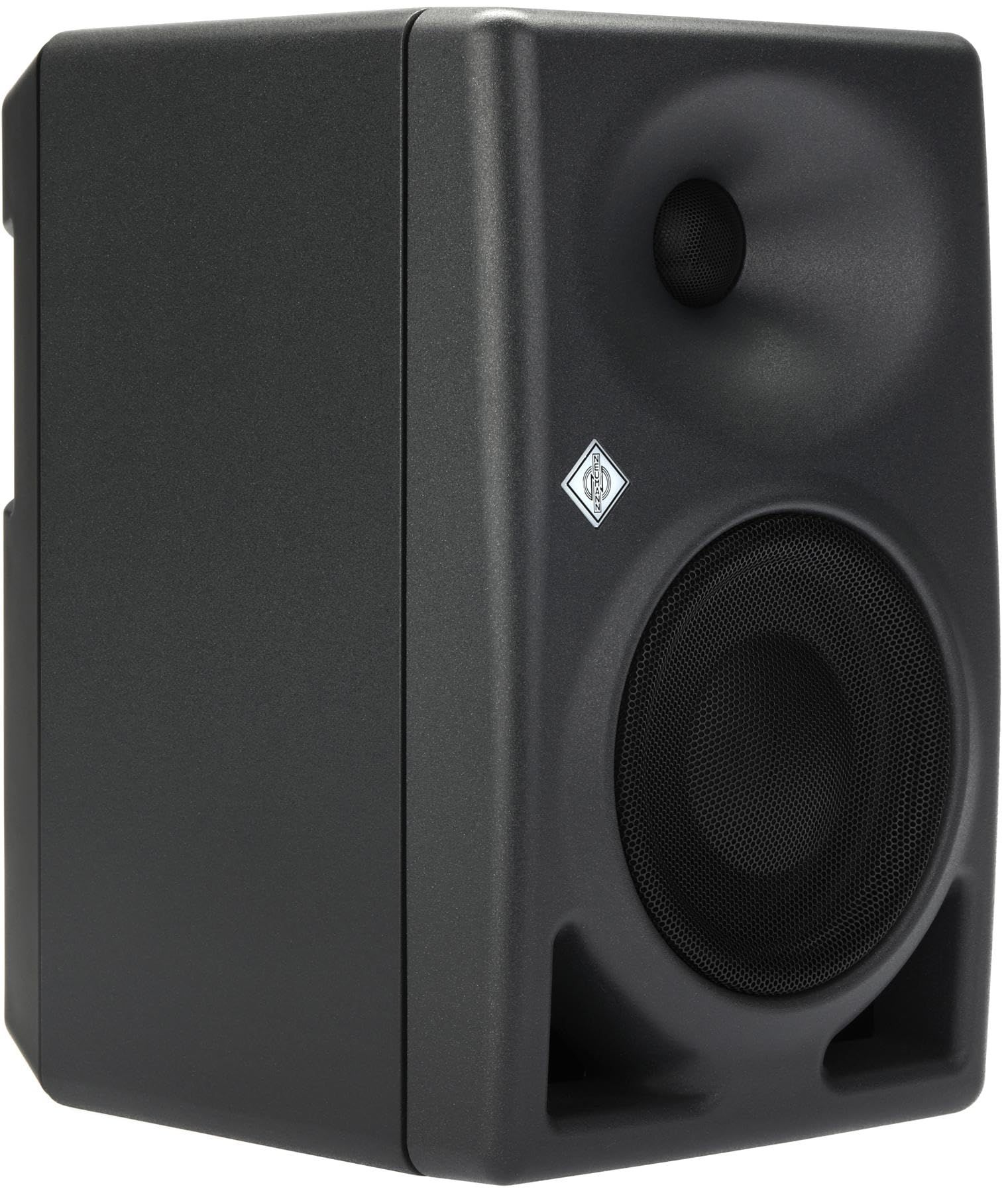
The Neumann KH 120 II is the best overall pick. It combines a 5.25-inch woofer and internal DSP with a 44 Hz to 21 kHz (+/-3 dB) response and support for Neumann's Automatic Monitor Alignment through MA 1, which is sold separately.
The other picks cover value, a wide sweet spot, wall mounting, and small desks, from a 7-inch woofer down to compact 3.5-inch speakers.
At a Glance
| Category | Product | Why We Picked It |
|---|---|---|
| Best overall | Neumann KH 120 II | Compact DSP monitor with 44 Hz low end and optional MA 1 room alignment |
| Best value | Kali Audio LP-6 V2 | 6.5-inch woofer, 115 dB max SPL, and XLR, TRS and RCA inputs |
| Best for a wide sweet spot | ADAM Audio T7V | U-ART ribbon tweeter in a waveguide designed for wide, even dispersion |
| Best for wall mounting | Focal Alpha 65 Evo | Wall and ceiling mounting inserts plus bass and treble controls |
| Best for small desks | Mackie CR3.5 | Compact 3.5-inch monitors with a front headphone output and tone knob |
How we chose
We compared each maker's published specifications, including driver size, amplifier power, frequency response, maximum output, inputs, and room controls, and matched every pick to a specific kind of buyer. We also checked that each pick is sold new on Amazon.
The best Studio Monitors right now
Neumann KH 120 II - Best overall
The Neumann KH 120 II packs a serious spec sheet into a compact two-way design. Neumann lists a 5.25-inch woofer and a 1-inch tweeter on separate amplifiers rated at 145 W and 100 W (both at 10% THD), a frequency response of 44 Hz to 21 kHz (+/-3 dB), and maximum output of 116.8 dB SPL (half space, 3% THD at 1 m).
Its internal DSP supports Neumann's Automatic Monitor Alignment, which uses the separately sold MA 1 to adapt the monitor to the room and the listening position. Inputs are analog balanced XLR and S/PDIF on RCA, and rear-panel EQ trims bass, low-mid, and treble. AES67 network ports appear only on the separate AES67 versions, not the standard model.
Key highlights
- 5.25-inch woofer and 1-inch tweeter
- 145 W woofer and 100 W tweeter amplifiers (10% THD)
- 44 Hz to 21 kHz (+/-3 dB)
- 116.8 dB max SPL (half space, 3% THD at 1 m)
- Analog XLR and S/PDIF (RCA) inputs
- Bass, low-mid, and treble EQ on the rear panel
- Anthracite finish on this listing; Neumann also offers White
Pros
- Highest published max SPL among these picks, though makers measure it differently
- DSP with support for automatic room alignment
- Three-band rear EQ helps with placement near walls
- Digital S/PDIF input alongside analog XLR
Cons
- No TRS or analog RCA input, so TRS-only interfaces need an XLR cable or adapter
- MA 1 room alignment is sold separately
- Bass and low-mid controls only cut (0 to -6 dB) and cannot boost
Who it is for: Producers and mix engineers who want a compact DSP monitor with high output and a path to automatic room alignment.
Skip if
You are shopping on a tight budget, or your setup relies on TRS or RCA outputs and you would rather not deal with adapters.
Kali Audio LP-6 V2 - Best value
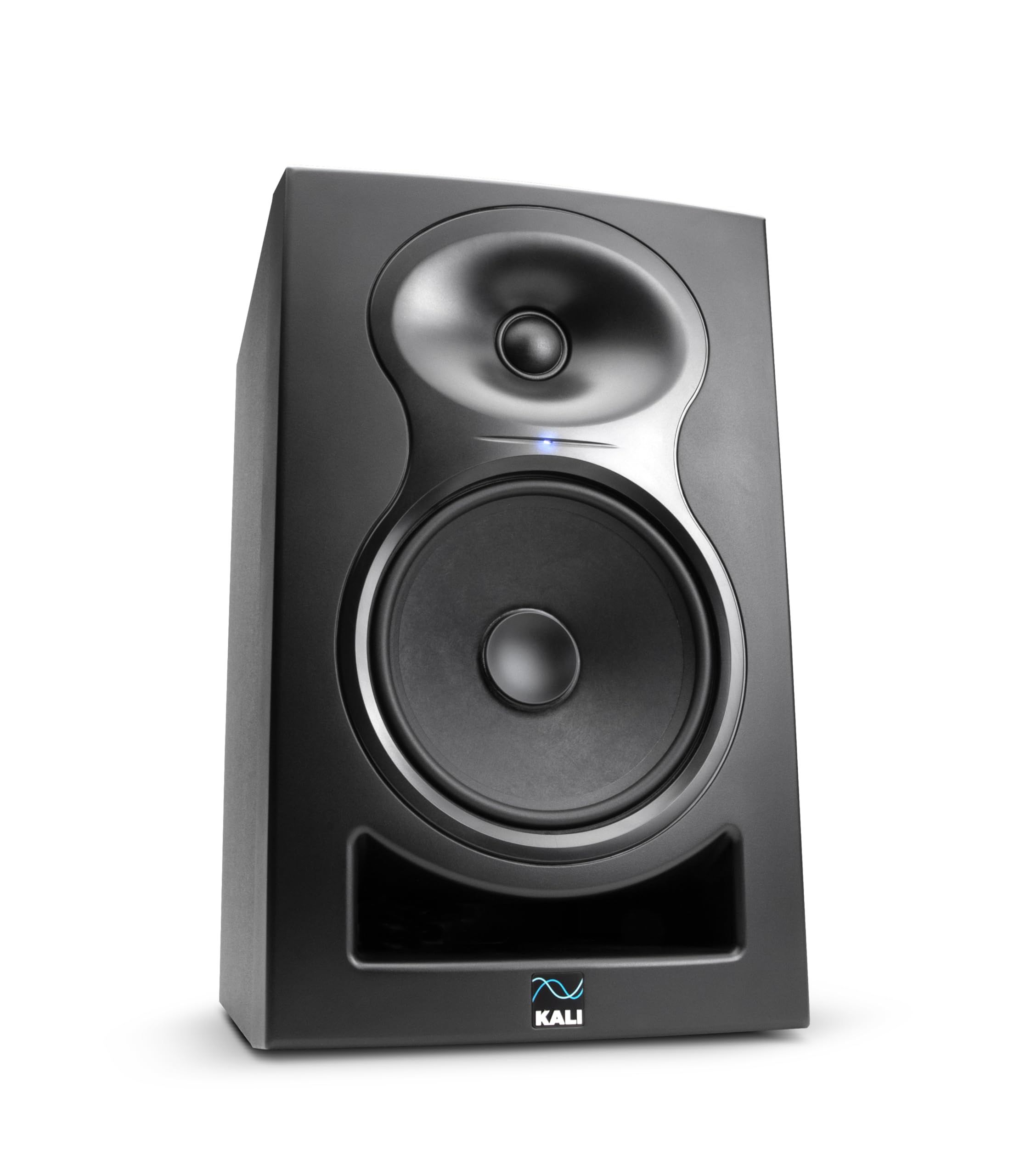
The Kali Audio LP-6 V2 is the 2nd Wave version of Kali's Project Lone Pine 6.5-inch monitor. It pairs a 6.5-inch paper woofer with a 1-inch textile dome tweeter, bi-amped with 40 W of Class D power to each driver for 80 W total, and Kali rates it at 115 dB max SPL.
Kali quotes a range of 47 Hz to 21 kHz at +/-3 dB and 39 Hz to 25 kHz at -10 dB. Balanced XLR and TRS inputs sit alongside unbalanced RCA, and boundary compensation EQ settings, which Kali tuned at The Village Studios in Los Angeles, work with LF and HF trims to suit where the speaker sits.
Key highlights
- 6.5-inch paper woofer and 1-inch textile dome tweeter
- 80 W bi-amped Class D (40 W + 40 W)
- 115 dB max SPL
- 47 Hz to 21 kHz (+/-3 dB), 39 Hz to 25 kHz (-10 dB)
- XLR, TRS, and RCA inputs
- Boundary EQ settings plus LF and HF trims
Pros
- Covers all three common input types
- High rated output for a 6.5-inch monitor
- Boundary settings help when the speaker has to sit near a wall
- Strong spec sheet for a value pick
Cons
- This listing is a single speaker, so stereo means buying two
- The +/-3 dB range stops at 47 Hz, so the deepest bass rolls off
- A 6.5-inch speaker needs more desk space than the compact picks
Who it is for: Home studio owners who want a full-size 6.5-inch monitor with flexible inputs and placement settings.
Skip if
Your desk is small, or you want Bluetooth for casual listening.
ADAM Audio T7V - Best for a wide sweet spot
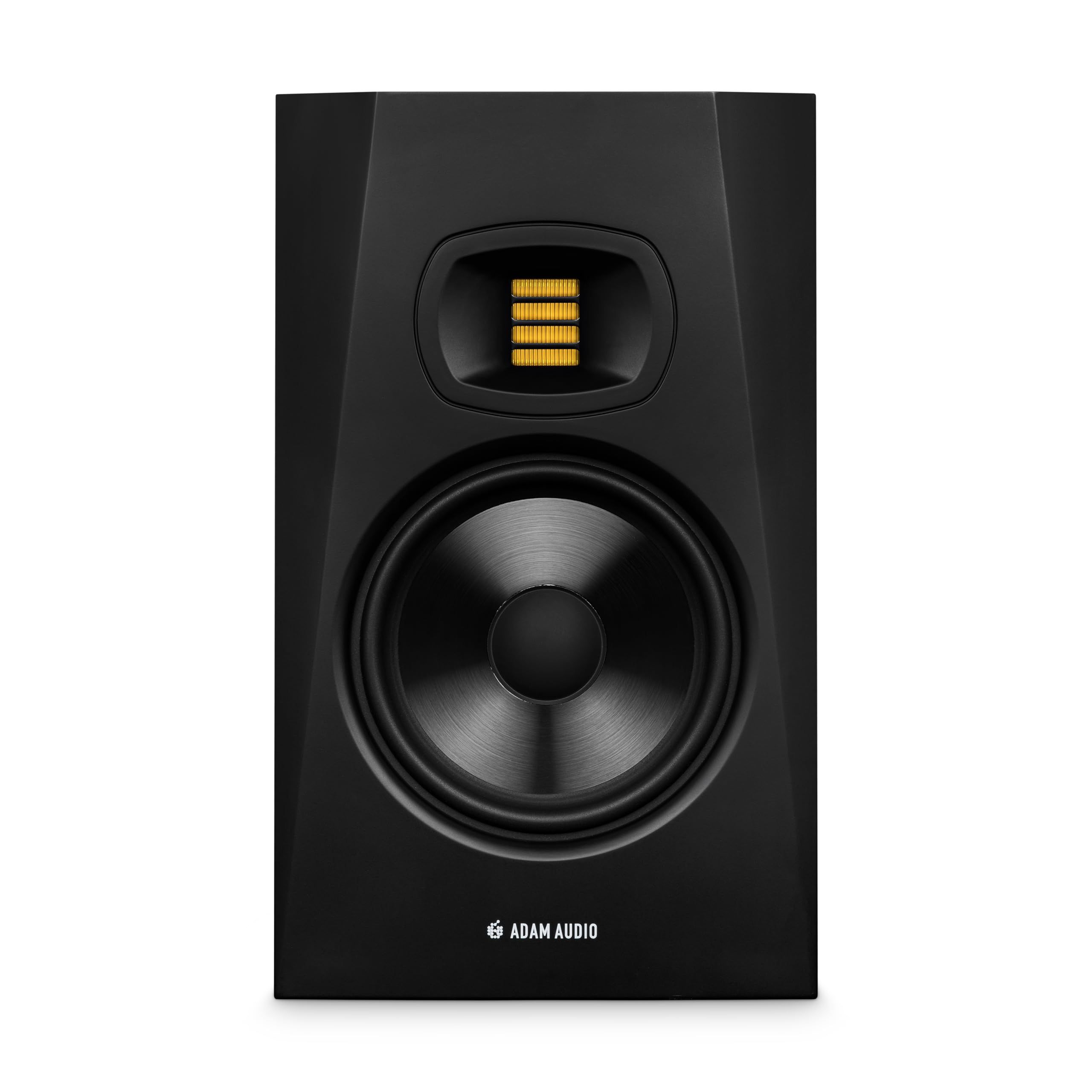
The ADAM Audio T7V is built around ADAM's U-ART 1.9-inch accelerated ribbon tweeter, a design ADAM says is based on the tweeters in its AX Series and S Series monitors. The tweeter sits in a precision waveguide that ADAM says gives uniform high-frequency dispersion and a wide sweet spot, so you are not locked to one mix position.
A 7-inch polypropylene woofer handles the low end, with 70 W of Class D power split 50 W to the woofer and 20 W to the tweeter. ADAM lists 39 Hz to 25 kHz (-6 dB), max SPL of at least 110 dB per pair at 1 m, XLR and RCA inputs, and high and low shelf EQ. ADAM designed it for vertical use in a nearfield setup.
Key highlights
- U-ART 1.9-inch accelerated ribbon tweeter with HPS waveguide
- 7-inch polypropylene woofer
- 70 W Class D (50 W woofer, 20 W tweeter)
- 39 Hz to 25 kHz (-6 dB)
- At least 110 dB max SPL per pair at 1 m
- High shelf (above 5 kHz) and low shelf (below 300 Hz) EQ at -2, 0, or +2 dB
Pros
- Largest woofer in this list
- Ribbon tweeter and waveguide aimed at a wide listening area
- Low and high shelf EQ for basic room tuning
Cons
- No TRS input, only XLR and RCA
- EQ is limited to two shelves at +/-2 dB
- Max SPL is quoted per pair, so ADAM gives no single-speaker figure
Who it is for: Producers who shift around the desk while working and want a 7-inch woofer for low-end reach.
Skip if
Your interface has TRS outputs only and you want to avoid adapter cables, or you need finer room correction.
Focal Alpha 65 Evo - Best for wall mounting
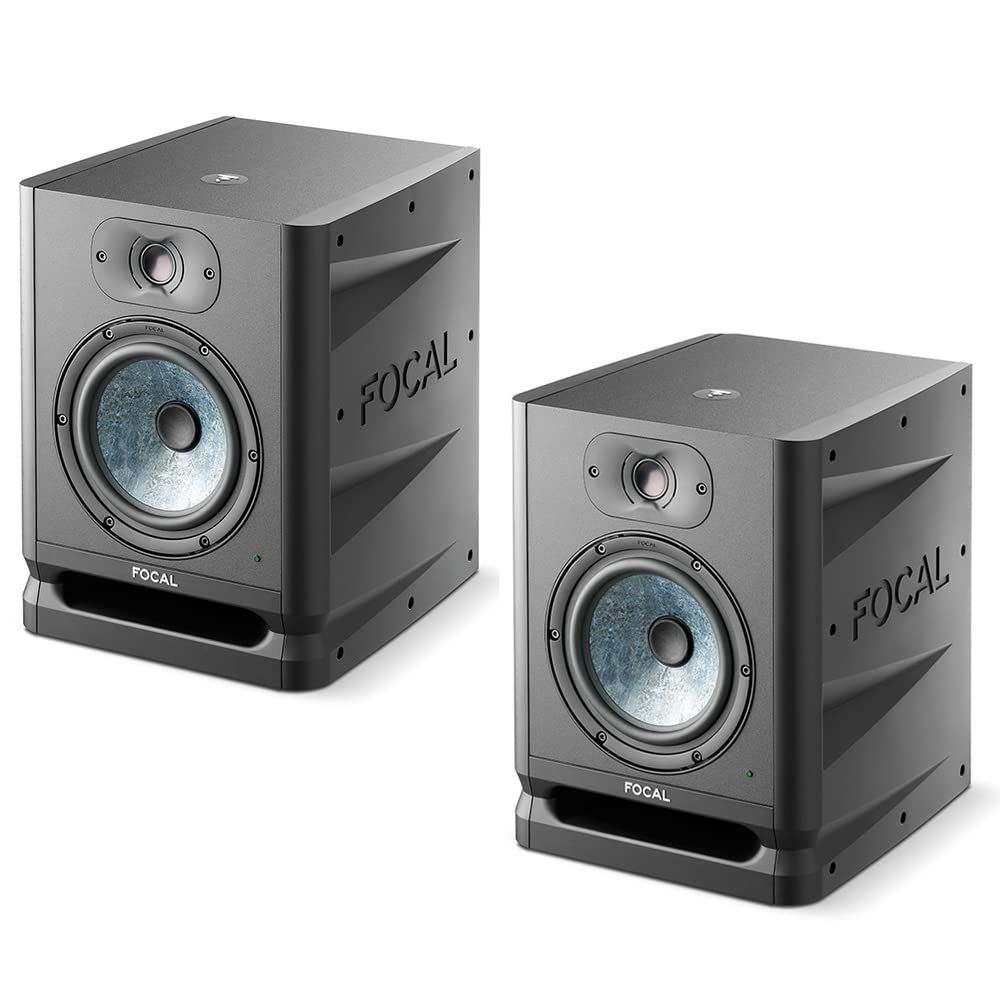
Focal's Alpha 65 Evo is an active 2-way monitor with a 6.5-inch Slatefiber woofer and a 1-inch aluminium inverted dome tweeter. Class D amplification gives the woofer 55 W and the tweeter 30 W, and Focal rates the response at 40 Hz to 22 kHz (+/-3 dB) with a bass-reflex design using a large laminar vent.
It earns the mounting slot because Focal builds in wall and ceiling mounting inserts, which helps in rooms where stands do not fit. TRS, XLR, and RCA inputs cover most interfaces, bass (+/-6 dB) and treble (+/-3 dB) level controls help with placement, and the automatic standby mode can be turned off.
Key highlights
- 6.5-inch Slatefiber woofer
- 1-inch aluminium inverted dome tweeter
- 55 W + 30 W Class D amplification
- 40 Hz to 22 kHz (+/-3 dB)
- TRS, XLR, and RCA inputs
- Wall and ceiling mounting inserts
Pros
- Built-in inserts for wall or ceiling mounting
- All three common input types
- Wide bass adjustment range of +/-6 dB
- Automatic standby that can be disabled
Cons
- Rated max SPL of 104 dB (peak at 1 m) is the lowest among the 6.5-inch and larger picks here
- Room controls are limited to bass and treble levels
Who it is for: Creators and producers who want a 6.5-inch monitor that can go on a wall or ceiling instead of a desk or stand.
Skip if
You work at high volume in a larger room, or you want boundary presets or DSP room correction.
Mackie CR3.5 - Best for small desks
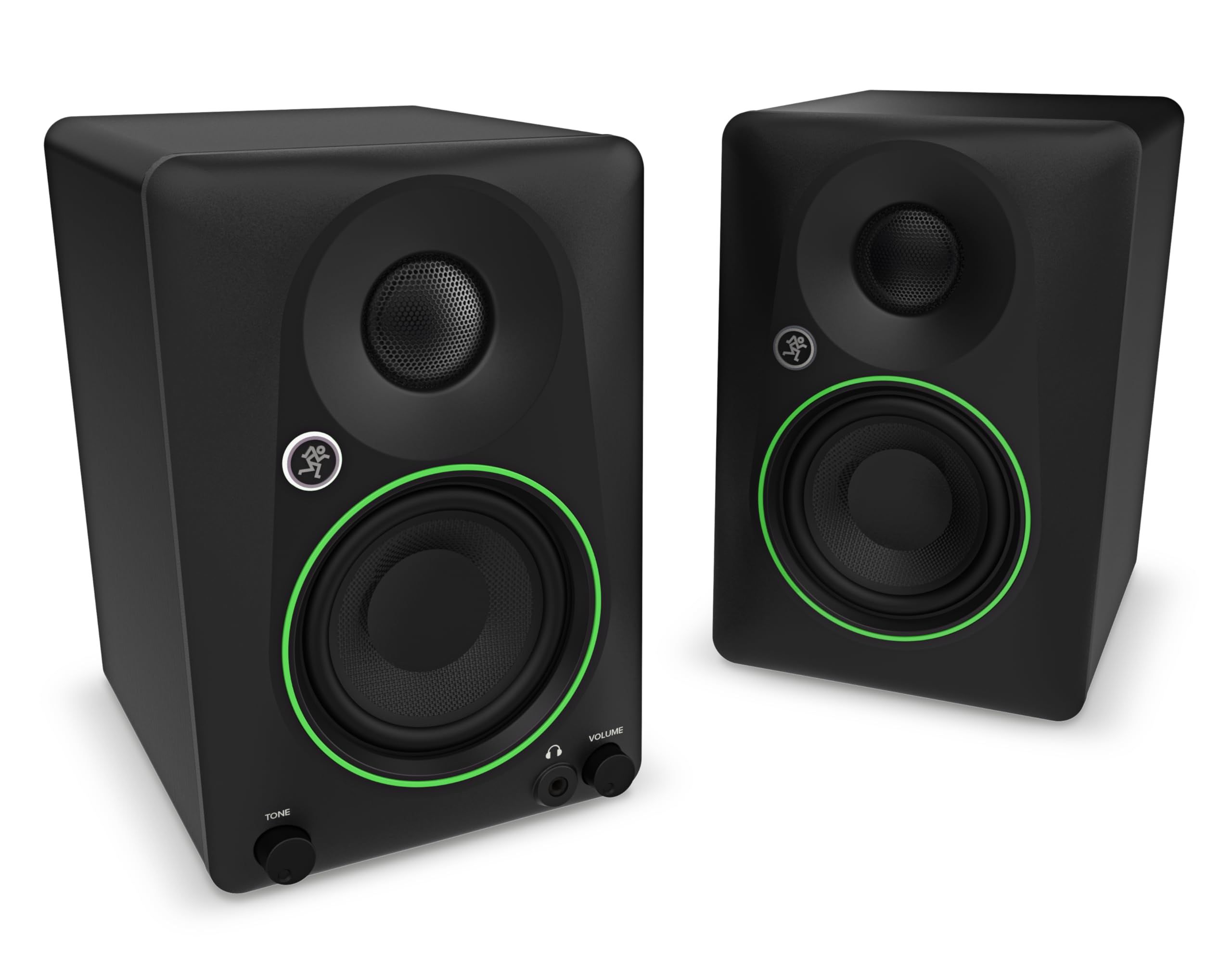
The Mackie CR3.5 is the compact pick for small desks and people who want studio monitors that also handle everyday listening. Mackie lists a 3.5-inch woven woofer and a silk dome tweeter, powered by 50 W RMS of bi-amplified Class A/B amplification.
Inputs are TRS, RCA, and 3.5 mm, and a headphone output sits on the front. A tone control knob shapes the sound starting from what Mackie calls the transparent response of studio monitors, and a location switch sets it for desktop or bookshelf placement. Mackie sells a separate CR3.5BT version with Bluetooth; this listing is the standard CR3.5.
Key highlights
- 3.5-inch woven woofer and silk dome tweeter
- 50 W RMS bi-amplified Class A/B
- TRS, RCA, and 3.5 mm inputs
- Front headphone output
- Tone control knob
- Desktop and bookshelf location switch
Pros
- Small woofers suit tight desks
- 3.5 mm input connects to a computer or phone without an interface
- Front headphone output is easy to reach
- Tone knob and location switch make quick adjustments simple
Cons
- No XLR input
- Mackie's product page lists no frequency response or max SPL
- No Bluetooth on this version; that requires the CR3.5BT
Who it is for: Beginners, podcasters, and creators with limited desk space who want simple monitors for podcasts, music and everyday listening.
Skip if
You mix bass-heavy music, need XLR connections, or want Bluetooth.
How to Choose
- Match woofer size to the room. Larger woofers generally reach lower bass and suit bigger rooms, though specs vary: the 5.25-inch Neumann KH 120 II lists 44 Hz, lower than the 47 Hz of the 6.5-inch Kali LP-6 V2. Compact 3.5-inch models fit small desks and short listening distances.
- Check the inputs against your interface. Most audio interfaces use balanced TRS or XLR outputs. The ADAM T7V has XLR and RCA only, and the Neumann KH 120 II has analog XLR plus S/PDIF, so plan cables before buying.
- Look for room controls. Speakers near walls or in corners gain extra bass. Shelf EQ, boundary settings, or DSP room alignment help counter that.
- Know whether you are buying one speaker or two. Some listings are a single speaker and others a set. The Kali LP-6 V2 listing here is one speaker, so you need two for stereo.
- Decide whether you need Bluetooth. Most studio monitors are wired only. If the same speakers will play music from a phone, a model with Bluetooth avoids an extra receiver; Mackie sells a CR3.5BT version of its pick with Bluetooth.
- Compare max SPL with care. Makers measure maximum output differently, per speaker or per pair and at different distortion levels, so treat it as a rough guide.
FAQ
Are studio monitors different from regular speakers?
Studio monitors aim for an accurate, uncolored response so mix decisions carry over to other systems, while many consumer speakers shape the sound for enjoyment. Some picks here, such as the Mackie CR3.5, add tone controls for casual listening.
Do I need a subwoofer with studio monitors?
Not always. A subwoofer is most useful with small monitors whose bass stops higher, or when you work on bass-heavy music.
What size studio monitor is best for a small room?
For a small desk or bedroom studio, woofers from 3.5 to 5.25 inches are usually easier to place. Larger 6.5-inch and 7-inch models need more space and suit bigger rooms.
What if my monitors have to sit close to a wall?
Use the speaker's room controls to reduce the extra bass a wall adds. The Kali LP-6 V2 has boundary EQ settings, and the Neumann KH 120 II has bass and low-mid cut controls.
Can I connect studio monitors directly to a computer?
Models with a 3.5 mm or AUX input, such as the Mackie CR3.5, can connect directly. Monitors with only XLR, TRS, or RCA inputs usually connect through an audio interface.
Published November 12, 2026 Last updated November 12, 2026
Add Technobezz on Google:Preferred SourceGoogle Discover
More on monitors
Buying guide
6 Best OLED Monitors in 2026
Buying guide
5 Best 1440p Gaming Monitors in 2026
Buying guide
7 Best Curved Gaming Monitors in 2026
Buying guide
5 Best 4K Monitors in 2026
More buying guides
Buying guide6 Best CD Players in 2026Buying guide8 Best Capture Cards in 2026Buying guide6 Best Cameras for Landscape Photography in 2026Buying guide6 Best DJ Controllers in 2026Buying guide6 Best PC Cases in 2026Buying guide5 Best Audio Interfaces in 2026Buying guide6 Best CPU Coolers in 2026Buying guide5 Best Bass Earbuds in 2026