A MIDI keyboard controller sends notes and control moves to your music software or other gear. Which one suits you comes down to three things: how much desk space you have, how many keys you play with, and how many pads, knobs and faders you want for controlling your DAW.
Technobezz is supported by its audience. We may get a commission from retail offers.
8 Best MIDI Keyboards in 2026
The Novation Launchkey 49 MK4 leads our best MIDI keyboards for 2026, with picks for 88-key players, small desks, FL Studio users and first-time buyers.
T
Technobezz
Editorial Team
Updated November 12, 2026Nov 12, 2026
•13 min read

Get Deals Like These in Your Inbox
The best prices, straight to your inbox.
Add Technobezz on Google:Preferred SourceGoogle Discover
The Novation Launchkey 49 MK4 is our best overall pick. It has 49 semi-weighted piano-style keys and 16 velocity-sensitive pads with polyphonic aftertouch. It also has nine faders, eight endless encoders, an OLED display and built-in Chord and Scale modes, so one unit covers playing, beat making and mixing.
This page is for beginners, beat makers, songwriters and keyboard players setting up a home studio. The other picks cover 88-key weighted playing, 61-key and 37-key setups, a 25-key portable option, FL Studio users and a simple budget controller.
At a Glance
| Category | Product | Why We Picked It |
|---|---|---|
| Best overall | Novation Launchkey 49 MK4 | Semi-weighted keys, aftertouch pads, nine faders and Chord and Scale modes |
| Best 88-key studio controller | Arturia KeyLab 88 mk3 | Fatar hammer-action keybed with aftertouch and a full control surface |
| Best for MIDI 2.0 | Roland A-88MKII | PHA-4 keys, MIDI 2.0 support, three zones and MIDI in and out |
| Best 61-key | Arturia KeyLab Essential 61 mk3 | Nine faders, a 2.5-inch screen and broad DAW scripts |
| Best compact | Akai Professional MPK Mini IV | 25 keys, 8 pads, 8 knobs and a color display in a small footprint |
| Best for small desks | Arturia MiniLab 37 | 37 slim keys for two-handed parts in a 1.17 kg body |
| Best for FL Studio | Novation FLkey 2 37 | Custom FL Studio scripts and six months of Producer Edition |
| Best budget | M-Audio Keystation 49 MK3 | 49 full-size keys, transport buttons and plug-and-play USB setup |
How we chose
We compared the published specifications of keyboard controllers from 25 to 88 keys. We looked at key action, pads, faders and encoders, displays, connections, DAW integration and bundled software. We also checked that each pick is sold new on Amazon.
The best MIDI Keyboards right now
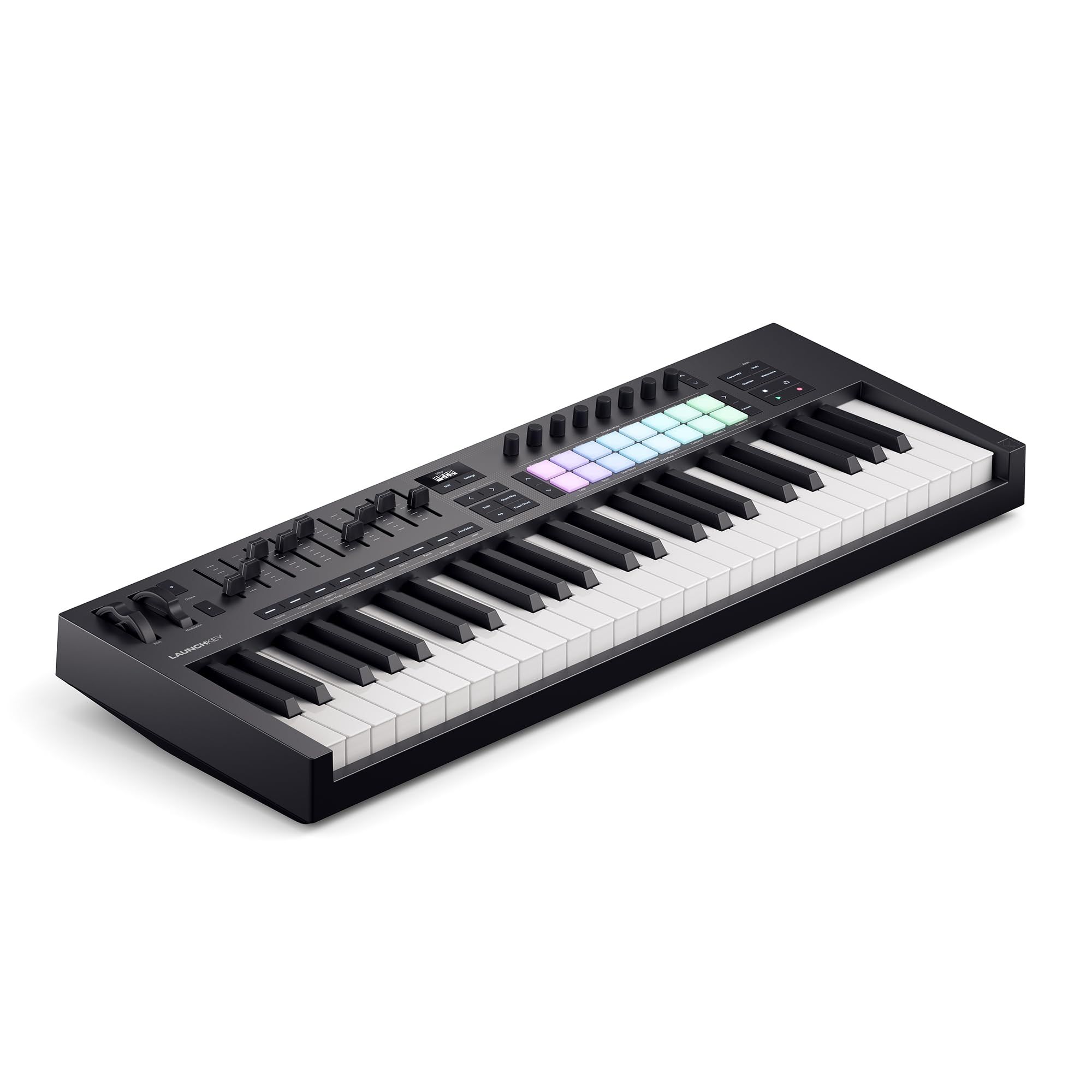
Novation Launchkey 49 MK4 - Best overall
The Launchkey 49 MK4 covers more jobs than anything else on this list. Its 49 semi-weighted piano-style keys give both hands room to play. Its 16 velocity-sensitive RGB pads add polyphonic aftertouch for drums, clip launching and expressive parts.
Novation lists nine faders, eight endless rotary encoders and a 128 x 64 monochrome OLED display. Scale Mode has 30 scales, and you also get Chord Map, Fixed Chord and User Chord modes plus an arpeggiator with a step editor. Custom integration covers Ableton Live 11 or later, Logic, Cubase, Reason, FL Studio and Ardour. A 5-pin MIDI out socket lets it play hardware synths too.
Key highlights
- 49 semi-weighted piano-style keys
- 16 velocity-sensitive RGB pads with polyphonic aftertouch
- 9 faders and 8 endless rotary encoders
- 128 x 64 monochrome OLED display
- Scale Mode with 30 scales, plus Chord Map, Fixed Chord and User Chord
- USB-C, 5-pin MIDI out and 1/4-inch sustain pedal jack
Pros
- Faders and encoders give mixer-style control over a DAW
- Pads with polyphonic aftertouch add expression beyond velocity
- Chord and Scale modes help players still learning theory stay in key
- Bundle includes Ableton Live Lite, Cubase LE and Native Instruments Komplete 15 Select
Cons
- Semi-weighted keys are not hammer action for piano practice
- Only a MIDI out socket is listed, with no MIDI in
- At 730 mm wide and 4.08 kg it needs a dedicated desk spot
- The display is monochrome rather than color
Who it is for: Producers and songwriters who want one controller for playing parts, finger drumming, launching clips and mixing.
Skip if
You want weighted piano action or a controller small enough to carry in a laptop bag.
Arturia KeyLab 88 mk3 - Best 88-key studio controller
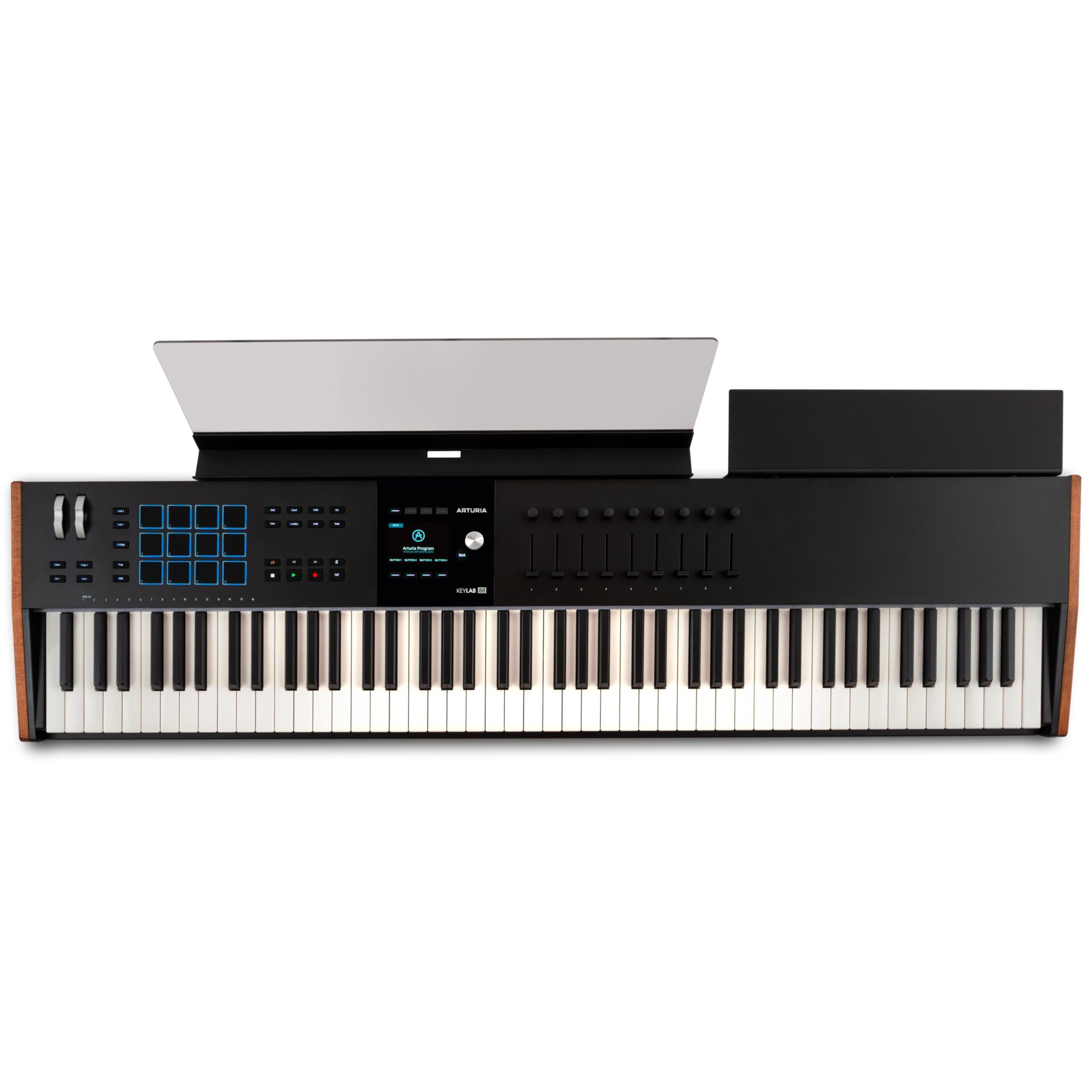
The KeyLab 88 mk3 is for players who want the full piano range and a full studio control surface in one unit. Arturia builds it around an 88-note fully-weighted Fatar TP/110 hammer-action keybed with aftertouch.
Above the keys are 12 touch- and pressure-sensitive RGB pads, nine 360-degree encoders, nine 50 mm faders and a 3.5-inch full-color display with eight contextual buttons. Four pedal inputs cover sustain, modulation, expression and aux. Arturia lists integration with Ableton Live, FL Studio, Logic Pro, Cubase, Bitwig Studio and MainStage. It comes in black or white, and this listing is the black version.
Key highlights
- 88-note fully-weighted Fatar TP/110 hammer-action keybed with aftertouch
- 12 touch- and pressure-sensitive RGB pads
- 9 rotary encoders and 9 x 50 mm faders
- 3.5-inch full-color display
- 4 pedal inputs: sustain, modulation, expression and aux
- Analog Lab Pro, Piano V, Mini V and Ableton Live Lite included
Pros
- Hammer-action keys with aftertouch suit piano and expressive synth parts
- Largest screen and most pads of the 88-key picks here
- Four pedal inputs for players who use more than a sustain pedal
- MCU/HUI support and NKS compatibility on top of the DAW scripts
Cons
- At 15.7 kg it is heavy to move
- Measures 323 x 1295 x 113 mm, so it needs a large desk or stand
Who it is for: Pianists and producers who want weighted keys and deep DAW control without a separate control surface.
Skip if
You have a small desk or mostly program beats and short synth lines.
Roland A-88MKII - Best for MIDI 2.0
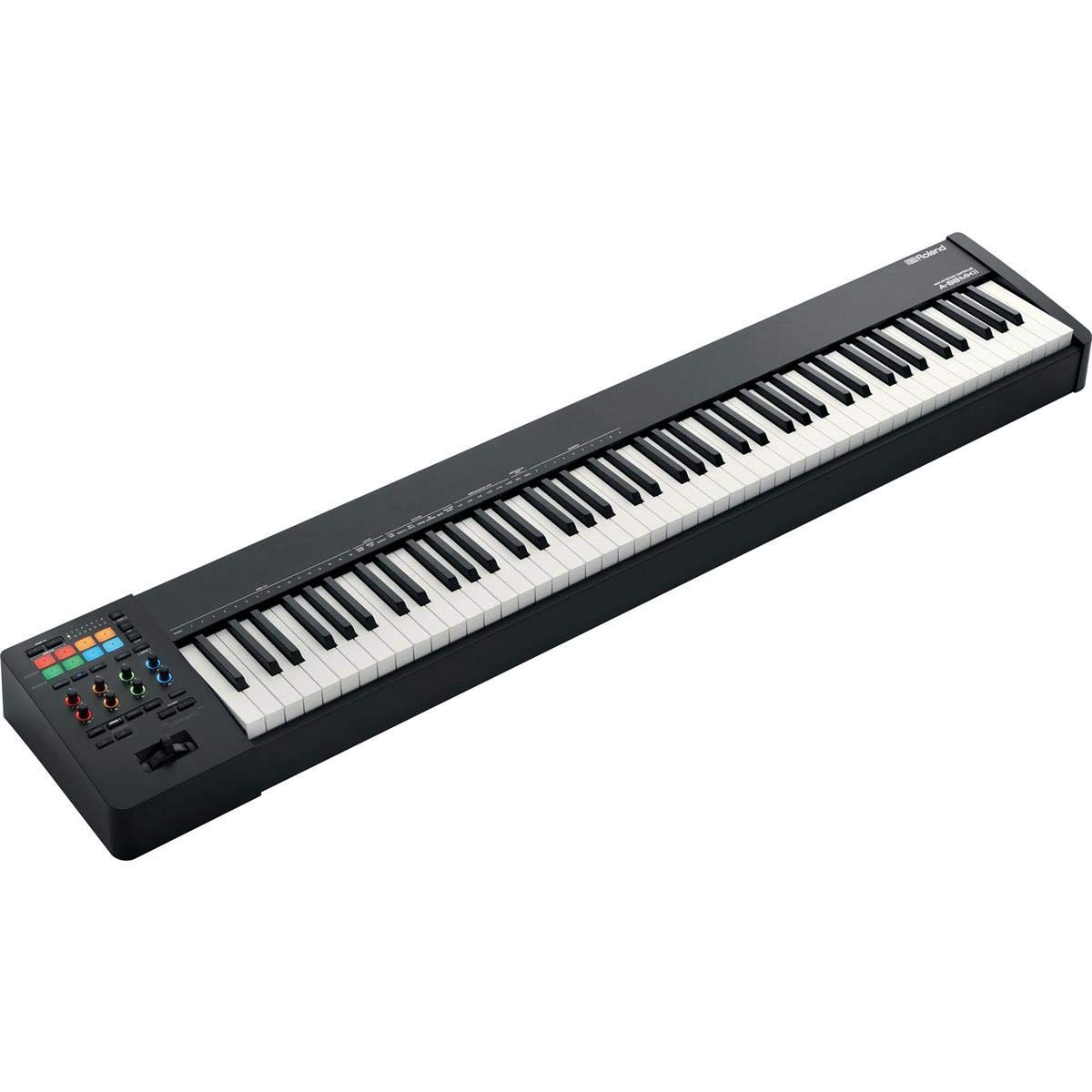
The Roland A-88MKII has 88 keys on Roland's PHA-4 Standard keyboard with escapement and ivory feel. Roland describes its build as wood and premium materials. It is our pick for MIDI 2.0, which the keyboard supports from system software Version 2.0 onward.
Its controls are eight RGB-lit assignable knobs, eight RGB-lit pads, a pitch bend and modulation lever and two assignable buttons. Three user-definable zones, an onboard arpeggiator and chord memory let you split or layer the keyboard. It has MIDI in and MIDI out, and it adds USB-C plus three pedal jacks for damper, FC1 and FC2.
Key highlights
- 88-key PHA-4 Standard keyboard with escapement and ivory feel
- MIDI 2.0 support with system software Version 2.0 and later
- 8 RGB-lit assignable knobs and 8 RGB-lit pads
- 3 customizable zones, arpeggiator and chord memory
- MIDI in and out, USB-C and three pedal jacks
- USB bus power or optional PSB-1U AC adapter
Pros
- MIDI in and out make it easy to fit into a hardware rig
- Three zones suit layered or split parts
- Three pedal inputs, including damper
- Wood construction for a sturdy build
Cons
- The heaviest pick here at 17.5 kg
- The AC adapter is optional, so you buy it separately if you want one
- Roland's specs list no faders, display or aftertouch
Who it is for: Keyboard players who want piano-style action and need to control several instruments or hardware modules from one board.
Skip if
You want faders and a screen for DAW mixing, or you need something light enough to carry often.
Arturia KeyLab Essential 61 mk3 - Best 61-key
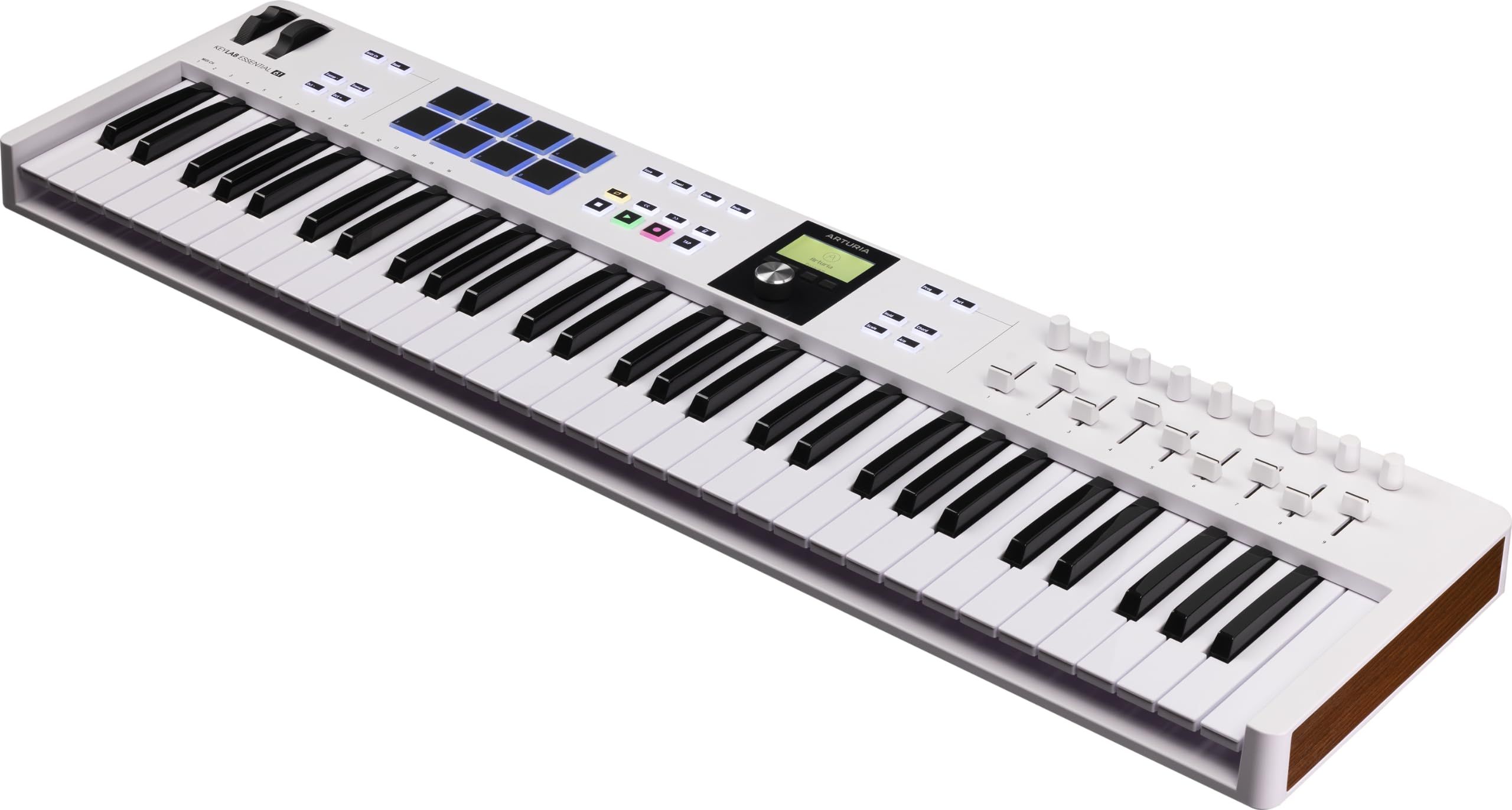
The KeyLab Essential mk3 comes in 49-key and 61-key sizes, and this listing is the 61-key model. Arturia lists a 61-note velocity-sensitive keyboard with hybrid synth-piano feel, plus a pedal input for sustain, expression or a footswitch.
Both sizes share the same controls: 8 touch- and pressure-sensitive RGB pads, nine rotary encoders plus a clickable encoder, nine 30 mm faders, pitch and mod wheels and a 2.5-inch LCD with contextual buttons. You also get an arpeggiator and Chord and Scale modes. Arturia provides custom scripts for Ableton Live, Logic Pro, Cubase, FL Studio, Bitwig, Reason, Pro Tools, Studio One and Digital Performer. Arturia says it is made with at least 40% recycled plastic.
Key highlights
- 61-note velocity-sensitive hybrid synth-piano feel keyboard (49-key version also sold)
- 8 touch- and pressure-sensitive RGB pads
- 9 rotary encoders and 9 x 30 mm faders
- 2.5-inch LCD with contextual buttons
- USB-C bus power and 5-pin MIDI out
- Analog Lab V, Ableton Live Lite and UVI Model D included
Pros
- 61 keys give room for two-handed parts without going full size
- Nine faders cover a DAW mixer bank
- The widest list of custom DAW scripts in this roundup
- Strong software bundle for a new studio
Cons
- No aftertouch is listed for the keys
- 8 pads, half the count on the Launchkey 49 MK4
- Only a MIDI output is listed, with no MIDI input
Who it is for: Players who want more keys than a 49 without the weight and size of an 88-key controller.
Skip if
You need weighted keys for piano practice or key aftertouch.
Akai Professional MPK Mini IV - Best compact
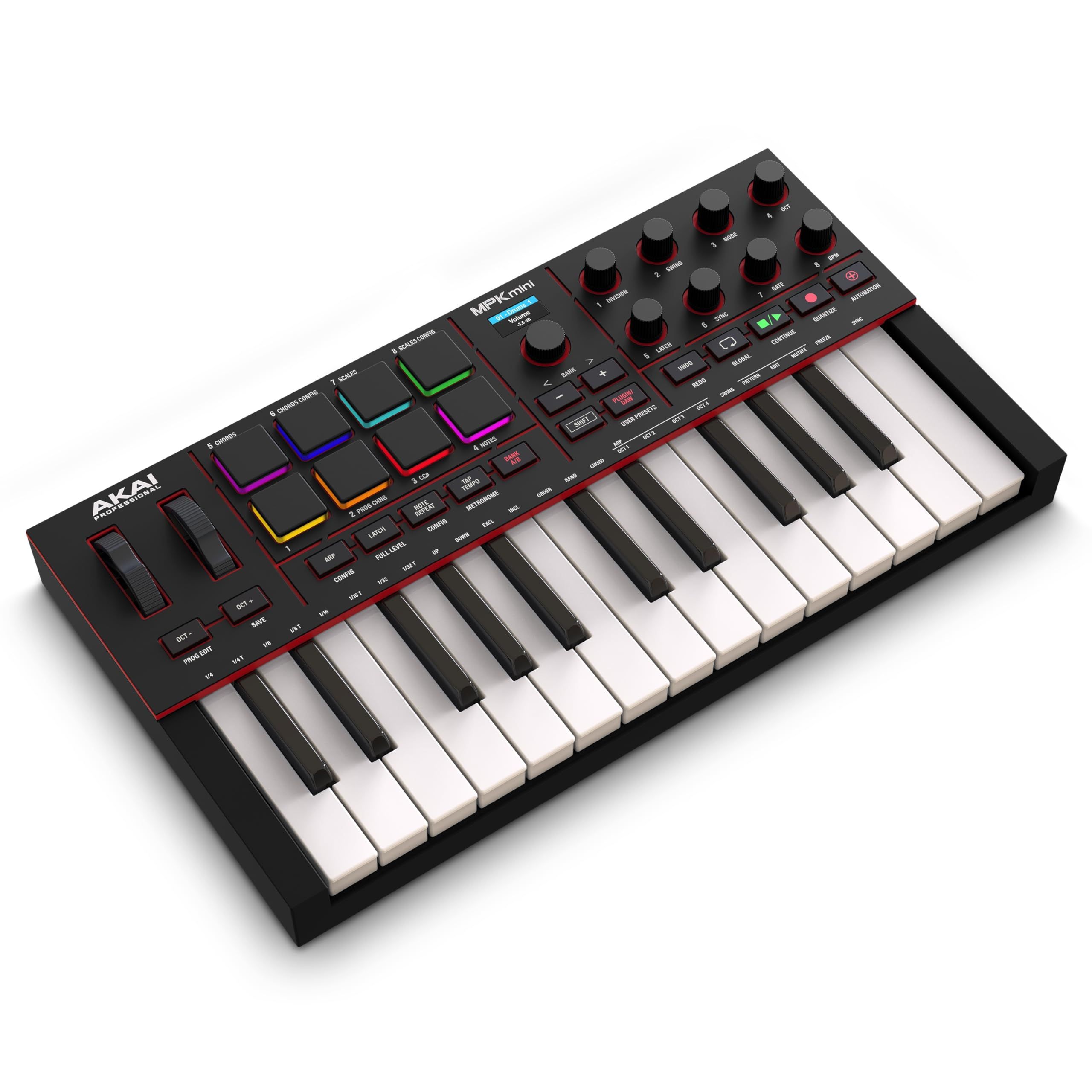
The MPK Mini IV is the pick for a backpack or travel. Akai lists a 25-note velocity-sensitive keyboard, 8 drum pads, 8 endless knobs and real mod and pitch wheels. A color display gives 1-to-1 feedback on what you are controlling.
Scales and Chords modes and an adjustable arpeggiator are built in, and Program Edit Mode lets you customize the pads and knobs. Connections are USB-C and a 5-pin DIN MIDI output. Akai lists support for macOS 13 or later, 64-bit Windows 10 or later and class-compliant smart devices. Studio Instrument Collection and Ableton Live Lite 12 are included.
Key highlights
- 25-note velocity-sensitive keyboard
- 8 drum pads and 8 endless knobs
- Real mod and pitch wheels
- Color display with 1-to-1 feedback
- USB-C and 5-pin DIN MIDI output
- Studio Instrument Collection and Ableton Live Lite 12 included
Pros
- Small enough for travel and tight desks
- 5-pin MIDI out lets it play hardware gear
- Color display for 1-to-1 feedback
- Chord and scale help for beat makers who do not play keys
Cons
- 25 notes limit two-handed playing
- Needs a USB 3.0 port or a USB-C wall adapter for power, and no battery option is listed
- 8 pads, fewer than the 16 on the Novation picks
Who it is for: Beat makers and laptop producers who want pads, knobs and a few octaves of keys in the smallest space.
Skip if
You play with both hands or want faders.
Arturia MiniLab 37 - Best for small desks
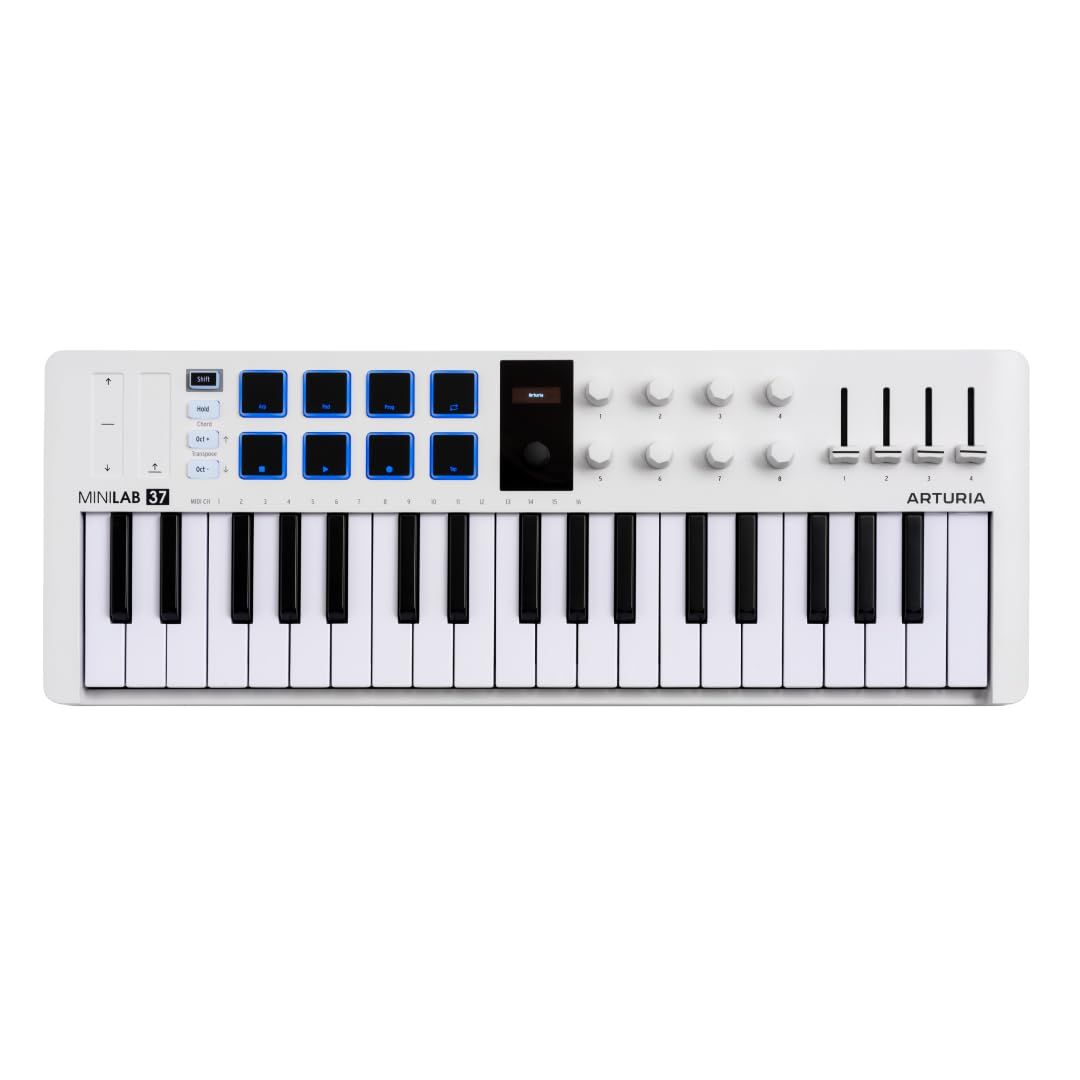
The MiniLab 37 sits between a 25-key mini and a full 49-key controller. It has 37 velocity-sensitive slim keys in a body measuring 503 x 183 x 54 mm and weighing 1.17 kg. That gives you enough range for two-handed parts in a small space.
Controls are 8 rotary encoders, 4 faders, two banks of 8 velocity- and pressure-sensitive RGB pads, and two capacitive touch sensors for pitch bend and modulation. A mini display with a clickable browser knob, an arpeggiator, Chord mode and Hold are built in. It connects to computers or an iPad over bus-powered USB-C, and it also has a 5-pin MIDI output and a pedal input.
Key highlights
- 37 velocity-sensitive slim keys
- 8 encoders and 4 faders
- 2 banks of 8 velocity- and pressure-sensitive RGB pads
- Capacitive touch sensors for pitch bend and modulation
- USB-C, 5-pin MIDI out and pedal input
- 503 x 183 x 54 mm, 1.17 kg
Pros
- Three octaves in a light, desk-friendly body
- Works with an iPad as well as a computer
- Pedal input for sustain, expression or a footswitch
- Bundle includes Analog Lab Intro, Komplete 15 Select and Ableton Live Lite
Cons
- Slim keys are narrower than full-size keys
- Pitch and modulation use touch sensors, not wheels
- Only 4 faders, and the pads are 8 physical pads across two banks
Who it is for: Home producers who want more than 25 keys but have little desk space.
Skip if
You want full-size keys or physical pitch and mod wheels.
Novation FLkey 2 37 - Best for FL Studio
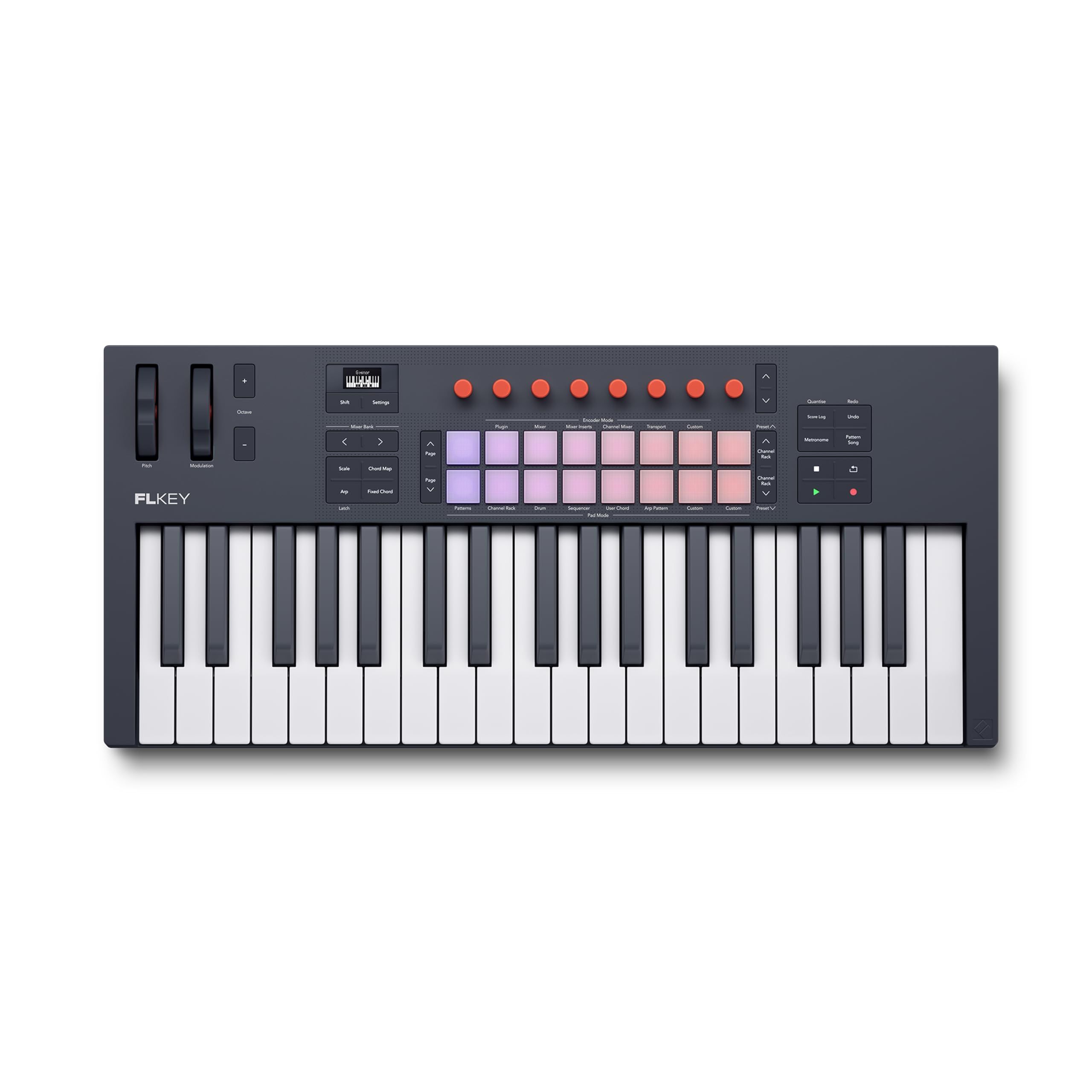
Novation built the FLkey 37 around one DAW. The company says it is officially supported by Image-Line and is the only keyboard controller made for FL Studio. It has 37 synth-action keys, 16 velocity-sensitive RGB pads, 8 endless encoders, pitch and mod wheels and a 128 x 64 monochrome OLED display.
Scale Mode offers 30 scales, alongside Chord Map, Fixed Chord and User Chord modes and an arpeggiator with a step editor. The custom scripts need FL Studio 26.1.1 or later, and HUI support covers other DAWs. It includes six months of FL Studio Producer Edition, and the connections are USB-C, 5-pin MIDI out and a 1/4-inch sustain pedal jack.
Key highlights
- 37 synth-action keys
- 16 velocity-sensitive RGB pads
- 8 endless encoders and pitch and mod wheels
- 128 x 64 monochrome OLED display
- Custom FL Studio scripts (FL Studio 26.1.1 or later)
- Six months of FL Studio Producer Edition
Pros
- Made for FL Studio with official Image-Line support
- 16 pads for step sequencing and drums
- Chord and Scale modes plus a step-editing arpeggiator
- 557 mm wide and 2.18 kg, so it fits most desks
Cons
- No faders are listed
- Producer Edition is a six-month inclusion, not a permanent license
- Other DAWs get HUI support rather than the same custom scripts
Who it is for: FL Studio users who want pads and keys that map to the software out of the box.
Skip if
You work mainly in another DAW or want faders for mixing.
M-Audio Keystation 49 MK3 - Best budget
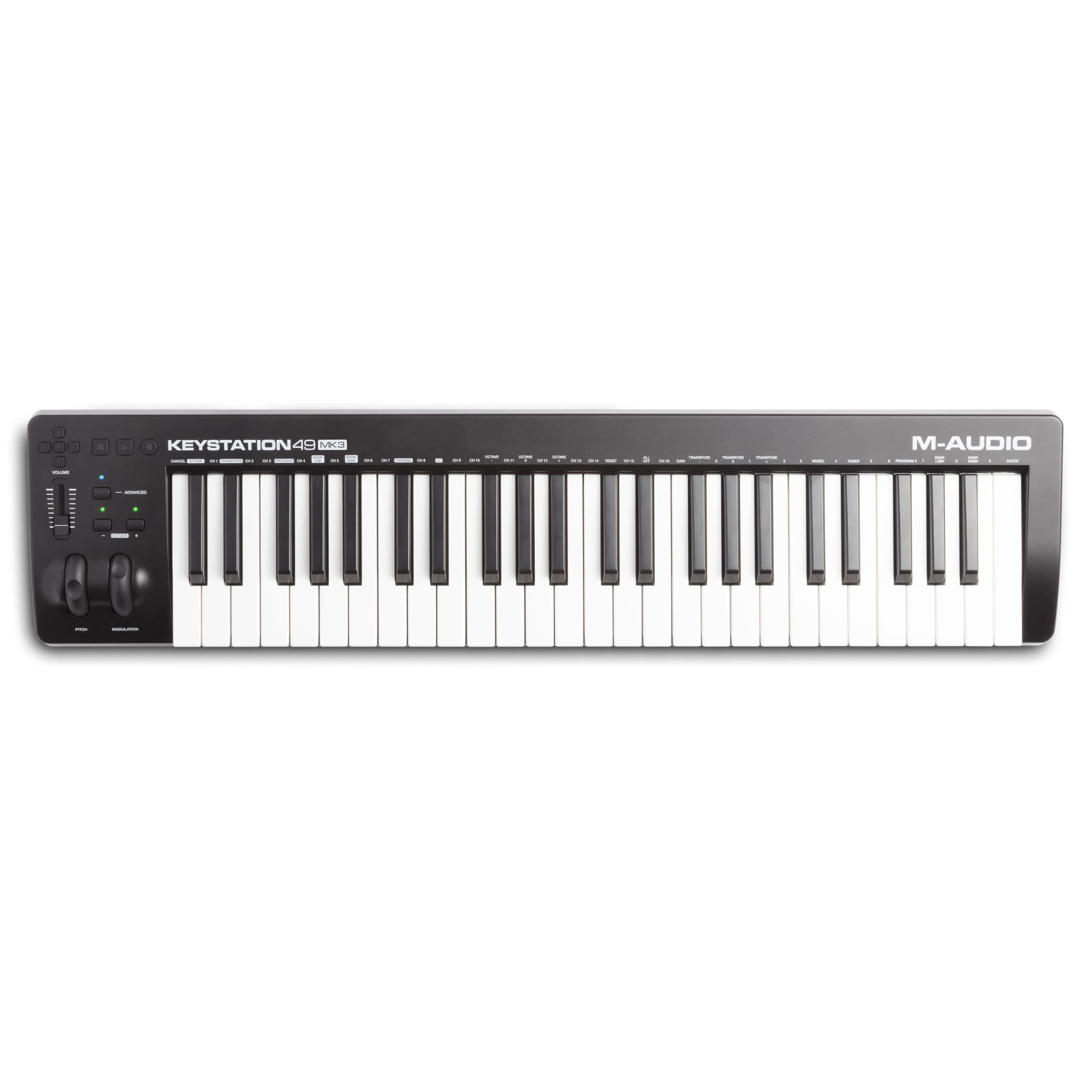
The Keystation 49 MK3 keeps things simple. It has 49 full-size velocity-sensitive synth-action keys, pitch and modulation wheels, a volume fader, octave buttons, and transport and directional buttons for controlling your recording software.
It runs on USB power and connects plug-and-play to a Mac or PC. With the Apple iPad Camera Connection Kit, sold separately, it also works with iOS. A 1/4-inch sustain pedal input is included. The software bundle has Ableton Live Lite, MPC Beats, AIR Music Tech instruments, Skoove, Melodics and Touch Loops.
Key highlights
- 49 full-size velocity-sensitive synth-action keys
- Pitch and modulation wheels
- Volume fader plus transport and directional buttons
- USB-powered, plug-and-play USB-MIDI
- 1/4-inch sustain pedal input
- Ableton Live Lite and MPC Beats included
Pros
- Full-size keys across four octaves
- Simple layout that is easy for first-time players
- Transport buttons cover basic recording control
- Useful starter software bundle
Cons
- No 5-pin MIDI output is listed, so it connects over USB only
- No pads or knobs are listed
- iOS use needs an adapter sold separately
Who it is for: Beginners and pianists learning to record who mainly need keys, wheels and transport control.
Skip if
You want pads for drums, knobs for synth control or a direct connection to hardware synths.
How to Choose
- Match the key count to how you play. 25 keys suit beats and one-handed lines, 37 and 49 keys allow two-handed parts, and 61 or 88 keys suit pianists and wider arrangements.
- Pick the right key action. Synth-action keys are light and quick, semi-weighted keys add some resistance, and hammer-action keys such as the KeyLab 88 mk3 and Roland A-88MKII aim to feel like a piano.
- Decide how much control you need. Pads help with drums and clip launching, faders help with mixing, and encoders or knobs help with plugin settings. The Keystation 49 MK3 has a single fader, while the Launchkey 49 MK4 and KeyLab Essential mk3 each list nine.
- Check DAW integration. Custom scripts map controls automatically. The FLkey 2 37 is built for FL Studio, while the Arturia and Novation Launchkey models list scripts for several DAWs.
- Look at the connections. A 5-pin MIDI out lets a controller play hardware synths, MIDI in matters for hardware rigs, and extra pedal inputs help if you use expression pedals.
FAQ
Do MIDI keyboards make sound on their own?
The controllers on this list send MIDI data to a computer, tablet or other instrument, which produces the sound. That is why most of them come with software instruments and a DAW.
How many keys do I need?
For beats and simple melodies, 25 or 37 keys are enough. If you play chords with one hand and bass with the other, 49 or 61 keys are more comfortable, and pianists usually want all 88.
What is polyphonic aftertouch on pads?
Aftertouch responds to pressure after a note is struck. Polyphonic aftertouch, as on the Launchkey 49 MK4 pads, reads that pressure separately for each pad instead of as one value for the whole surface.
Can I use a MIDI keyboard with an iPad?
Often, yes. Arturia lists iPad connection over USB-C for the MiniLab 37, Akai lists class-compliant smart device support for the MPK Mini IV, and M-Audio lists iOS use for the Keystation 49 MK3 with the Apple iPad Camera Connection Kit.
Do I need 5-pin MIDI?
Only if you want to control hardware synths or drum machines directly. USB is enough for software, but a 5-pin MIDI out, found on every pick here except the Keystation 49 MK3, adds that option.
Published November 12, 2026 Last updated November 12, 2026
Add Technobezz on Google:Preferred SourceGoogle Discover
More on keyboards
Buying guide
8 Best Wireless Gaming Keyboards in 2026

Buying guide
5 Best Wireless Keyboard and Mouse Combos 2026
Buying guide
Best Low Profile Mechanical Keyboards in 2026
Buying guide
7 Best Corsair Keyboards in 2026
More buying guides
Buying guide5 Best Laptops for Seniors in 2026Buying guide5 Best Earbuds for Calls in 2026Buying guide6 Best CD Players in 2026Buying guide8 Best Capture Cards in 2026Buying guide5 Best Studio Monitors in 2026Buying guide6 Best Cameras for Landscape Photography in 2026Buying guide6 Best DJ Controllers in 2026Buying guide6 Best PC Cases in 2026