An audio interface is the box that gets microphones, guitars and keyboards into a computer and sends clean sound back out to speakers and headphones. The right one depends on how many sources you record at once, whether you use MIDI gear, and whether the interface needs to travel.
Technobezz is supported by its audience. We may get a commission from retail offers.
5 Best Audio Interfaces in 2026
The Focusrite Scarlett 2i2 4th Gen leads our audio interface picks for home studios, with options from MOTU, Arturia, RME and an 8-preamp Scarlett for bands.
T
Technobezz
Editorial Team
Updated November 11, 2026Nov 11, 2026
•12 min read

Get Deals Like These in Your Inbox
The best prices, straight to your inbox.
Add Technobezz on Google:Preferred SourceGoogle Discover
The Focusrite Scarlett 2i2 4th Gen is the best overall pick. It pairs two mic preamps with 69dB of gain, a 120dB dynamic range rating, and Auto Gain and Clip Safe features that help set levels and avoid clipped takes. It suits solo musicians, podcasters and home producers who record one or two sources at a time.
The rest of this list covers more specific needs: on-unit metering and monitoring, MIDI and synth setups, a premium portable option with optical expansion, and an eight-preamp interface for recording bands and drum kits.
At a Glance
| Category | Product | Why We Picked It |
|---|---|---|
| Best overall | Focusrite Scarlett 2i2 4th Gen | Two preamps with 69dB gain, Auto Gain, Clip Safe and loopback |
| Best for on-unit metering | MOTU M2 | Color LCD level meters and a 2.5 ms round trip latency rating |
| Best for MIDI gear | Arturia MiniFuse 2 | 5-pin MIDI in and out, a USB-A hub and a 5-year warranty |
| Best premium portable | RME Babyface Pro FS | Bus-powered 24-channel interface with optical I/O and TotalMix FX |
| Best for recording bands | Focusrite Scarlett 18i20 4th Gen | Eight mic preamps, dual ADAT, MIDI and a talkback mic |
How we chose
We compared the specifications each maker publishes on its product page, including inputs, outputs, preamp gain, dynamic range, connections and power. We then checked that each pick is sold new on Amazon and matched each one to a specific kind of buyer.
The best Audio Interfaces right now
Focusrite Scarlett 2i2 4th Gen - Best overall
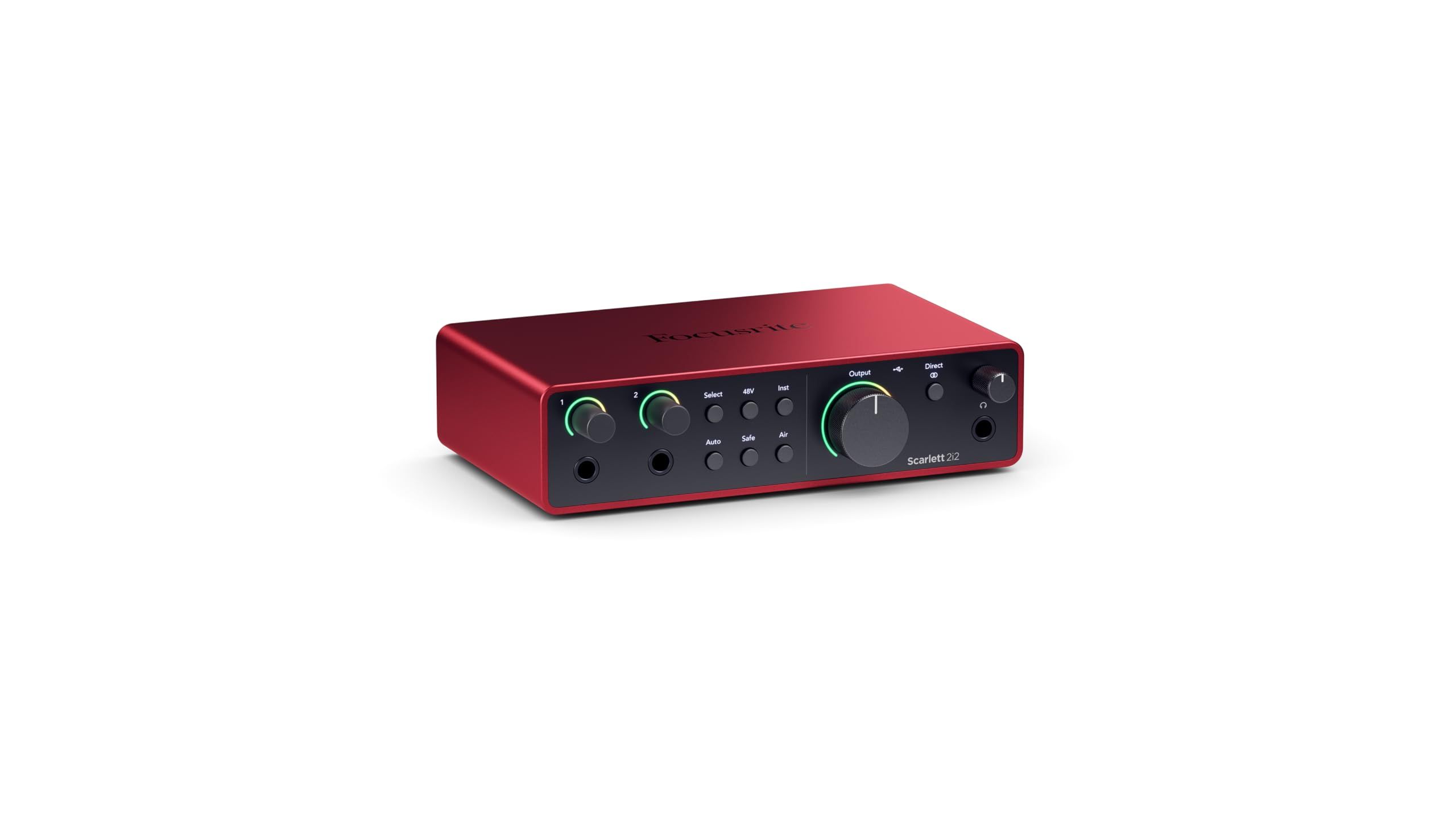
The Focusrite Scarlett 2i2 4th Gen is the most balanced choice here for a home studio or podcast desk that records one or two sources at a time. It has two mic preamps with a 69dB gain range, line and instrument inputs with 62dB of instrument gain, and a 120dB dynamic range rating at up to 24-bit/192kHz.
Auto Gain and Clip Safe are the features that set it apart for newer recordists. Focusrite says Auto Gain sets your levels, while Clip Safe adjusts gain automatically if a signal is in danger of clipping. Two Air modes, Presence and Harmonic Drive, lift the high end or the mid-range harmonics of a source. It is bus powered over USB-C and includes loopback, but no MIDI ports are listed.
Key highlights
- Two mic preamps with a 69dB gain range
- 62dB gain range on instrument inputs
- 120dB dynamic range
- 24-bit/192kHz
- Auto Gain and Clip Safe
- Air modes: Presence and Harmonic Drive
- USB-C, bus powered
- Loopback
- Pro Tools Intro+, Ableton Live Lite and Cubase LE included
Pros
- Auto Gain and Clip Safe help prevent clipped recordings
- Generous 69dB of mic gain for a two-input interface
- Loopback makes streaming and podcast setups simpler
- Supports Windows on Intel, AMD and Arm64, and Macs with Apple Silicon or Intel
Cons
- No MIDI ports listed in the specifications
- Only one headphone output
- Two mic inputs are not enough for multi-mic drum or band recording
- iPad support is not listed on the product page
Who it is for: Solo musicians, podcasters and home producers recording vocals, guitar or keys who want help setting safe levels.
Skip if
You need 5-pin MIDI for hardware synths, a second headphone output, or more than two mic inputs at once.
MOTU M2 - Best for on-unit metering
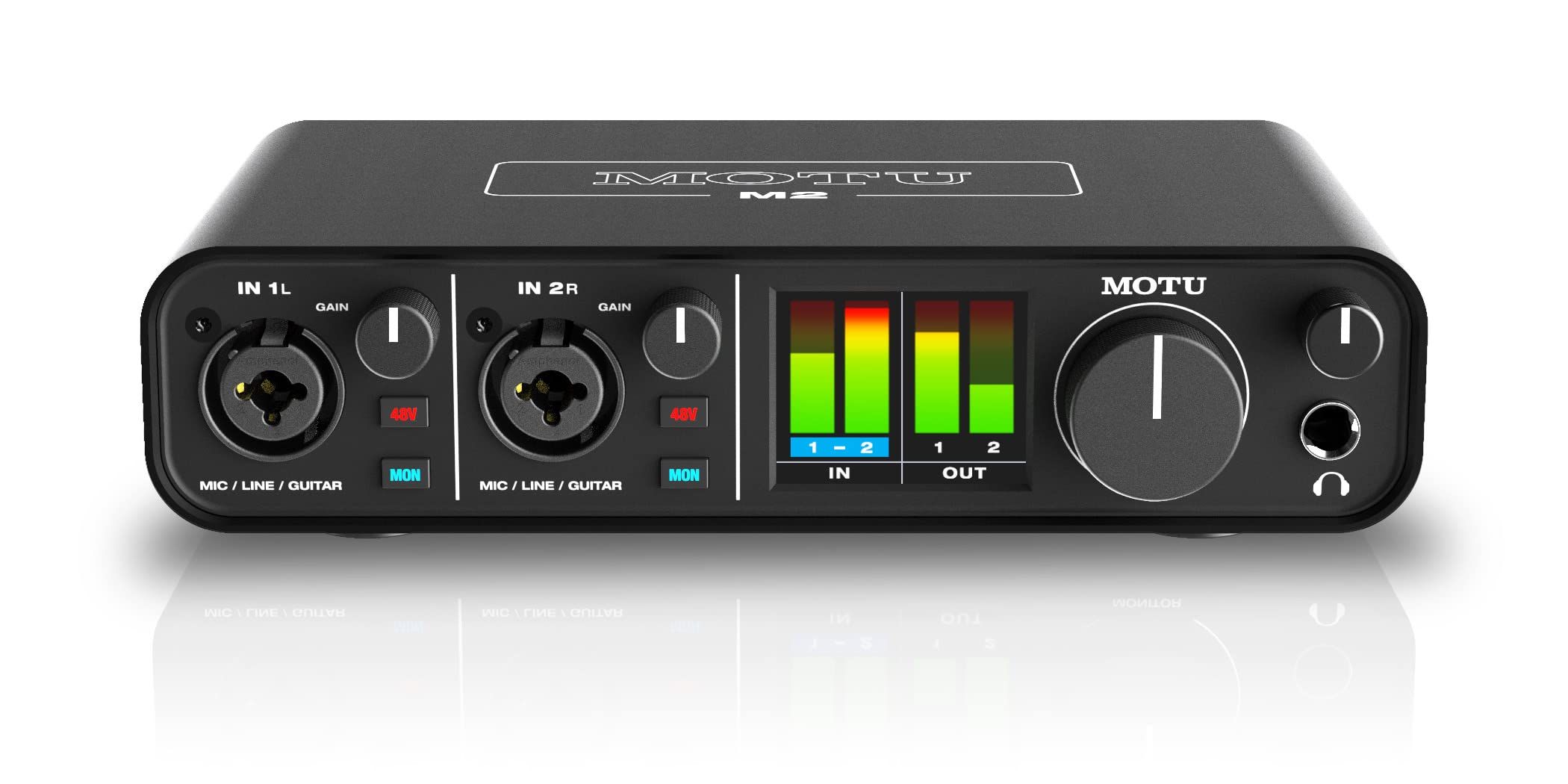
The MOTU M2 is aimed at recordists who want to see and hear their signal clearly. A full color LCD shows level meters for all inputs and outputs, and MOTU rates the main outputs at 120 dB dynamic range using ESS Sabre32 Ultra DAC technology. The mic inputs have a measured -129 dBu EIN.
MOTU quotes 2.5 ms round trip latency at 96 kHz with a 32 sample buffer, a figure that matters when you monitor through plug-ins in your software. There is also hardware direct monitoring with a MON button, MIDI in and out, loopback channels, mirrored RCA outputs alongside the balanced TRS pair, and independent 48V phantom power. It is bus powered over USB-C.
Key highlights
- Two mic/line/Hi-Z combo inputs
- Full color LCD level meters for all inputs and outputs
- 120 dB dynamic range on main outputs
- 2.5 ms round trip latency (at 96 kHz, 32 sample buffer)
- Balanced TRS outputs plus mirrored RCA outputs
- MIDI in/out
- Loopback channels
- Bus-powered USB-C
- MOTU Performer Lite and Ableton Live Lite 11 included
Pros
- On-unit metering for every input and output
- Low quoted round trip latency figure
- MIDI in and out built in
- RCA outputs make it easy to connect consumer speakers
Cons
- Only one headphone output
- The product page does not state a mic preamp gain range
- iOS use needs an adapter kit and a powered USB hub
- No automatic gain feature is listed
Who it is for: Home producers and streamers who want clear level meters on the box and fast monitoring through their software.
Skip if
You want automatic level setting or a clearly stated mic gain figure before you buy.
Arturia MiniFuse 2 - Best for MIDI gear
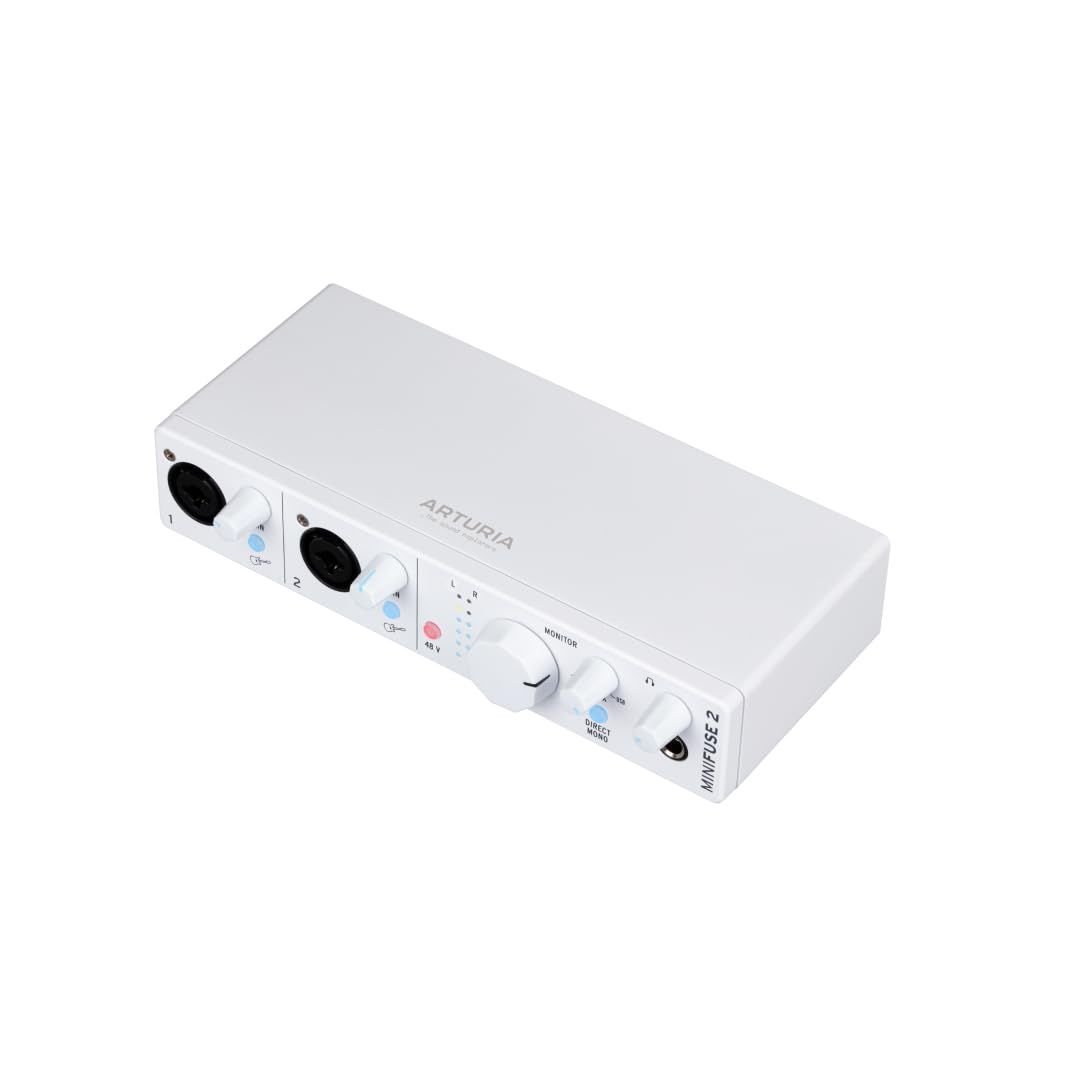
The Arturia MiniFuse 2 suits producers who work with keyboards and synths. Alongside two combo XLR and 1/4-inch inputs and two balanced TRS outputs, it has 5-pin MIDI in and out plus a USB-A hub (250mA max) for powering or connecting a small controller.
Arturia rates it at 110dB typical dynamic range (A-weighted) with -129dB typical equivalent input noise and sample rates up to 192kHz. It is bus powered over USB-C, has a stereo virtual loopback channel and a direct mono switch for monitoring, and comes with a 5-year hardware warranty. The bundle includes Ableton Live Lite, Analog Lab Intro, the Arturia FX suite and Native Instruments Guitar Rig. Arturia also sells a Champagne Edition finish, so check the color on the listing.
Key highlights
- Two combo XLR/1/4-inch inputs
- 5-pin MIDI in and out
- USB-A hub (250mA max)
- 56dB mic preamp gain range
- 110dB typical dynamic range (A-weighted)
- Up to 192kHz sample rate
- Stereo virtual loopback
- Bus-powered USB-C
- 5-year hardware warranty
Pros
- MIDI and a USB hub in one compact unit
- Rugged aluminium casing for travel
- Long 5-year hardware warranty
- Software bundle leans toward synth and guitar production
Cons
- 56dB mic gain range is the lowest in this list
- 110dB dynamic range rating is lower than the other picks here
- USB hub is limited to 250mA
- Only Mac and Windows are listed as supported
Who it is for: Producers with a MIDI keyboard or hardware synth who want audio, MIDI and a USB port in one portable box.
Skip if
You mostly record quiet sources with low-output microphones and want more preamp gain.
RME Babyface Pro FS - Best premium portable
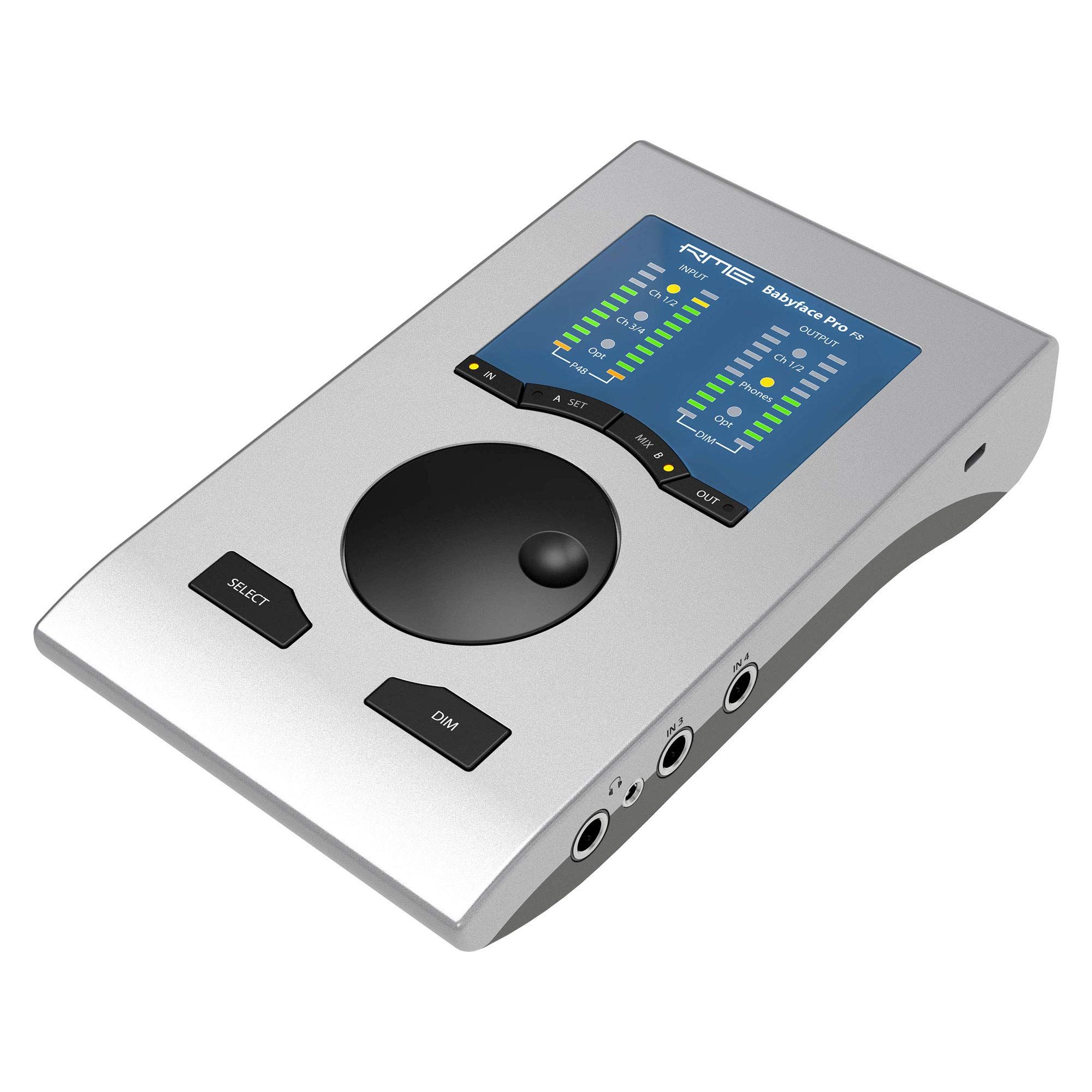
The RME Babyface Pro FS is a premium, bus-powered interface for engineers who want more than a basic two-input box on the road. RME lists it as a 24-channel, 192 kHz USB 2.0 interface with four analog inputs, four analog outputs (two line outputs plus parallel 6.3mm and 3.5mm headphone jacks on outputs 3/4), ADAT/SPDIF optical I/O and MIDI I/O.
Its two digitally controlled preamps run from -11 dB to +65 dB with individually switchable 48V phantom power. RME includes its SteadyClock FS circuit and the TotalMix FX mixer, which runs on an FPGA-based DSP with a 3-band parametric EQ. Line outputs are rated at 115 dB RMS unweighted (118 dBA) dynamic range, and there is a Class Compliant Mode. The 24-channel count includes the optical connection, so the analog count is four in and four out.
Key highlights
- 24 channels at up to 192 kHz over USB 2.0
- Four analog inputs and four analog outputs
- Two mic preamps, -11 dB to +65 dB gain
- ADAT/SPDIF optical I/O
- MIDI I/O
- Parallel 6.3mm and 3.5mm headphone jacks
- SteadyClock FS and TotalMix FX
- Class Compliant Mode
- USB bus power or external power supply
Pros
- Widest mic gain range in this list
- Two headphone jack sizes on a portable unit
- Optical I/O allows expansion with an external preamp
- TotalMix FX offers onboard DSP mixing and EQ
Cons
- Only two mic preamps
- RME says it is stable on most USB 2 ports, so some ports may need the external power supply
- No automatic gain feature is listed
- A premium choice for a two-preamp interface
Who it is for: Mobile engineers and experienced home recordists who want a compact interface with optical expansion, two headphone jack sizes and a DSP mixer.
Skip if
You need more than two mic preamps without adding external gear, or you want the simplest possible setup.
Focusrite Scarlett 18i20 4th Gen - Best for recording bands
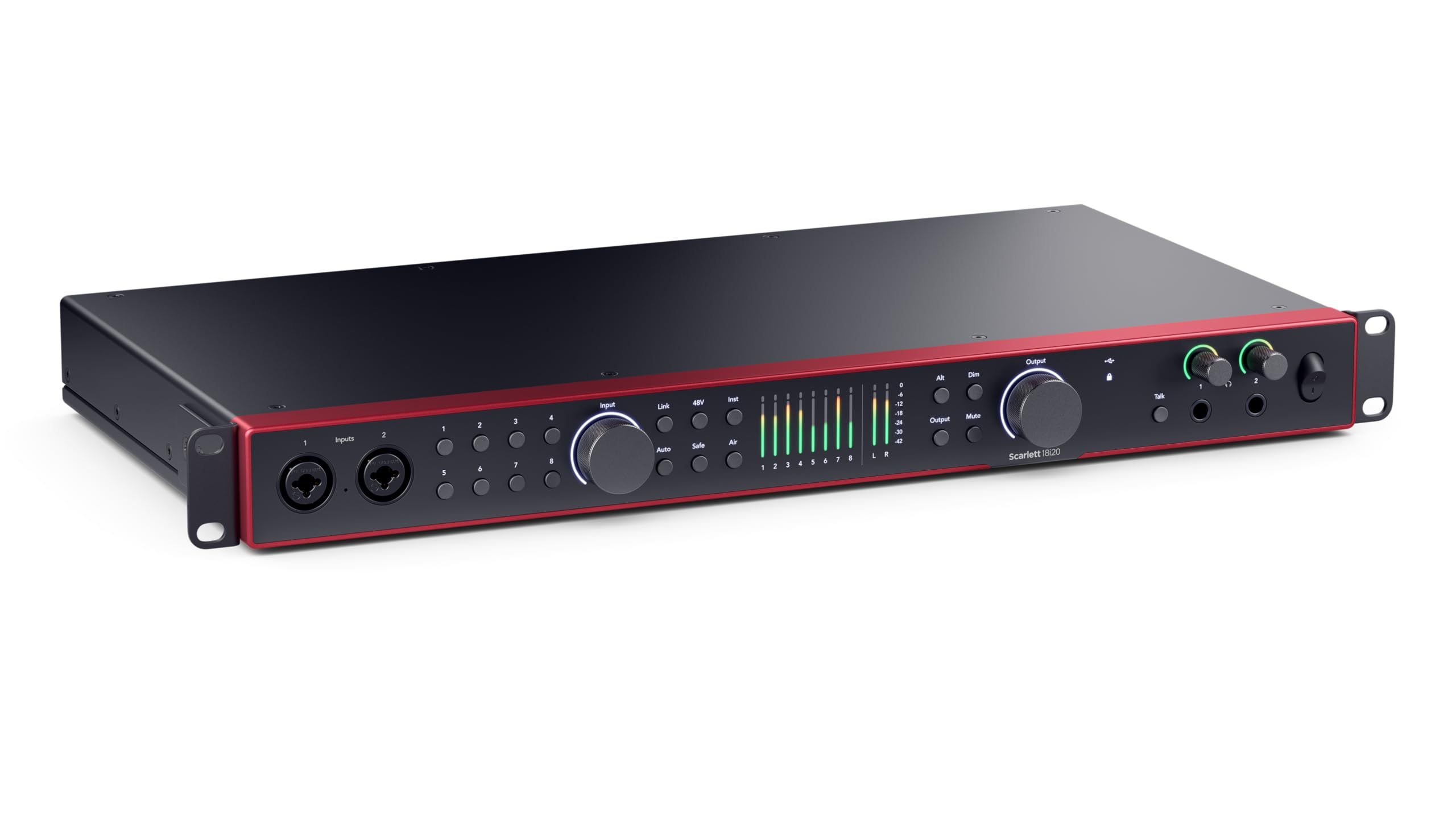
The Focusrite Scarlett 18i20 4th Gen is built for recording many sources at once. Focusrite lists 26 inputs and 26 outputs, eight mic preamps with a 69dB gain range and independent phantom power, and a 122dB D-A dynamic range rating at up to 192kHz.
Connections include dual ADAT in and out, S/PDIF, word clock and MIDI, plus a talkback mic and two independent headphone outputs. ADAT carries 16 channels at 44.1/48kHz but up to 8 at 96kHz, so the usable channel count depends on sample rate. It shares Auto Gain, Clip Safe and Air modes with the smaller Scarlett, fits a 1U rack space, and runs from an external 30W power supply rather than USB bus power.
Key highlights
- 26 inputs and 26 outputs (ADAT channels vary by sample rate)
- Eight mic preamps with a 69dB gain range
- 122dB D-A dynamic range
- Dual ADAT, S/PDIF, word clock and MIDI
- Built-in talkback mic
- Two independent headphone outputs
- Auto Gain, Clip Safe and Air modes
- 1U rack mountable
Pros
- Eight preamps cover drum kits and full band sessions
- Dual ADAT allows further expansion
- Talkback and two headphone outputs help in tracking sessions
- Highest dynamic range rating in this list
Cons
- Not bus powered; needs its external 30W power supply
- 1U rack size is less portable than the desktop picks
- ADAT channels drop from 16 to 8 at 96kHz
Who it is for: Bands, project studios and drummers who need eight mic inputs and room to expand through ADAT.
Skip if
You record alone, work on a laptop away from mains power, or only need one or two inputs.
How to Choose
- Count your inputs. Two inputs cover a vocal and a guitar or a two-person podcast. Recording a drum kit or a band at once calls for something like the eight-preamp Scarlett 18i20.
- Check the mic gain. Gain range varies a lot, from 56dB on the MiniFuse 2 to 69dB on the Scarlett models and 76dB on the Babyface Pro FS. More gain helps with quiet sources and low-output microphones.
- Decide whether you need MIDI. The MOTU M2, Arturia MiniFuse 2, RME Babyface Pro FS and Scarlett 18i20 list MIDI connections. The Scarlett 2i2 does not.
- Think about power and portability. Bus-powered interfaces run from a laptop's USB port. The Scarlett 18i20 needs its external power supply, and RME notes the Babyface Pro FS is stable on most, not all, USB 2 ports.
- Look at monitoring and loopback. Two headphone outputs help when two people record together, and loopback is useful for streaming and podcasts where computer audio needs to be captured.
FAQ
Do I need an audio interface for a USB microphone?
No. A USB microphone has its own converter built in. An audio interface is for XLR microphones, guitars, keyboards and other analog sources, and for driving studio monitors and headphones.
How many inputs do I need?
Count the sources you want to record at the same moment. A singer-songwriter or podcaster with one guest can work with two inputs, while a drum kit or live band usually needs eight or more.
What does loopback do?
Loopback sends audio playing on your computer back into your recording or streaming software, so you can capture a call, game or music track along with your microphone. The Scarlett 2i2, MOTU M2 and MiniFuse 2 all list it.
What sample rate should I record at?
Many people record at 44.1kHz or 48kHz, and every pick here supports rates up to 192kHz. On the Scarlett 18i20, ADAT channels drop from 16 to 8 at 96kHz, so higher rates reduce the usable channel count.
What is ADAT used for?
ADAT is an optical connection that carries several digital audio channels. It lets you add an external preamp unit for more mic inputs, which is how the Babyface Pro FS and Scarlett 18i20 reach their higher channel counts.
Published November 11, 2026 Last updated November 11, 2026
Add Technobezz on Google:Preferred SourceGoogle Discover
More buying guides
Buying guide
6 Best CPU Coolers in 2026
Buying guide
5 Best Bass Earbuds in 2026
Buying guide
7 Best Nintendo Switch 2 Controllers in 2026
Buying guide
6 Best OLED Monitors in 2026
Buying guide5 Best Walkie Talkies in 2026Buying guide6 Best Open-Back Headphones in 2026Buying guide5 Best On-Ear Headphones in 2026Buying guide8 Best Wireless Gaming Keyboards in 2026Buying guide6 Best Gaming Mouse Pads in 2026Buying guide5 Best Phones for Kids in 2026Buying guide5 Best Emergency Radios in 2026Buying guide6 Best Short Throw Projectors in 2026