Fixed wireless internet is home broadband where the last-mile connection to a fixed location is wireless. That is how the FCC describes it in its broadband reporting. 5G home internet from T-Mobile, Verizon and AT&T is one kind of fixed wireless, because the FCC's licensed fixed wireless category includes service over 4G LTE or 5G mobile networks when it is sold as a fixed solution.
How fixed wireless works
The FCC lists fixed wireless as its own technology next to copper, coaxial cable, fiber to the premises and satellite. It splits terrestrial fixed wireless into three types by spectrum: unlicensed, licensed and licensed by rule.
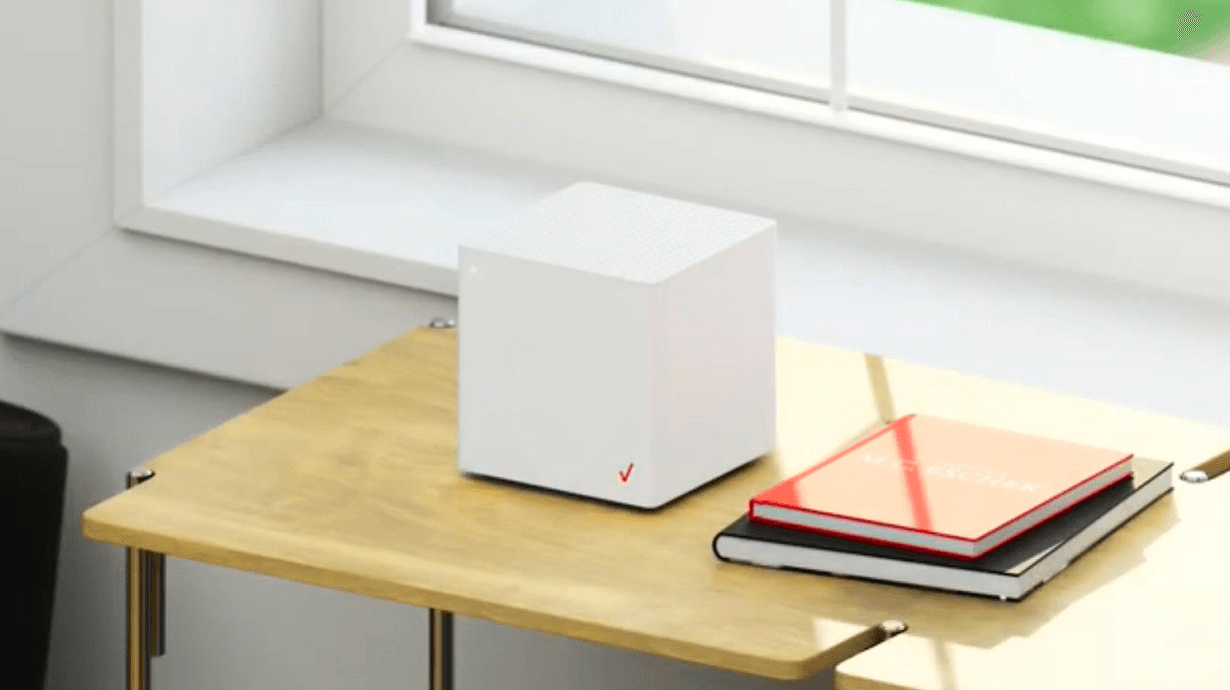
At home, a gateway does the work. T-Mobile says its gateway converts the nearest 5G signal into Wi-Fi, combining modem and router functions in one box. Verizon says it supplies equipment suited to local coverage and describes an included Internet Gateway router and Ultra Wideband receiver. AT&T Internet Air includes the All-Fi Hub, with $0 self-setup using Smart Home Manager.
The cellular signal behind the service varies. AT&T says Internet Air can use 5G or LTE depending on location, can use C-band spectrum, and is not a millimeter wave product. Verizon publishes separate speed ranges for mid-band and for high-band 5G Ultra Wideband. See 5G vs LTE and What Is 5G UW on Verizon?
What 5G home internet costs
These are the carriers' regular monthly prices as of November 2026. AT&T says pricing and offers can depend on the address.
- T-Mobile: Rely lists at $60, Amplified at $70 and All-In at $80 before discounts. Eligible AutoPay with a bank account or debit card brings those to $50, $60 and $70, plus taxes and fees. Plan terms list a $35 device connection charge at sale and require credit approval.
- Verizon: 5G Home is $60, 5G Home Plus is $70 and 5G Home Ultimate is $85. Verizon says its plan prices include taxes and fees. Auto Pay with paper-free billing takes $10 a month off when paid from a bank account or Verizon Visa Card, and qualifying Verizon mobile service takes off another $15.
- AT&T Internet Air: the residential broadband label lists $65 a month before discounts and government taxes. AT&T advertises service starting at $55 a month plus taxes and fees with AutoPay and paperless billing, and says an AT&T mobile plan is not required.
All three carriers say there is no annual contract. T-Mobile says there is no monthly equipment fee, and Verizon says there is no separate router rental charge.
How fast it is
The carriers publish typical speed ranges, not one fixed number. For scale, the FCC's 2026 Section 706 Report keeps 100 Mbps download and 20 Mbps upload as its benchmark for fixed broadband. As of November 2026 the carrier ranges are:
- T-Mobile: the broadband labels give typical downloads of 133 to 354 Mbps on Rely and 170 to 498 Mbps on Amplified and All-In, with uploads of 12 to 55 Mbps. The FAQ on the same page gives Rely downloads of 170 to 354 Mbps.
- Verizon mid-band: typical downloads of 25 to 85 Mbps on 5G Home, 50 to 100 Mbps on Plus and 85 to 250 Mbps on Ultimate, with uploads from 5 to 20 Mbps depending on the plan.
- Verizon high-band: typical downloads of 85 to 300 Mbps on 5G Home, 200 to 500 Mbps on Plus and 300 to 1,000 Mbps on Ultimate.
- AT&T Internet Air: the plans page states typical downloads of 90 to 300 Mbps and uploads of 8 to 30 Mbps in select areas. The broadband label lists 89 to 346 Mbps down and latency of 40 to 69 ms.
Speeds can drop when the network is busy. T-Mobile says home internet customers can see lower speeds than other T-Mobile customers during congestion, with a further reduction after 1.2 TB of use in a month. AT&T says it may temporarily slow service when the network is busy. Verizon says speeds depend on address, equipment, network connection and cellular conditions.
Availability depends on your address
Cell coverage in your area does not mean your home qualifies. T-Mobile says availability can vary by address, even on the same street, and depends on network capacity, signal strength and building materials. AT&T says not every home in a covered area qualifies. Each carrier checks the exact service address before it takes an order.
The FCC National Broadband Map offers a second check. Searching an address shows the providers reporting service there, the technologies and the maximum advertised speeds. Fixed wireless appears on the fixed map.
The FCC's guide to the map notes that the mobile map shows outdoor or in-vehicle coverage, not indoor coverage. The data is reported by providers twice a year.
Who it fits
If you want home internet without an annual contract, fixed wireless from these carriers fits, since all three state there is no annual contract. Verizon's terms for a promotional service credit say the credit can be recovered if service is canceled within 12 months. If your household uses a lot of data, read the congestion terms first, because T-Mobile and AT&T both describe slower speeds at busy times. If a wired line also reaches your home, see What Is Fiber Internet? and What Is DSL Internet?