DuckDuckGo says it does not save or share your search history. Google's privacy policy lists the terms you search for among the information it collects, stored with your Google Account when you are signed in and with identifiers tied to your browser, app or device when you are not.
DuckDuckGo vs Google at a glance
- Search history: DuckDuckGo says it does not save or share it. Google can save it to your account, and you choose how long it stays.
- Ads: DuckDuckGo says its search ads depend on the results page you are viewing. Google says its personalized ads may use your interests and activity, depending on your settings.
- Results: DuckDuckGo says its traditional links and images largely come from Bing. Google says it retrieves results from its own Search index.
- AI answers: DuckDuckGo says all of its AI features can be turned off or reduced. Google says AI Overviews cannot be turned off.
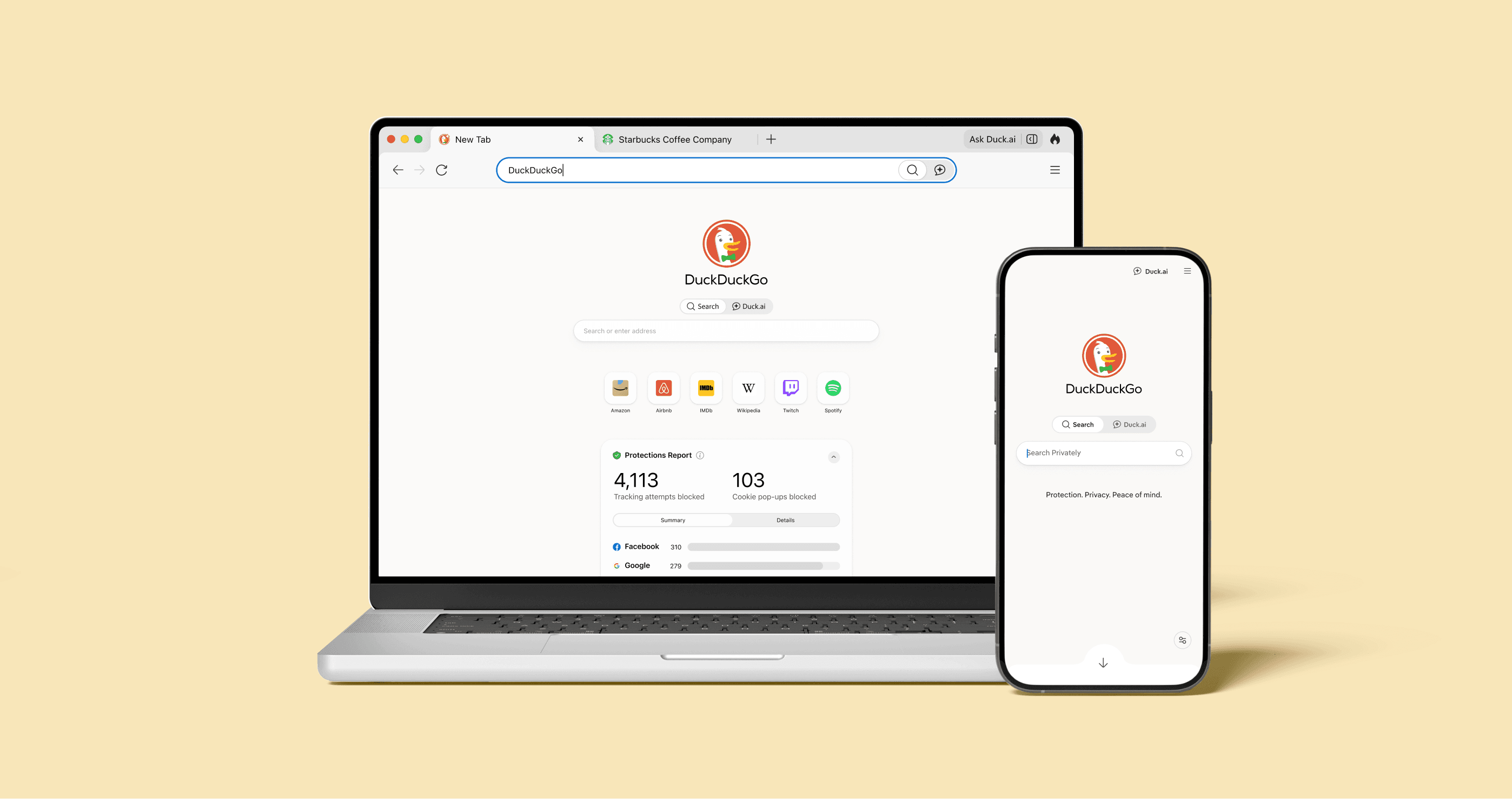
- Browsers: DuckDuckGo offers its own browser for Mac, Windows, iOS and Android. Google offers Chrome for Windows, Mac, Linux, Android and iOS.
- Price: As of November 2026, DuckDuckGo lists its search, browser extensions and browser as free, and Google says Chrome is available at no charge.
What each one keeps about your searches
DuckDuckGo's privacy policy, dated June 3, 2026, says it does keep anonymous search queries, disconnected from unique identifiers such as IP addresses, to improve its search indexes. Your device still sends details such as IP address, browser type and language. DuckDuckGo says it uses these only temporarily for delivery and security, without saving IP addresses alongside searches.
Google's privacy policy, dated October 16, 2026, lists search terms, interactions with content and ads, IP addresses, browser and device information, and the time of requests among what it collects. Google also says sites and apps that use its advertising or analytics services share information with it regardless of browser or browsing mode, including Incognito mode in Chrome.
Google's help page says signed-in Search Services History can contain searches, information from sites visited through Search, generative AI responses and general location, and that you can set how long it is kept or delete it. Google says this setting is rolling out gradually. Where it has not appeared yet, Web & App Activity still controls search history and personalized recommendations.
How the ads differ
DuckDuckGo says most of its revenue comes from private search ads, which are based on the results page you are viewing instead of a profile built from your search, browsing or purchase history. For ads provided by Microsoft, a page written jointly by the two companies says Microsoft Advertising uses the full IP address and user-agent string to process ad clicks, and that those clicks are not associated with user profiles.
Google's My Ad Center lets you turn personalized ads on or off and ask for more or fewer ads about certain topics and brands. With personalization off, Google says ads rely on general factors such as the time and the content you are viewing.
Where the results come from
Beyond Bing, DuckDuckGo says it runs its own crawler, DuckDuckBot, and draws Instant Answers from sources that include Sportradar and Wikipedia. Requests to partners are proxied through DuckDuckGo's servers, and the company says no unique identifiers, such as your IP address, are passed along. Google says most of its Search index is built by crawlers that visit publicly accessible webpages and follow links.
AI answers on each
DuckDuckGo describes Search Assist as brief AI-generated answers that link to one or two sources and sit beside traditional results. You can set it to often, sometimes, on-demand or never, and sometimes is the default. DuckDuckGo says Duck.ai, which gives access to chatbots, does not record or store chats by default. Searches started at noai.duckduckgo.com have all AI features turned off.
Google describes AI Overviews as AI-generated snapshots with key information and links. Choosing the Web filter after a search shows text-based links without them. AI Mode gives AI responses, follow-up questions and web links. Google's own documentation says AI responses may include mistakes.
Google says saved Search Services History helps train its generative AI models, with the data disconnected from your account first. With the setting off, Google says future activity is not used for that training unless you provide feedback.
Which one fits
If you want searches that are not saved to a history, DuckDuckGo fits, because its policy says it does not save or share them. The company also says other websites' privacy policies apply once you follow a link. For more, see Is DuckDuckGo Safe?
If you want answers that draw on your own past activity, Google fits, because AI Mode can reference your Search Services History when you are 18 or older and have history and personalized recommendations turned on. If you stay with Google and want less saved to your account, one control Google documents is Search Services History, where you set how long history is kept or delete it. The personalized ads switch in My Ad Center is a separate control. Google says turning it off changes how ads are chosen.