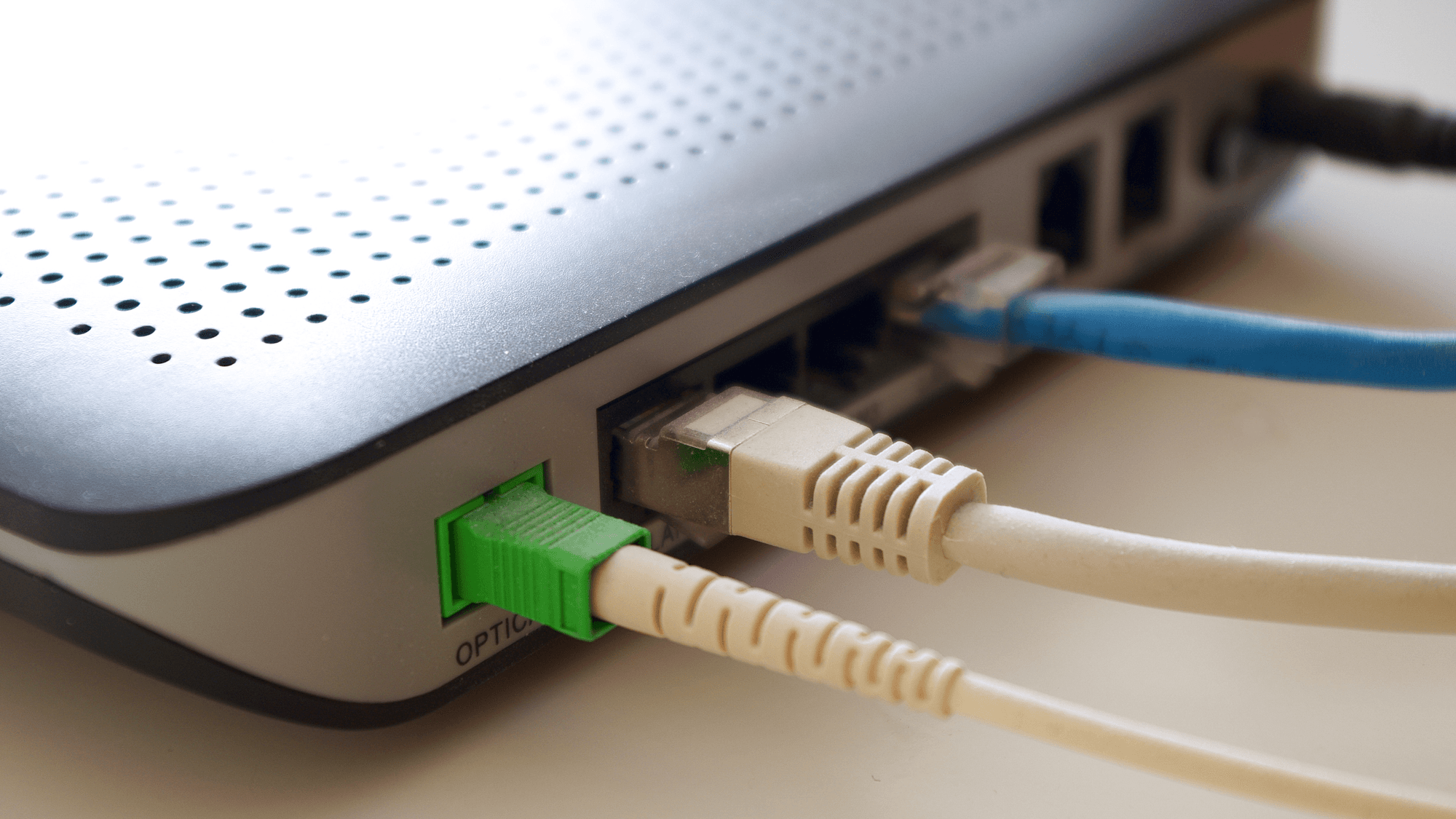
Fiber internet sends data as pulses of light through thin strands of glass or plastic instead of electrical signals over copper. With fiber to the home, the line runs straight to your house, and a small box converts the light into a signal your router can use. AT&T, Verizon and Google Fiber advertise most of their fiber plans with the same speed for uploads as for downloads.
How fiber internet works
An FCC technical report describes fiber-optic communication as sending information by means of light energy through small strands of glass. Verizon puts it in consumer terms: a fiber-optic cable carries laser-generated pulses of light, and the strands can be glass or plastic.
One common term is FTTH, short for fiber to the home. Verizon's telecom glossary defines it as a setup where each home has a direct fiber connection, rather than fiber that stops somewhere down the street.
At your home, the fiber ends at an ONT, or Optical Network Terminal, which AT&T says can be installed inside or outside. AT&T explains that the ONT changes fiber light waves back into electrical signals and passes them over an Ethernet cable to the Wi-Fi gateway.
What fiber plans offer and cost
AT&T says all of its fiber speed tiers are symmetrical, with expected speeds of 300, 500, 1,000, 2,000 and 5,000 Mbps in both directions. Google Fiber advertises matching speeds on every current plan, and Verizon does on most of its Fios tiers. Monthly regular prices as of November 2026:
- AT&T Fiber: the plans page lists Internet 300 at $60, Internet 500 at $75, Internet 1000 at $90 and Internet 5000 at $135, next to 12-month sale prices. A separate Broadband Facts label for Internet 300 shows $65 as a monthly price that is not introductory, so check the label for your address. AT&T notes the 5 GIG plan tops out at 4.7 Gbps on a single wired device.
- Verizon Fios: 300 Mbps at $40, 500 Mbps at $75, 1 Gig at $90, 2 Gig at $100 and 5 Gig at $110 before Auto Pay, with taxes and fees included, Verizon says. Auto Pay plus paper-free billing takes $10 off each plan.
- Google Fiber: Core 1 Gig at $70, Home 3 Gig at $100 and Edge 8 Gig at $150, each advertised at the same speed up and down.
The fine print varies by tier. Verizon lists Fios 1 Gig at up to 940 Mbps down and 880 Mbps up, and gives its 2 Gig and 5 Gig plans average wired ranges of 1.5 to 2.3 Gbps and 4.5 to 5.3 Gbps. Google Fiber says its earlier 1 Gig, 2 Gig, 5 Gig and 8 Gig plans are previous plans that existing customers may still have.
Cable vs fiber internet
Cable internet also uses fiber, just not all the way to you. CableLabs, the cable industry's research group, describes cable broadband as a hybrid of optical fiber and coaxial cable. Xfinity says its service is powered by fiber and connected to the premises by coaxial cable.
Cable runs on DOCSIS, the Data Over Cable Service Interface Specification. CableLabs lists DOCSIS 3.1 at 10 Gbps of downstream capacity and 1 to 2 Gbps upstream. Those are limits of the technology, not plan speeds, and upstream capacity is a fraction of downstream.
DOCSIS 4.0 raises the upstream side. CableLabs says DOCSIS 4.0 reaches up to 10 Gbps downstream and 6 Gbps upstream, enabling symmetrical multi-gigabit service over hybrid fiber-coax lines. Xfinity says DOCSIS 4.0 brings symmetrical multi-gigabit speeds over existing coax without running new fiber to every home. For now, Comcast discloses Xfinity download tiers from up to 50 Mbps to 10 Gbps, and upload tiers from up to 10 Mbps to 2 Gbps.
How to check if fiber reaches your address
The FCC National Broadband Map shows internet availability as reported by providers. Enter your address and it lists the providers reporting service there, the connection technology each uses and the maximum advertised download and upload speeds.
The map's Service Filters can narrow results to fiber and to chosen speed levels, and a sidebar dropdown changes the date the data is as of. If a listing looks wrong, the map has an Availability Challenge link for disputing it.
What to weigh before you switch
If you upload a lot, such as video calls, cloud backups or large files, compare upload speeds, since fiber plans often advertise uploads that match downloads. AT&T, Verizon and Google Fiber advertise uploads at or near download speeds, while Xfinity's cable upload tiers top out at 2 Gbps against downloads of up to 10 Gbps. If only cable reaches your home, ask whether your area has DOCSIS 4.0, which CableLabs and Xfinity say supports symmetrical multi-gigabit speeds.
Compare the regular price, not the sale price. AT&T shows sale prices next to its list prices, and Verizon's lowest numbers assume Auto Pay and paper-free billing.