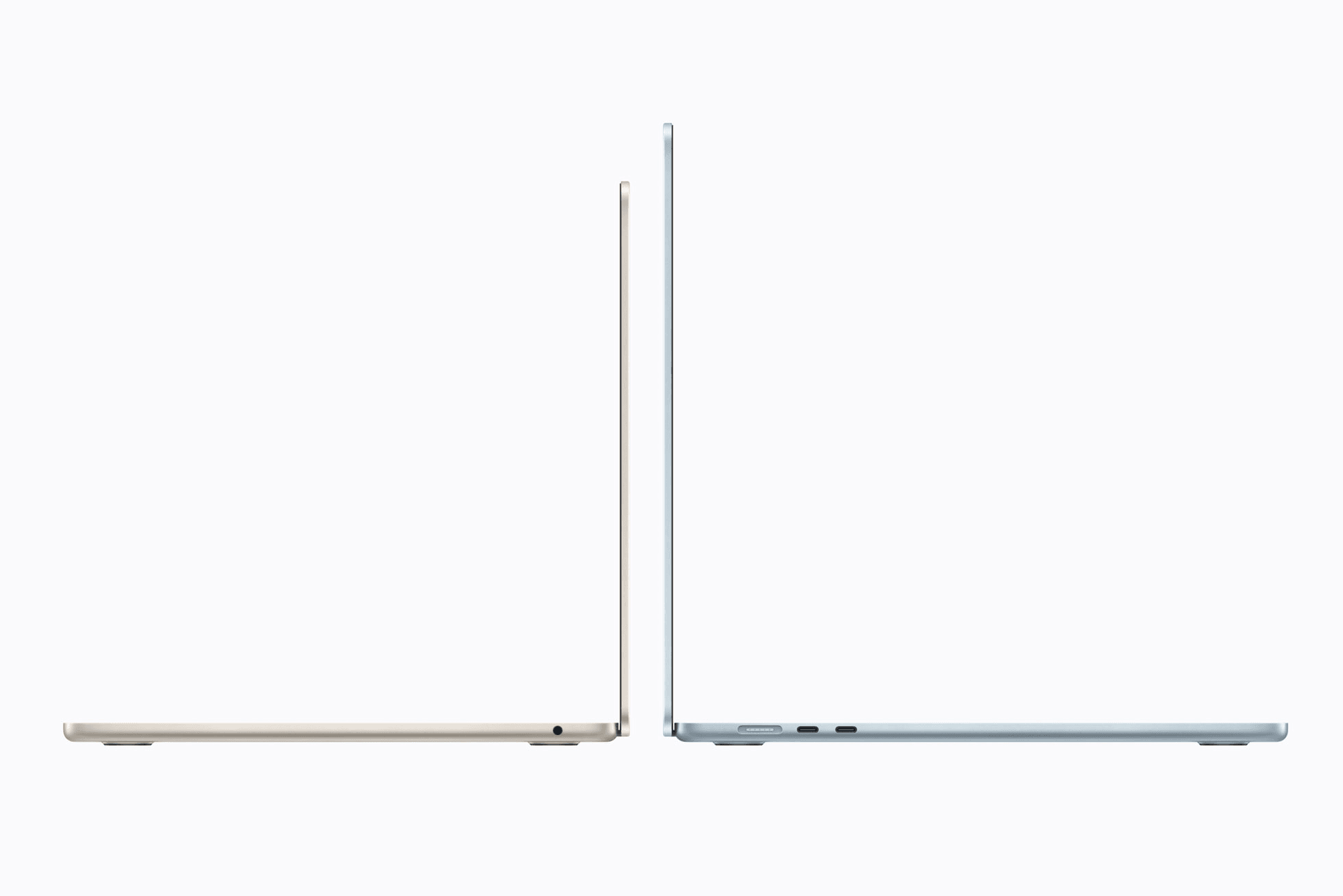
As of November 2026, Apple's MacBook Air range is two laptops, the 13-inch M5 and the 15-inch M5. Apple's listings for the two differ in screen size, weight, speakers, the entry graphics configuration and $200 in starting list price. Apple lists the same battery ratings, ports, colors and memory and storage ceilings for both.
What each one costs
As of November 2026, Apple's US online store lists the 13-inch M5 MacBook Air from $1,299 and the 15-inch from $1,499. Both of those entry configurations come with 16GB of memory and a 512GB SSD.
These are Apple's regular list prices, not sale prices. The gap between the two sizes at the entry level is $200.
MacBook Air 13 vs 15 at a glance
- Display: 13.6-inch Liquid Retina on the smaller model, 15.3-inch Liquid Retina on the larger one.
- Resolution: 2560 x 1664 pixels on the 13-inch, 2880 x 1864 pixels on the 15-inch, both at 224 pixels per inch.
- Brightness: 500 nits on both.
- Weight: 2.7 pounds (1.23 kg) for the 13-inch, 3.3 pounds (1.51 kg) for the 15-inch.
- Speakers: four speakers on the 13-inch, six speakers with force-cancelling woofers on the 15-inch.
- Chip: Apple M5 with a 10-core CPU in both. The entry 13-inch has an 8-core GPU, configurable to 10 cores, and the 15-inch is listed with a 10-core GPU.
- Battery: Apple rates both at up to 18 hours of video streaming or 15 hours of wireless web use.
Screen and speakers
The 15-inch model has a 15.3-inch panel with a native resolution of 2880 x 1864 pixels, against 13.6 inches and 2560 x 1664 pixels on the smaller model. Both screens are specified at 224 pixels per inch and 500 nits, so the larger model gives you a bigger canvas at the same pixel density and the same rated brightness.
Apple measures both diagonals as a standard rectangle. The actual viewable area is smaller on each, and on the 13-inch Apple ties that to the rounded upper corners.
The speaker systems also differ. Apple lists a four-speaker sound system on the 13-inch and a six-speaker sound system with force-cancelling woofers on the 15-inch.
Weight and battery
Apple lists the 13-inch at 2.7 pounds and the 15-inch at 3.3 pounds, a difference of 0.6 pounds. Apple notes that weight varies by configuration and manufacturing process.
The larger body does not come with a longer battery rating. Apple rates both sizes at up to 18 hours of video streaming or up to 15 hours of wireless web use, and says battery life varies by use and configuration.
What stays the same
Both sizes use the Apple M5 chip with a 10-core CPU, which Apple describes as four super cores and six efficiency cores on the 13-inch spec page. Apple's listings do differ on graphics. The entry 13-inch has an 8-core GPU that can be configured to 10 cores.
The ports match. Each model has two Thunderbolt 4 USB-C ports that support charging, DisplayPort, Thunderbolt 4 at up to 40Gb/s and USB 4 at up to 40Gb/s, plus one MagSafe 3 charging port and a 3.5 mm headphone jack.
Both can be configured with up to 32GB of unified memory and up to 4TB of SSD storage. Both come in Sky Blue, Silver, Starlight and Midnight. Apple's tech specs pages for the 13-inch and the 15-inch carry the full lists.
Which one fits
If you want the lighter and lower-priced size, the 13-inch fits because Apple lists it 0.6 pounds lighter and at $200 less, with the same battery ratings and ports. If the money matters more than the screen, Apple lists the 13-inch with a 10-core GPU option and the same 32GB and 4TB ceilings as the 15-inch.
If you want the larger display, the 15-inch fits because Apple lists a 15.3-inch display with more pixels and the six-speaker system, and Apple's battery ratings are the same for both sizes. If you want the 10-core GPU either way, note that Apple lists it on the 15-inch as sold and as an upgrade on the entry 13-inch. See also MacBook Air vs MacBook Pro and MacBook Neo vs MacBook Air.