
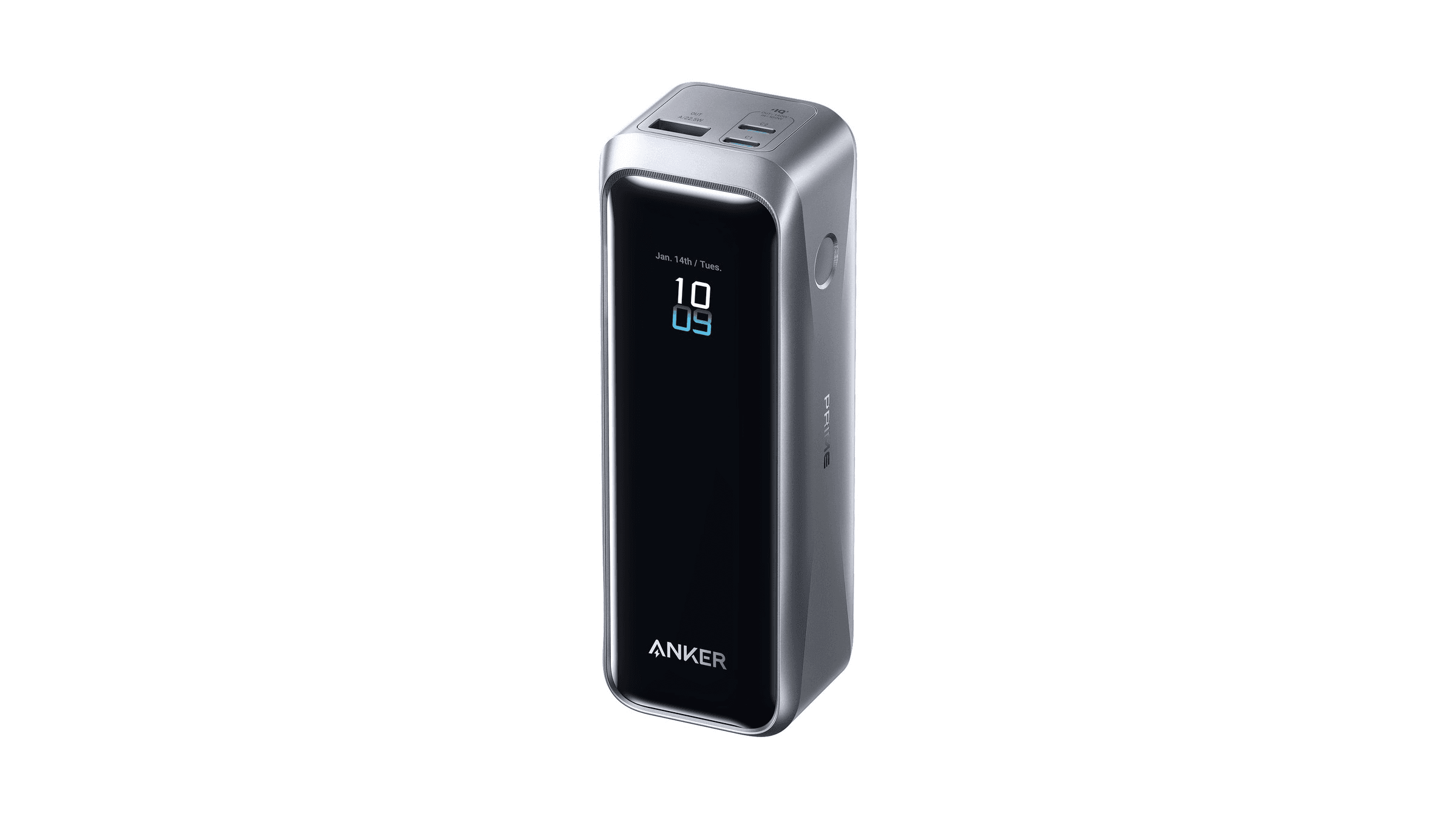
A power bank is a portable battery that stores electrical energy so you can charge a phone, tablet, earbuds or laptop away from an outlet. That is how Belkin defines it, and Anker describes its own models as portable battery packs with rechargeable batteries and output ports. Devices connect by cable or, on wireless models, by sitting on a compatible charging surface.
The shapes a power bank takes
Mophie describes its Signature Series Powerstation Plus 10K as a portable battery with two integrated cables and an additional USB-C charging port. Anker calls its 733 Power Bank a 10,000mAh hybrid that works as both a wall charger and a portable battery.
Apple's original MagSafe Battery Pack attaches magnetically to compatible iPhone 12, 13 and 14 models and charges them wirelessly, and Apple says charging starts automatically.
mAh, Wh and why you get less than the label
Anker explains that mAh measures charge capacity, while Wh measures energy. To convert, divide mAh by 1,000 and multiply by the cell's nominal voltage. Belkin's FAQ gives these equivalents for 3.7V cells:
- 5,000 mAh: 18.5 Wh
- 10,000 mAh: 37 Wh
- 20,000 mAh: 74 Wh
- 25,000 mAh: 92.5 Wh
A phone does not receive all of that. Anker says boosting the cell voltage up to USB output voltage loses energy. In its worked example, a 74 Wh bank at 82% conversion efficiency delivers 60.7 Wh, or about 12,140 mAh at 5V. The figures are Anker's worked example, not a rating for every product.
The receiving device loses energy too. Anker puts the charging efficiency of a phone or laptop at roughly 80% to 90%, because of its internal power management circuits. Belkin adds that wired charging is generally more efficient than wireless, since power goes directly through the cable.
Apple publishes additional charge figures for its original MagSafe Battery Pack. Apple says the pack provides up to 70% additional charge on an iPhone 12 mini or 13 mini and up to 40% on specified larger models, and that actual results will vary.
USB-C, Power Delivery and Qi2
Capacity and charging power are separate specifications. Mophie's Powerstation Plus 10K, for example, lists 10,000 mAh of capacity and up to 30W through its USB-C cables and port.
A USB-C port alone does not mean a power bank supports USB Power Delivery, which the USB-IF describes as an optional capability. With PD, devices negotiate for the power they need, and the direction of power can change depending on which product is supplying it.
For wireless models, the Wireless Power Consortium says the original Qi2 brought 15W charging and magnetic attachment that aligns device and charger to improve efficiency. On July 23, 2025, it announced Qi v2.2.1, branded Qi2 25W. Only certified products can display the Qi or Qi2 logo.
Flying with a power bank
The FAA treats power banks as spare lithium batteries. Its PackSafe page, dated August 11, 2026, says they go in carry-on baggage only, never in checked bags. If a carry-on is checked at the gate or planeside, the power bank must come out and stay in the cabin.
The ordinary limit is 100 Wh per battery. With airline approval, a passenger can bring up to two larger spares of 101 to 160 Wh. A power bank above 160 Wh is forbidden on passenger aircraft, according to the FAA's passenger battery FAQ. The FAA also notes that airlines may set stricter quantity and Wh limits, including on the number of power banks. See Can You Take a Power Bank on a Plane?
Recalls on the CPSC's pages
The Consumer Product Safety Commission has posted several power bank recalls. These are examples from its recall pages, not a complete list.
A June 12, 2025 notice covers about 1,158,000 Anker PowerCore 10000 power banks, model A1263, for fire and burn hazards. It applies only to units sold in the US with qualifying serial numbers. A November 13, 2025 Belkin recall of about 83,500 charging stands and power banks includes model BPB002, with 14 character serial numbers beginning 35S, and all PB0003 units.
On April 16, 2026, the CPSC reannounced the recall of about 429,200 Casely Power Pods 5,000mAh wireless power banks, model E33A. It reported 28 additional incidents, including one fatality and one serious incident on an airplane. Each of these notices tells owners to stop using the product. The Casely notice adds that recalled lithium-ion batteries must not go into household trash, general recycling or retail battery recycling boxes.
What to check before you buy
If you fly often, look for the Wh figure and keep it at or under 100 Wh, since that is the FAA's ordinary limit. By Belkin's math, a 25,000 mAh bank at 92.5 Wh still fits. If you want faster charging, check the wattage and whether the maker lists USB Power Delivery, because the USB-C port alone does not confirm it.
If you already own a power bank from a brand named above, compare its model and serial number with the matching CPSC notice. See What Is mAh? Battery Capacity Explained.