
mAh stands for milliampere-hour, a rating of battery capacity. One milliampere-hour is one milliampere of current drawn for one hour, and 1,000 mAh equals 1 Ah. The number describes electric charge, not energy, and working out energy also takes the voltage.
What mAh measures and how it differs from Wh
Cadex's Battery University glossary says milliampere-hour specifies a battery's capacity or rating. It builds on the ampere-hour, which is a current of one ampere drawn for one hour. By the same math, a 5,000 mAh battery is a 5 Ah battery.
Anker describes battery capacity as the total amount of charge the battery can store under specific conditions. Its support page separates that figure from usable capacity, saying the actual usable capacity might be less.
Wh means watt-hour, and it is a unit of electrical energy. One watt-hour is one watt supplied or used for one hour. So mAh counts charge, while Wh counts energy.
The FAA gives the conversion on its batteries page for airline passengers: divide mAh by 1,000 to get Ah, then multiply by the voltage. Its own example is a 12 V battery rated at 8 Ah, which works out to 96 Wh. Anker uses the same formula with the cell's nominal voltage.
Because voltage is part of the formula, an mAh figure alone cannot tell you a battery's Wh rating. Two batteries with the same mAh and different voltages hold different amounts of energy.
Why Wh matters when you fly
The FAA writes its lithium-ion battery limits in watt-hours, not mAh. On its lithium batteries page, dated August 11, 2026, the limit for spare rechargeable lithium-ion batteries and power banks is 100 Wh per battery. With airline approval, passengers may also carry up to two larger spare lithium-ion batteries in the 101 to 160 Wh range.
Spare lithium batteries, including power banks and charging cases, must go in carry-on baggage and be protected from damage and short circuit. The FAA also says individual airlines may set stricter quantity and Wh limits, including limits on power banks regardless of capacity.
If a power bank lists only mAh, the FAA formula turns it into Wh once you know the voltage. In Anker's worked example, a 20,000 mAh power bank with 3.7 V cells comes to 74 Wh.
Why a power bank delivers less than its cell capacity
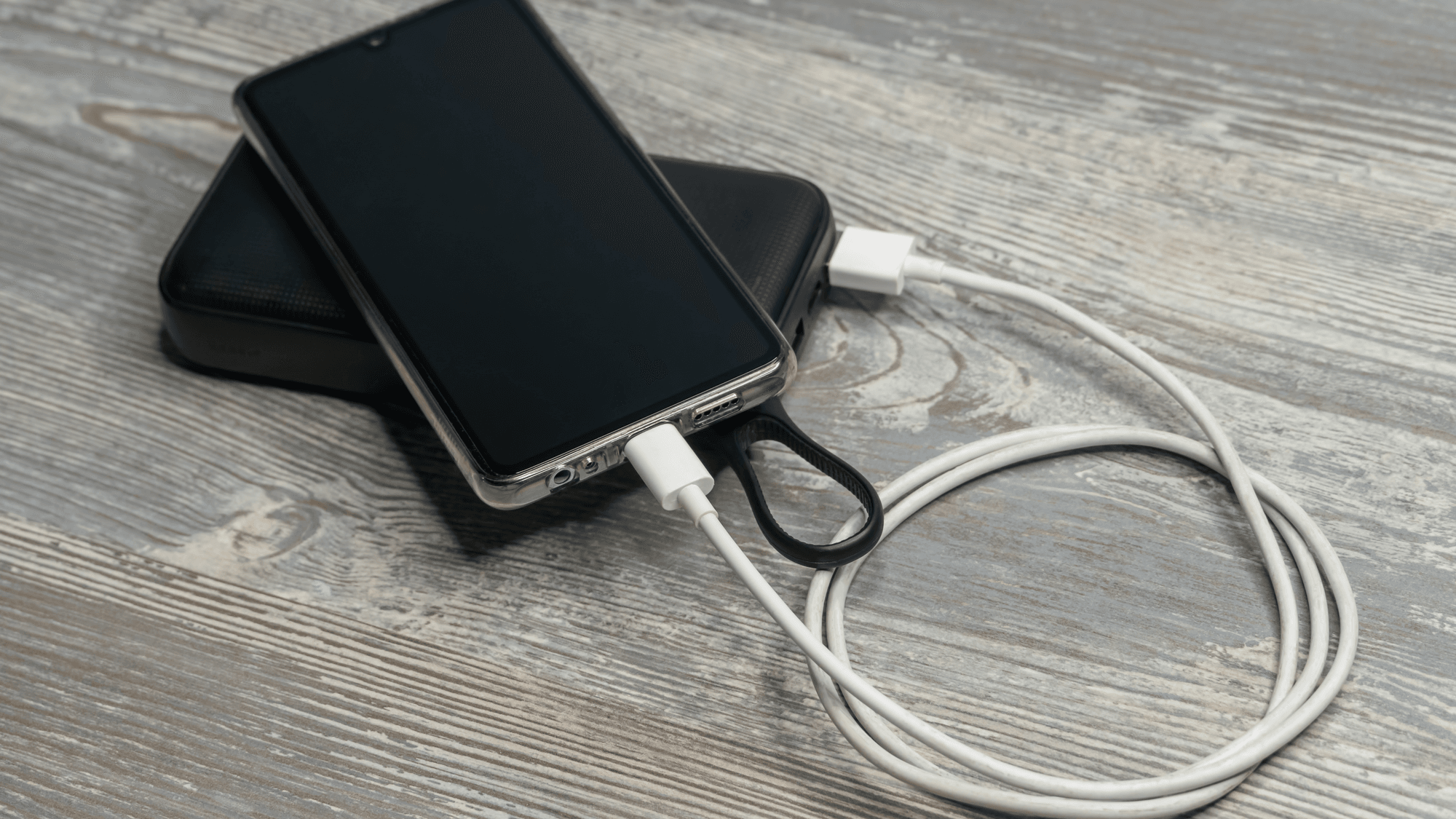
Anker separates the capacity of the cells inside a power bank from its rated output capacity. It explains that the power bank has to boost the cell voltage from 3.7 V up to the 5 V USB output, and that boost loses energy. The phone then has charging losses of its own.
Anker's support article walks through the numbers. It starts with 20,000 mAh at 3.7 V, or 74 Wh. Assuming 82% conversion efficiency, about 60.7 Wh is left, which equals roughly 12,140 mAh at a 5 V output. Those are illustrative assumptions, not a specification for every Anker model.
Watts are a separate spec again. Anker describes total output, measured in W, as the combined power available from all of the power bank's ports. That is about how much power it can supply at once, not how much charge it stores.
Phone battery capacity examples
Phone makers publish mAh figures too, sometimes two per phone. The Apple figures below come from Apple's Irish product page and the Samsung figures from Samsung's Canadian specification page.
- iPhone 16 (model A3287): rated battery capacity of 3,561 mAh.
- iPhone 17 (model A3520): rated battery capacity of 3,692 mAh.
- Galaxy S26: 4,300 mAh typical capacity, 4,175 mAh rated capacity.
- Galaxy S26 Ultra: 5,000 mAh typical capacity, 4,855 mAh rated capacity.
Samsung defines typical capacity as an estimated average that accounts for variation among battery samples tested under the IEC 61960 standard. It publishes the rated capacity separately, and for both phones the rated figure is the lower one.
What to check before you buy or pack
If you are comparing power banks, check whether an mAh figure is the cell capacity or a rated output capacity, and at what voltage, because Anker's example turns 20,000 mAh at 3.7 V into about 12,140 mAh at the 5 V output under its assumptions. If you plan to fly with one, look for the Wh figure or work it out with the FAA formula, since the 100 Wh limit is set in watt-hours. Check your airline as well, because the FAA says carriers may be stricter.
If you are comparing phones, check whether a spec sheet quotes typical or rated capacity before lining up two numbers. See How to Improve Battery Life on Your Phone or Laptop and How to Fix a Power Bank That Is Not Charging Your Phone.