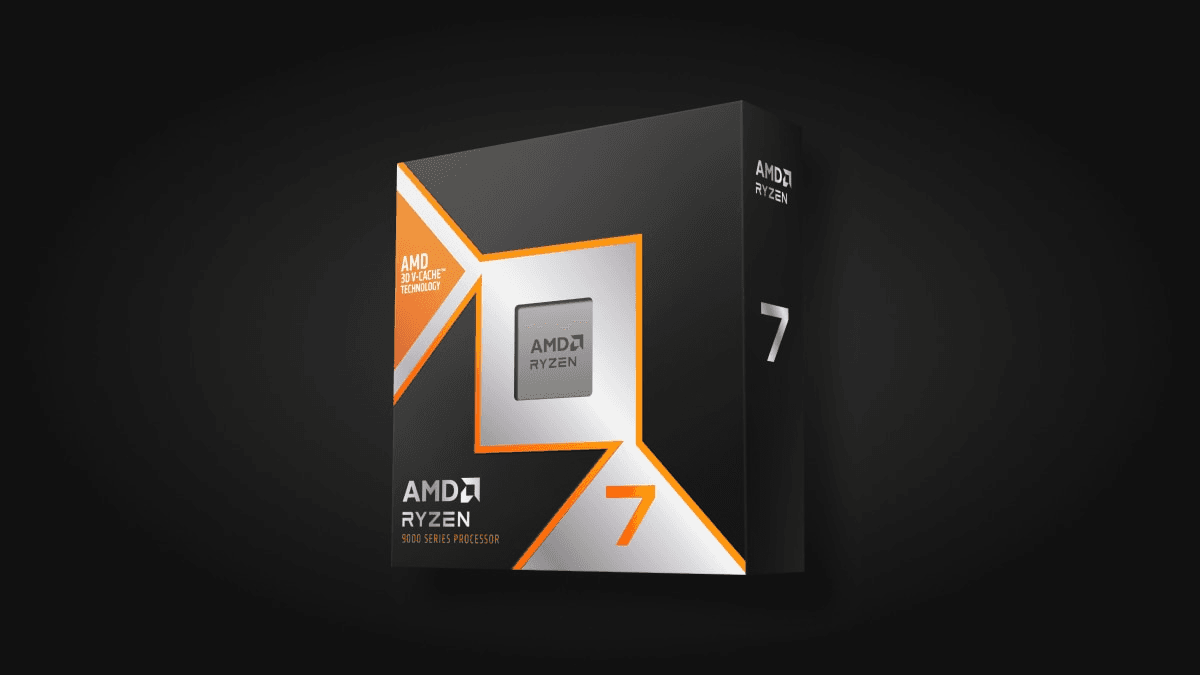
The Ryzen 7 9800X3D and the Ryzen 9 9950X3D are both AM5 processors with AMD's second-generation 3D V-Cache. On AMD's spec sheets, the split is core count, cache, clock range and default TDP. The 9800X3D has 8 cores and 16 threads with a 120 W default TDP, while the 9950X3D has 16 cores and 32 threads with a 170 W default TDP.
Ryzen 7 9800X3D vs Ryzen 9 9950X3D at a glance
These figures come from AMD's product pages and its two announcement press releases, dated October 31, 2024 for the 9800X3D and January 6, 2025 for the 9950X3D.
- Cores and threads: 8 cores and 16 threads on the 9800X3D, 16 cores and 32 threads on the 9950X3D.
- Clock speeds: up to 5.2 GHz boost with a 4.7 GHz base on the 9800X3D, up to 5.7 GHz boost with a 4.3 GHz base on the 9950X3D.
- L2 cache: 8 MB on the 9800X3D, 16 MB on the 9950X3D.
- L3 cache: 96 MB on the 9800X3D, 128 MB on the 9950X3D, both including 3D V-Cache.
- Total cache: 104 MB on the 9800X3D, 144 MB on the 9950X3D.
- Default TDP: 120 W on the 9800X3D, 170 W on the 9950X3D.
- Socket and memory: AM5 and DDR5 on both.
- Cooler in the box: not included with either.
Cores, clocks and cache
The 9950X3D doubles the core and thread count of the 9800X3D, and its L2 cache doubles with it, from 8 MB to 16 MB. Its L3 cache is 128 MB against 96 MB. That puts AMD's combined L2 and L3 figure at 144 MB for the 9950X3D and 104 MB for the 9800X3D.
The 9950X3D has the higher maximum boost, up to 5.7 GHz against up to 5.2 GHz. The 9800X3D has the higher base clock, 4.7 GHz against 4.3 GHz.
Both chips use what AMD calls 2nd Gen AMD 3D V-Cache technology. In its 9800X3D announcement, AMD describes 64 MB of cache memory relocated beneath the processor cores. For background, see What Is a CPU?
Power, cooling and the platform
AMD lists a default TDP of 120 W on the Ryzen 7 9800X3D product page and 170 W on the Ryzen 9 9950X3D product page. Both pages mark the cooler as not included.
The socket and memory fields on the two product pages match. Both list the AM5 socket and DDR5 UDIMM memory across two channels, up to 256 GB. AMD lists DDR5-5600 as the maximum speed for its 2x1R and 2x2R configurations and DDR5-3600 for its 4x1R and 4x2R configurations. Both pages list ECC support with the note that it requires motherboard support.
What they cost
AMD announced the Ryzen 7 9800X3D with a launch price of $479, the suggested e-tail price in its October 31, 2024 press release. That is AMD's launch price, not a current store price.
For the Ryzen 9 9950X3D, AMD's US store lists $699 as its regular comparison price as of November 2026. Both figures are in US dollars. See also Ryzen 5 vs Ryzen 7.
Which one fits
If you want the higher core and thread count, the 9950X3D fits because AMD lists 16 cores and 32 threads against 8 and 16, plus 40 MB more combined cache. If you want the lower default TDP, the 9800X3D fits because AMD lists 120 W against 170 W, with the same 3D V-Cache generation, socket and memory type.
If cooling is part of the plan, AMD's default TDP figures are 50 W apart, and neither product page lists a cooler in the box. If you already have an AM5 system, AMD lists the AM5 socket and the same DDR5 speed limits for both chips. See How to Check CPU on Windows.