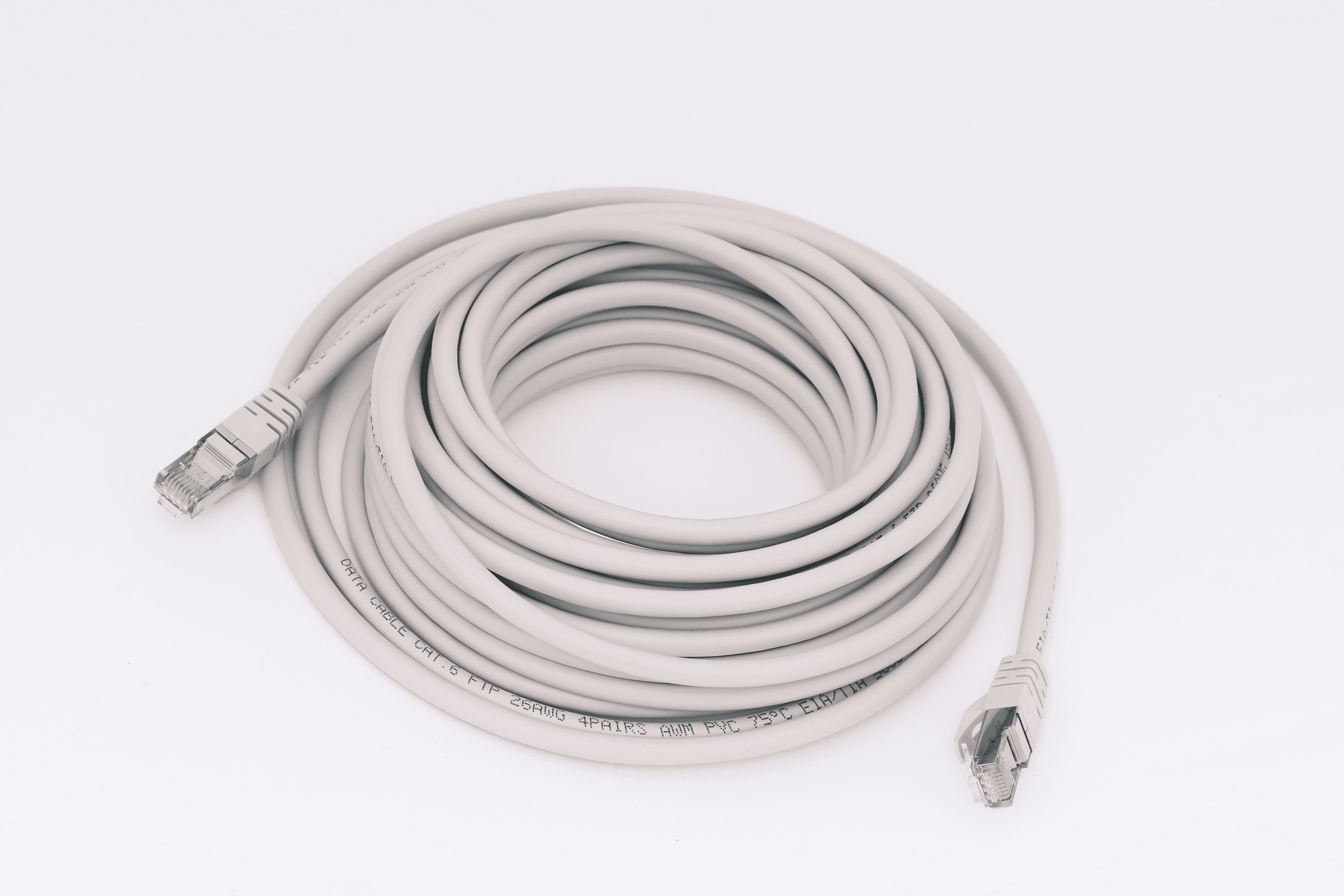
Cat5e, Cat6 and Cat6a cables share the RJ45 connector, and cable makers list all three for Gigabit Ethernet over 100 meters. The differences are in rated bandwidth, at 100 MHz, 250 MHz and 500 MHz, and in how far Cat6 and Cat6a carry 10 Gigabit Ethernet. If the goal is 10GBASE-T over a full 100 meter run, Cat6a is the category that a Panduit-hosted comparison table lists for it.
Cat5e vs Cat6 vs Cat6a at a glance
Panduit's TX5500 sheet refers to Category 5e ratified standards. TIA announced in November 2024 that ANSI/TIA-568.2-E, its balanced twisted-pair cabling and components standard, will revise ANSI/TIA-568.2-D.
- Cat5e: Panduit's TX5500 specification puts the Cat5e standard at swept frequencies up to 100 MHz. It lists 1000BASE-T (Gigabit Ethernet) and certifies channel performance up to 100 m with four connectors.
- Cat6: Leviton's Cat6 system summary states a bandwidth of up to 250 MHz and data rates of 1 Gbps over 100 meters.
- Cat6a: a Leviton specification sheet for its EMEA (Europe, Middle East and Africa) range rates its FDT Cat6a cable to 500 MHz. A comparison table in a white paper hosted by Panduit lists Cat6a for Gigabit Ethernet and 10GBASE-T over 100 meters. The same Leviton Cat6a sheet that rates the cable to 500 MHz also says it is characterized to 550 MHz.
2.5, 5 and 10 Gigabit Ethernet
NBASE-T is the name the Panduit-hosted white paper uses for 2.5 or 5 Gigabit Ethernet. Its table lists NBASE-T support over 100 meters for both Cat6 and Cat6a.
IEEE's approved objectives for the 802.3bz project, dated March 2015, call for 2.5 Gb/s over at least 100 m of four-pair Cat5e cabling and 5 Gb/s over up to 100 m, on defined use cases and deployment configurations. An IEEE-hosted presentation from October 2026 reports 100 m supported distances for Cat5e and Cat6, with an additional requirement for alien crosstalk. Fluke Networks states in its guide for network engineers that not all installations of Cat5e cabling can support NBASE-T technologies.
The categories split at 10 Gigabit. For 10GBASE-T, the Panduit-hosted table lists Cat6a at 100 meters and Cat6 at "limited distances." Fluke Networks' summary of the 10GBASE-T field testing requirements gives figures for Cat6. It says 10GBASE-T should operate over Cat6 channels up to 37 m, and that operation between 37 and 55 m depends on the alien crosstalk environment. Longer channels may require mitigation.
Fluke's compatibility table for network engineers gives a separate Cat6 summary figure of 35 m maximum for 10GBASE-T. Both Fluke figures for Cat6 at 10 Gigabit are below 100 meters.
What the 100 meter figure covers
The 100 meters is a total for the whole channel, not only the cable in the wall. Leviton's residential installer guide describes a total allowable channel length of approximately 328 feet (100 meters), including patching and equipment cords. Within that, the permanent link runs up to 90 m and the cords and jumpers total up to 10 m.
The October 2026 IEEE-hosted presentation states that IEEE 802.3 specifies electrical requirements. It says there is no normative requirement in the standard specifically limiting the length to 100 meters. That document is an ad hoc presentation, not a newly published standard.
Shielding and connectors
Shielding is a separate choice from category. Leviton's technical glossary describes Cat5e, Cat6 and Cat6a cabling as available in UTP (unshielded twisted pair) and STP (shielded twisted pair) versions. Makers' catalogs show foil-shielded F/UTP cable in every category, including Belden's 2138A in Cat5e and Leviton's LANMARK-6 FTP in Cat6. In Cat6a, Leviton lists both an F/UTP cable and a U/UTP cable with four unshielded twisted pairs.
Leviton's glossary names RJ45 as the physical interface for Cat5e, Cat6 and Cat6a network cabling and notes that RJ45 connectors are sometimes called 8P8C connectors. Belden lists its Cat5e cable as RJ-45 compatible, and Leviton's Cat6a coupler mates RJ-45 8P8C plugs. Leviton's EMEA specification for its Cat6a patch cords states they are backward compatible with Cat6 and Cat5e.
Which one fits
If the network runs at Gigabit speeds, any of the three fits on paper, because makers list Cat5e, Cat6 and Cat6a for 1 Gb/s over a 100 meter channel. If the plan is 2.5 or 5 Gigabit on existing Cat5e, the IEEE objectives cover it, but Fluke's caution about individual installations applies. See What Is Ethernet?
If 10GBASE-T is the target and any run is longer than the Cat6 figures Fluke publishes, Cat6a fits because it is the category listed for 100 meters. For short 10 Gigabit runs, Cat6 can fit within the conditions Fluke describes. See Ethernet vs Wi-Fi, Which Should You Use at Home?