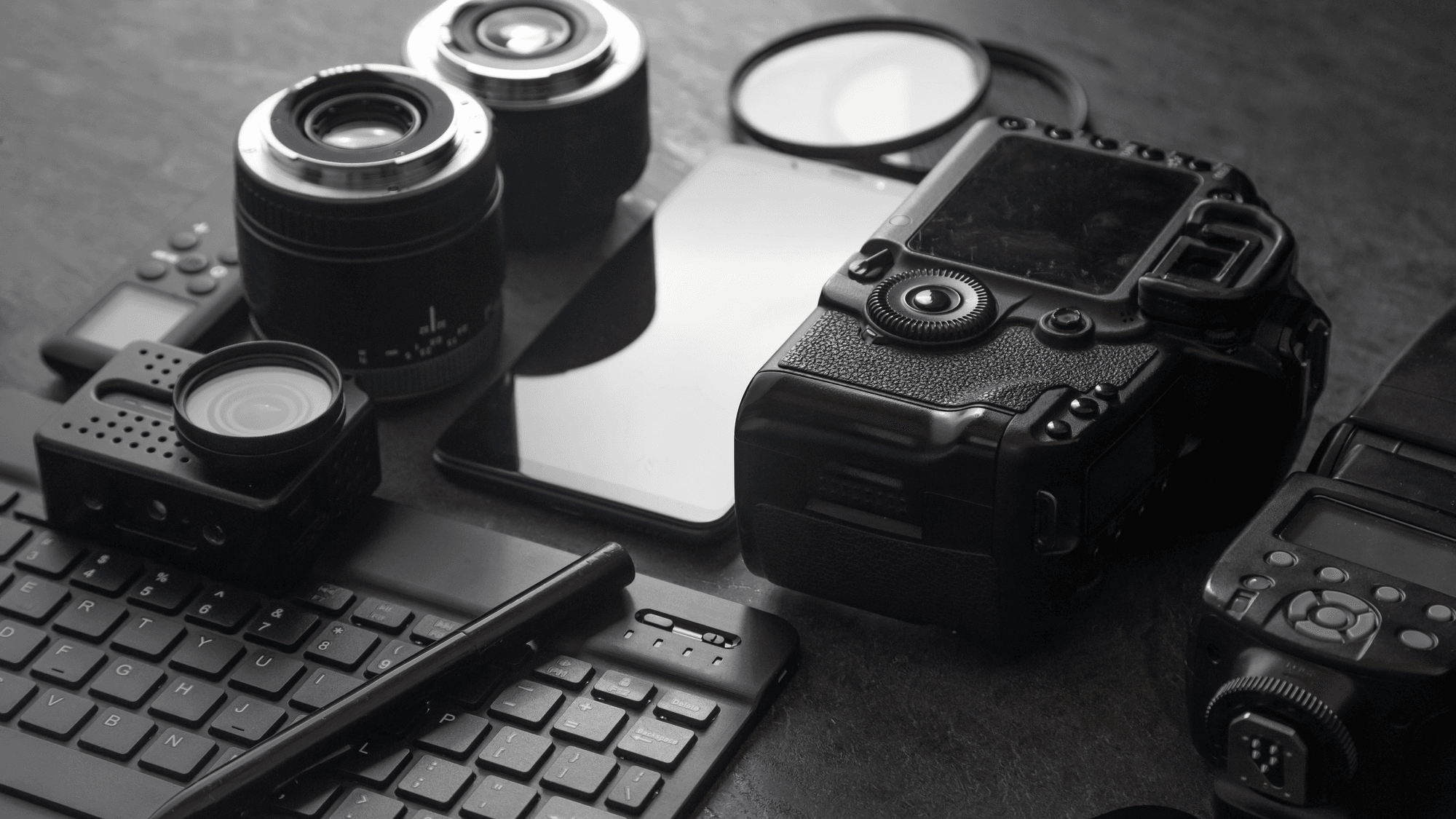
A DSLR bounces light from the lens off a mirror and up to an optical viewfinder, and the mirror flips out of the way when you press the shutter. A mirrorless camera has no reflex mirror, so light goes straight to the sensor, which feeds an electronic viewfinder or the rear screen. Canon and Nikon both still list DSLRs for sale in the US next to their mirrorless lines, so the lenses you own, video, weight and price are worth weighing.
How each one works
Canon explains that an SLR reflects the light coming through the lens with a mirror and a pentaprism or pentamirror, sending it to the optical viewfinder. In Nikon's comparison of the two designs, pressing the shutter raises the mirror so the light can reach the sensor.
In a mirrorless camera, the sensor and processor create the picture you see in the electronic viewfinder. Canon compares it to the rear screen's Live View appearing in an eye-level viewfinder.
Not every mirrorless camera follows that pattern. Fujifilm's X-Pro3 switches between optical and electronic viewfinder modes, and Nikon's full-frame Z5IIC has no viewfinder at all, which Nikon says reduces the size of the camera.
What the makers list for sale
Nikon USA's DSLR category lists the D7500, D780 and D850. Its mirrorless category lists twelve Z models, among them the Z5II, Z6III, Z 8 and Z 9. Canon USA still lists the EOS Rebel T7 DSLR with an 18-55mm kit lens, and the page showed it in stock on November 16, 2026. Canon calls its mirrorless EOS R line its most advanced camera series, and its store lists models such as the EOS R8 Mark II, EOS R6 Mark III and EOS R1.
Sony's US store sorts its interchangeable-lens cameras into Mirrorless Full-frame and Mirrorless APS-C, with listings that include the Alpha 7R VI, Alpha 7 V and Alpha 7 IV. Fujifilm groups X Series bodies such as the X-T5, X-H2 and X-S20 under Mirrorless Digital Camera.
On price, as of November 2026 Canon lists the Rebel T7 kit at a regular price of $579.99 and the mirrorless EOS R50 body at a regular price of $779.99. Sony gives the Alpha 7 IV body an MSRP of $2,499.99.
Lens mounts and adapters
- Canon: the Rebel T7 uses the EF mount and takes EF and EF-S lenses. The EOS R50 uses the RF mount and takes RF and RF-S lenses, and it can use EF and EF-S lenses through the Mount Adapter EF-EOS R. EF-M lenses are excluded.
- Nikon: the D780 uses the F mount and the Z6III uses the Z mount. Nikon says its FTZ II adapter allows more than 360 F-mount NIKKOR lenses on Z cameras. Full autofocus and auto exposure apply to specified AF-S, AF-P and AF-I lenses, and other lenses can have limitations.
- Sony: the Alpha 7 IV uses the E-mount. The LA-EA5 adapter attaches A-mount lenses to E-mount bodies, autofocus support depends on the body, lens and firmware, and Sony states that autofocus is not available during movie recording.
- Fujifilm: the X-T5 uses the X mount, and Fujifilm's M Mount Adapter lets a variety of M-mount lenses fit X-mount bodies.
Autofocus, video and weight in two pairs
Two same-brand pairs show how the published specs differ. These figures apply only to the models named.
- Canon EOS Rebel T7 (DSLR): nine autofocus points, Full HD video at 30 or 24 fps, and about 475 g with battery and card.
- Canon EOS R50 (mirrorless): Dual Pixel CMOS AF II with up to about 100% coverage of the frame, which can vary with the lens, uncropped 4K video at up to 30 fps, and about 375 g with battery and card.
- Nikon D780 (DSLR): a 51-point phase-detection system through the viewfinder, sensor-based hybrid autofocus in Live View, 4K UHD video at 30, 25 or 24p, and a listed weight of 840 g.
- Nikon Z6III (mirrorless): automatic detection of nine subject types, internal 6K/60p RAW video, and a listed weight of 670 g.
Nikon's spec pages do not say whether those two weights include the battery and card. Canon lists the T7 at about 129.0 x 101.3 x 77.6 mm and the R50 at about 116.3 x 85.5 x 68.8 mm.
Which one fits
If you own Canon EF or Nikon F lenses, the DSLRs that use them are still listed, and both makers offer an adapter that puts those lenses on a mirrorless body, with the limits Nikon notes for lenses outside its fully compatible list. If price comes first, the Rebel T7 kit has the lowest regular price here and includes a lens, while the R50 price is for the body alone.
If video matters, the mirrorless models in these pairs list the higher video specs, 4K against Full HD on the Canon pair and 6K RAW against 4K on the Nikon pair. If weight matters, the R50 is listed about 100 g lighter than the T7. For specific models, see the best DSLR cameras for 2026 and the best digital cameras for beginners.