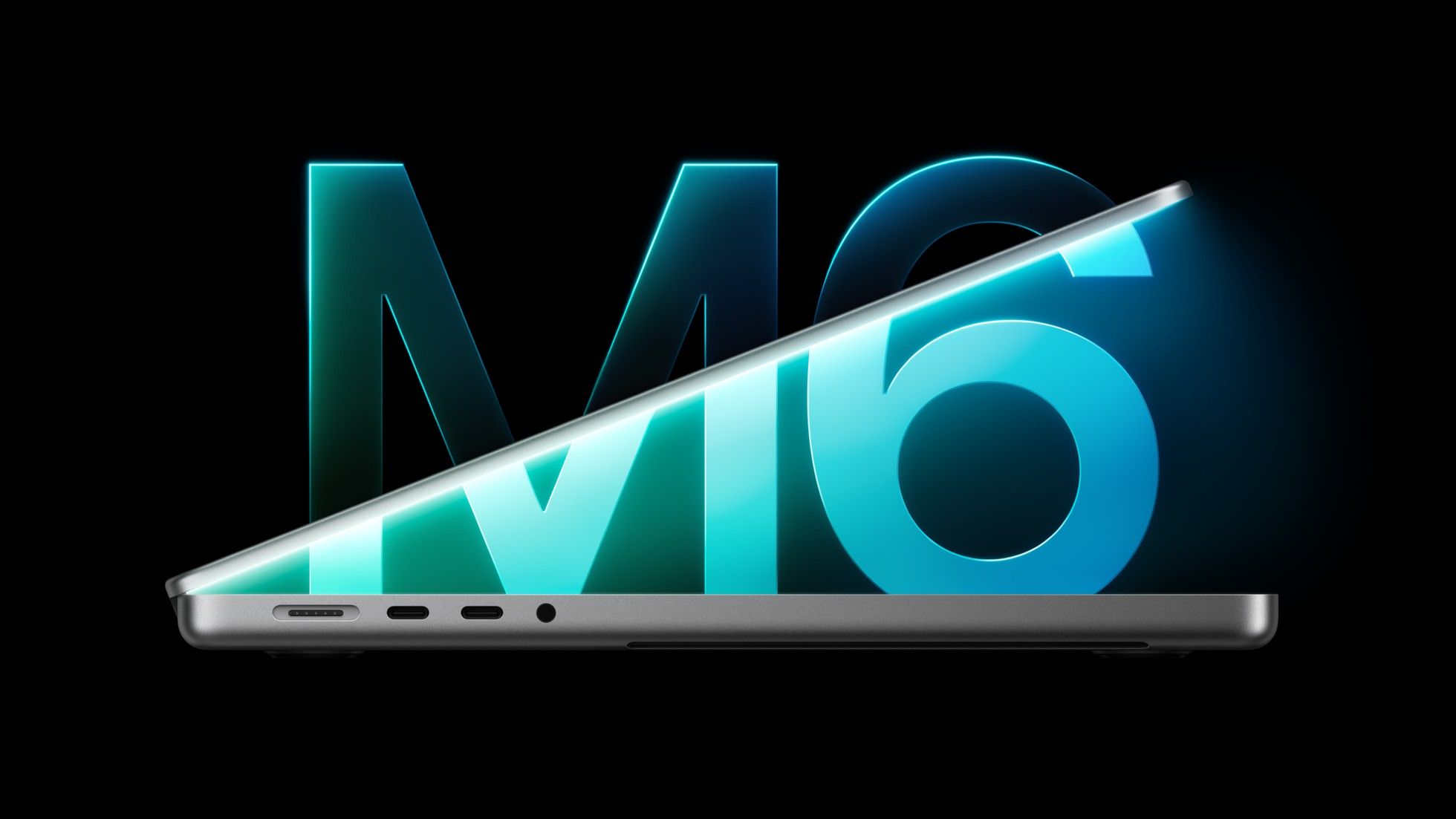
Apple's 14-inch MacBook Pro with M6 began reaching customers and stores on November 6, starting at $1,999 in the U.S., and the first reviews describe a faster chip inside an otherwise unchanged laptop. How much faster varies by test, and storage speed barely moved.
Apple announced the model on October 27 and opened pre-orders the next day in 35 countries and regions. It claims up to 30% faster graphics and up to 25% faster AI workloads than the M5 model.
Read more: Apple’s 14-Inch MacBook Pro Gets M6 With a 12-Core CPU and GPU
What the Reviews Measured
Engadget recorded a small CPU gain in Geekbench 6, with 4,458 single-core and 19,077 multi-core points against 4,310 and 18,003 for the M5 model. Its GPU score rose further, to 64,115 from 48,840, and it also measured about 30% more in Cinebench R24's multi-threaded test. Lies of P ran about 25 frames per second faster at the highest resolution and settings.
Tom's Hardware saw a larger CPU gain in the same benchmark, about 10% in single-core and just over 18% in multi-core. The M6 also beat the Dell XPS 14 and Gigabyte Aero X16 in its productivity tests. Its Cyberpunk 2077 results moved less, from 47.65 to 53.7 frames per second at 1800 x 1125 and from 31.47 to 32.66 at 3024 x 1890. Its 25GB file transfer test showed no real change, at 1,914 MBps against 1,917 MBps for the M5 model.
Apple rates the laptop for up to 24 hours of battery life, and test results depend heavily on the workload. It lasted 19 hours and 5 minutes in Tom's Hardware's web browsing and video test, nearly an hour longer than the M5 model. Engadget's programming-style script ran for 9 hours and 35 minutes.
A Higher Starting Price
The $1,999 price matches the M5 model's current listing but sits $400 above its $1,599 launch price in October 2025. Tom's Hardware ties the increase to industry-wide price rises for memory and storage. The M6 model includes 1TB of storage as standard, and education pricing starts at $1,899. In the U.K., it starts at £1,999, or £1,899 for education buyers.
What Changed and What Did Not
The M6 moves to a 2nm process and has 12 CPU cores and 12 GPU cores, two more of each than the M5, plus a dual 16-core Neural Engine. Memory bandwidth reaches up to 170GB/s, compared with 153GB/s, while memory still tops out at 32GB. Wi-Fi 7 and Bluetooth 6 replace Wi-Fi 6E and Bluetooth 5.3, though Wi-Fi 7 availability varies by country.
Most of the rest is carried over, including the mini-LED display, the chassis and three Thunderbolt 4 ports rather than Thunderbolt 5. Buyers who need more power still have to step up to the M5 Pro or M5 Max, since Apple has not announced M6 Pro or M6 Max chips. The OLED touchscreen MacBook Pro costs $900 more.