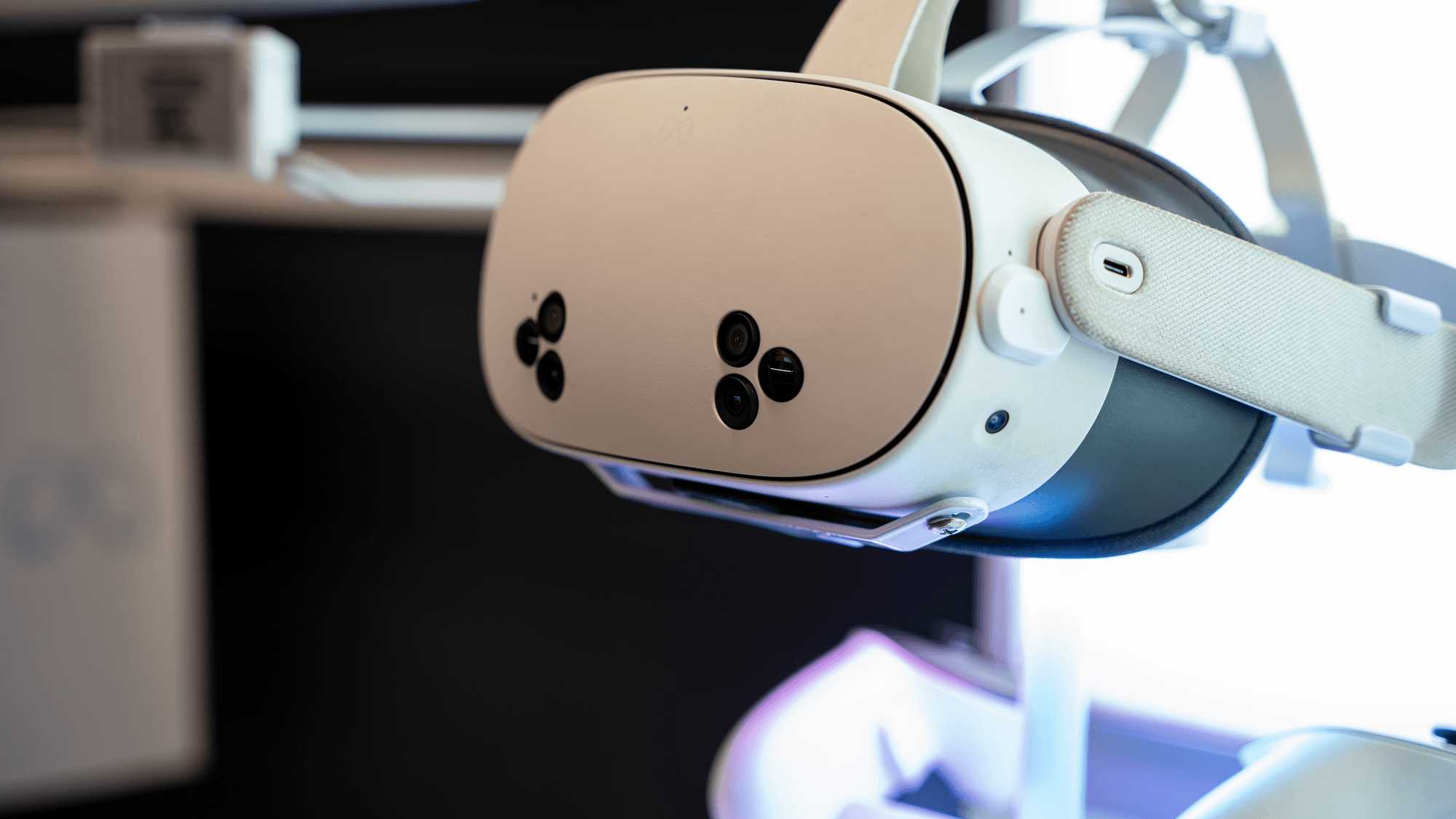
The Meta Quest 3 and Meta Quest 3S run on the same chip and ship with the same controllers. The Quest 3 lists at $599.99 with 512GB of storage, pancake lenses and a higher resolution per eye. The Quest 3S starts at $349.99 with Fresnel lenses and a lower resolution, and the two also differ in storage, battery life and weight.
Prices and storage
Meta's pricing update from April 16, 2026 sets the regular list prices below, which still apply as of November 2026. All are US dollars before tax.
- Meta Quest 3S (128GB): $349.99.
- Meta Quest 3S (256GB): $449.99.
- Meta Quest 3 (512GB): $599.99.
Both headsets are still offered through Meta's US store. The Quest 3 is sold new in one 512GB version, while the Quest 3S comes in 128GB and 256GB. That puts the Quest 3 $250 above the cheapest Quest 3S and $150 above the 256GB one.
Key differences at a glance
- Lenses: Meta lists a pancake lens for the Quest 3 and a Fresnel lens for the Quest 3S.
- Resolution per eye: 2064 x 2208 pixels on the Quest 3, 1832 x 1920 on the Quest 3S.
- Field of view: 110 degrees horizontal and 96 degrees vertical on the Quest 3, 96 degrees horizontal and 90 degrees vertical on the Quest 3S.
- Lens spacing: a continuous adjustment wheel on the Quest 3, three preset positions on the Quest 3S.
- Battery claim: up to 2.2 hours of typical usage for the Quest 3, up to 2.5 hours of average use for the Quest 3S.
- Weight: 515 grams for the Quest 3, 514 grams for the Quest 3S.
Lenses, resolution and fit
Meta's comparison page lists pancake lenses on the Quest 3 and Fresnel lenses on the Quest 3S. Meta's developer comparison table gives the Quest 3 more pixels per eye and a wider field of view in both directions, with 14 more degrees horizontally and 6 more vertically.
Fit works differently too. The Quest 3 has a wheel that moves the lenses mechanically across a 58 to 70 mm spacing range, and Meta lists an accommodated IPD range of 53 to 75 mm. The Quest 3S uses three preset lens positions, which Meta calls interaxial distance adjustment.
What both headsets share
Both use the Qualcomm Snapdragon XR2 Gen 2 chip. Meta lists the same refresh rates for both: 72Hz, 90Hz and 120Hz.
Both offer full color passthrough, which Meta lists as 4MP and 18 pixels per degree, and each product page lists two RGB cameras. Each box includes two Touch Plus controllers with wrist straps and two AA batteries.
Meta's developer comparison table lists a depth sensor for the Quest 3, while a separate Meta mixed reality guide describes a dedicated depth sensor when it covers the Quest 3 and Quest 3S together.
Battery life and weight
Meta claims up to 2.5 hours of average use for the Quest 3S and up to 2.2 hours of typical usage for the Quest 3. Actual battery life varies with settings and usage conditions. The listed weights are one gram apart, at 515 grams for the Quest 3 and 514 grams for the Quest 3S.
Which one fits
If price matters most, the Quest 3S is the cheaper way in. It starts $250 lower and keeps the same chip, refresh rates, color passthrough and controllers. Getting started is covered in this guide on how to set up a Meta Quest 3S.
If you want the higher resolution and wider field of view, the Quest 3 has them, along with pancake lenses and a continuous lens-spacing wheel instead of the Quest 3S's three presets. It is also the only one of the two with 512GB, which matters if you plan to keep a large library installed. A separate piece looks at whether the Meta Quest 3 is worth it on its own.
If you need more than 128GB but not the better optics, the 256GB Quest 3S sits in the middle at $449.99.