
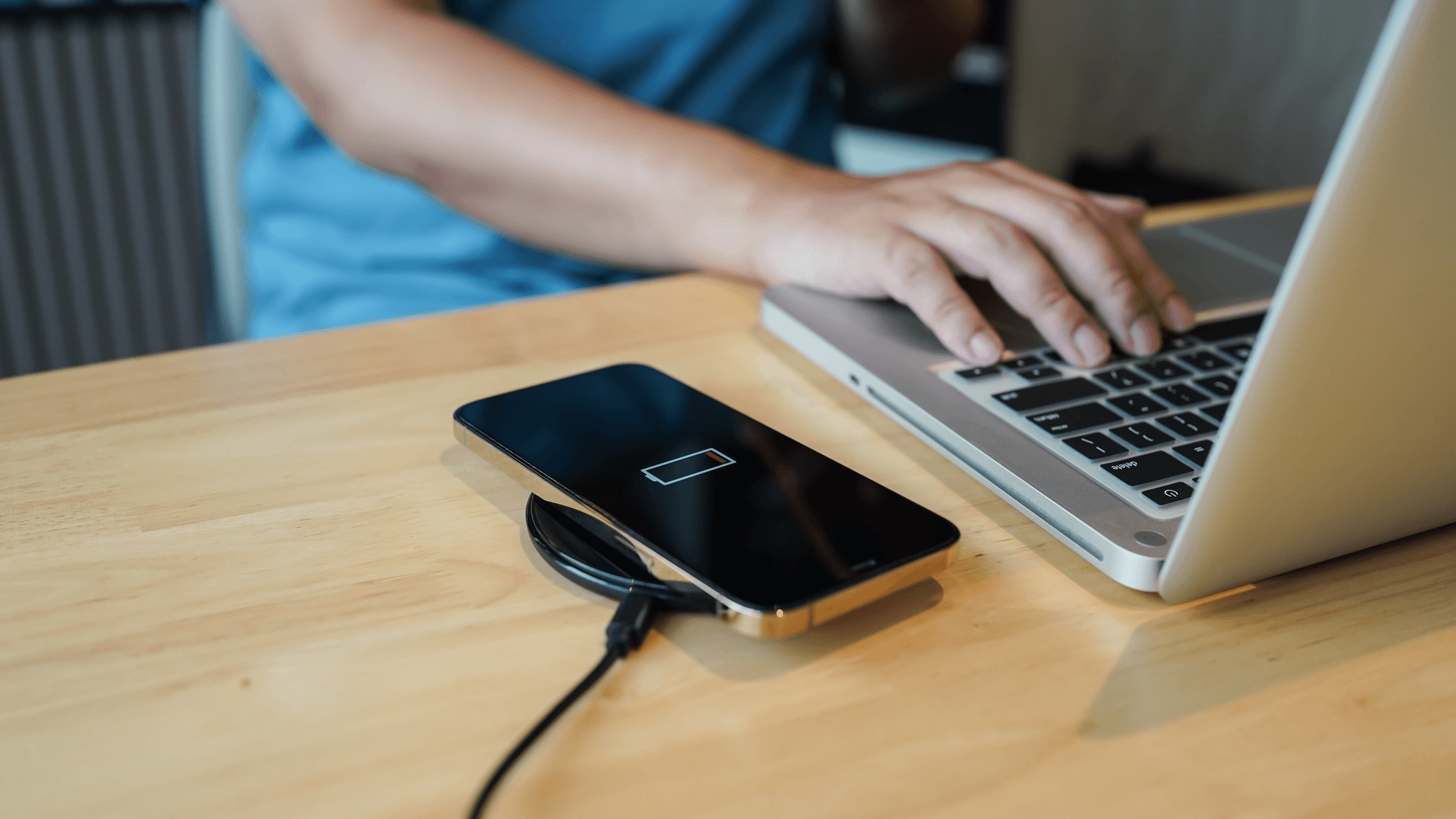
Wireless charging moves power between two coils of wire, one in the charger and one in the phone. Alternating current in the charger's coil creates a magnetic field, and that field induces a voltage in the phone's coil that charges the battery. Qi, created by the Wireless Power Consortium (WPC), is an open, universal standard for it.
How the coils pass power
The WPC describes the two coils as a transmitter and a receiver. The phone is not passive in this exchange. It sends control signals to the charging station, and those signals let the transmitter shut down when the battery is full.
Charger and phone also agree on a power level before charging starts. The WPC's Qi v1.3 documents say power is subject to negotiation, so a 15W charger does not force 15W into a receiver designed for 5W.
Position matters as well. The WPC says transfer efficiency depends on the coupling between the coils and on their quality, and that coupling depends on the distance between the coils, their relative size, their shape and their angle.
Qi, Qi2 and the watt numbers
- Qi Baseline Power Profile: up to 5W.
- Qi Extended Power Profile: up to 15W.
- Qi2: launched in November 2023 with 15W. It added the Magnetic Power Profile, which is based on MagSafe technology that Apple contributed to the WPC.
- Qi2 25W: the consumer brand for Qi v2.2.1, which the WPC launched on July 23, 2025.
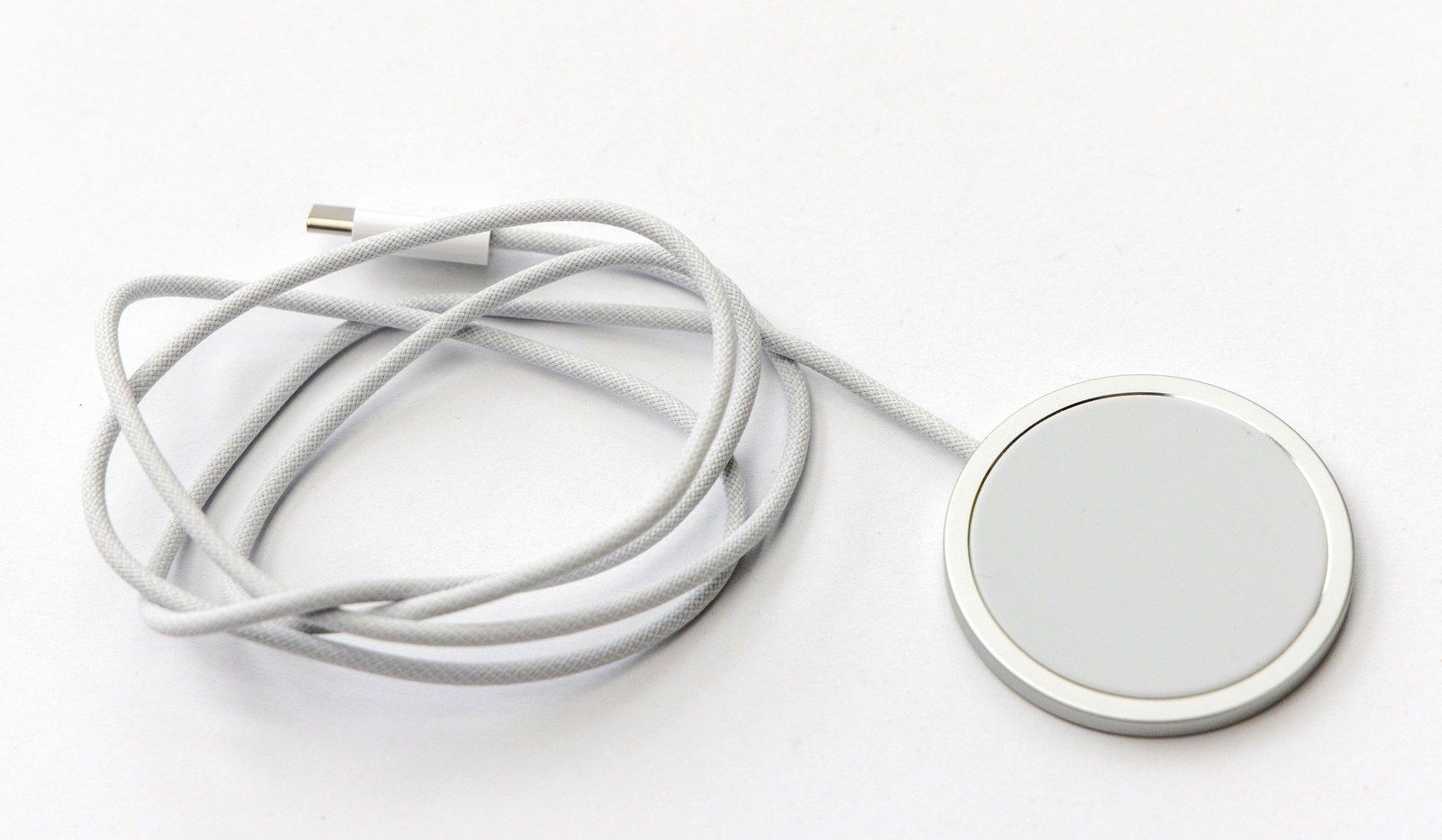
The magnets in Qi2 are there for alignment. The WPC says magnetic attachment lines up the device and charger, which improves energy efficiency and charging speed. Qi v2.0 also includes an updated Extended Power Profile without magnets, and those products carry the existing Qi logo instead of the Qi2 one.
A Qi logo on its own is not proof, because the WPC says some products use it without authorization, so check the WPC's product database. Qi certification includes safety and interoperability testing at independent authorized laboratories before a product may use the Qi or Qi2 logo.
What phones support
Apple's comparison table lists Qi2 for iPhone families from the iPhone 12 onward, and its spec pages give different ceilings by model. The iPhone 15 lists Qi2 and MagSafe charging up to 15W, the iPhone Air up to 20W, and the iPhone 17, iPhone 17 Pro and iPhone 18 Pro up to 25W. On a plain Qi charger, Apple says many Qi-certified chargers charge an iPhone at up to 7.5W.
MagSafe is Apple's magnetic version of the same idea, and Apple's current MagSafe Charger is certified for Qi2 25W and Qi charging. The top speed has conditions. Apple's September 2026 guide ties 25W peak charging to specified chargers and a power adapter of 30W or greater, and says the actual power delivered will vary.
On the Android side, Google says the Pixel 10 and later support Qi2, excluding the Pixel 10a. With the Pixelsnap Charger, Google lists up to 15W for the Pixel 10 and Pixel 10 Pro with a 20W or greater USB-C adapter. It lists up to 25W for the Pixel 10 Pro XL and the Pixel 11 line with a 35W or greater adapter.
Samsung's German support site says the Galaxy S26 supports Qi 2.2 wireless charging up to 15W, the S26+ up to 20W and the S26 Ultra up to 25W with a compatible charging pad. That page also says the S26 phones have no built-in magnets, so a case with integrated magnets provides the magnetic attachment.
Heat, efficiency and reverse charging
Phones can get warm on a wireless charger, and both Apple and Google document what happens next. Apple's wireless charging guide says that if the battery gets too warm, software may limit charging above 80 percent until the temperature drops. Google says a Pixel that gets too warm may pause wireless charging to protect the battery and resume after it cools.
Wireless charging can also use more electricity. Apple documents a notification, required in the EU, stating that wireless charging might use more power than wired charging.
Some phones can send power as well as receive it. Samsung's Wireless PowerShare lets a compatible Galaxy phone charge another compatible phone, watch or earbuds when the two are placed back to back. Samsung says the feature will not turn on below 30 percent battery when the phone is unplugged, and that thick cases or some materials can prevent charging.
What to check before you buy a charger
If you want the fastest speed your phone lists, check three things: the phone's own wattage ceiling, the charger's certification and the power adapter, because Apple ties its top speeds to a minimum adapter wattage and Google recommends one. If your phone has no built-in magnets, as Samsung's German page says of the Galaxy S26, a magnetic case is what makes a magnetic charger attach.
For picks, see the best wireless chargers for 2026. If charging stalls, there are fix guides for the iPhone 17 and for a Galaxy S26 Ultra stuck at 15W.