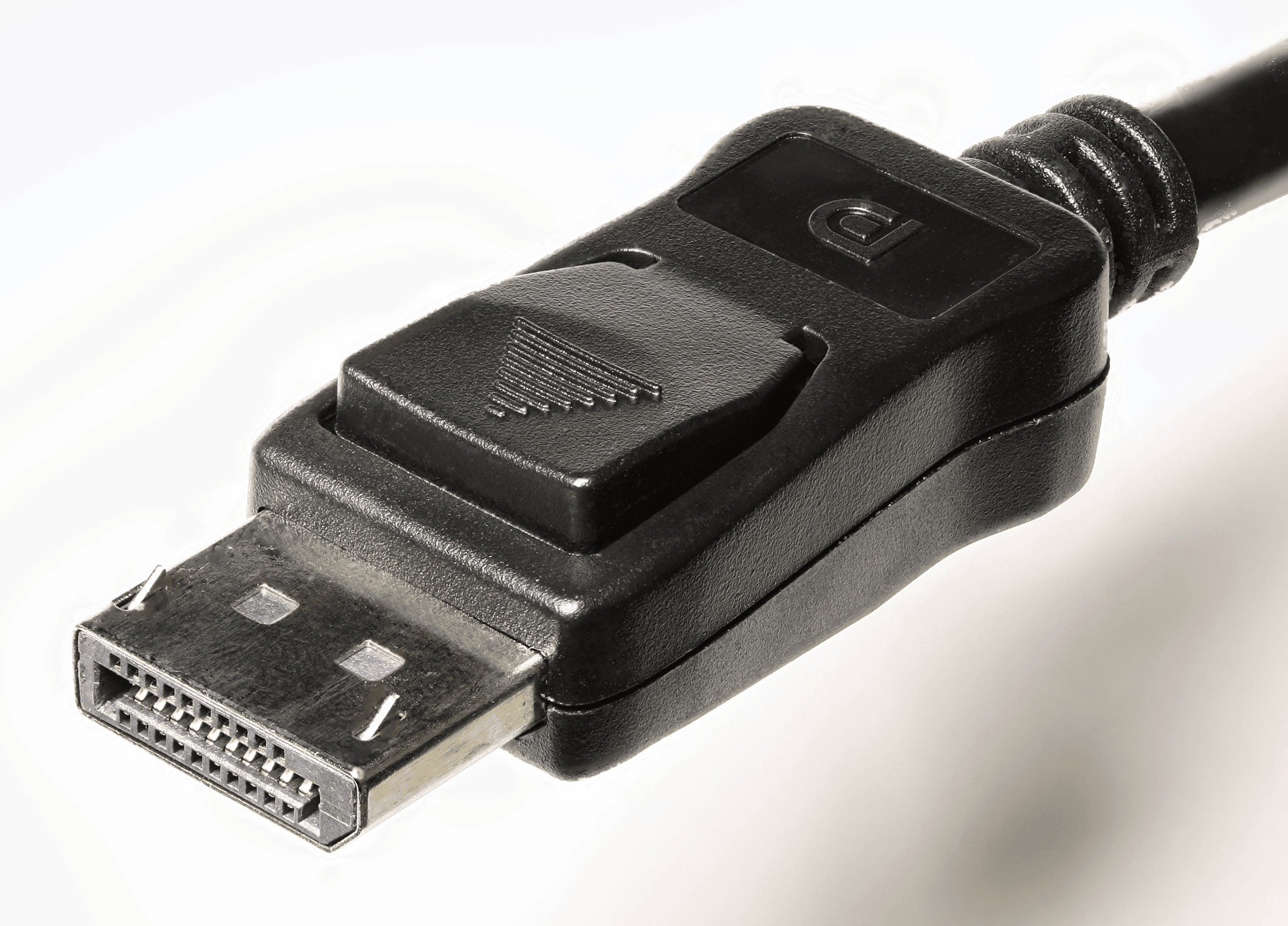
DisplayPort 1.4 tops out at the HBR3 link rate, which is 32.4 Gbps raw across four lanes and 25.92 Gbps of usable data. The DisplayPort 2.1 family adds UHBR link rates that reach 80 Gbps raw, and VESA publishes a maximum payload of 77.37 Gbps for DP 2.1b. A DP 2.1 label alone does not promise those speeds, because VESA's DP 2.1b certification does not require UHBR.
DisplayPort 1.4 vs 2.1 at a glance
- DP 1.4 link rate: HBR3 at 8.1 Gbps per lane, or 32.4 Gbps raw across four lanes. After 8b/10b coding overhead, 25.92 Gbps is usable.
- DP 2.1 link rates: UHBR10 at 10 Gbps per lane (40 Gbps raw), UHBR13.5 at 13.5 Gbps per lane (54 Gbps raw) and UHBR20 at 20 Gbps per lane (80 Gbps raw), each across four lanes.
- DP 2.1b maximum payload: 77.37 Gbps over four lanes, using 128b/132b channel coding.
- Compression: DP 1.4 introduced DSC 1.2 transport with up to 3:1 compression, which VESA describes as visually lossless. VESA's DP 2.1 announcement specifies mandated support for DSC.
- Backward compatibility: VESA describes DP 1.4 as backward compatible with earlier DisplayPort versions, and states the same for DP 2.1b.
What each version can drive
VESA's launch examples for DP 1.4 both rely on compression. They are 8K at 60 Hz with HDR deep color and 4K at 120 Hz with HDR deep color.
For UHBR, VESA lists several single-cable setups as uncompressed. They are one 8K 60 Hz HDR display, one 4K 240 Hz HDR display, two 4K 120 Hz HDR displays, or four 4K 60 Hz HDR displays.
The DisplayPort FAQ goes further for DP 2.1b. Its single-display examples are one 16K (15360×8640) display at 60 Hz with 30 bpp 4:4:4 HDR using DSC, or one 10K (10240×4320) display at 60 Hz with 24 bpp 4:4:4 uncompressed. Its multi-display examples include two 4K displays at 144 Hz with 24 bpp 4:4:4 uncompressed, and three 4K displays at 90 Hz with 30 bpp 4:4:4 HDR uncompressed.
A DP 2.1 label does not mean UHBR20
DP 2.1b certification does not require UHBR speeds. VESA requires at least HBR2 with DSC, plus at least one listed new feature. That means two DP 2.1b ports can support different link rates.
If you are comparing DP 2.1b ports, check the link rate each spec sheet lists. UHBR10, UHBR13.5 and UHBR20 correspond to 40, 54 and 80 Gbps of raw four-lane throughput.
Cables, from DP40 to DP80LL
VESA certifies cables by link rate. Its original DP40 certification requires UHBR10 support and full four-lane operation, for 40 Gbps raw. DP80 cables support UHBR20 across four lanes for 80 Gbps raw, and DP80 certification also covers UHBR13.5.
The DP 2.1a update, announced in January 2024, replaced the DP40 cable specification with DP54. DP54 supports UHBR10 and UHBR13.5 over passive cables up to two meters. VESA confirmed that DP40 cables shipped before the change met DP54 requirements and supported UHBR13.5.
In January 2025, as part of its DP 2.1b update, VESA announced DP80LL active cables for four-lane UHBR20 operation at 80 Gbps over lengths up to three meters. VESA also states that DP40 and DP80 cables are backward compatible with devices using the RBR, HBR, HBR2 and HBR3 link rates. VESA's UHBR certification announcement covers the DP40 and DP80 cable certifications.
DisplayPort over USB-C
A USB-C connector alone does not establish DisplayPort support. USB-IF's Type-C specification describes Alternate Mode support as optional, and it uses USB Power Delivery structured messages to discover and configure it.
Where a port does support it, a USB-IF presentation from VESA states that a passive full-feature USB-C cable can carry up to four DisplayPort lanes. A configuration with simultaneous USB 3.2 uses two lanes for DisplayPort and two for USB 3.2. USB 2.0 and USB Power Delivery remain available in all configurations.
VESA's Alt Mode 2.0 announcement specifies up to 80 Gbps of DisplayPort video using all four high-speed lanes, or up to 40 Gbps with simultaneous SuperSpeed USB data. For how the connector relates to other standards, see USB-C vs Thunderbolt.
Which one fits
If your display target is 4K at 120 Hz with HDR, DP 1.4 fits on paper, since that is one of VESA's own DP 1.4 examples with compression. If you want 4K at 240 Hz with HDR uncompressed, that sits on VESA's UHBR list, so check the link rate each port lists and not only the version number.
If a device lists UHBR20, a DP80 cable fits because that is the certification VESA ties to 80 Gbps. If it lists UHBR10 or UHBR13.5, DP54 covers both over passive cables up to two meters. VESA states that DP 1.4 and DP 2.1b are backward compatible with earlier versions, and that DP40 and DP80 cables work with RBR, HBR, HBR2 and HBR3 devices. If you are still choosing between connector types, HDMI vs DisplayPort compares the two, and What Is HDMI 2.1? explains the HDMI side.