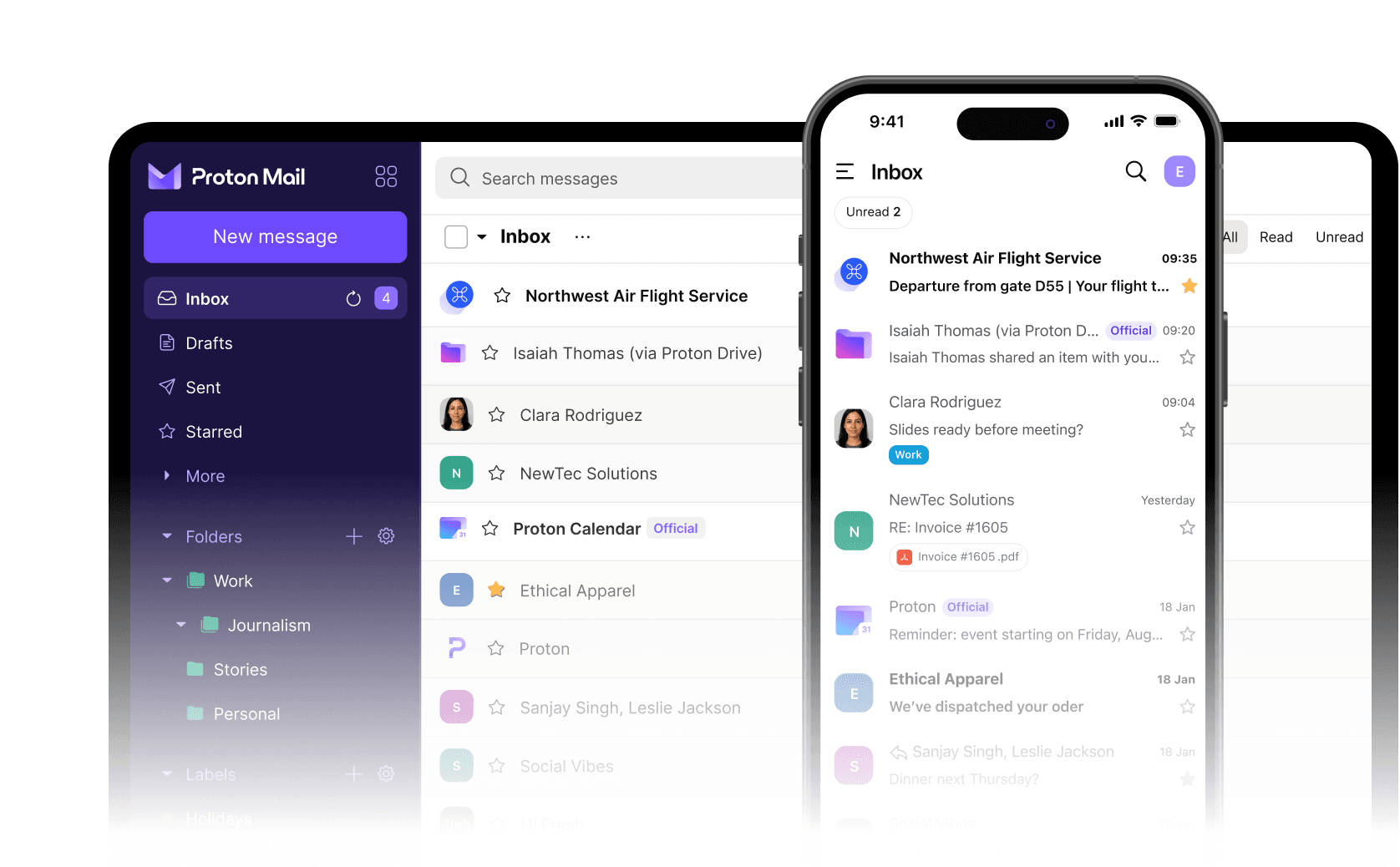
Google lists up to 15 GB of free storage for a personal Google Account, shared across Gmail, Google Drive and Google Photos. Proton Mail's free plan starts at 500 MB, and Proton says it secures all messages and attachments in the inbox with zero-access encryption, which prevents Proton from accessing their contents. If free storage matters most, Gmail lists more of it. If zero-access encryption matters more than storage, Proton Mail fits because Proton says it covers all messages and attachments in the inbox.
Proton Mail vs Gmail at a glance
- Free storage: Proton Mail starts at 500 MB. Personal Gmail lists up to 15 GB, shared with Google Drive and Google Photos.
- Daily sending: Proton Free includes 150 messages per day. Personal Gmail may show a sending-limit error after more than 500 emails in a day, or more than 500 recipients in one email.
- Attachments: Proton Free and personal Gmail both list a 25 MB limit.
- Custom domain: Proton Mail Plus includes one custom email domain. Google provides Gmail at a custom company domain through a Google Workspace subscription.
- Apps: Proton Mail has a web app, iOS and Android apps, and desktop apps for Windows, macOS and Linux, with Linux labeled beta. Gmail runs in a web browser and has apps for Android phones and tablets, iPhone and iPad.
What the free plans include
Proton Free costs $0 and includes one email address, three folders, three labels and one custom filter. New users can raise the 500 MB of Mail storage to 1 GB by completing Proton's starter checklist within their first 18 days. Custom email domains and IMAP/SMTP email client support are not part of the free plan, and the desktop app comes as a 14-day trial.
Google offers Gmail at no cost. If the total attachment size goes over 25 MB, Gmail replaces the attachment with a Google Drive link.
When the account reaches its storage limit, Gmail cannot send or receive email, and incoming messages go back to the sender. Gmail also works with other email clients, including Microsoft Outlook, Apple Mail and Mozilla Thunderbird, and IMAP access is always turned on for personal Google Accounts.
What the paid plans cost
As of November 2026, Proton's US pricing page lists Mail Plus at $4.99 month to month, or $47.88 every 12 months, which the page shows as the renewal price. Mail Plus covers one user with up to 10 email addresses, 15 GB of storage shared with Proton Drive and one custom email domain. Proton Unlimited lists at $12.99 month to month, or $119.88 every 12 months at the renewal price, with up to 15 addresses, 500 GB shared with Proton Drive and three custom domains.
Both Proton paid plans include unlimited labels, folders and filters, plus the desktop app. Paid accounts can also use Proton Mail Bridge with desktop clients such as Microsoft Outlook, Mozilla Thunderbird and Apple Mail.
Google sells extra room through Google One, and the storage covers Gmail, Google Drive and Google Photos. Google's US plans page lists Basic with 100 GB at $1.99 per month and Google AI Plus with 2 TB at $9.99 per month. Storage on both can be shared with up to five others. Google lists Google AI Pro with 5 TB at $19.99 monthly or $199.99 annually. The free 15 GB is included within those totals.
How each company describes its encryption
Proton's encryption explainer says messages between Proton Mail addresses are always end-to-end encrypted in transit. Ordinary messages to non-Proton addresses are not end-to-end encrypted by default, and Proton says they use TLS in transit if the non-Proton mail server supports it. Proton offers password-protected emails for end-to-end encrypted exchanges with non-Proton recipients, and it supports PGP. A separate Proton support page states that subject lines and sender and recipient addresses are encrypted, but not end-to-end encrypted.
Google's Gmail privacy documentation says data is encrypted in transit and at rest. Google describes TLS as Gmail's standard encryption for most emails. For TLS to work, the email providers for both the sender and the recipient must use it, and Google's email security page says messages may be unencrypted when a provider does not. Google separately offers client-side encryption for certain Workspace editions: Enterprise Plus, Education Plus, Education Standard and Frontline Plus.
Which one fits
If free storage and a no-cost email client connection matter most, Gmail fits because Google lists up to 15 GB and keeps IMAP access turned on for personal accounts, while Proton Free starts at 500 MB and does not include IMAP/SMTP support. If most of your mail goes to other Proton Mail users, Proton Mail fits because Proton says messages between Proton Mail addresses are always end-to-end encrypted in transit. If you want an address at your own domain, Proton Mail Plus fits because Proton lists one custom email domain on that plan at $4.99 month to month, while Google provides Gmail at a custom company domain through a Google Workspace subscription.
See Is Proton VPN Safe? and How to Add Another Email Account to iPhone.