
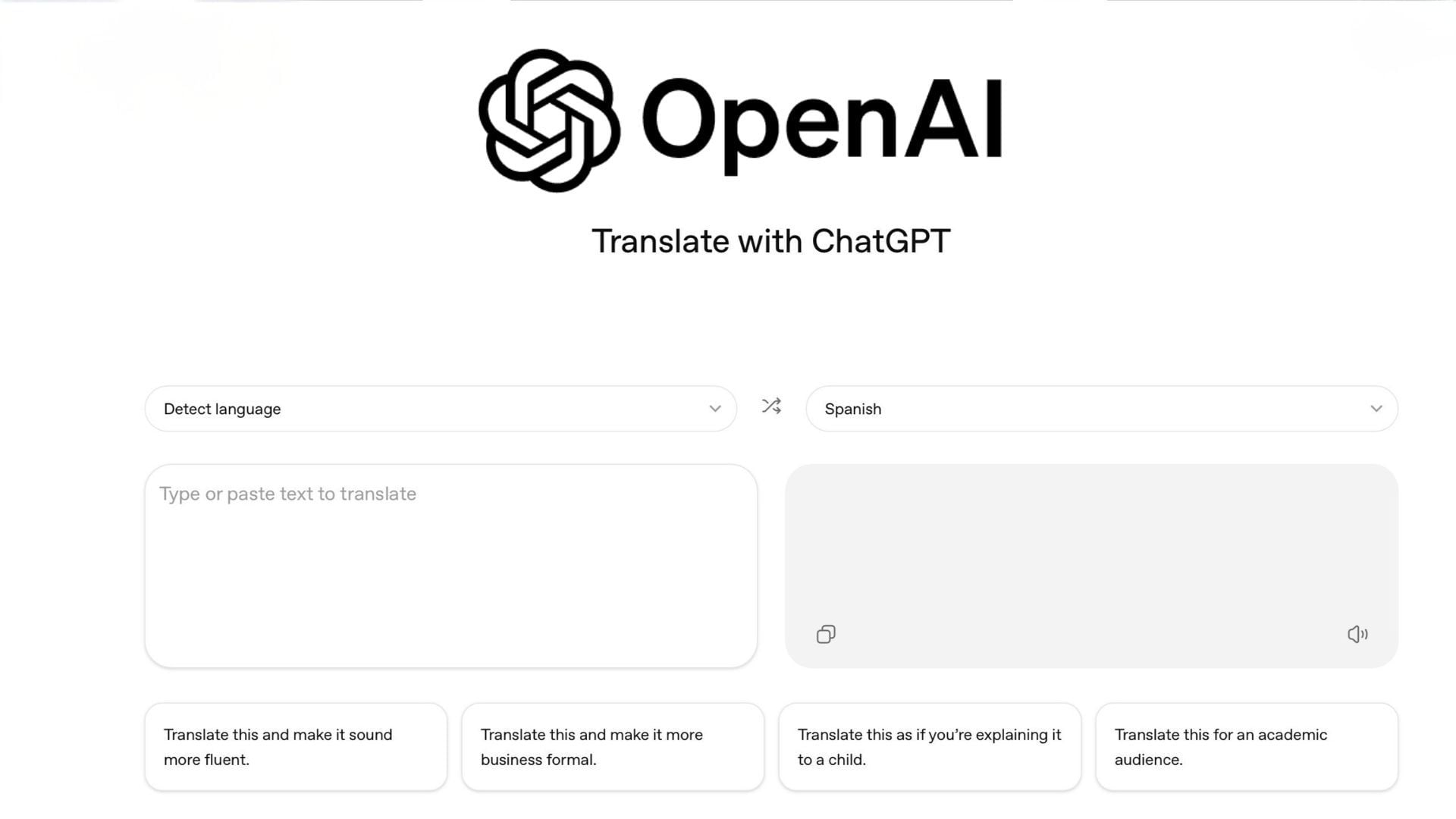
OpenAI launched ChatGPT Translate this week, a web-based translation tool supporting over 50 languages that directly challenges Google's market dominance. The service arrived without formal announcement, appearing as a dedicated webpage at chatgpt.com/translate.
ChatGPT Translate features the familiar two-box interface common to translation tools, with input on the left and output on the right. Users select source and target languages from dropdown menus, similar to Google Translate's layout. The tool automatically detects language input when unspecified.
The AI-powered service distinguishes itself through contextual understanding and tone adjustment. Unlike basic word-for-word translation, ChatGPT Translate accounts for idioms, cultural context, and user-specified styles. Quick prompts below translation boxes let users refine outputs with single clicks for business formal, child-friendly, or academic phrasing.
OpenAI's translation capability has existed within ChatGPT for years, but this standalone release signals strategic expansion into specialized applications. The company recently followed a similar pattern with ChatGPT Health, launching dedicated portals for specific use cases rather than relying solely on conversational interfaces.
Google Translate currently supports 249 languages and includes features like document uploads, website translation, and offline mode. ChatGPT Translate lacks these capabilities in its initial release, though the interface mentions future support for images and voice inputs. Image translation functions remain unavailable despite being listed on the site.
The translation market represents a multi-billion dollar opportunity that OpenAI now targets directly. Google added 110 languages to its service in 2024 and continues developing AI-powered features like live conversation translation through headphones. Multiple companies demonstrated real-time translation devices at CES 2026 earlier this month, though Google and OpenAI were not reported to have showcased dedicated hardware. The CES 2026 event featured various AI and tech innovations beyond translation.
ChatGPT Translate's contextual approach could appeal to professionals needing nuanced translations for international business, education, or content creation. The tool's ability to adjust tone and rewrite outputs for specific audiences provides advantages over literal translation services.
No dedicated mobile applications exist for ChatGPT Translate, unlike Google Translate's established presence on iOS and Android app stores. The web-only approach limits functionality in areas with poor internet connectivity, where Google's offline capabilities maintain an edge.
OpenAI's quiet launch suggests testing before broader promotion, consistent with the company's iterative release strategy. Industry observers note the move positions ChatGPT as a versatile assistant beyond conversational AI, expanding into practical utilities that compete with established tech giants like Google.
Translation quality in less common languages remains untested, inheriting potential biases from ChatGPT's underlying language models. Early users report smooth performance for major languages like Spanish, German, and French, with the tool handling multi-turn conversations that maintain translation context across exchanges.
The competitive landscape intensifies as AI companies embed translation across platforms. Microsoft and Meta offer integrated translation services, while Samsung develops real-time translation for mobile devices. ChatGPT Translate's generative approach could innovate where literal translations struggle with slang or idiomatic expressions.
Business implications include potential cost reductions for companies needing localized content, though concerns persist about AI displacing human translators. The tool's free tier may attract users from paid translation services, particularly for casual or educational purposes requiring contextual adjustments rather than perfect accuracy.
Future developments could include mobile applications, offline functionality, and expanded language support. OpenAI's pattern suggests gradual feature additions based on user feedback, with image and document translation likely arriving in subsequent updates.
ChatGPT Translate represents OpenAI's calculated expansion into everyday AI utilities, challenging Google's 20-year translation dominance with contextual intelligence rather than feature breadth. The tool's success will depend on balancing nuanced understanding with practical functionality across diverse language pairs, even as Google continues to enhance its own AI offerings.