
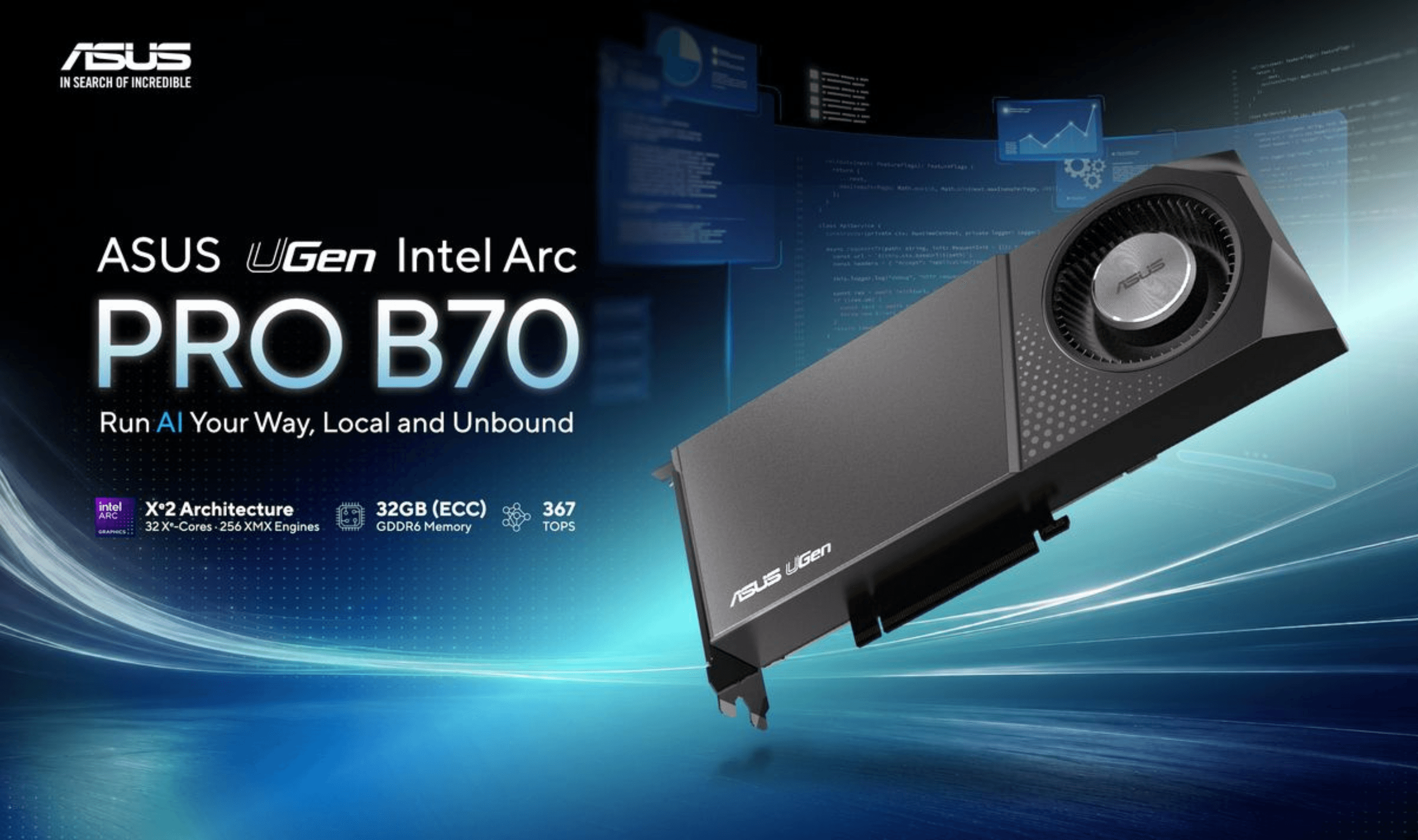
ASUS has announced the UGen Intel Arc Pro B70 32GB, a graphics card aimed at running AI models on desktops and workstations, with 32GB of GDDR6 memory protected by ECC. ASUS lists its power consumption at 310W and says systems using four cards can provide 128GB of video memory; pricing was not disclosed. The company is targeting independent developers, small businesses and enterprise teams that want to operate AI locally.
For buyers weighing memory capacity, the card offers twice the 16GB ASUS identifies as a constraint on larger models in mainstream cards. ASUS says one card supports most models with fewer than 27 billion parameters and can handle a context window reaching 128K tokens when running Llama 3.1 8B. A pair of cards provides 64GB of memory, giving businesses and creative studios another configuration between a single card and a four-card system.
ASUS attributes the need for more memory partly to reasoning over longer contexts, which increases KV-cache demands, and to workflows that run multiple AI models simultaneously. The company says inference speed can fall by as much as 90% when insufficient video memory forces data into host memory. It positions the card’s 32GB capacity as sufficient to keep demanding models local in some deployments.
Software support includes Ollama, ComfyUI for generating images, and llama.cpp through SYCL and Vulkan, alongside Intel tools and PyTorch XPU. ASUS says Intel LLM Scaler provides online quantization using INT4/FP8, removing the need for external quantization tools based on CUDA. Its listed software stack also includes vLLM XPU, Intel OpenVINO and oneAPI.
ASUS reports that a two-card setup ran models in the 80B class at 43.4 tokens per second. Models the company says it has verified include OpenAI gpt-oss in 20B and 120B sizes, Whisper-large-v3 and InternVL3.5. The verification list also covers Qwen 3.x, Mistral and Mixtral, plus Llama 3.1/3.2 and DeepSeek-R1 Distill variants.
For small businesses, ASUS pitches the two-card configuration as a way to run larger deployments while retaining sensitive information internally. For enterprise departments, the company claims systems with 128GB can lower longer-term spending relative to cloud APIs and meet data-compliance needs in areas including medicine and finance.