


Disclosure: Toshiba provided the OptiChef Pro Max for this review and is sponsoring its coverage. Every observation and opinion below comes from my family's own hands-on testing.
Technobezz is supported by its audience. We may get a commission from retail offers. Reviews ethics statement.
My Family Cooked a Whole Weekend in the Toshiba OptiChef Pro Max, and Our Big Oven Never Came On
My family cooked a whole weekend of meals in the Toshiba OptiChef Pro Max, a 1.3 cu.
Updated November 26, 2026Nov 26, 2026
•16 min read

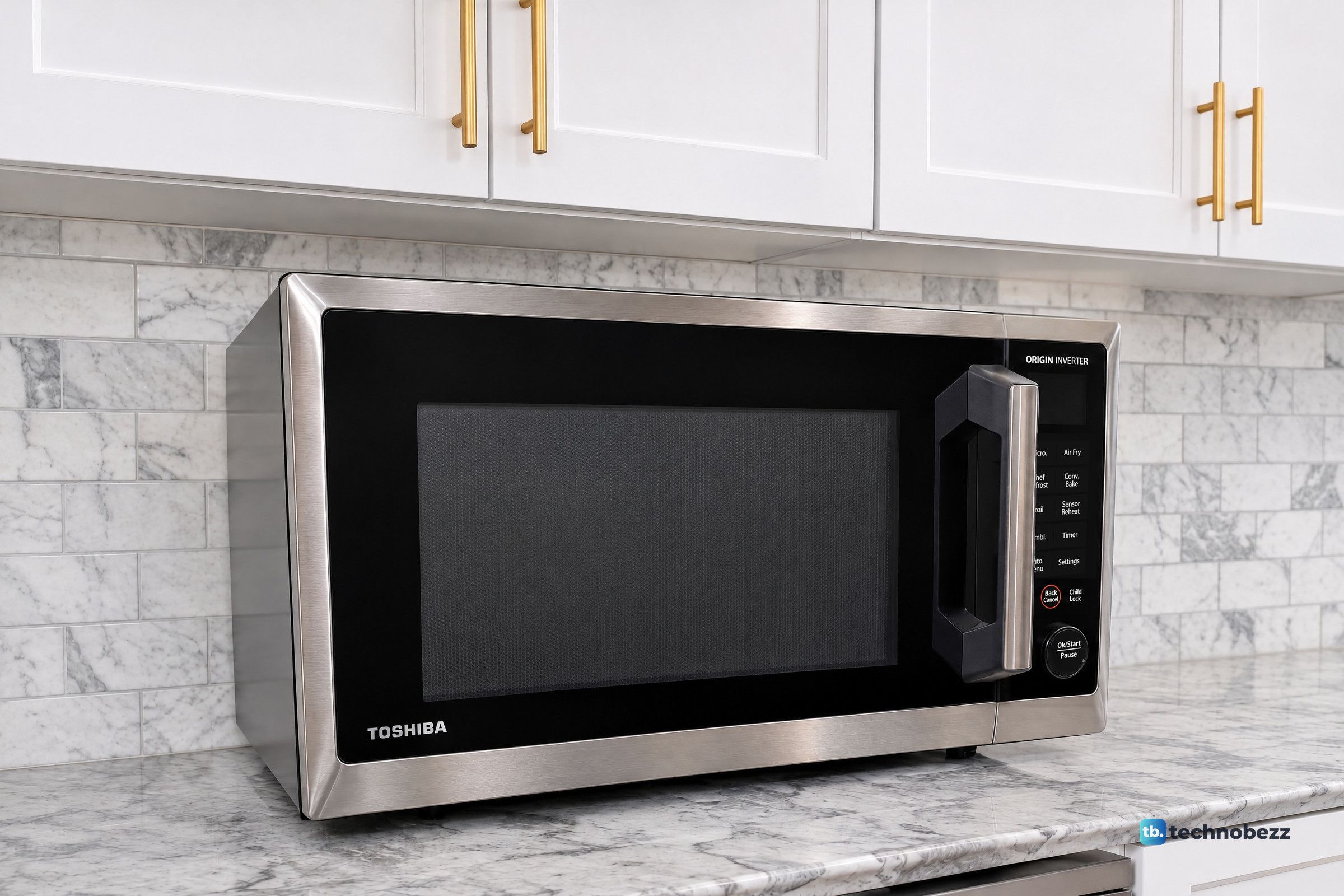
Credit: Technobezz
Get Deals Like These in Your Inbox
The best prices, straight to your inbox.
Add Technobezz on Google:Preferred SourceGoogle Discover
9.2/ 10

Best for Households that want one countertop appliance to replace a microwave and an air fryer, with Combi, convection baking and broiling on top.
TOSHIBA OptiChef Pro Max Air Fryer Microwave Oven
BrandToshiba
ModelOptiChef Pro Max (ML2-STC13SAIT(SS))
Capacity1.3 cu. ft.
Turntable13.58 in glass
Microwave output1,100 W (Origin Inverter)
Input power1,250 W
For one whole weekend, the full-size oven in our kitchen never came on. Saturday started with a bag of popcorn and ended with a tray of glazed wings, a basket of fries and a frozen pizza. Sunday brought salmon, bone-in chicken cooked two different ways, a bowl of reheated pasta, a slice of cheese toast and a tray of chocolate cookies. Every bit of it went through one box on the counter: the Toshiba OptiChef Pro Max.
It's a 1.3 cubic foot microwave that also air fries, convection bakes, broils and runs a Combi mode that pairs microwave power with convection heat. Toshiba calls it a 5-in-1. After a weekend where everyone in my house took a turn at the controls, I'd just call it the most useful thing on our counter.
We cooked the way a busy family really cooks, using the built-in programs when they fit and setting time and temperature by hand when they didn't. I still kept score the whole way through, with a kitchen scale for the food, a timer on every cycle and a probe thermometer for doneness. Here's how it went.
TOSHIBA OptiChef Pro Max Air Fryer Microwave Oven (ML2-STC13SAIT(SS)) - Best All-in-One Countertop Oven
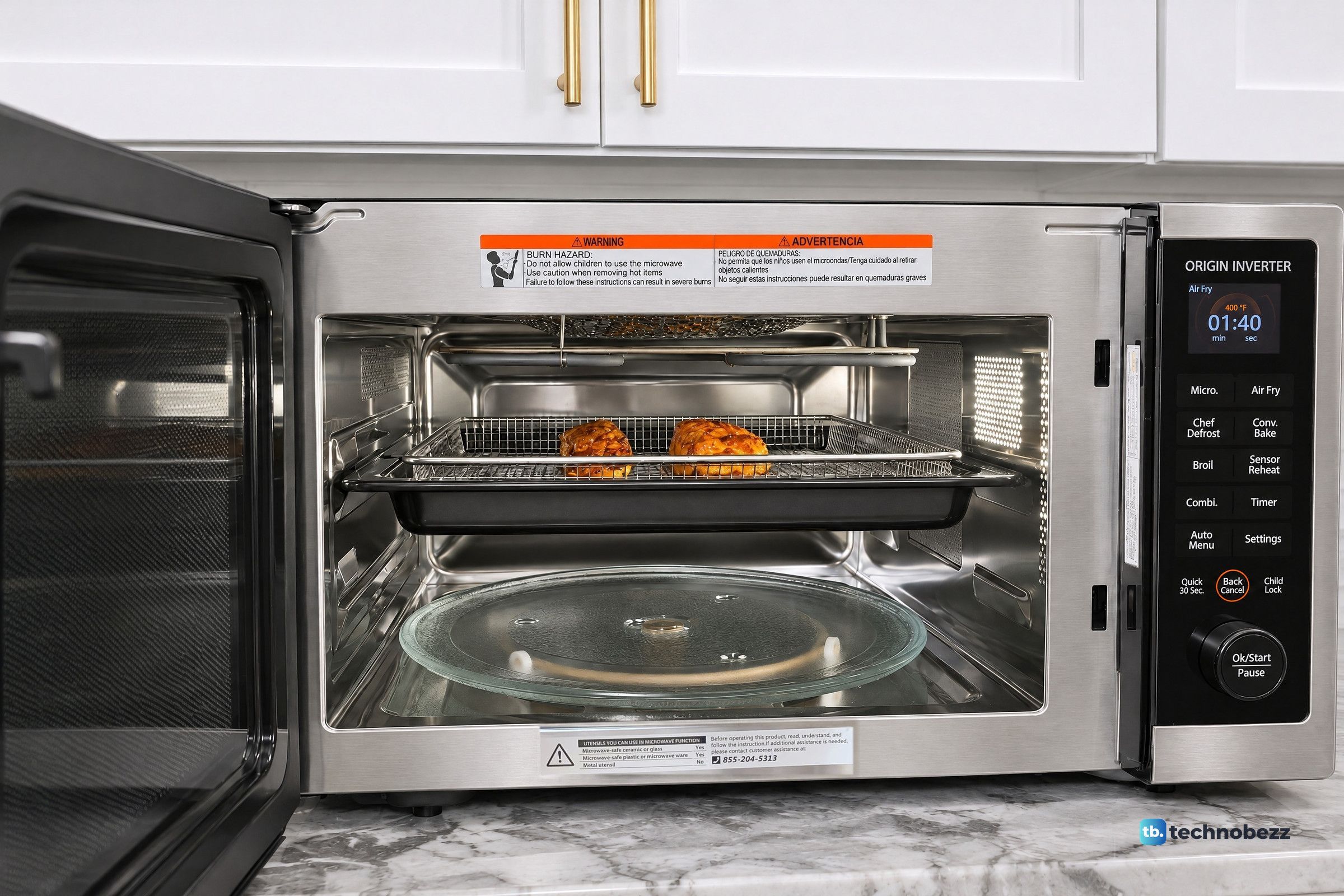
The OptiChef Pro Max is Toshiba's 5-in-1 countertop oven. It pairs a 1,100 W Origin Inverter microwave with ChefFry Plus air frying, convection baking from 100 to 425°F, broiling and a Combi mode, all run from a 2.4-inch color screen, a dial and two columns of one-touch keys. A humidity sensor drives the Sensor Reheat program, and the TSmartLife app adds remote start and cooking alerts.
Key Highlights
- 1.3 cu. ft. cavity with a 13.58-inch glass turntable
- 1,100 W Origin Inverter microwave (1,250 W input)
- ChefFry Plus air frying with a top heating element and fan
- Convection baking from 100 to 425°F, plus Broil and a Combi mode
- Sensor Reheat for 8 to 24 oz portions, guided by a humidity sensor
- 25 Auto Menu programs that show the rack level and accessory on screen
- 2.4-inch color screen, dial and one-touch mode keys
- TSmartLife app on 2.4 GHz Wi-Fi, plus Alexa support
Toshiba is America's No. 1 Countertop Microwave Oven Brand.* Guided by the Japanese Takumi spirit of craftsmanship and the philosophy "Details Matter," Toshiba combines precision engineering, thoughtful design and reliable technology for everyday life.
*Source: Circana, LLC, Retail Tracking Service, US Small Appliances, Dollars, 12 ME Aug 2026.
Pros
- Five cooking methods in one footprint, and everything we made was worth serving
- Combi cooked a bone-in chicken thigh through in 15 minutes, skin already crisp
- Wings came out with properly crisp skin, and fries had a real crunch
- The color screen walks you through each mode, down to the rack level
- Sensor Reheat got cold pasta piping hot with no time or power to choose
- Convection Bake turned out an even tray of cookies at 350°F
- The app mirrors the countdown and sends finish and door alerts
Cons
- Frozen pizza crusts stay soft underneath on Air Fry; the lower rack or Conv. Bake gives a crisper base
- Auto Menu weights come in fixed steps, so in-between amounts need a manual setting
- At about 45 lb and roughly 22 by 18 inches, it wants a permanent spot on the counter
Who It Is For
Families who want one appliance doing the jobs of a microwave and an air fryer, with a second oven on hand for busy weeks and holidays. It fits best in apartments, smaller kitchens and homes where the full-size oven is too much for a weeknight dinner.
Skip if
You only reheat coffee and leftovers, in which case a basic microwave will do. If your counter is tight, Toshiba's smaller 1.0 cu. ft. OptiChef Pro is the one to look at.
Unboxing and Setup Took One Evening
The oven comes with a glass turntable and roller ring, a round wire rack, a black enamel tray and a stainless mesh air fry basket that sits on top of the tray. Setup is quick. Pull everything out of the cavity, peel the protective film off the control panel (it took a fingernail to get the first corner going), drop in the roller ring and turntable, plug it in and set the clock.
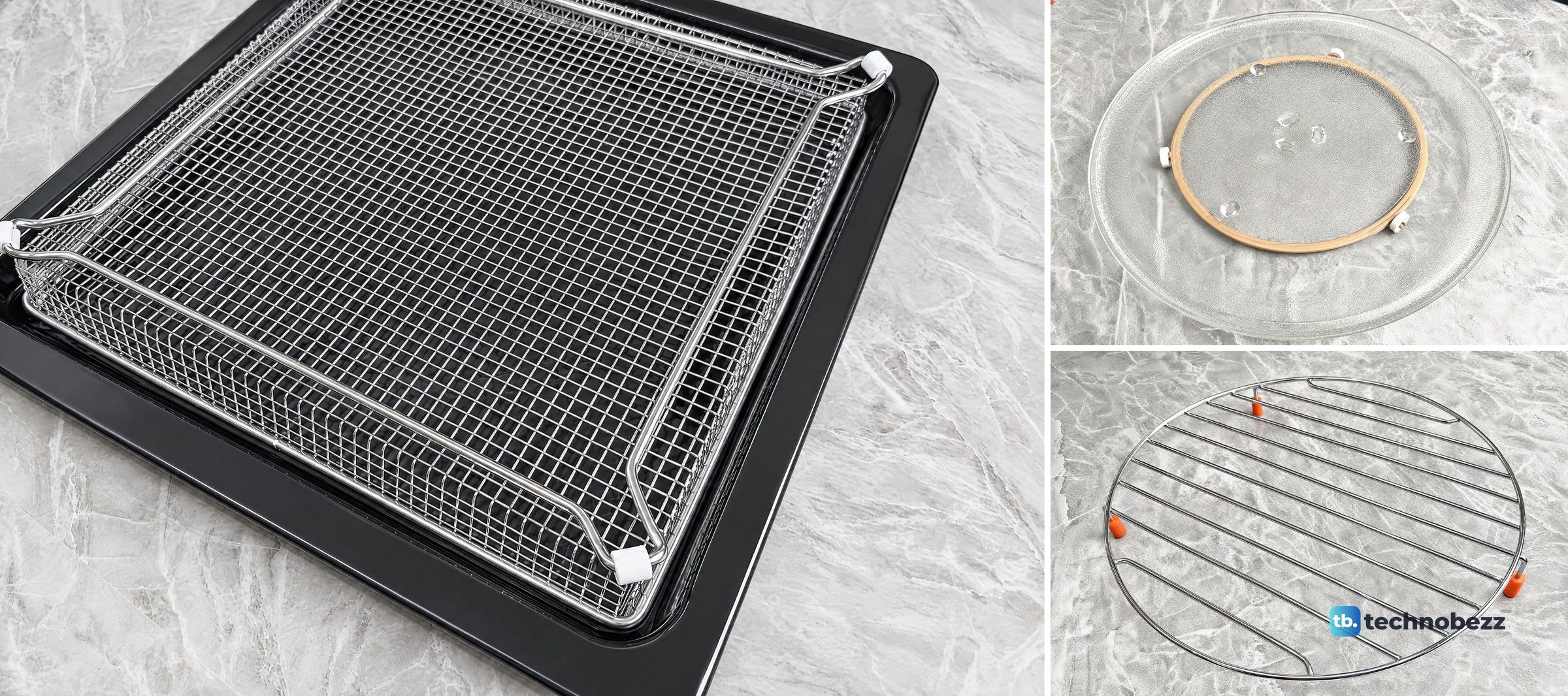
At about 45.2 lb it's a two-handed lift, and once it was down it sat level and solid on our counter.
The first thing everyone in my house asked was which accessory goes with which mode. The manual answers it in one chart, and it's simple once you see it:
- Microwave, Chef Defrost and Sensor Reheat: glass turntable only, no metal.
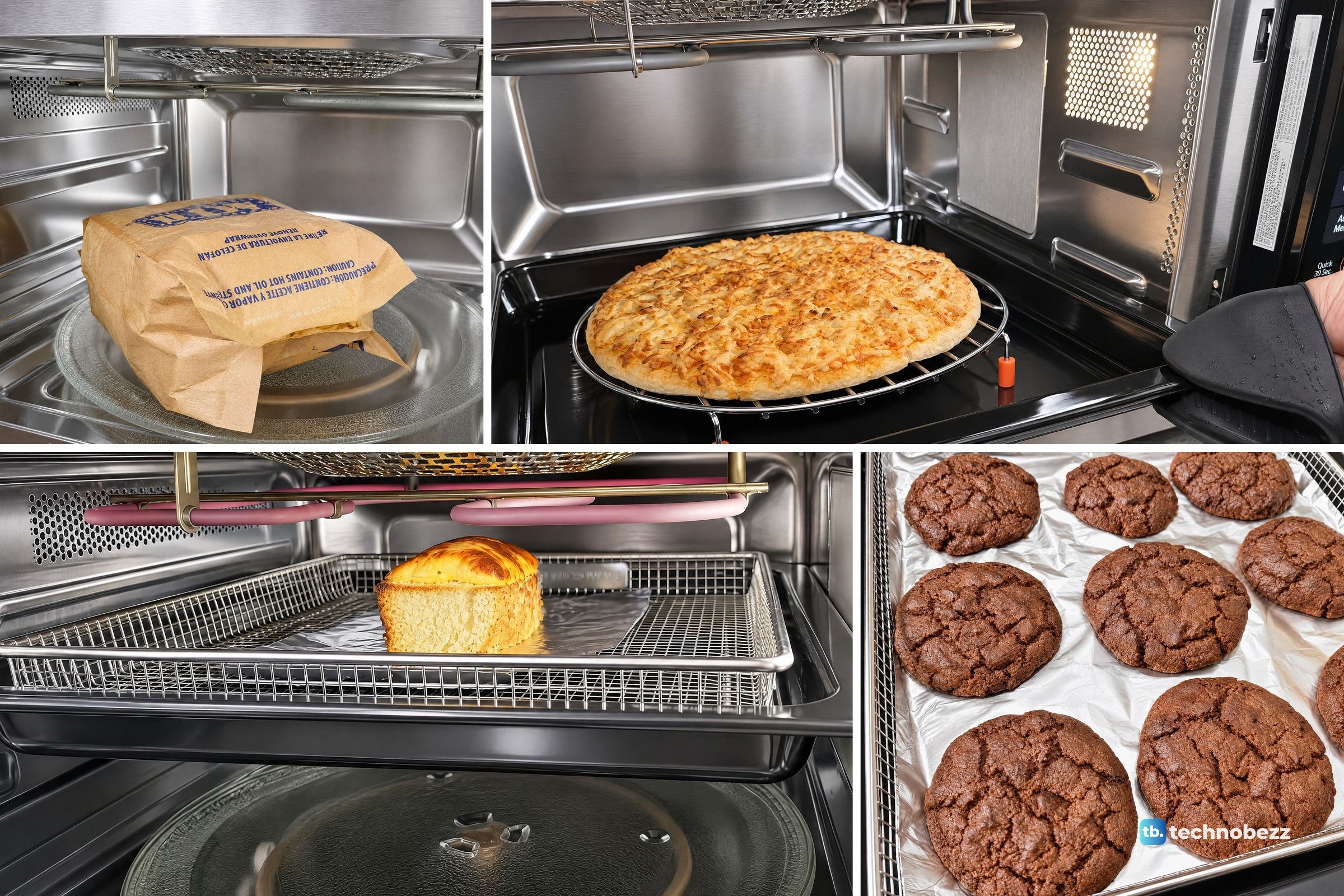
- Air Fry, Convection Bake and Broil: the rack, tray and basket can all go in.
- Combi: the wire rack only, with glass or ceramic dishes.
The Auto Menu programs make it even easier, because the screen tells you the rack level and accessory before you press Start.
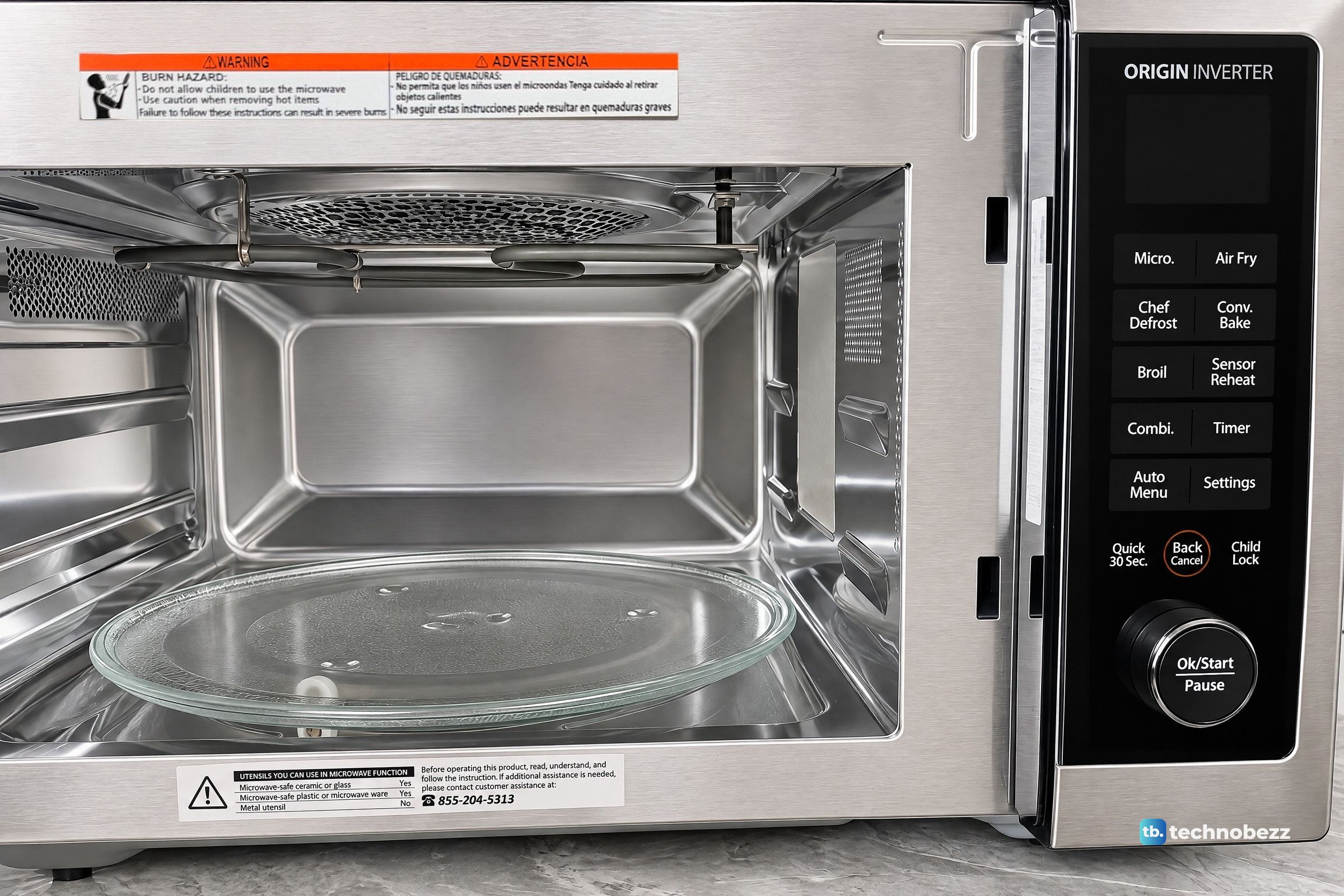
It Looks Like It Belongs on the Counter
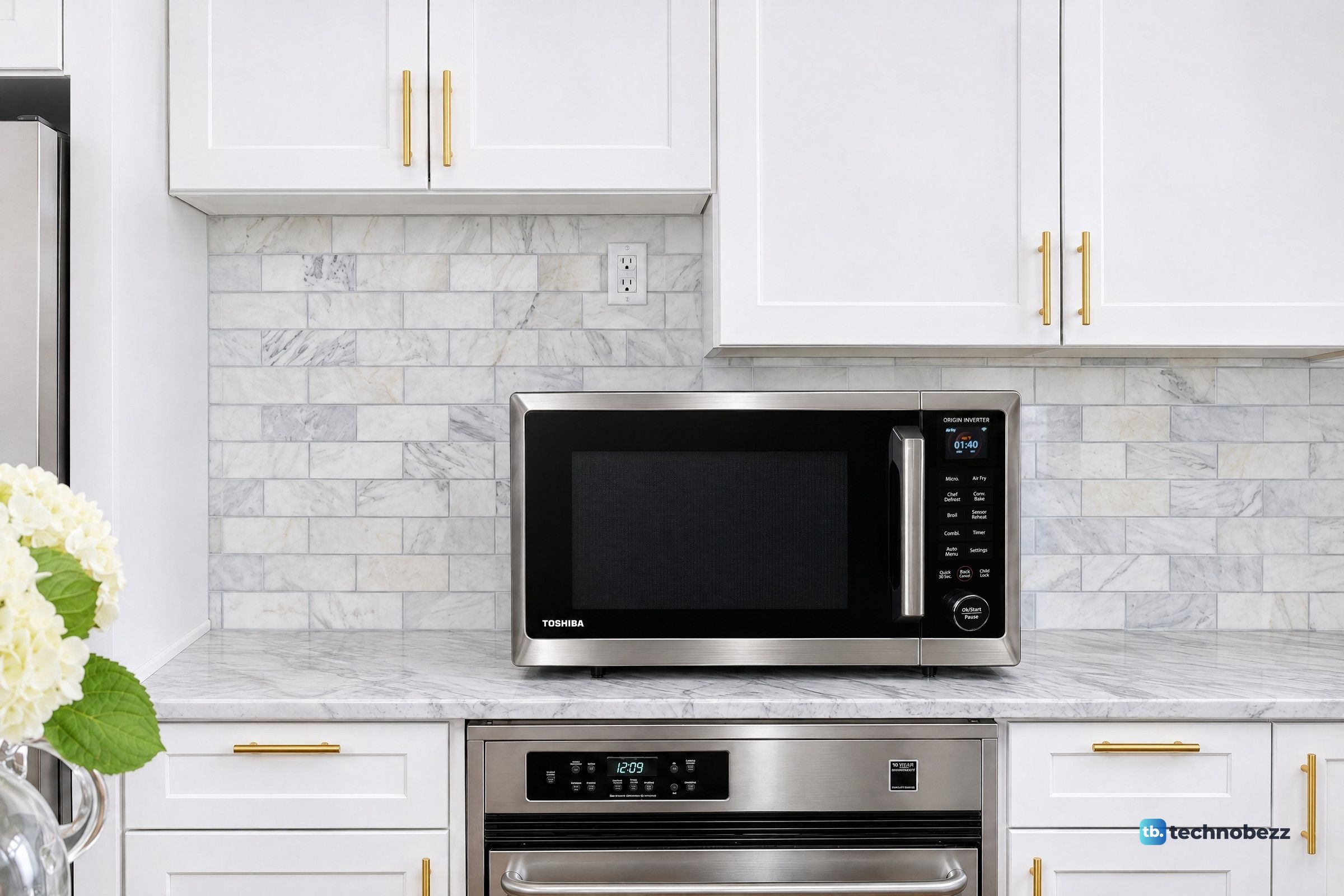
The brushed stainless frame and black glass door look more like a built-in oven than a microwave, and the lit control column on the right gives it a premium look on the counter. It measures 21.8 by 17.8 by 12.8 inches, so plan for a spot a little larger than a typical microwave.
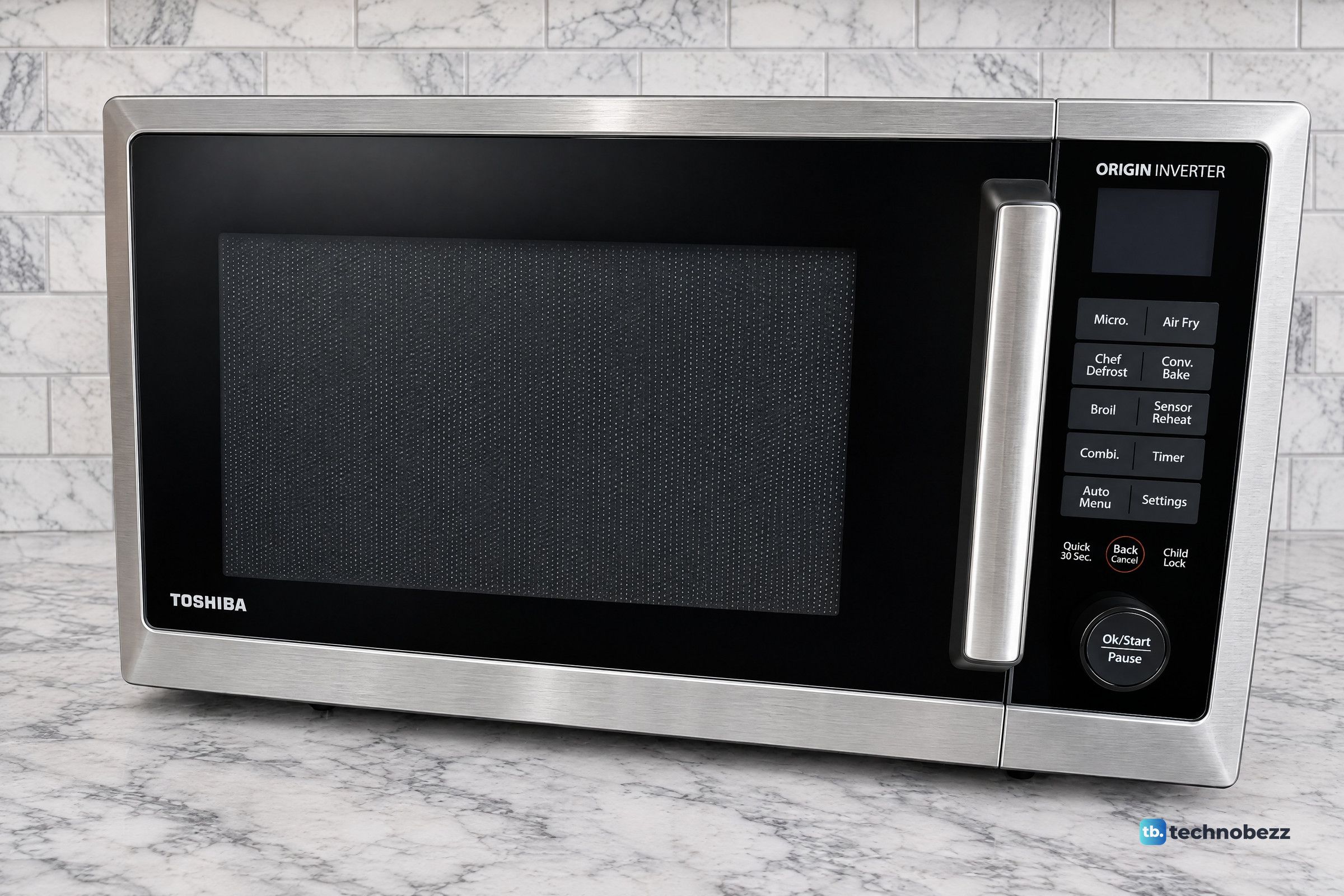
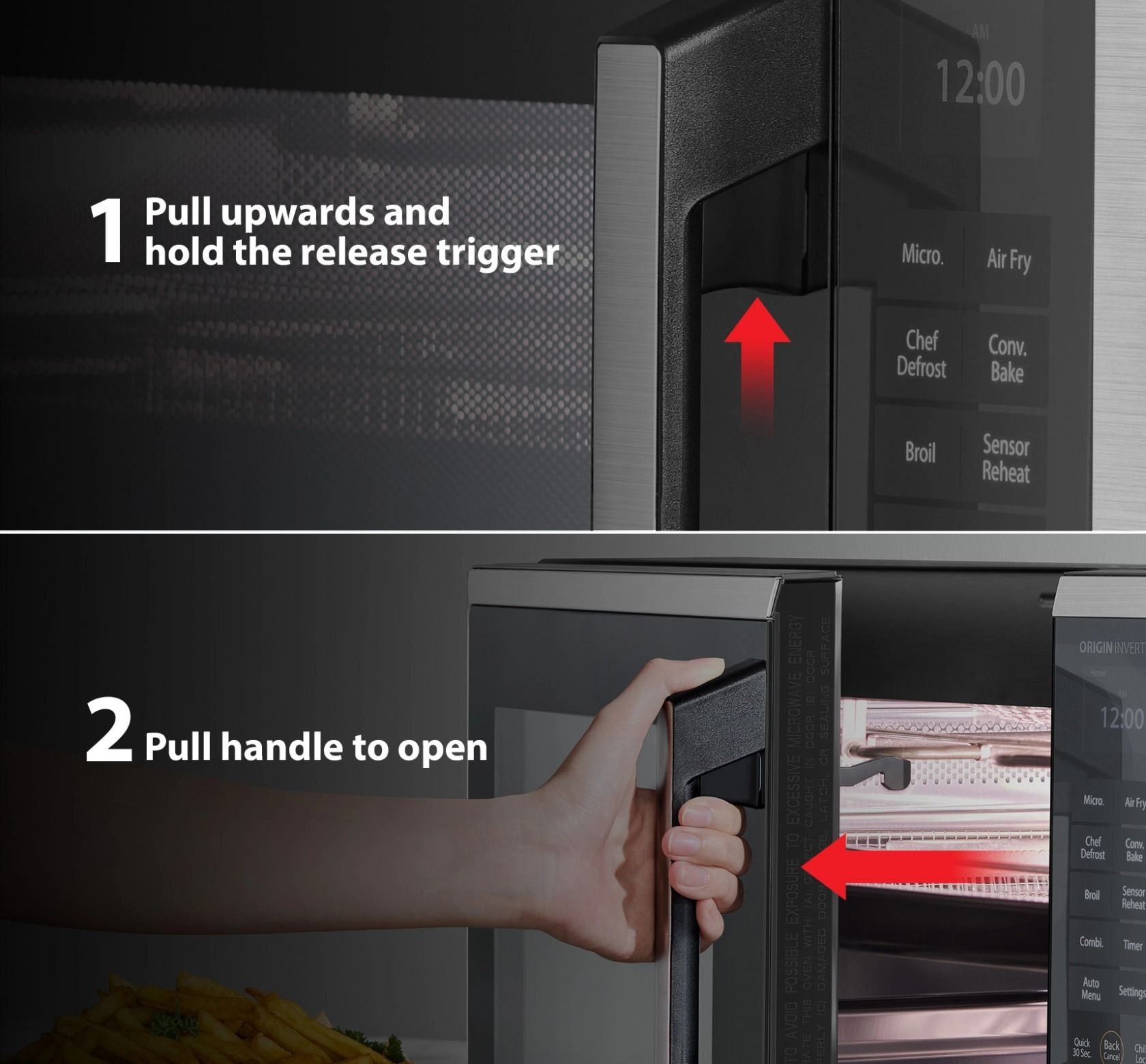
The door opens in two steps: you lift the release trigger in the handle, then pull. It's one small extra step, and it means the door never pops open by accident.
The Color Screen Does the Explaining
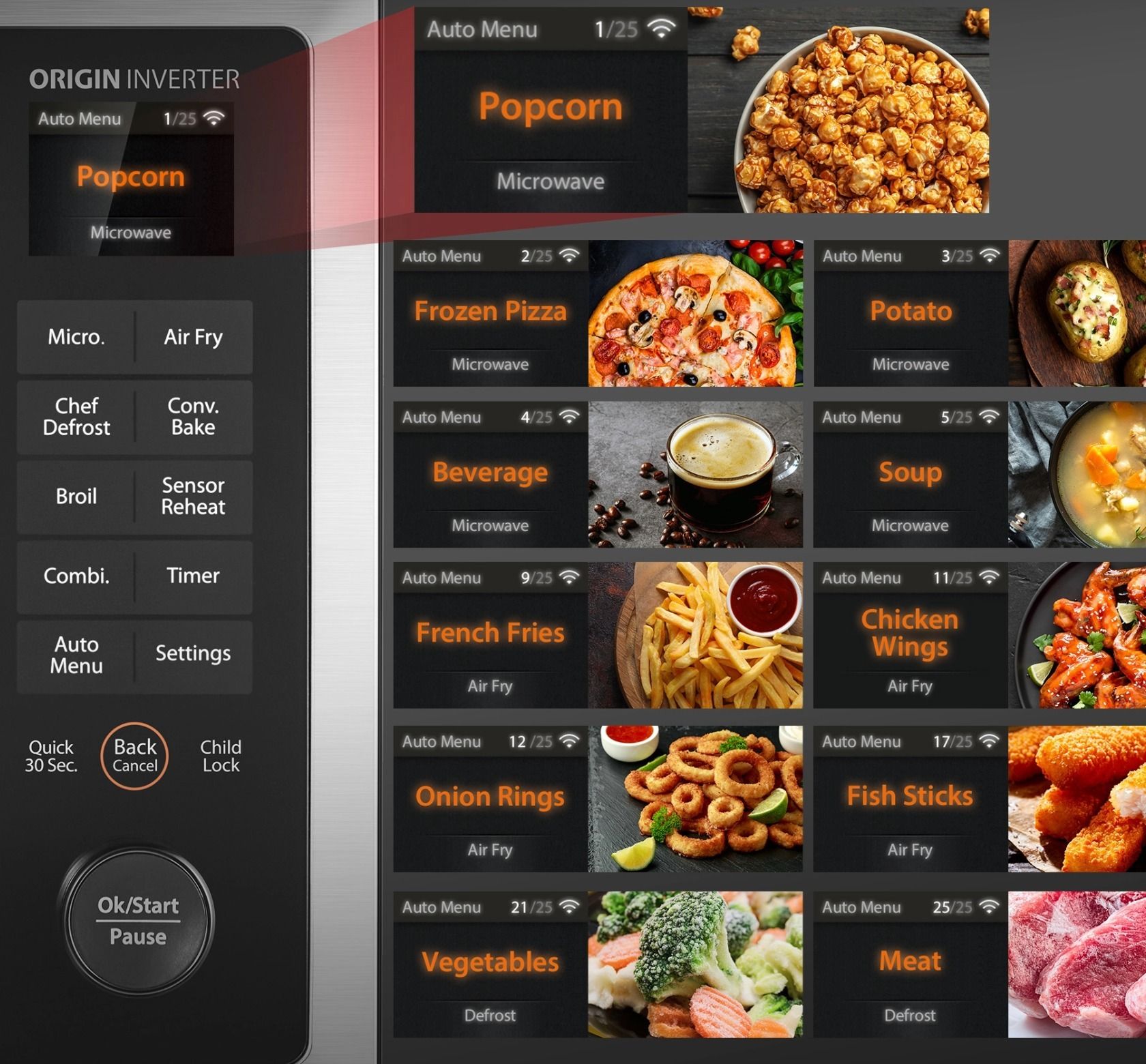
The 2.4-inch color screen sits at the top of the control column, with two columns of keys below it for Micro., Air Fry, Chef Defrost, Conv. Bake, Broil, Sensor Reheat, Combi., Timer, Auto Menu and Settings. Under those are Quick 30 Sec., Back/Cancel and Child Lock, plus a dial with the Ok/Start button in the middle.
A manual Air Fry cycle takes five actions: press Air Fry, turn the dial to the temperature, press it, turn to the time and press Start. The value you're changing shows in big orange digits with the next options above and below, so you always know where the dial is heading. The idle screen is a large clock that stayed easy to read in our bright kitchen.
Auto Menu is where the screen really earns its place. You scroll through 25 numbered programs, pick one, choose the weight, and the screen shows the cook time, rack level and accessory before you start. For chicken wings it showed "Upper Level, Tray + Basket" next to the time.
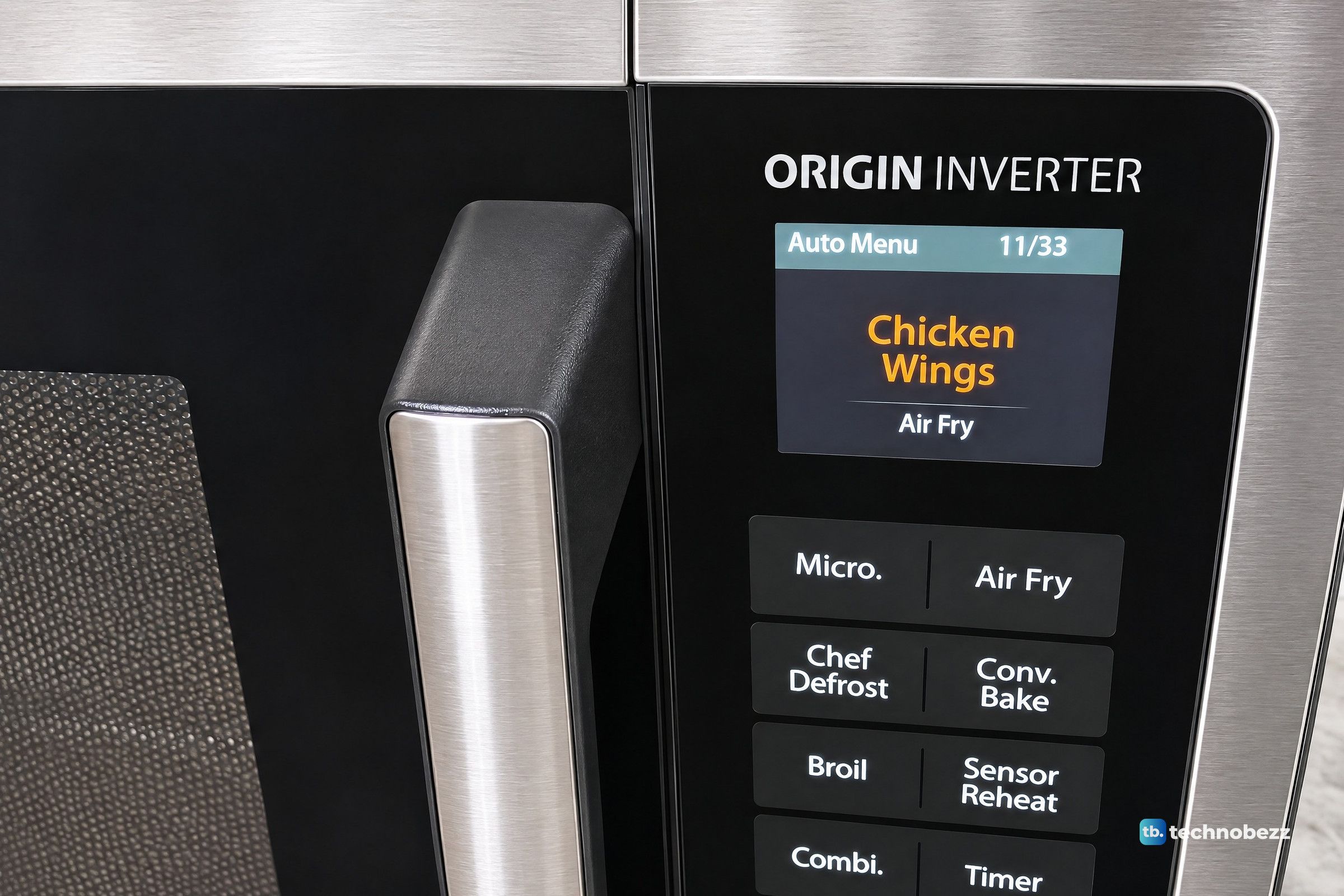
Two small things to know. The weights come in fixed steps, so when my first batch of wings weighed 14.4 oz and the choices were 9, 18 or 26 oz, I set it by hand instead. And there's no number pad, so every time is set with the dial. It quickly became second nature, and Quick 30 Sec. covers the most common microwave job with one press.
Starting Fries From My Phone
The OptiChef Pro Max connects to Toshiba's TSmartLife app over 2.4 GHz Wi-Fi, and pairing took about four minutes. I started a batch of fries from my phone at Air Fry, 400°F for 15 minutes, and the countdown in the app matched the oven's own display to within a second.
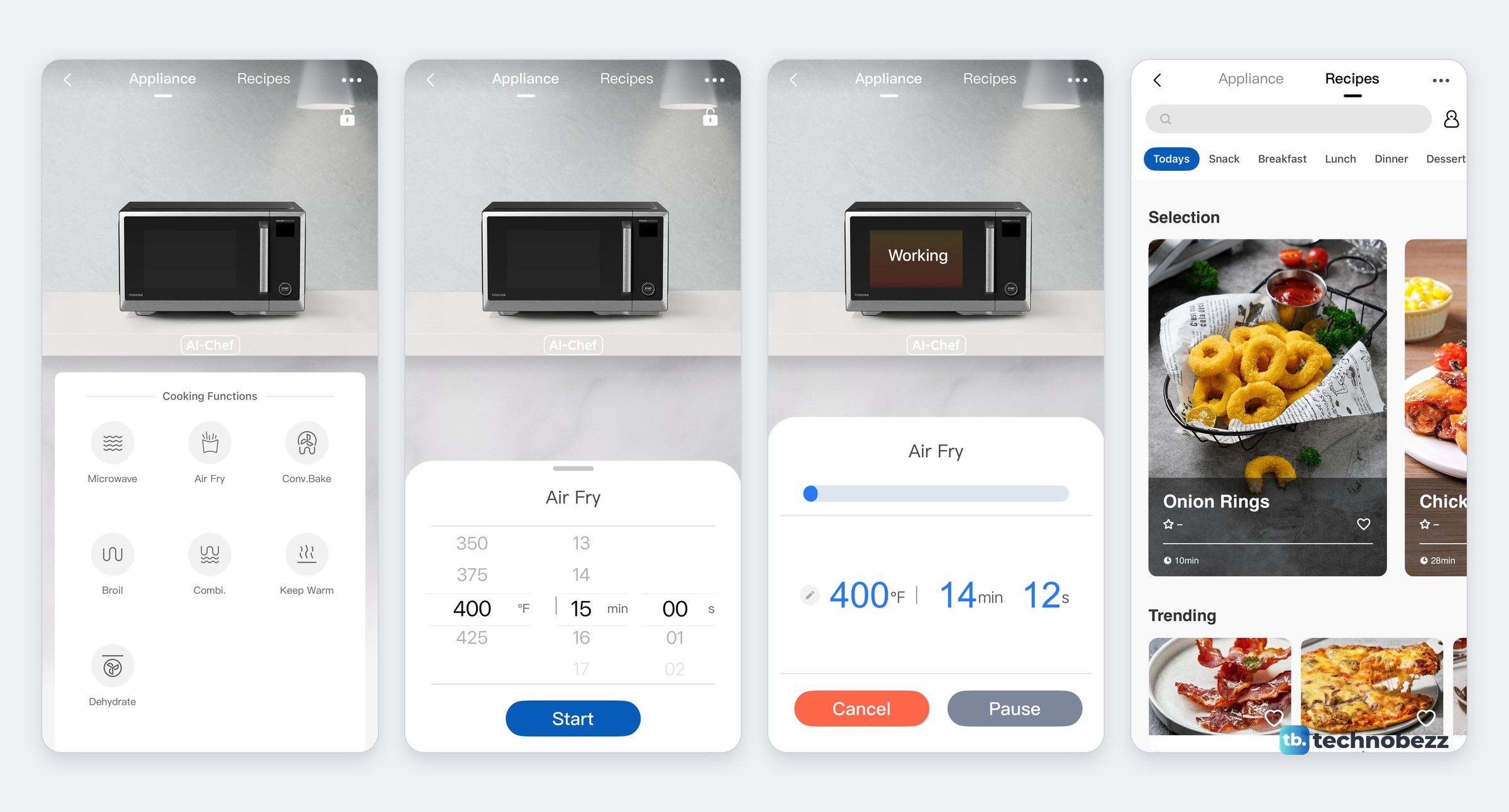
The app goes beyond remote start. It adds Keep Warm and Dehydrate modes that aren't on the control panel, has a recipes tab, and sends genuinely useful alerts: a three-minute warning, a "cooking finished" note and a heads-up when the door is left open. Toshiba also lists Alexa support, which we didn't set up.
A Weekend of Cooking, Dish by Dish
For every dish I noted the food, the amount, the mode, the settings and the time. Unless I say otherwise, nothing needed extra time.
Quick Microwave Jobs: Popcorn and Defrost
Saturday kicked off with a standard microwave popcorn bag on the glass turntable at High for about two minutes. It came out fully popped, with only a handful of unpopped kernels and no scorched smell. Movie night snacks, sorted.
Next came a frozen bone-in chicken thigh. I weighed it at 8.0 oz and chose Chef Defrost, then Weight, then 8 oz. A few minutes later it was thawed through, with just one thin edge starting to cook, which is normal for microwave defrosting. We cooked it straight away, as food safety guidance recommends.
Wings That Came Out Properly Crisp
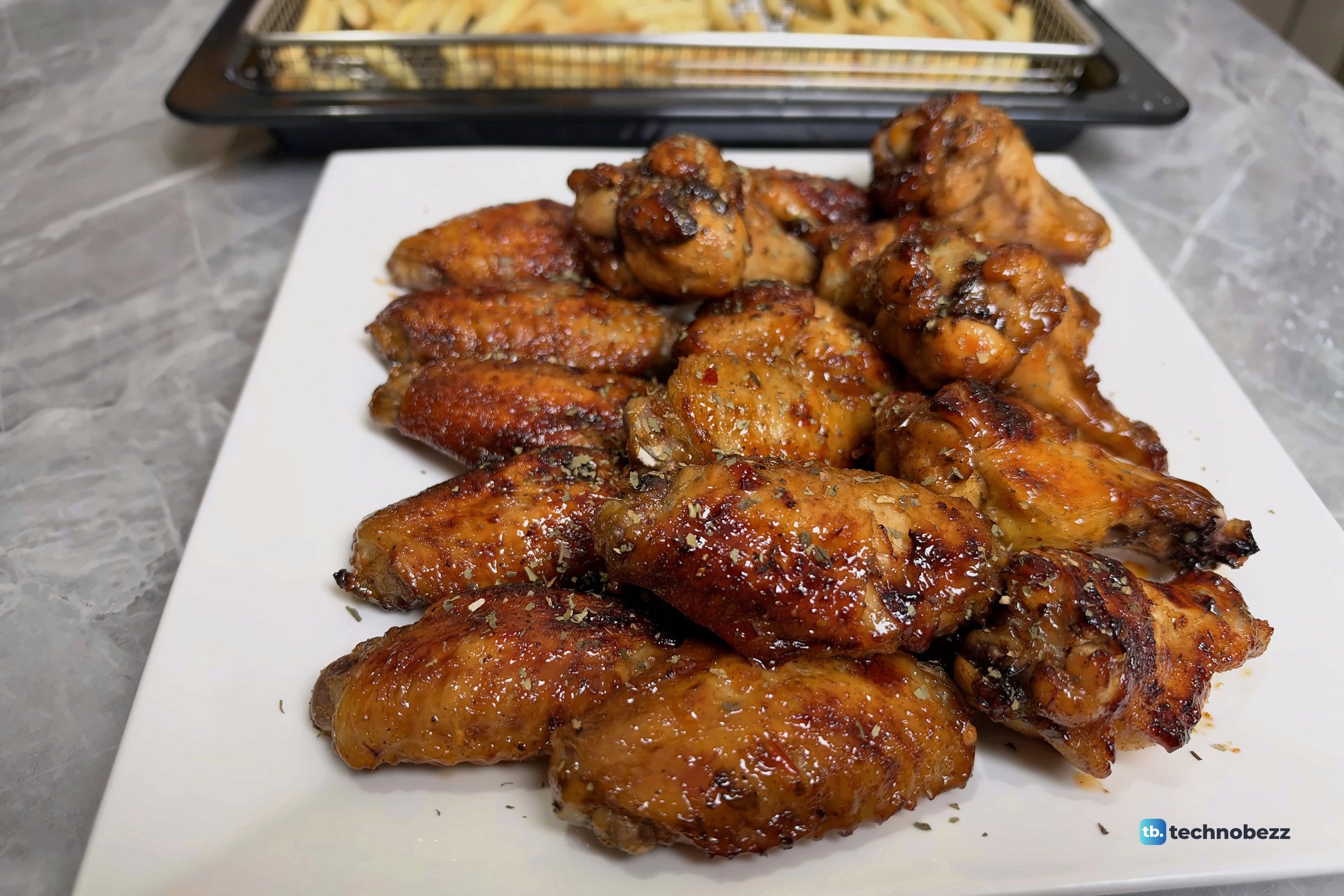
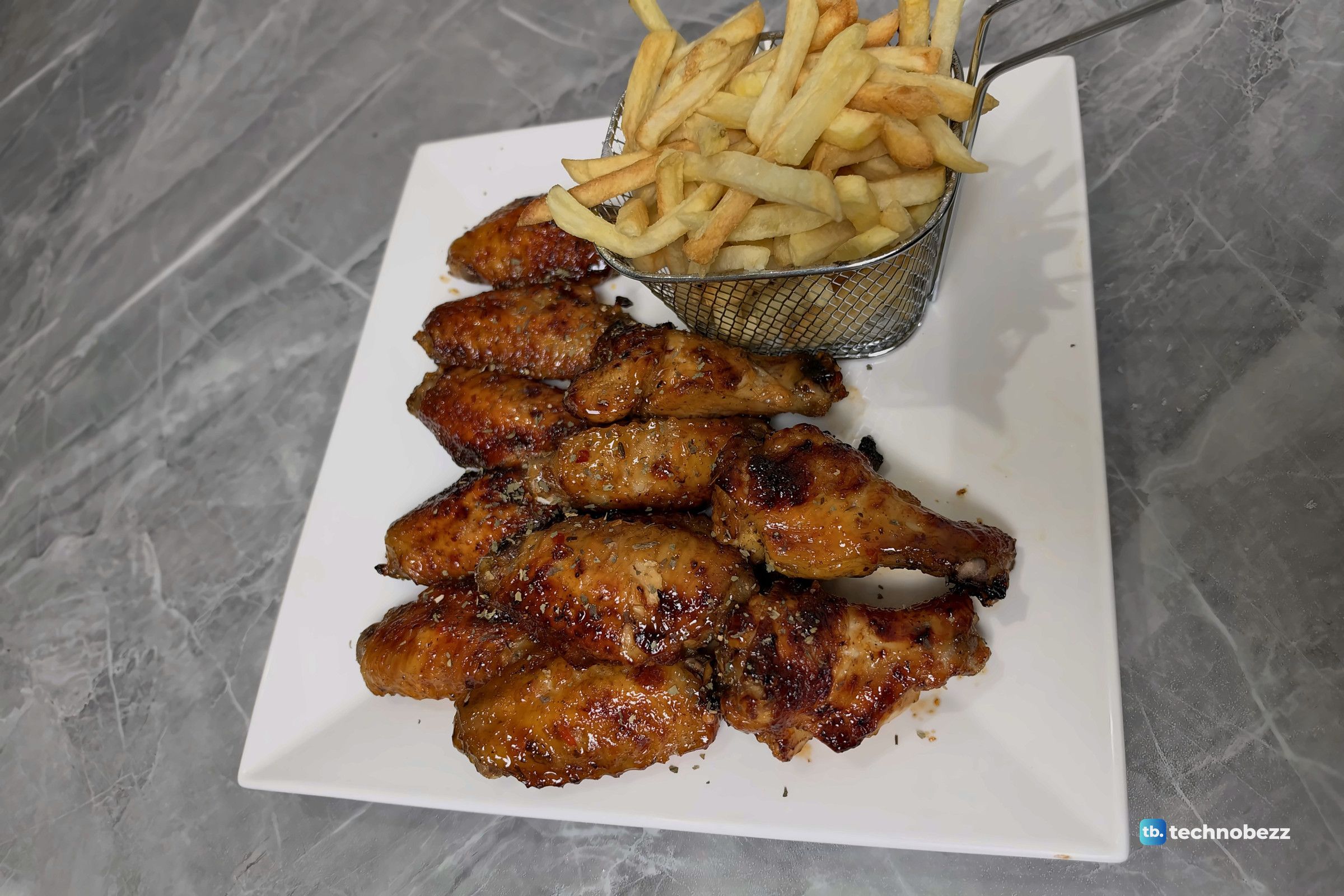
Wings were the dish I was most curious about, so we went big. About 22 pieces went on the basket over the enamel tray at the upper level, at Air Fry, 400°F for 22 minutes, turned halfway. They came out browned and crisp with juicy meat, and the probe read 169.7°F in the thickest piece.
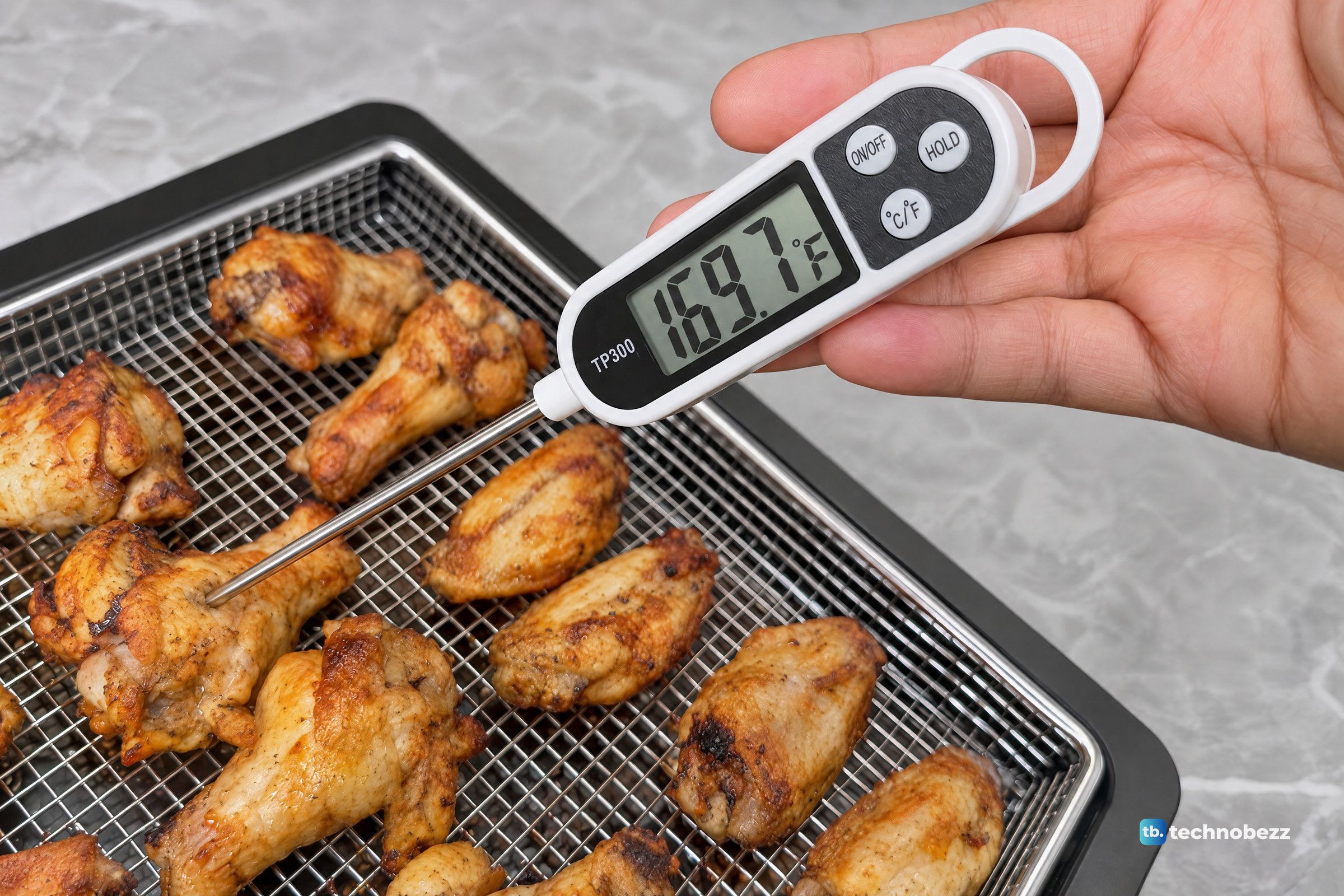
After a toss in glaze, a short second round set the sauce without softening the skin.
Fries, Straight From the Bag
Frozen fries went onto the basket in one layer at Air Fry, 400°F for 15 minutes, started from my phone. They came out golden and crunchy.
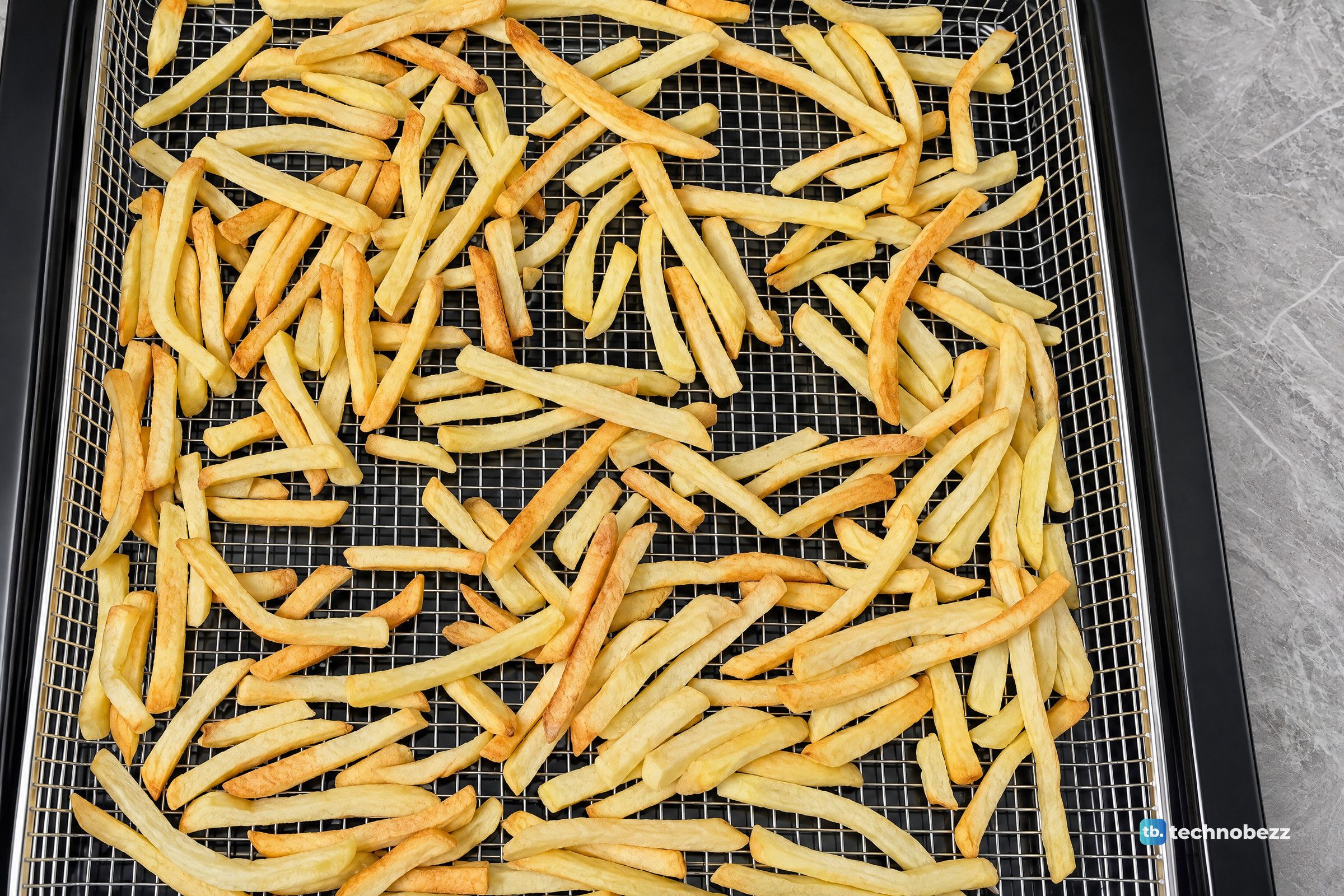
The ones in the middle were a shade lighter than the edges, so a quick shake halfway is worth doing.
Frozen Pizza, and the One Thing I'd Change
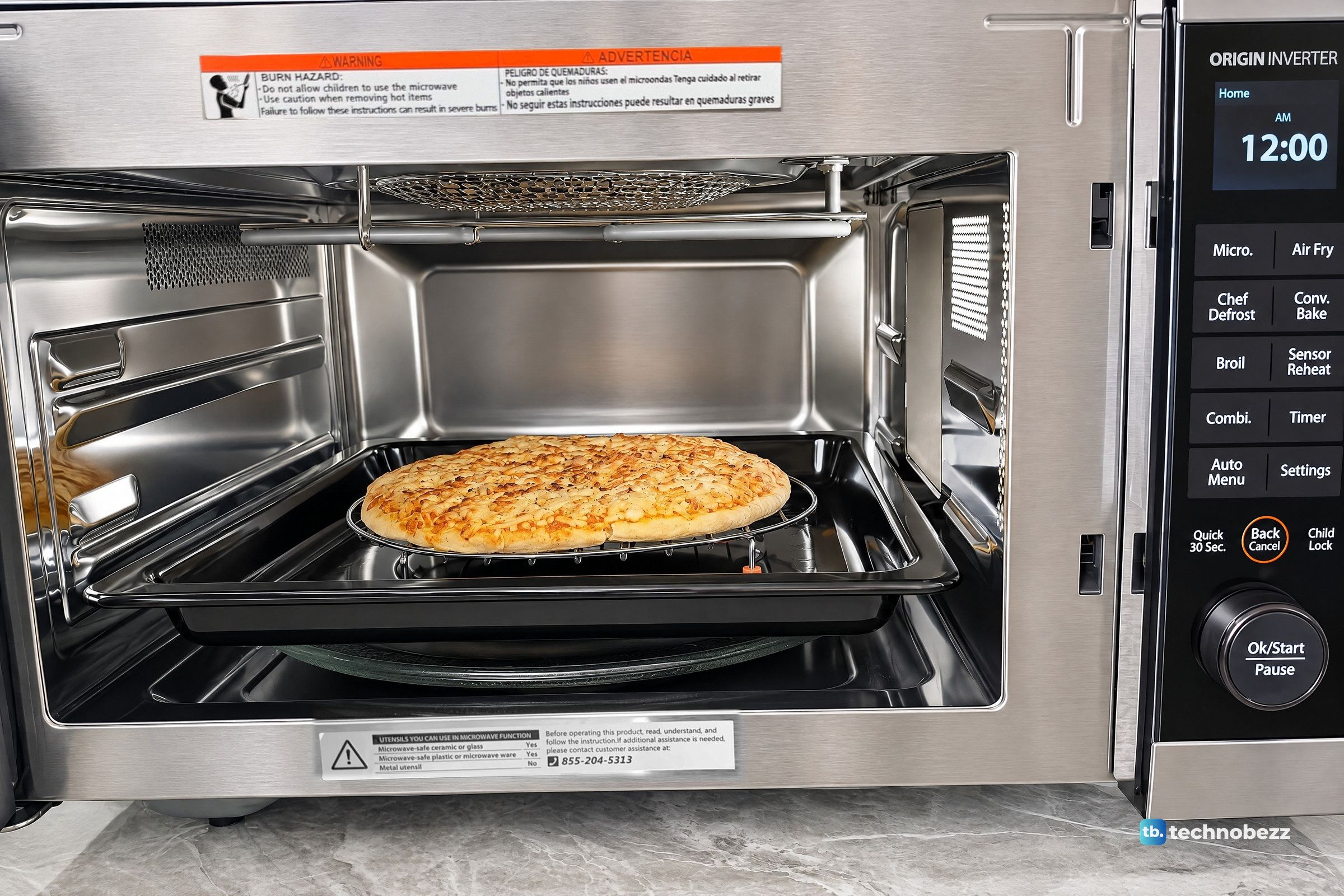
A frozen cheese pizza went on the round wire rack over the enamel tray at Air Fry, 400°F for 12 minutes. The top came out evenly golden with fully melted cheese. The crust underneath stayed soft rather than crisp, so next time I'll use the lower position, add a few minutes, or switch to Convection Bake with preheat for a crisper base.
Salmon From Partly Frozen
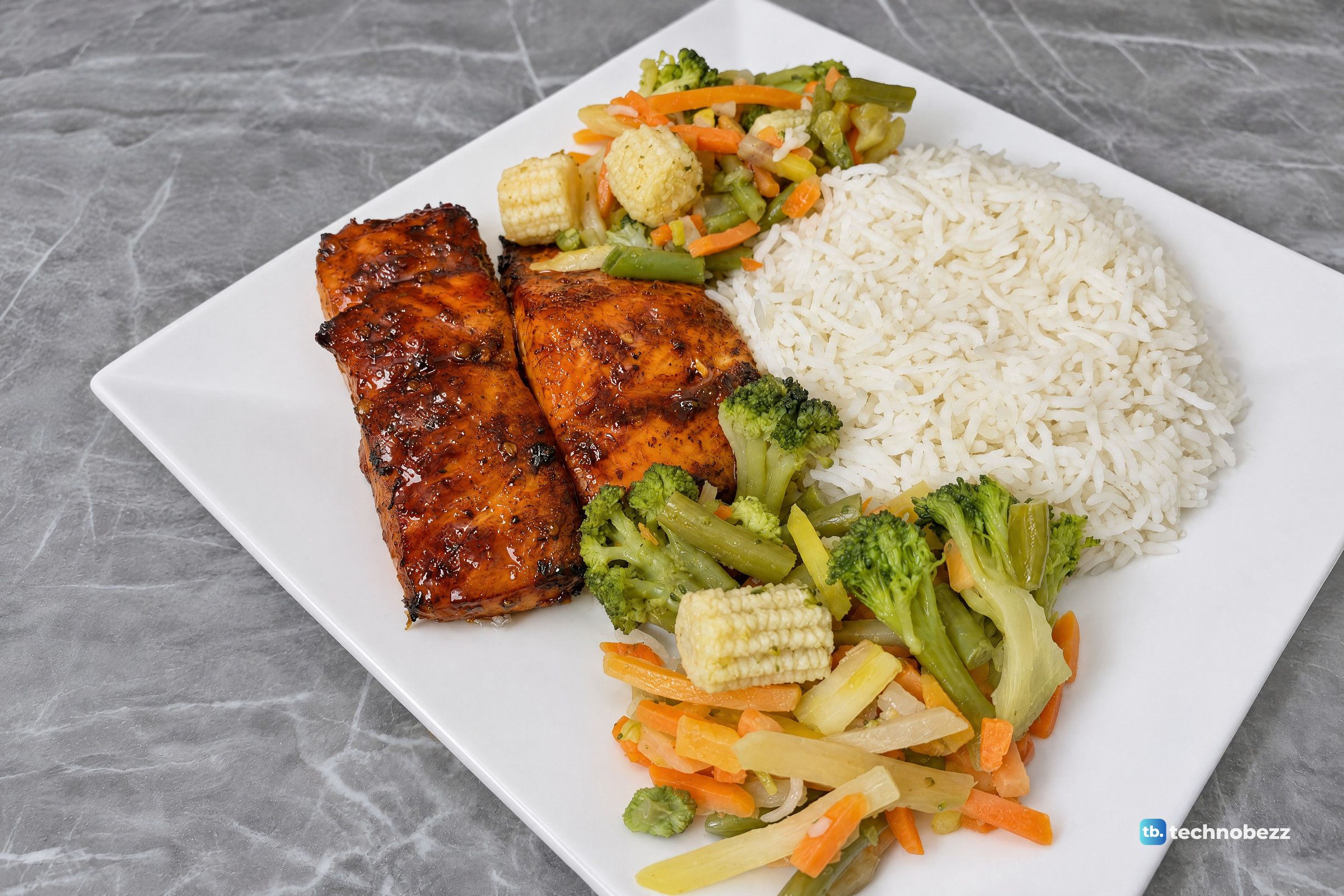
Two seasoned and glazed salmon fillets, still partly frozen, went in at Air Fry, 400°F. I gave them about 20 minutes, and the glaze caramelized beautifully at the edges. That was longer than they needed, though: the probe read 165 to 168°F, well past the 145°F guideline, so the fish was firm rather than silky. That's on my timing, not the oven. For fillets this size I'd check at 12 to 14 minutes.
Combi vs Air Fry on the Same Chicken
This was the test that told me the most. We split a pack of bone-in chicken between two modes. On Air Fry, two thighs and three drumsticks went on the basket at around 375°F, lowered to 350°F partway, for 22 to 25 minutes in total. They reached about 170°F with crisp, well-browned skin.
On Combi, a single 4.9 oz thigh went on a ceramic plate on the turntable, since Combi allows no metal pans, and on the control panel Combi asks only for a time. I set 15 minutes. It came out cooked through to the bone with skin that was already crisp and deeply browned, so it didn't need the air fry finish I'd planned.
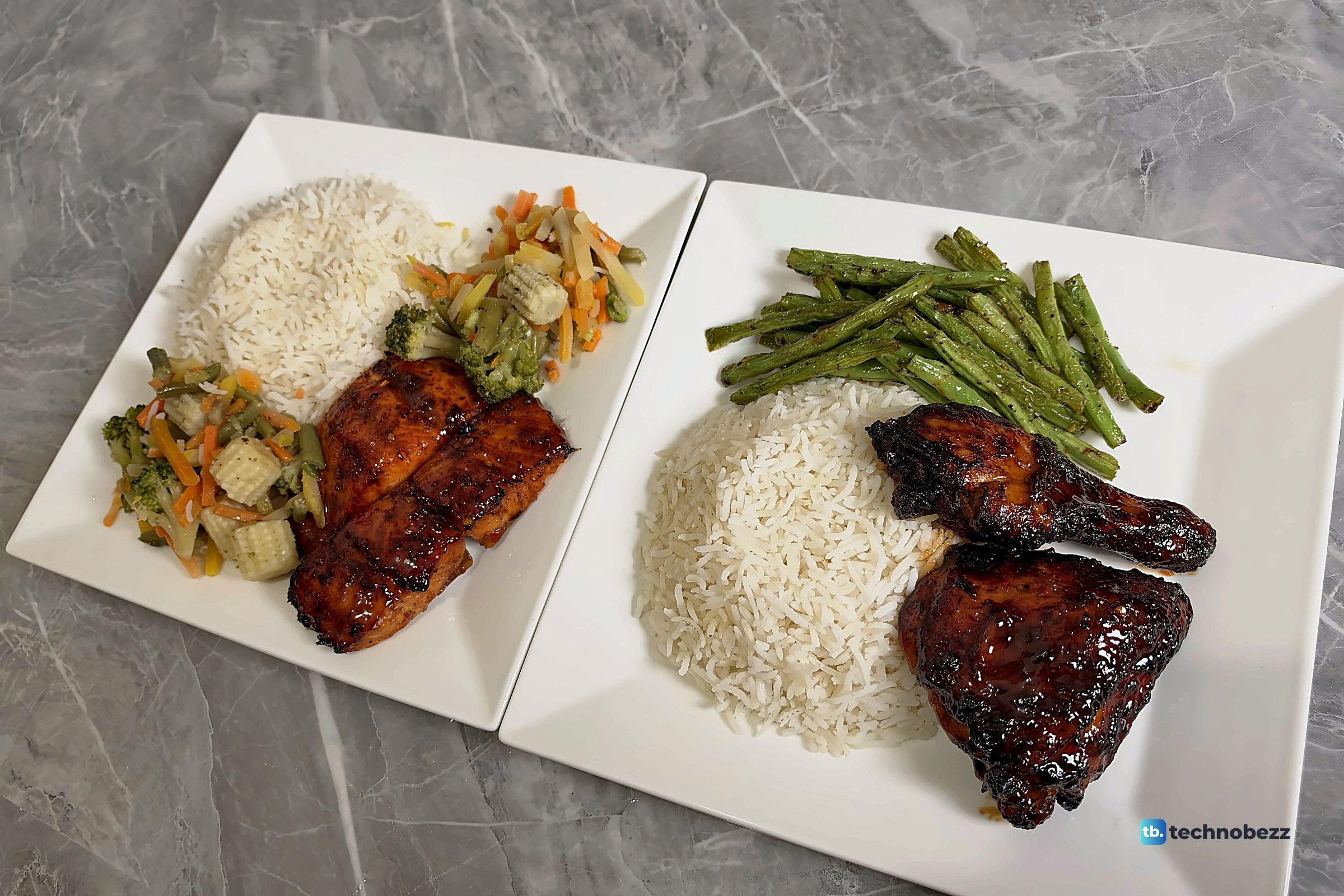
The pieces weren't identical, so this isn't a stopwatch race, but the pattern was clear. Air Fry gives the most control over browning across a full basket. Combi is the faster route for one or two portions, because the microwave heats the meat from the inside while the convection heat browns the outside.
Leftover Pasta, by Hand and by Sensor Reheat
Leftover penne in a creamy herb sauce, straight from the fridge, went into a ceramic bowl at Microwave High for a few minutes, with no stirring. The probe read 172.5°F in the middle of the bowl, and the sauce stayed creamy.
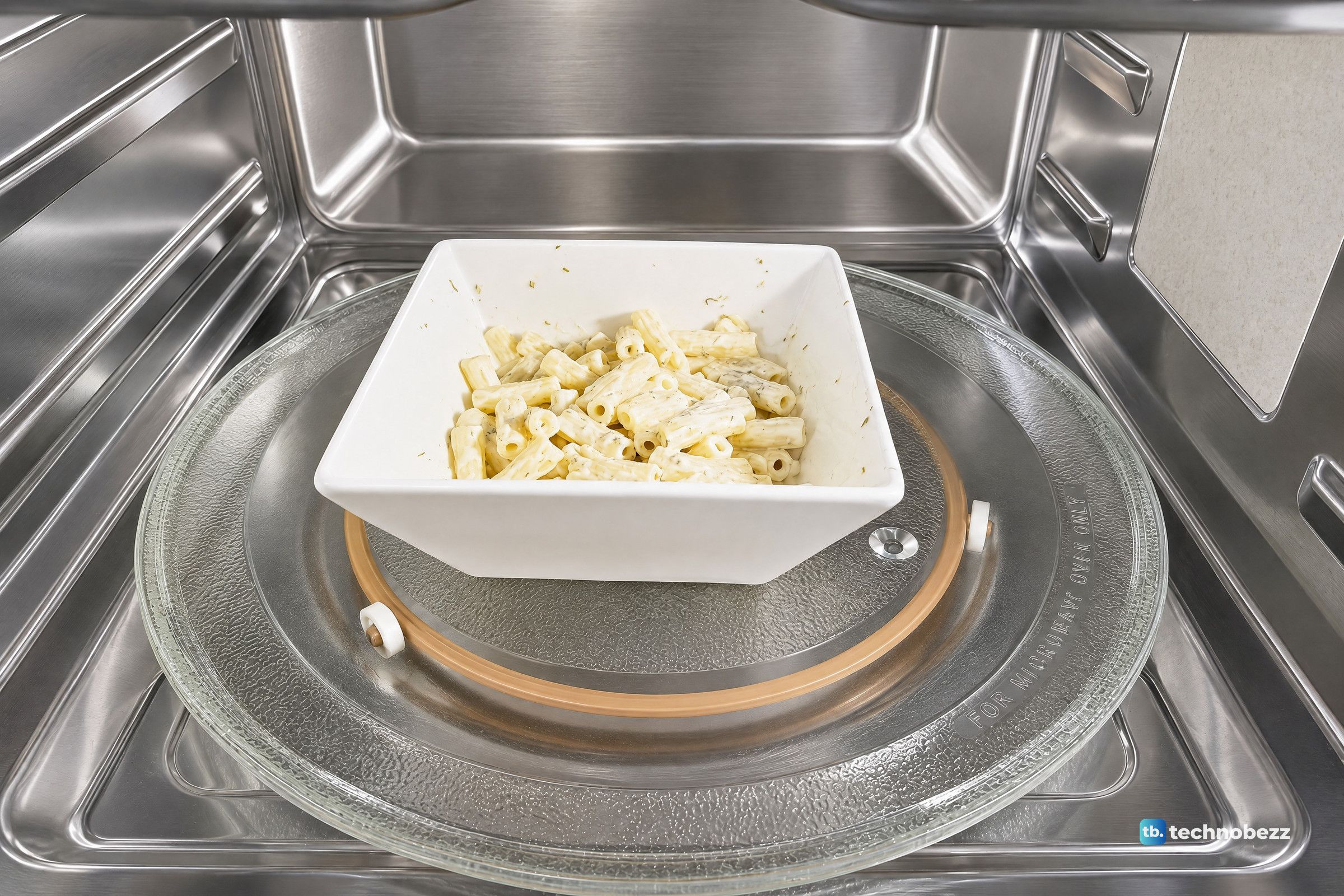
Then I tried a second bowl on Sensor Reheat, the program the manual ties to the humidity sensor. It covers 8 to 24 oz portions. You press Sensor Reheat, then Start, keep the door shut while it senses, and it works out the time itself.
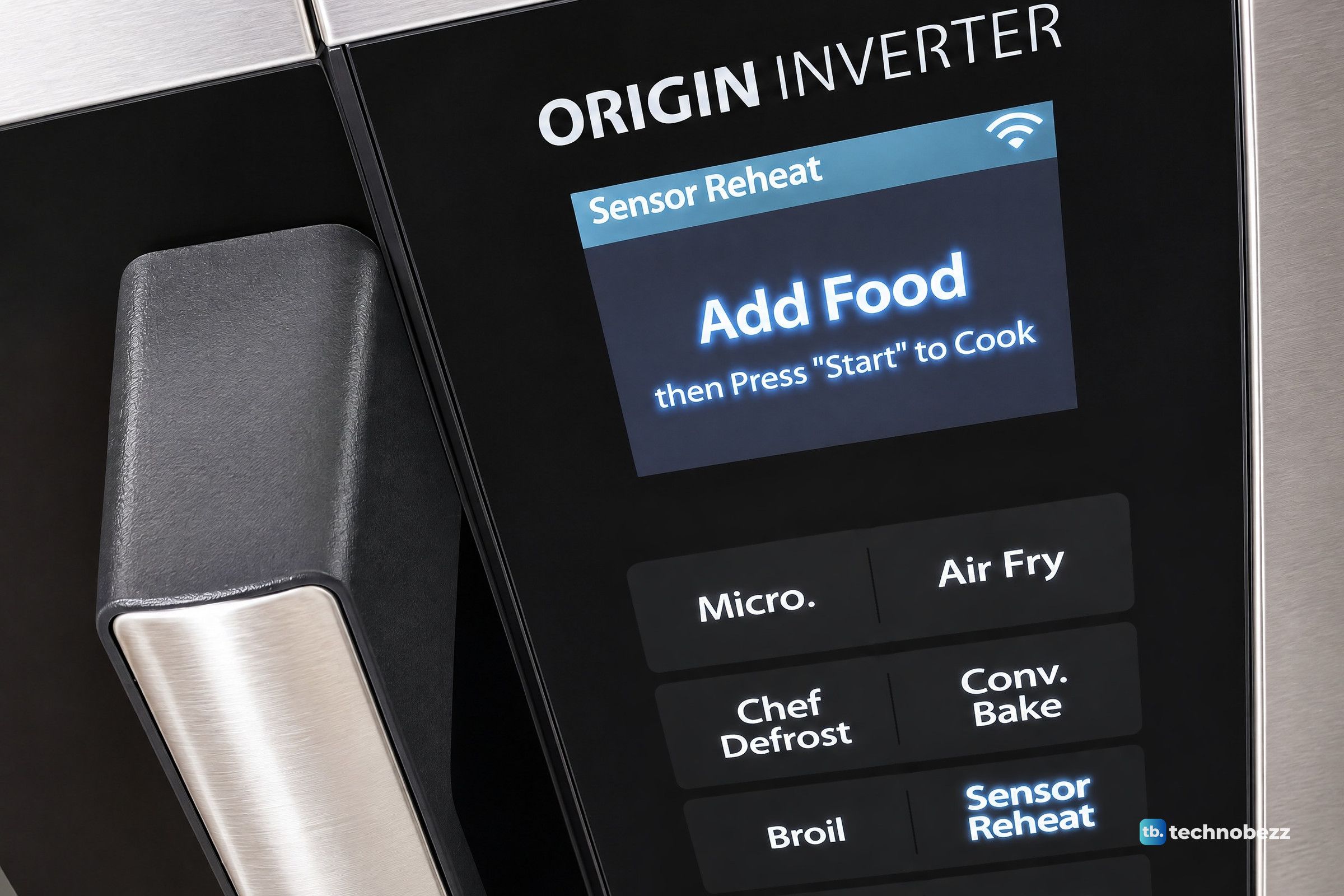
I didn't set a time or a power level. It settled on 3 minutes, and the pasta came out at 191 to 194°F across several readings. Sensor Reheat leans hot, which is the right direction for leftovers, and nobody had to guess at minutes.
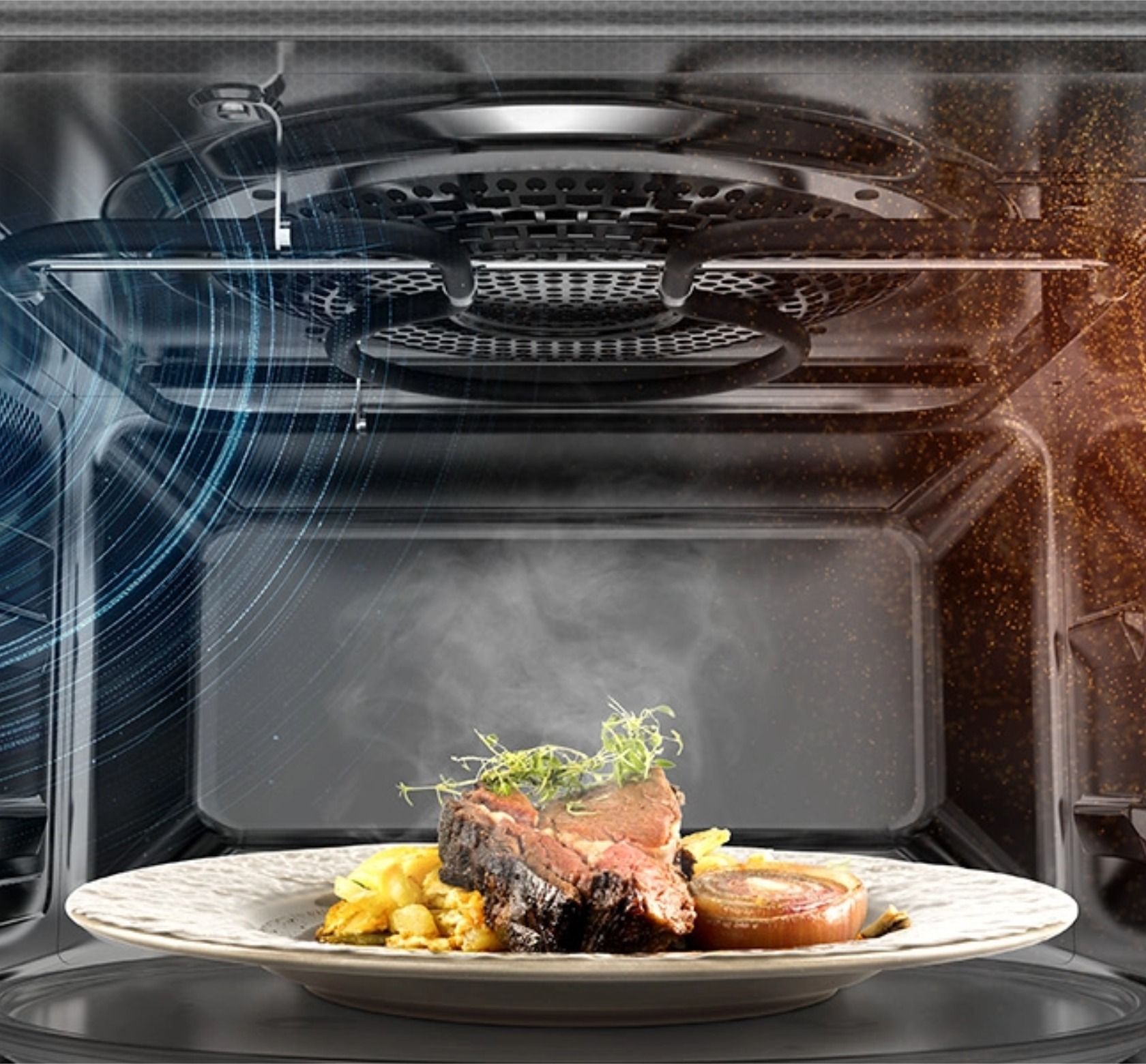
Cheese Toast Under the Broiler
A thick slice of bread with cheddar went on the basket and tray at the upper level, close to the top element, on Broil for 3 minutes. The cheese melted and blistered and the bread toasted underneath. Broil works fast, so for a lighter golden finish I'd check it a minute sooner.
A Tray of Chocolate Cookies to Finish
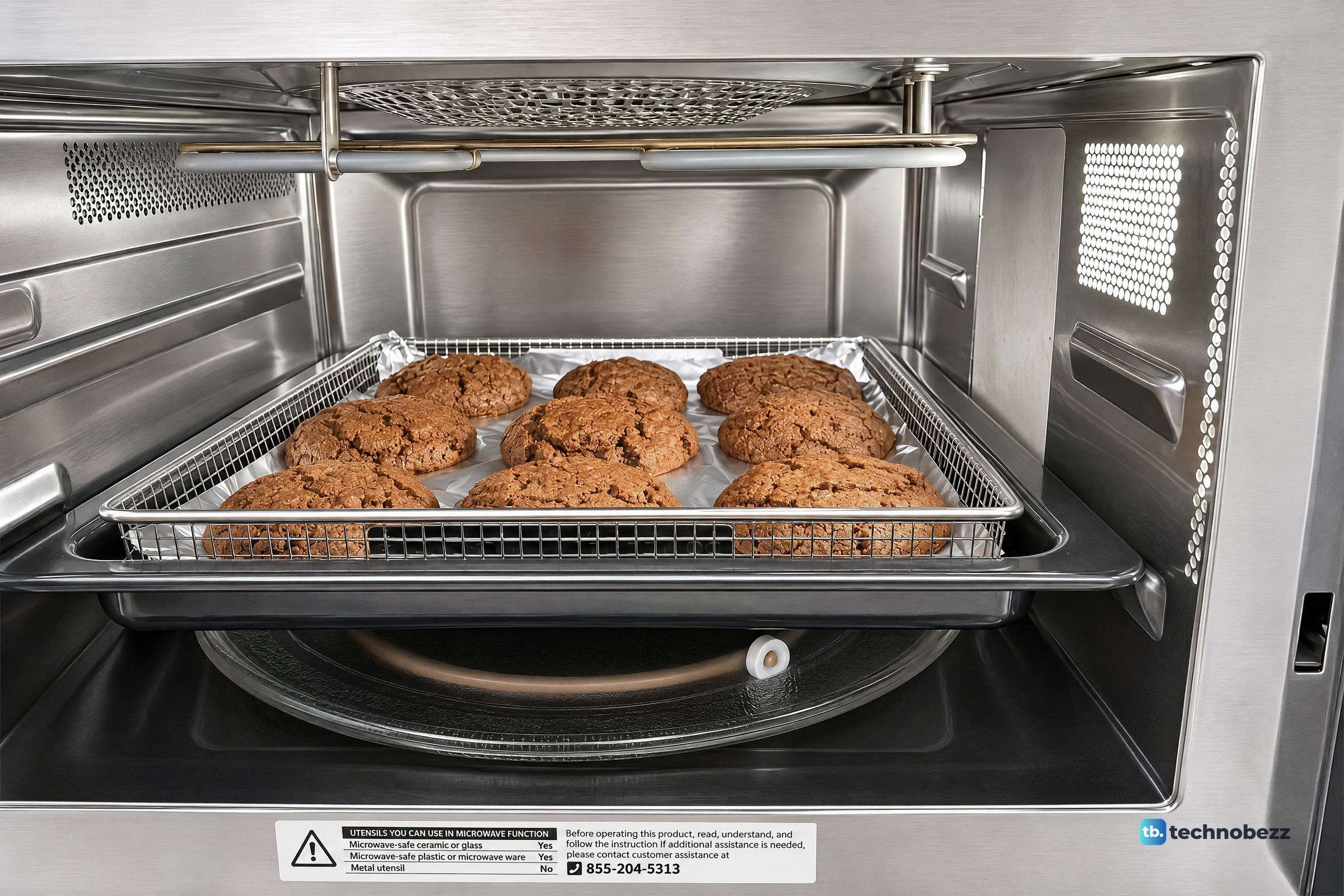
Nine balls of chocolate cookie dough went onto foil on the basket and tray. I set Convection Bake to 350°F with preheat, and the screen shows "Preheating" with an orange progress bar until it's ready. The cookies were done in about 8 minutes, spread evenly, with crackled tops and set edges. The ones in the corners looked just as done as the ones in the middle, which is exactly what you want from the convection fan. Nine cookies is a full tray for this cavity, so a big holiday batch means a few rounds.
What I Cook in It, and the Settings I Start With
These are the settings that worked for us, as a starting point. A thermometer has the final say: 165°F for poultry and 145°F for fish.
- Popcorn: standard bag on the glass turntable, Microwave High for about 2 minutes, or the Popcorn program.
- Leftovers: a ceramic bowl on the turntable, Sensor Reheat, then Start, with the door closed while it senses.
- Frozen chicken thigh: Chef Defrost by weight (8 oz for one thigh), then cook it right away.
- Wings: basket on the tray, upper level, Air Fry 400°F for about 22 minutes, turned halfway.
- Frozen fries: one layer on the basket, Air Fry 400°F for 15 minutes, shaken halfway.
- Frozen pizza: round rack over the tray, Air Fry 400°F for about 12 minutes, lower position for a crisper base.
- Salmon fillets: Air Fry 400°F, checked from 12 minutes.
- One or two chicken thighs: ceramic plate on the turntable, Combi for 15 minutes.
- Cookies: basket and tray, Convection Bake 350°F with preheat, about 8 minutes.
- Cheese toast: upper level, Broil for 2 to 3 minutes.
A Second Oven When the Holidays Fill the Main One
Everything we cooked that weekend maps straight onto a holiday kitchen. Wings, fries and pizza cover the appetizer table while the big oven handles the main event, and the basket held about 22 wings in one batch. Combi cooks a bone-in thigh in 15 minutes, which is the kind of speed that rescues a late guest's plate. Convection Bake handles a tray of cookies, and Sensor Reheat turns the leftovers from the big meal into lunch without anyone choosing a setting.
As a gift, it makes the most sense for someone in an apartment or a smaller kitchen, someone replacing an old microwave, or anyone running a microwave and an air fryer side by side who would like that counter space back.
Living With It, and Cleaning Up
The one habit to build is swapping accessories. Microwave modes want all the metal out, while the heating modes use the rack, tray and basket, so we kept them stacked beside the oven between cycles. After air frying or baking, the cavity and the top element stay hot for a while, so use oven mitts and give it a few minutes before microwaving anything in plastic, as the manual advises.
A weekend of wings, salmon and chicken left the expected grease on the enamel tray. The tray and the basket that held the glazed wings took the most scrubbing, which is no surprise after a sticky glaze. The stainless cavity held up well: mostly clean, with only a few light marks after two days of air frying, baking, broiling and microwaving.
My Verdict After a Weekend of Family Cooking
By Sunday night we'd stopped thinking of it as a microwave. The Toshiba OptiChef Pro Max did five jobs and did them well: crisp wings and fries, chicken through to the bone in 15 minutes on Combi, a quick and even defrost, a tray of evenly baked cookies, and leftovers that came out piping hot on Sensor Reheat without anyone choosing a setting. The color screen and its guided Auto Menu programs meant everyone could use it, not just me.
The things to know are small and practical. Pizza crusts crisp better on the lower rack or Conv. Bake, Auto Menu weights come in steps, and it needs a generous spot on the counter. For a family that wants one appliance in place of two, and a second oven when the holidays arrive, it's an easy one to recommend.
Rating: 9.2/10, Best All-in-One Countertop Oven
Frequently Asked Questions
Can the OptiChef Pro Max replace a standalone air fryer?
For what we cooked, yes. Wings came out crisp, fries were golden and crunchy, and the basket held about 22 wings in one batch.
What does Combi mode do?
It runs microwave and convection heat together, so food cooks from the inside while the outside browns. It cooked a bone-in chicken thigh through in 15 minutes for us.
Does it need Wi-Fi?
No. Everything works from the control panel. The TSmartLife app is optional and connects over 2.4 GHz Wi-Fi.
How is it different from the OptiChef Pro?
The OptiChef Pro is the smaller sibling, with a 1.0 cu. ft. cavity against the Pro Max's 1.3 cu. ft., so it suits tighter counters.
Add Technobezz on Google:Preferred SourceGoogle Discover
More reviews
Review
Six Months With the ZimaBoard 2, and We Now Run Two of Them
Review
The FlexiSpot Foldable Walking Pad Disappears When You Need the Space Back
Review
Three Wyze Gadgets That Quietly Get the Job Done
Review
The Technics EAH-A1000 Trades Thrills for All-Day Comfort, and It Works
ReviewThe Bose Ultra Open Earbuds (2nd Gen) Sound Like Headphones That Aren't ThereReviewMaono G3 Puts Your Whole Stream Mix Under Four FadersReviewThe Maono PD500W Keeps Recording Even When Your Computer Doesn'tReviewWhy the GOOLOO A5 Is Staying in My Trunk for GoodReviewOtto One Gives Your AI Agent a Computer of Its Own, and the Software Is the Real ProductReviewVTOMAN Jump 600X With 110W Solar: Small, Smart Power for Road Trips and BlackoutsReviewGameSir's Fortnite G8 Plus Is the One Controller I Use on My iPhone, iPad and SwitchReviewINIU Outdoor Rugged 10000 Review, a Compact 45W Power Bank Built for the Trail