
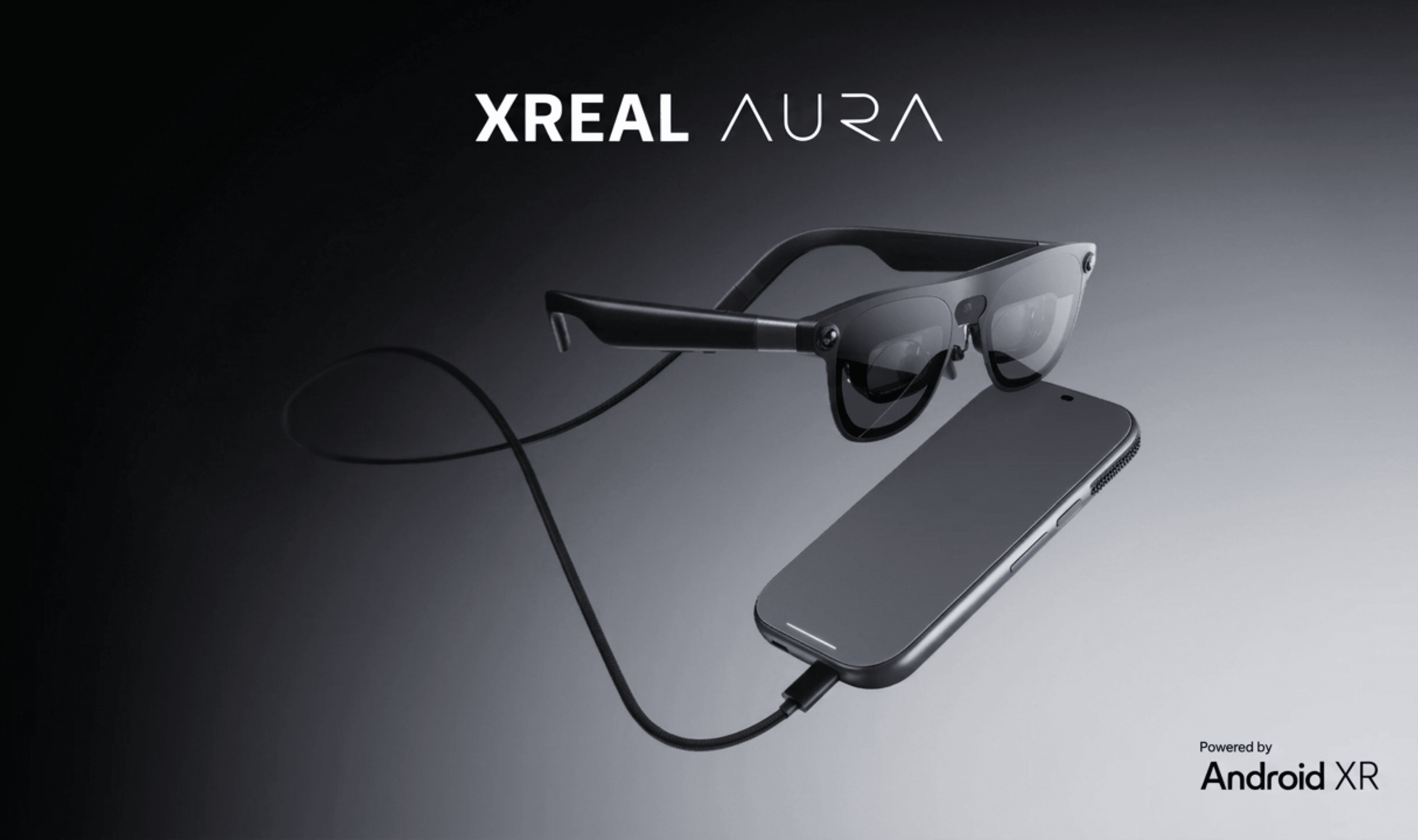
XREAL AURA launches today as wired Android XR glasses that put digital content over the wearer’s surroundings, with a 70-degree field of view and a frame weighing less than 95g. Google says workers can use Android business apps and connect a laptop to bring its applications into a spatial workspace. The glasses use an optical-see-through display, letting users view their physical surroundings while looking at digital information.
Google directs buyers to the XREAL AURA shop but lists no price. The company says use is limited to people 18 and older in Japan, South Korea, Canada and the United States. The glasses use a split-compute architecture, and their displayport-in (DP-in) function supports connecting laptops across platforms. That laptop connection lets users place computer applications alongside Android apps, extending the workspace beyond software running through Android XR.
Read more: Google Blocks Compromised eMudhra Keys in Chrome and Android
Google says XREAL AURA supports enterprise applications from the Google Play Store out of the box, with hundreds of Android productivity titles available. For businesses deploying the glasses, Android Enterprise supplies the management framework, following its introduction on Android XR earlier this year. IT administrators can use Managed Google Play to distribute business software, including both private applications and publicly available titles.
Deployment tools include Android zero-touch enrollment, which allows businesses to enroll devices remotely as part of their initial setup. A fully managed device mode gives administrators control over system resources such as Wi-Fi and lets them apply policies that block apps. Google also lists Device Trust from Android Enterprise, including support for devices outside an organization’s management.
For security, Google says Google Play Protect uses machine learning to detect threats including ransomware, malware and phishing. Platform protections also include device encryption and verified boot, with Google supplying regular security updates as well as modular updates.
Google pitches the glasses for work involving 3D product design and simulation, as well as displaying complex information over physical spaces. It also describes workers getting assistance from virtual experts while handling equipment.
Other proposed uses include virtual monitors that only the wearer can see, alongside three-dimensional content. Google says voice interaction could also help workers move information from their surroundings into digital record systems.