
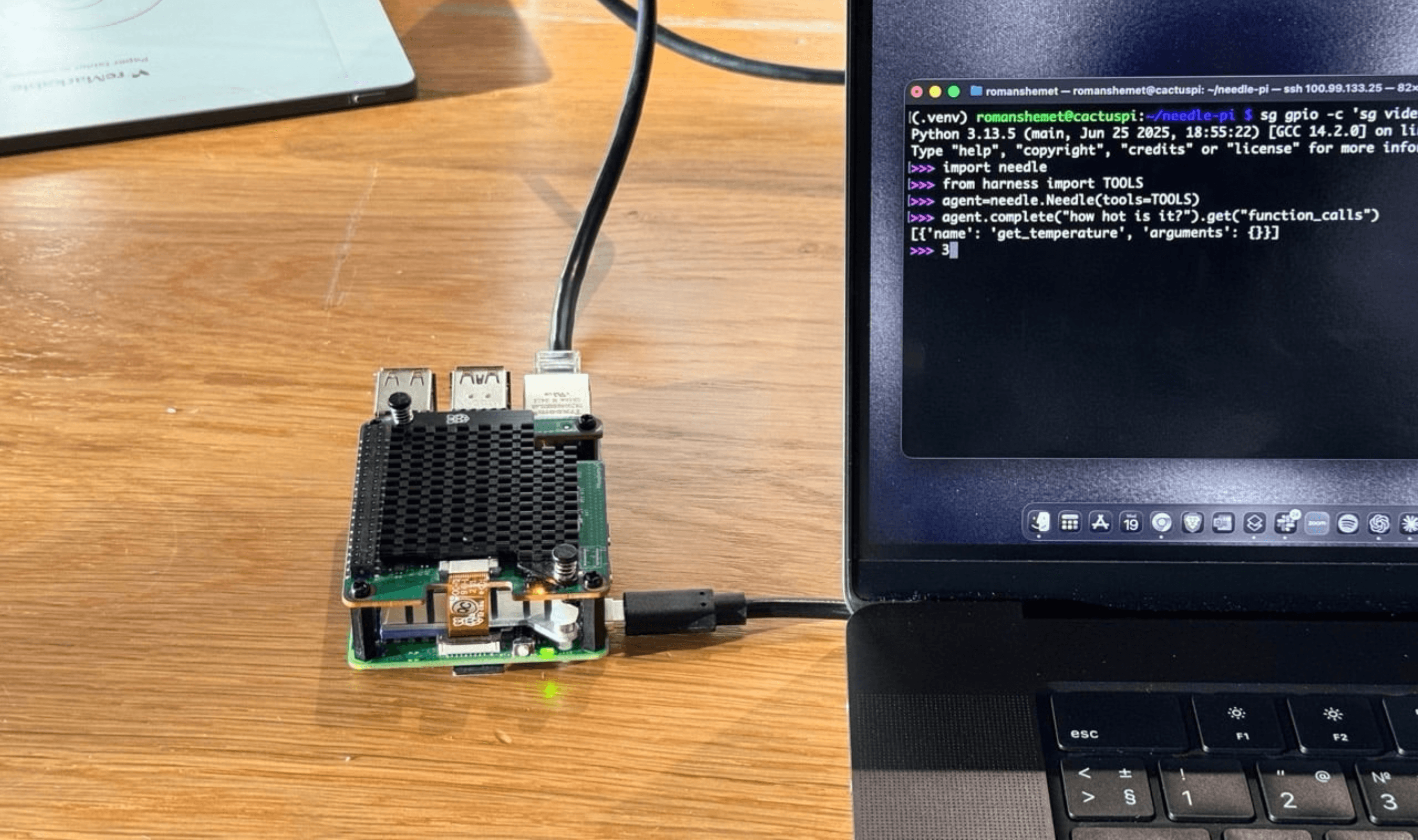
A 14MB model can now turn plain English into actions on a Raspberry Pi 5 without any cloud connection or dedicated AI hardware. Needle 2, built by Cactus Compute, runs entirely on the Pi's CPU and picks which Python function to call based on what you type, according to a Raspberry Pi post detailing the setup.
The model is not a chatbot and was trained for one job: reliable, structured on-device actions. Developers declare Python functions with a @needle.tool decorator, and Needle uses each function's name, docstring, and type annotations to decide which one to run and what arguments to pass. In the demo, prompts like "Turn the LED on" and "Take a photo" mapped to functions for the LED, a camera capture, and a CPU temperature reading through vcgencmd.
Speed is the headline number. Turning the LED on took 78 milliseconds from prompt to tool selection, blinking it twice took 83ms, taking a photo took 76ms, and saving a note took 107ms, all measured as wall-clock time for a single complete() call before the chosen Python function ran. A temperature query took 149ms. The model's native session sits around 28MB, while the full Python process peaked between 43MB and 46.4MB including the interpreter.
Installation is a standard Python virtual environment and a pip install of cactus-needle, and after the first download the model runs locally with no network connection required. The examples were run on a Raspberry Pi 5 with 8GB of RAM on Raspberry Pi OS, CPU only, using cactus-needle 2.0.7.
Needle is deliberately narrow, and the post frames refusal as a feature. Asked "What is the capital of France?" it returned an empty function_calls list in 92ms because none of the declared tools could answer, which the post calls the correct response for an action model. Existing GPIO Zero functions can be decorated and passed in the same way, and the model can be fine-tuned locally on a laptop for a specific set of tools.
Raspberry Pi CEO Eben Upton endorsed the release in the post, saying "Needle 2 is rather excellent". The weights and code are published on Hugging Face and GitHub under the Apache 2.0 license.
The launch follows Raspberry Pi's recent push into hands-on Python projects for its GPIO hardware, including an internet radio tutorial tied to its Simple electronics with GPIO Zero book, which covers LED lights, a motion-sensing alarm, and a rangefinder. The Needle 2 examples cover similar ground, wiring Python functions to hardware on the board, except that here the model chooses which function runs instead of a fixed tutorial script.