SMS, short for Short Message Service, sends text-only messages, ordinarily up to 160 characters each, and MMS is its companion for pictures and video. RCS, short for Rich Communication Services, sends messages over Wi-Fi or mobile data and adds typing indicators, read receipts and high-resolution media. A chat uses RCS only when everyone in it has RCS turned on, with a phone and carrier that support it, and otherwise it can go out as SMS or MMS.
RCS vs SMS at a glance
- Message length: SMS holds up to 160 characters. AT&T says messages with special characters, including some emoji or non-Latin characters, may be limited to 70.
- Photos and video: AT&T lists MMS pictures and video at up to 1 MB, and Verizon lists 3.5 MB videos on 4G LTE and 5G devices. Google Messages lists high-resolution photos and videos for RCS chats.
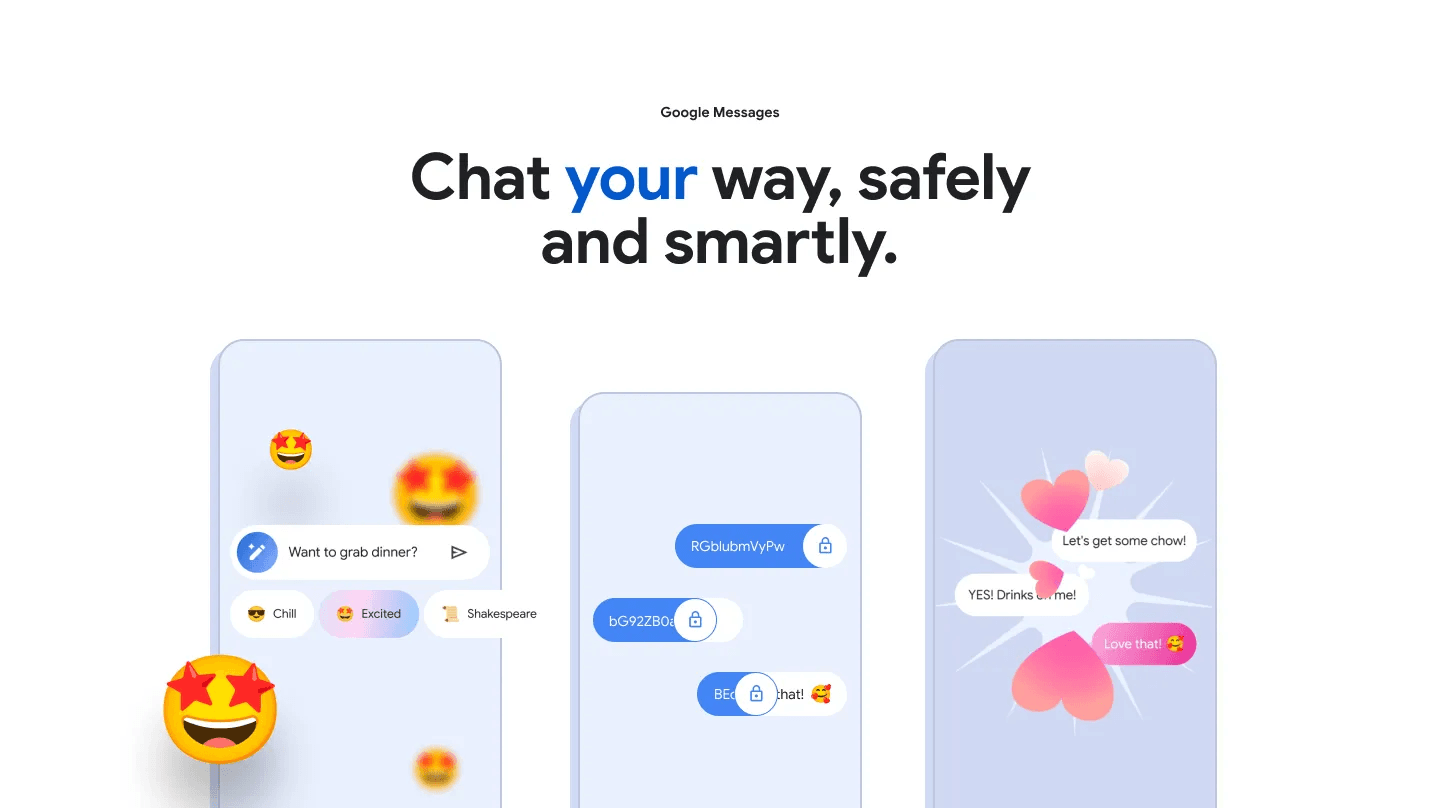
- Chat features: RCS in Google Messages shows when someone is typing and when a message was received or read.
- Encryption: Google states that end-to-end encryption is not available for SMS/MMS. Google says RCS conversations between Google Messages users default to it in eligible chats.
What SMS and MMS can carry
Verizon lists 160 characters for a standard SMS. AT&T generally counts 160 characters as one text message and charges longer text as multiple messages according to the plan. MMS limits differ by carrier.
- Verizon: 1.2 MB images and 3.5 MB videos on 4G LTE and 5G devices. Verizon says actual limits depend on device software and network capability, and a receiving device or another carrier may set lower ones.
- AT&T: pictures and video up to 1 MB.
- T-Mobile: 1 MB when sending, 3 MB when receiving, and image resolution under 3072 x 3072. MMS may be resized automatically and is limited to 10 recipients per message.
What RCS adds
Google describes RCS as an industry messaging standard, with the service provided by Google or a mobile carrier. The GSMA lists group messaging, high-resolution media sharing, read receipts and typing indicators as RCS functions that work between iOS and Android.
In Google Messages, read receipts and typing indicators have separate controls, and you only see another person's read receipts if that person has turned them on. RCS group chats can be renamed and edited, and you can remove yourself from one. Google's product page says these features apply in supported conversations when RCS chats are available and turned on, and that depends on region and carrier.
What Google and Apple say about encryption
Google's help page says RCS conversations between Google Messages users default to end-to-end encryption, for eligible one-to-one and group chats. Its listed requirements are Google Messages, RCS turned on, and data or Wi-Fi for all participants. When end-to-end encryption is not available, Google says its RCS service still uses Transport Layer Security (TLS) encryption to protect messages.
On iPhone, Apple's RCS setup page says end-to-end encrypted RCS is available in beta starting with iOS 26.5 on supported carriers. Apple says it rolls out over time and is on by default. Apple's comparison of iMessage, RCS and SMS/MMS says every participant's carrier must support encryption. Encrypted chats show the word "Encrypted" and a lock icon, and Apple says RCS messages without that indicator do not have that protection.
Apple's US carrier page, dated September 15, 2026, lists the encrypted RCS beta for AT&T, T-Mobile USA, Verizon Wireless, Cricket, Metro by T-Mobile, Mint Mobile, Visible and others. It lists RCS messaging for H2O Wireless and Total Wireless without the encrypted beta label.
What your phone and carrier need
On iPhone, Apple requires iOS 18 or later and a cellular plan from a carrier that supports RCS, and availability varies by region and carrier. On Android, Google's troubleshooting page asks for Android 5.0 or higher, a device and carrier network that support RCS, Google Messages set as the default SMS app, internet access and the ability to receive SMS. Google's RCS FAQ says you can check RCS availability and status in Google Messages settings.
Which one fits
If privacy matters most in a chat on iPhone, look for the "Encrypted" label and lock icon, because Apple says RCS messages without that indicator do not have that protection. Google says end-to-end encryption applies to eligible RCS conversations between Google Messages users and is not available for SMS/MMS messages. If you send a lot of photos and video, RCS fits because Google Messages lists high-resolution photos and videos for RCS chats, while the Verizon, AT&T and T-Mobile MMS limits listed here are 3.5 MB or less.
If you are often without data, the "Automatically resend as text (SMS/MMS)" setting in Google Messages lets a message go out as SMS or MMS when data is unavailable or the recipient is offline. If you turn RCS off, Google says typing indicators and read receipts turn off with it. On iPhone, Apple says SMS/MMS is what you can use when a chat uses neither iMessage nor RCS, and it needs a text-messaging plan that supports those services.