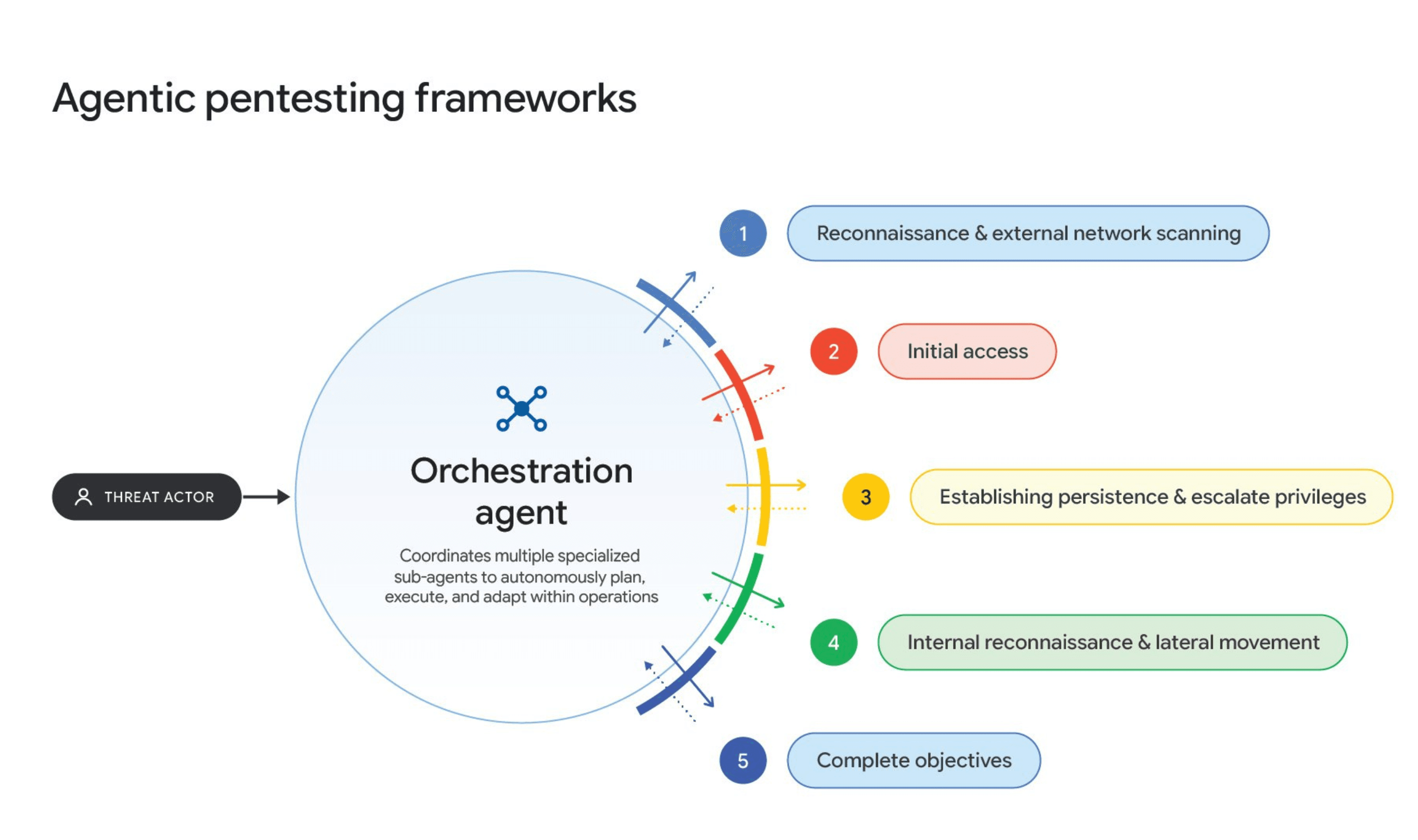
Attackers are using autonomous AI frameworks to automate parts of live cyber intrusions, Google Threat Intelligence Group (GTIG) and Mandiant reported today. Researchers observed multiple threat actors using open source penetration-testing tools for individual attack stages and operational tasks, moving beyond asking AI models for assistance through manual prompts. Google says the shift lets attackers connect complex attack steps and increase the pace and scale of their operations.
The underlying entry points remain familiar: attackers still exploit unpatched systems and use credentials they have compromised, according to the researchers. The observed automation covers particular intrusion tasks and phases, while Google's broader assessment describes growing use of frameworks that coordinate multiple agents. Google identifies PentAGI and CyberStrikeAI among the offensive frameworks involved in that shift.
Read more: Salesforce and Google Cloud Link AI Agents Across Both Platforms
Vulnerability research is another area where Google says attackers are expanding automation, including comparing software patches to work out what changed. Researchers say AI models and agent frameworks increasingly handle that analysis automatically, helping attackers develop exploits for already known vulnerabilities. Google says those workflows can also expand attacks on servers exposed to the internet without requiring human intervention.
For financially motivated attackers, stolen AI access has become something to sell through a practice Google calls LLMJacking. Criminals take credentials for large language models and cloud resources from breached enterprise systems, then resell model access through illicit proxy services. Google's findings draw on Mandiant's incident response work, tracking of threat actors worldwide and defenses operating on live platforms.
Google also says espionage groups use language models to research targets and analyze data automatically. Another technique involves changing configurations for autonomous coding assistants so that local execution installs backdoors. In influence operations, Google says state-backed groups and commercial operators use models to generate synthetic media, develop personas tailored to local audiences and distribute material across platforms automatically.
The findings follow Google's November 10 discussion of software repair delays, which cited Mandiant figures showing average developer fix times rising from roughly 59 days a decade earlier to more than 170 days in 2025. Enterprise adoption is also expanding: MSD's April partnership with Google Cloud committed up to $1 billion to deploying agentic AI across research, manufacturing and other business functions. That agreement included Deep Research, an agent designed to plan and carry out research and development tasks involving multiple steps autonomously.