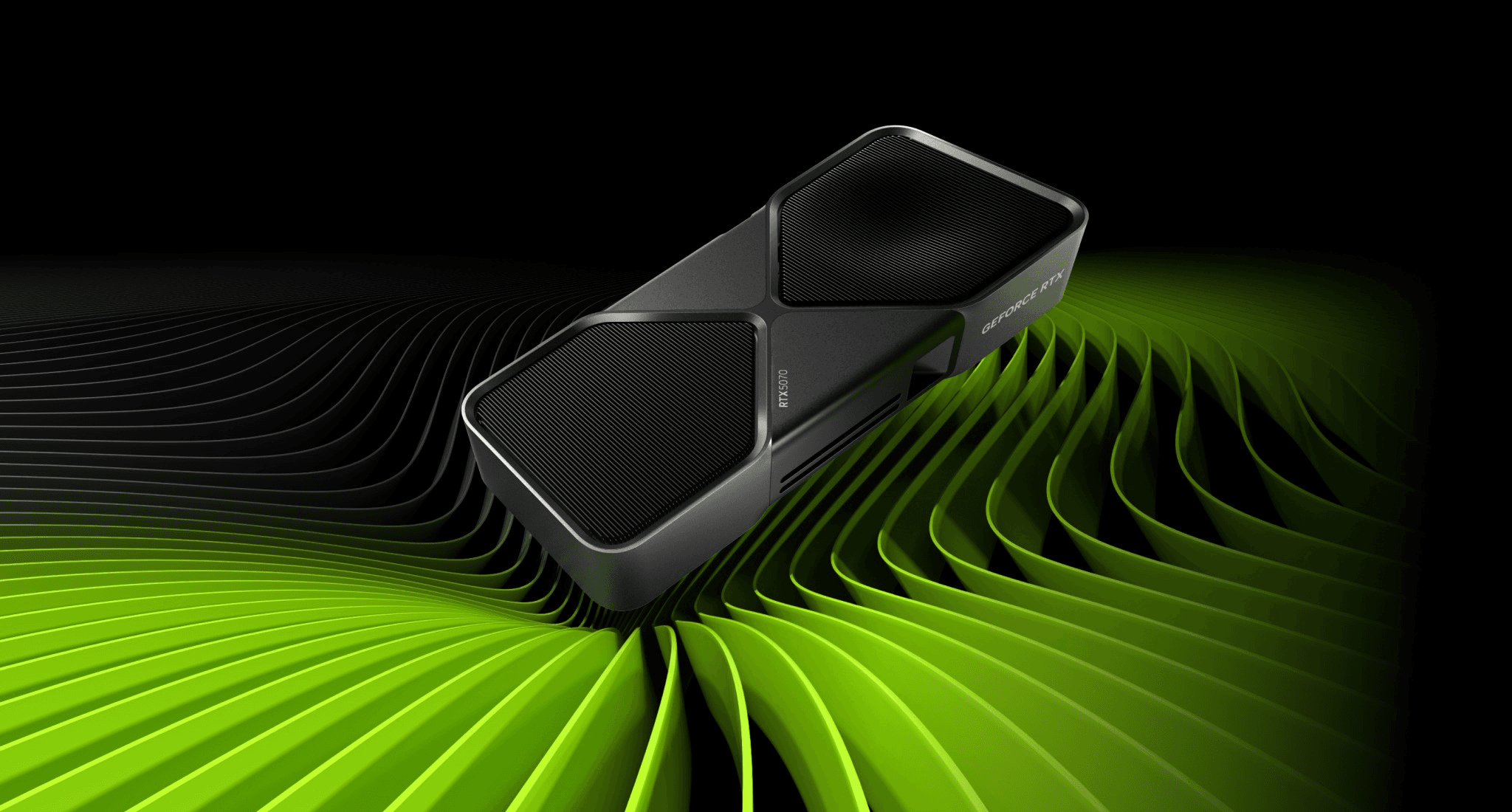
The GeForce RTX 5070 and RTX 5070 Ti share the same architecture and feature list, and they differ in memory, core count, listed power and price. NVIDIA's launch price was $549 for the RTX 5070 and $749 for the RTX 5070 Ti. For that $200 gap, NVIDIA's spec table gives the Ti 16 GB of memory instead of 12 GB, more CUDA cores and a second video encoder, along with a higher power requirement.
RTX 5070 vs RTX 5070 Ti at a glance
The specifications below come from NVIDIA's RTX 5070 family page and its comparison page as of November 2026. NVIDIA says they describe its Founders Edition or reference designs, and that cards from partner brands can vary. Both launch prices are the US launch list prices from NVIDIA's January 6, 2025 announcement, in US dollars.
- NVIDIA's launch price: $549 for the RTX 5070, $749 for the RTX 5070 Ti.
- CUDA cores: 6,144 on the RTX 5070, 8,960 on the RTX 5070 Ti.
- Boost clock: 2.51 GHz on the RTX 5070, 2.45 GHz on the RTX 5070 Ti.
- Memory: 12 GB GDDR7 on the RTX 5070, 16 GB GDDR7 on the RTX 5070 Ti.
- Memory interface: 192-bit on the RTX 5070, 256-bit on the RTX 5070 Ti.
- Total graphics power: 250 W for the RTX 5070, 300 W for the RTX 5070 Ti.
- Required system power: 650 W for the RTX 5070, 750 W for the RTX 5070 Ti.
- Video encoders: one ninth-generation NVENC encoder on the RTX 5070, two on the RTX 5070 Ti.
Memory and cores
The RTX 5070 Ti lists 16 GB of GDDR7 on a 256-bit memory interface, while the RTX 5070 lists 12 GB of GDDR7 on a 192-bit interface. Both use the same memory type, so the difference is the amount and the width of the interface.
The Ti also lists 8,960 CUDA cores against 6,144, which is 2,816 more. The boost clock goes the other way. NVIDIA lists 2.51 GHz for the RTX 5070 and 2.45 GHz for the RTX 5070 Ti.
Power supply and cables
NVIDIA lists total graphics power of 250 W for the RTX 5070 and 300 W for the RTX 5070 Ti. Its required system power is 650 W for the RTX 5070 and 750 W for the Ti. NVIDIA bases those minimums on a PC with a Ryzen 9 9950X processor and says the requirement varies with the system configuration.
The cabling is the same for both. NVIDIA's comparison page lists two PCIe 8-pin cables connected through the adapter in the box, or one PCIe Gen 5 cable rated for 300 W or greater. Both cards also have three DisplayPort outputs and one HDMI output, which NVIDIA's footnotes specify as DisplayPort 2.1b with UHBR20 and HDMI 2.1b.
Features both cards share
Both cards use NVIDIA's Blackwell architecture, with fifth-generation Tensor Cores and fourth-generation RT Cores. The product spec table lists DLSS 4 for both, covering Super Resolution, DLAA, Ray Reconstruction, Frame Generation and Multi Frame Generation. At launch, NVIDIA described Multi Frame Generation as using AI to generate up to three additional frames per rendered frame.
NVIDIA's current comparison page lists DLSS 5 for both cards, including 3D-Guided Neural Rendering and Dynamic Multi Frame Generation. The spec table also lists Reflex 2 with Low Latency Mode and Frame Warp, and it marks Frame Warp as Coming Soon. See How to Set Up and Use NVIDIA DLSS 5.
The rest of the list matches too. Both support AV1 encoding and decoding, PCIe Gen 5, G-SYNC, NVIDIA Broadcast, the NVIDIA App, RTX Remix, RTX HDR, VR, DirectX 12 Ultimate, OpenGL 4.6 and Vulkan 1.4, with Game Ready and Studio drivers (see How to Update NVIDIA Game Ready Drivers). Each has one sixth-generation NVDEC decoder. The video difference is on the encoding side, where the Ti has two NVENC encoders and the RTX 5070 has one.
Which one fits
If you want the lower launch price, the RTX 5070 fits, because NVIDIA's launch price for it was $200 lower and the listed feature support is the same as the Ti's. NVIDIA lists 650 W as its minimum system power and says that requirement varies with the system configuration. If the software you run needs more than 12 GB of graphics memory, the RTX 5070 Ti is the one of the two that lists 16 GB. The same goes for a second NVENC encoder, which only the Ti lists.
If you lean toward the Ti, check your power supply first. NVIDIA lists 750 W of required system power for it, 100 W more than for the RTX 5070, and notes that the figure depends on the rest of the build. If you buy a card from a partner brand, check that card's own spec sheet, since NVIDIA says partner specifications can vary.