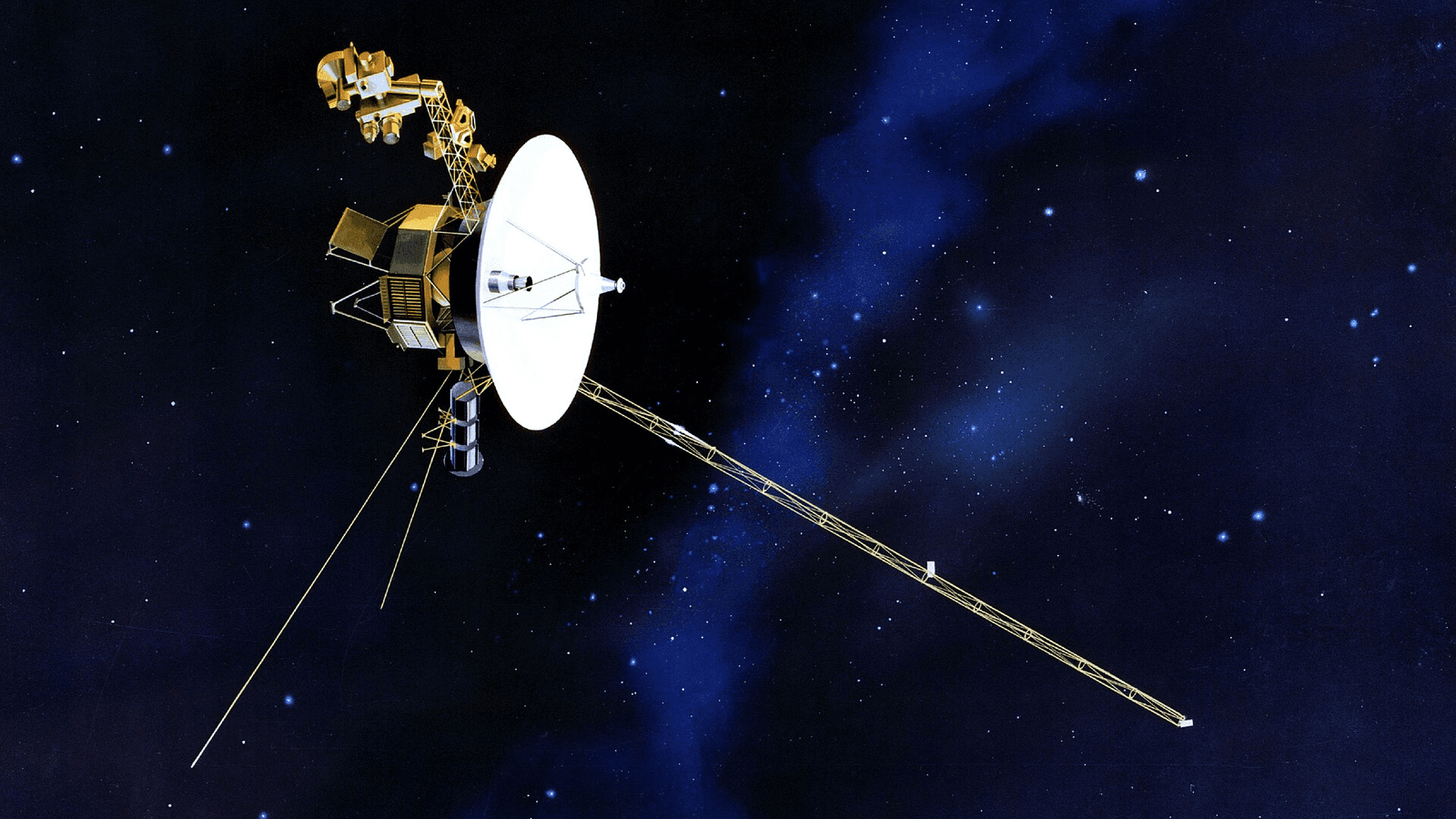
Voyager 1 is believed to have become the first spacecraft one light-day from Earth, putting a full 24 hours between the probe and anyone sending it a radio command. NASA calculated that it would cross the roughly 16-billion-mile threshold on November 18 at 5:16 a.m. ET, Reuters reported in a story carried by NBC News.
Confirmation still requires a signal to reach NASA’s Jet Propulsion Laboratory in California, a journey taking about a day. For mission controllers, sending an instruction and receiving the spacecraft’s answer now takes 48 hours, with each leg consuming an entire day.
The Journey Beyond the Sun
NASA launched Voyager 1 in September 1977, and the probe is traveling at almost 38,000 miles per hour. It gained speed through encounters with Jupiter in 1979 and Saturn in 1980, using the planets’ gravity while taking photographs and investigating their surroundings.
After exploring Saturn’s system, Voyager 1 headed away from the solar system’s plane toward the constellation Ophiuchus. In August 2012, its detectors registered passage through the heliopause, the boundary where the sun’s outward wind yields to material flowing from neighboring stars. That crossing made it humanity’s first spacecraft in interstellar space.
Voyager 2 also departed Earth in 1977 and reached interstellar space in 2018. Both probes have traveled beyond the heliosphere, the region of particles and magnetic fields generated by the sun.
Power for the Remaining Mission
Voyager 1 continues collecting scientific measurements, including observations of a faint, steady hum from vibrations in the sparse gas between stars. Its remaining working instruments are a plasma-wave detector and a magnetometer, Scientific American reports.
Electricity comes from three plutonium-fueled radioisotope thermoelectric generators rather than solar cells. Those generators supplied approximately 470 watts when the spacecraft launched; their output has since fallen below half that level.
A Jet Propulsion Laboratory representative said recent steps to conserve power could keep both Voyagers communicating with Earth for another three to four years. NASA supports its interplanetary missions through the Deep Space Network, an international collection of large radio antennas.
Voyager 1 also carries the Golden Record, a gold-plated copper disk measuring 12 inches across. Its contents include 115 images, music, sounds from Earth, greetings spanning 55 languages and messages from world leaders. A map using pulsars identifies the spacecraft’s starting point, while a small uranium 238 sample provides a way to estimate when the record departed.
The spacecraft lacks enough speed to leave the Milky Way and will continue orbiting the galaxy after its operating mission ends. The next scheduled milestone on Earth is a Jet Propulsion Laboratory event on Thursday, November 19, to discuss the light-day crossing.