
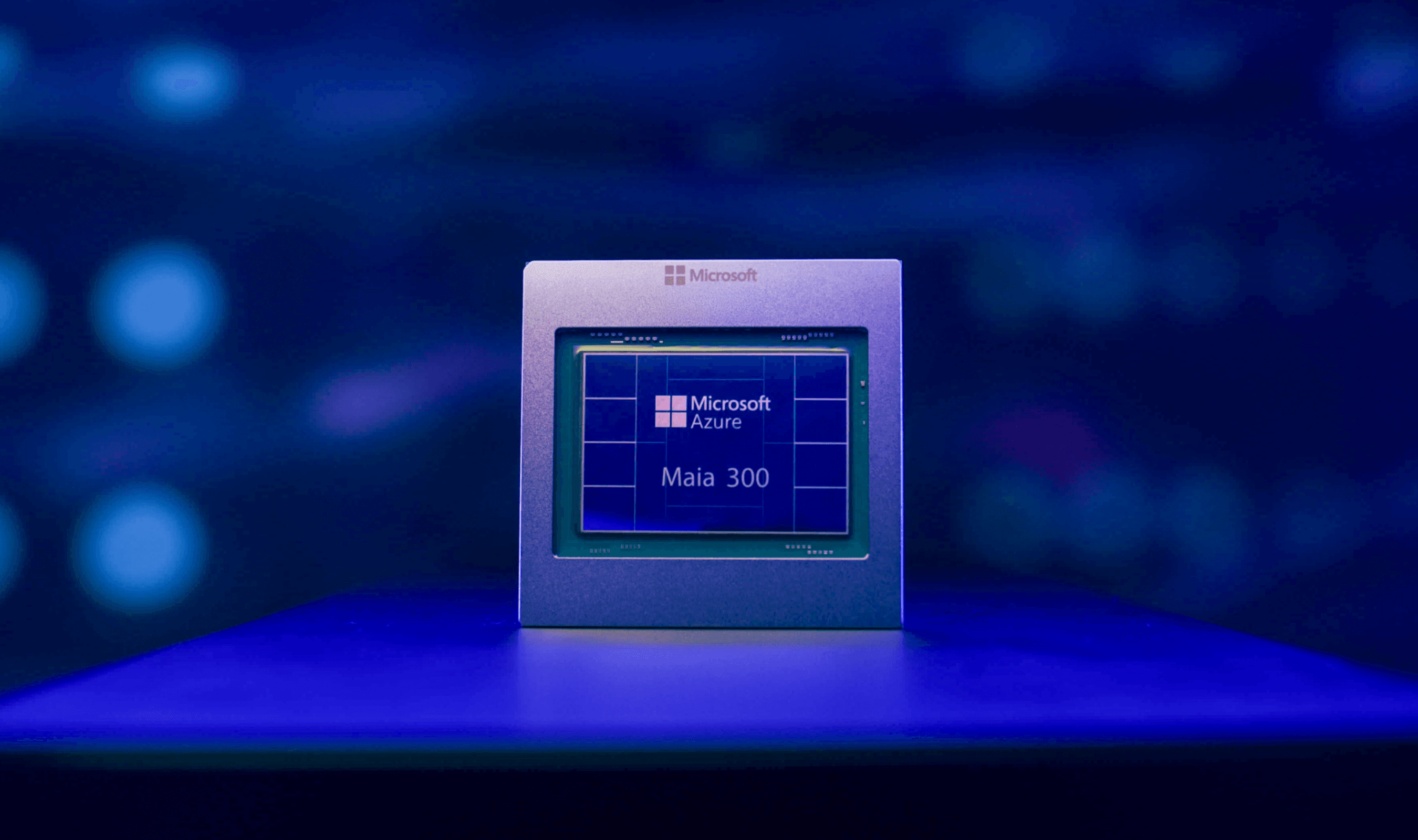
Microsoft plans to expand Azure Maia to multi-gigawatt deployments starting in 2027, making it the main system for inference across its products and services. Maia 300 is scheduled to enter production deployments that year, with Microsoft expecting it to generate 40% more tokens per megawatt than leading systems built around GPUs. Maia 200 already handles production workloads, including Microsoft Copilot, and supports the MAI team’s development of its next models.
GitHub Copilot and Microsoft Foundry are scheduled to join Maia 200’s workloads by the end of this year. The system runs models from OpenAI, Microsoft’s MAI team and open-source families across its workloads. Microsoft is deploying Maia 200 in Australia, Europe and the United States, giving the current generation a geographic footprint ahead of Maia 300’s planned production start.
Read more: Microsoft Ships Windows Agent Controls, Plans Local AI Routing
Microsoft says a Maia 300 configuration containing 96 accelerators delivers up to seven times the token throughput of Maia 200 at rack scale. That comparison uses a different measure from the projected 40% improvement against leading GPU systems, which counts tokens relative to megawatts. For Maia 200, Microsoft claims up to 1.7 times as many tokens per watt as leading GPU infrastructure for built-in AI features in Copilot, Cowork experiences and Microsoft Teams.
Each Maia 300 rack combines 96 accelerators with a power envelope of 167 kilowatts. Its HBM memory totals 27.6 TB, while aggregate HBM bandwidth reaches 1.7 PB/s. At the accelerator level, eight HBM4 stacks supply peak bandwidth of 18.0 TB/s within a 950-watt TDP.
Maia 300 targets conversational workloads sensitive to delays, reasoning over long contexts and agents carrying out sustained tasks across multiple steps. Its chiplet design separates I/O and memory-controller functions from compute, with the compute chiplets manufactured using TSMC’s N2P process. Microsoft says its dataflow design and AI-assisted kernel optimization reduce data movement and improve use of computing, memory and network resources.
The planned expansion follows Microsoft’s August launch of a fourth Azure region in India, centered on a Hyderabad facility serving cloud and AI customers. That expansion formed part of a $20.5 billion investment in the country’s cloud and AI infrastructure. Microsoft also intends the Maia generations to support Dragon Copilot interactions, Microsoft Foundry model serving and the MAI team’s inference and data-generation work.