
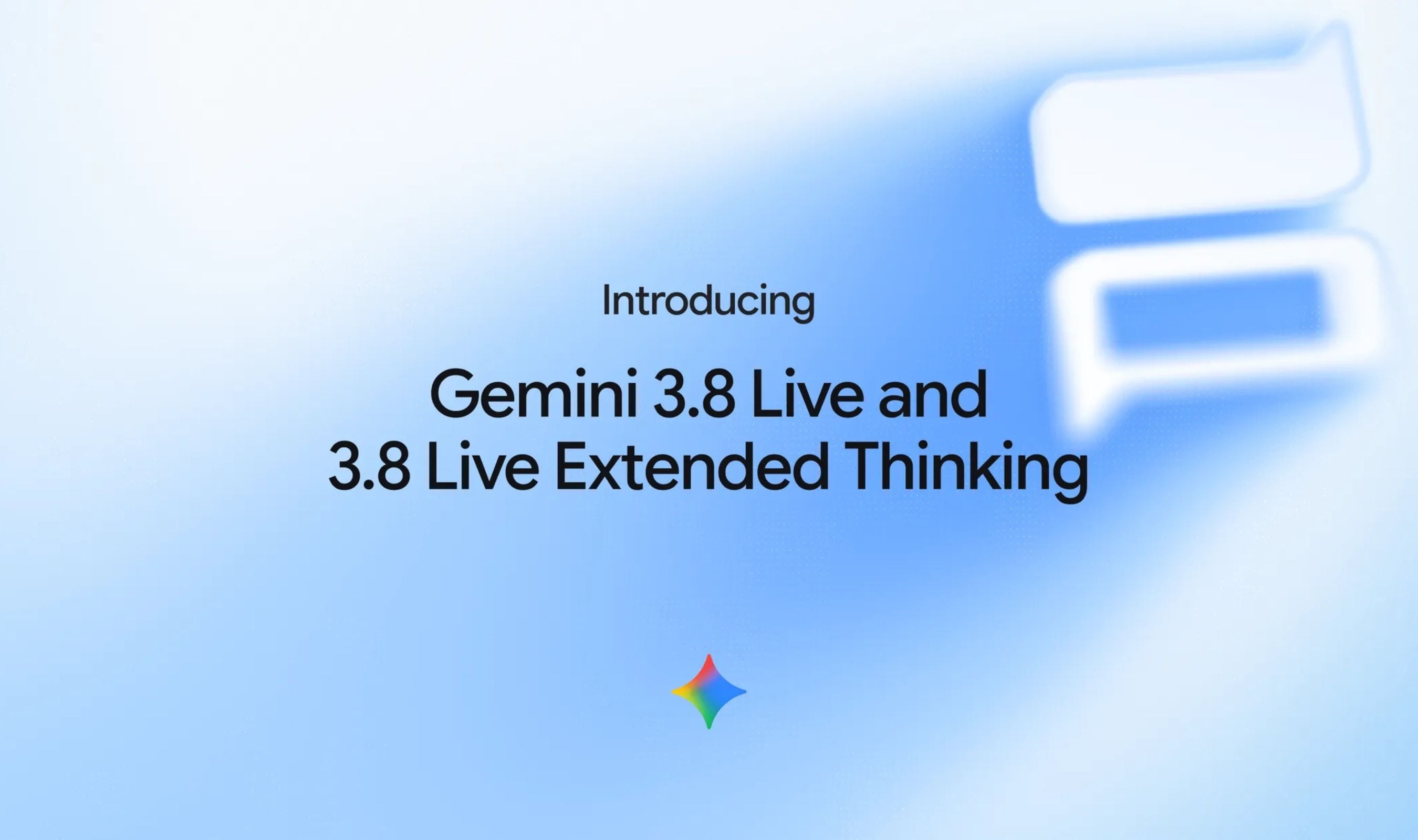
Google introduced two new voice-focused AI models today, Gemini 3.8 Live and Gemini 3.8 Live Extended Thinking, both aimed at developers and enterprises building near real-time voice agents. The company says the pair is meant to make spoken conversations with AI feel more natural and to support production-ready agent deployments. The models also extend to the Gemini app, Google Workspace, and Search, where Google says users can work through complex tasks by voice alone.
The two models split by workload. Gemini 3.8 Live is positioned for scale and cost efficiency, pairing conversational ability with visual grounding, while Gemini 3.8 Live Extended Thinking targets high-complexity jobs that need multi-step reasoning and more intelligence. Google did not disclose pricing for either model, saying only that Extended Thinking stays competitive on price against other frontier models.
Read more: Google Adds System-Wide Voice Dictation to Gemini for Mac
Google's announcement leans on benchmark results for the Extended Thinking variant. It took the top overall spot on Artificial Analysis' Speech to Speech Quality Index with a score of 82.6, according to the company. The same model scored 68.6% on the τ-Voice benchmark and 35.1% on Sierra's τ-Voice-banking test for agentic task completion, and reached 97.7% on Big Bench Audio for reasoning.
Gemini 3.8 Live placed second in the Speech Agent Arena, which Google describes as a sign of strong user preference, and the company calls it cost-effective for developers working at scale. No release date, regional rollout schedule, or developer access details appear in the announcement, leaving the availability question open for anyone planning to build on the models.
The launch follows years of groundwork on Gemini's voice stack. Earlier reporting described a hidden model selector inside the Google app that exposed seven unreported Gemini Live options, including a Thinking variant with enhanced reasoning, with two already at release candidate stage ahead of I/O 2026. That menu was delivered server-side, letting Google swap models without shipping an app update.
Google has also been reworking how it meters demanding models. In January it separated Thinking usage from Pro quotas, giving AI Pro subscribers 300 daily Thinking prompts alongside 100 Pro prompts and AI Ultra users 1,500 Thinking prompts with 500 Pro prompts. The change followed user requests for more clarity about which model to use for a given task.
Read together, the two moves suggest Google is treating voice as a distinct product line rather than a feature bolted onto its text models. The benchmark claims in today's notice cover speech quality and task completion, but the announcement offers no independent evaluation and no word on when developers outside Google can test the models themselves.