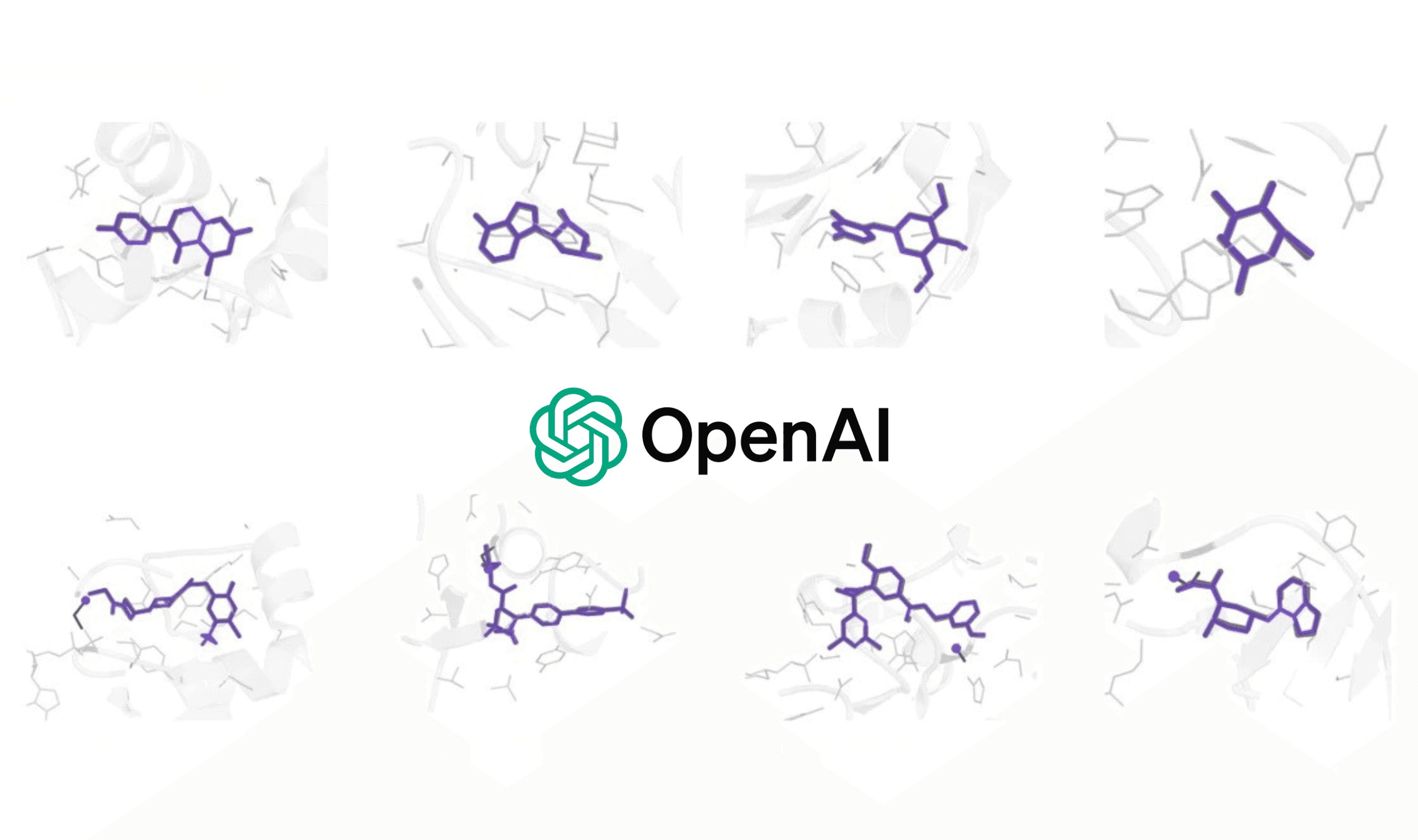
OpenAI said today that proteins built from designs by a pre-release version of GPT‑6.2 attached to their intended targets in 35 of 322 laboratory tests, a 10.9% hit rate. The work, conducted with Onava, produced at least one binding result for each of five target proteins. GPT‑6.2 generated the proposed shapes through code, while specialized biology models supplied amino acid sequences and helped researchers choose candidates for testing.
OpenAI says its GPT‑6 family can generate both protein shapes and sequences through reasoning and general-purpose coding tools, without specialized biology models generating the designs. The laboratory workflow nevertheless used additional models between GPT‑6.2’s shape designs and the proteins Onava tested. SolubleMPNN suggested sequences intended to produce those shapes, and other models screened candidates for their predicted folding and attachment.
The largest number of binding hits in that experiment was 18 for IL-17A, followed by eight for VEGF-A and five for PD-L1, which some cancers use to avoid an immune response. OpenAI said the original RFdiffusion study achieved higher hit rates, while cautioning that screening criteria and definitions of binding strongly affect those comparisons. In computational comparisons, GPT‑6.2’s shape designs scored slightly below RFdiffusion’s, while OpenAI’s latest internal models scored above it.
A separate experiment asked GPT‑6.2 to propose replacement sequences for existing minibinders after receiving their three-dimensional structures without the original sequences. Initial laboratory screening found binding in 75 of 88 designs targeting MDM2, 26 of 42 targeting VEGF-A and eight of 59 targeting PD-1. Specialized models again helped determine which candidates reached laboratory testing.
Researchers also directed designs through prompts specifying attachment sites and the number of coils or strands a minibinder should contain. OpenAI says an internal model met those structural instructions with almost perfect fidelity, but identifying an entire protein’s structure remained a pronounced weakness across its computational testing.
The research follows OpenAI’s introduction of GPT-6.2 Astra and GPT-6.2 Sol, with Astra’s API input and output token prices reduced by 20% against GPT-6 Astra. That launch positioned Astra for demanding professional work and Sol for everyday tasks, including household planning.