
NVIDIA has made Alpamayo 2 Super available now for commercial use, expanding its open reasoning model family for robotaxis and other autonomous vehicles on Hugging Face. Built on NVIDIA Cosmos 3 Super Reasoner and post-trained with reinforcement learning, the release pairs open commercial licensing with multitask capabilities aimed at production AV programs.
The model ships under OpenMDW-1.1, the Linux Foundation’s permissive license for open AI model distributions. That license covers fine-tuning, derivative models, and commercial redistribution, so developers, automakers, truckmakers, and suppliers can adapt it to their own data and policies.
Earlier Alpamayo releases were initially introduced for R&D. OpenMDW now applies across the entire family, letting teams deploy any of the models commercially without additional permissions.
Alpamayo 2 Super targets frontier-scale reasoning in cloud development workflows. Developers can generate reasoning traces, synthetic training data, and teacher outputs for model distillation.
Within the family it delivers the highest reasoning and driving performance for multimodal work, while Alpamayo 1.5 and Alpamayo 1 offer more cost-efficient options for the same cloud and distillation path. Distilled models can then be optimized for real-time inference in production vehicles, forming a cloud-to-car workflow for commercial fleets.
NVIDIA states the model ranks first on LingoQA, an autonomous driving reasoning benchmark, among nearly 40 models evaluated. It also ranks first across all autonomous driving benchmarks the company evaluated.
Alpamayo 2 Super offers 3x the scale of the 10-billion-parameter Alpamayo 1.5 and Alpamayo 1 models, which NVIDIA says helps generalize reasoning from sparse long-tail examples.
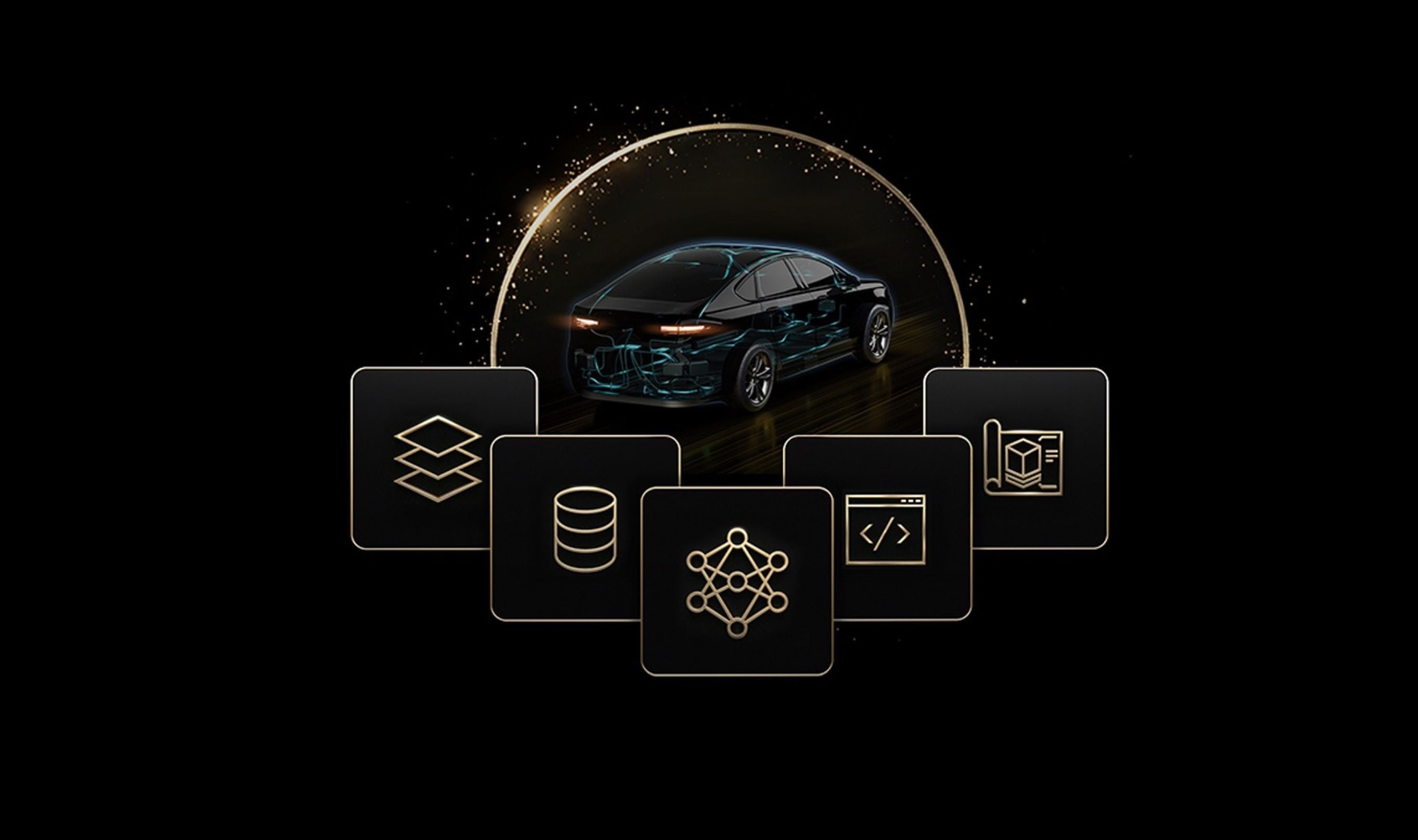
For each driving situation the model can produce five coupled outputs: a planned trajectory, a chain-of-causation trace explaining the decision, a meta-action such as yield or lane change, reasoning auto-labels for training data, and visual question answering with 2D grounding tied to camera regions. CoC traces integrate with NVIDIA Halos safety-validation workflows and support AI safety aligned with ISO/PAS 8800 requirements.
Teams can also run it as an autolabeler on proprietary fleet data, and use it for scene understanding, model critiquing, and knowledge distillation so one foundation model covers more of the stack.
The Alpamayo family sits inside a broader set of open models, datasets, and tools for AV development. The family has already surpassed 500,000 downloads on Hugging Face.
Developers can download Alpamayo 2 Super there to evaluate its reasoning and begin building commercial robotaxi and AV systems.