
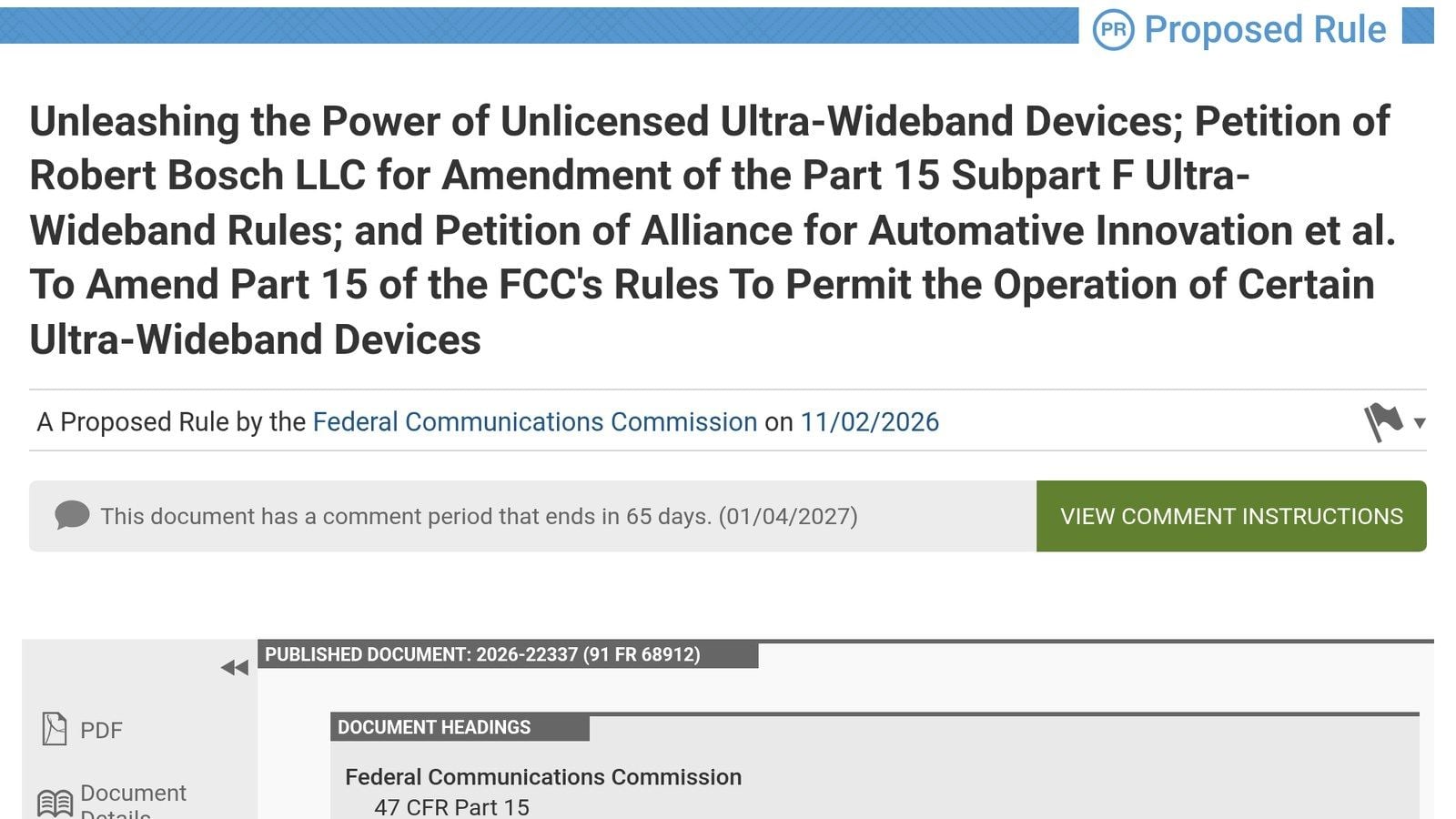
Ultra-wideband door locks, keyless entry systems and precision trackers could get a direct path to approval in the US. The FCC has proposed a rewrite of its ultra-wideband rules, which have stayed largely unchanged since 2002, and it wants a new device category for the location-sensing gadgets that today need a waiver before they can be sold.
The Commission adopted the proposal on September 30 and released it on October 1. It is set to appear in the Federal Register on November 2.
What Ultra-Wideband Does in Your Devices
Ultra-wideband, or UWB, is the short-range radio that lets a device work out both the distance and the direction to another one. It runs at very low power over very wide channels, usually 500 MHz or more, and it locates things more precisely than Wi-Fi or Bluetooth. The FCC notes that most modern smartphones already support it.
The current rules sort UWB equipment into fixed groups, such as handheld devices, indoor systems and several kinds of imaging radar, each with its own limits. A product that does not fit one of those groups has to go through a separate waiver first.
A New Category for Locks, Keyless Entry and Tracking
Those waiver requests have climbed sharply, according to the FCC, and many are nearly identical. The most common come from outdoor keyless entry and door lock systems, vehicle and rail safety ranging systems, and other precision tracking products. Those products asked for relief from the rule that handheld UWB devices must be held in the hand and cannot use fixed outdoor infrastructure.
The Commission says those requests draw little or no public comment and have produced no reports of harmful interference. Its answer is a new category for compact UWB devices that can be mobile or fixed and work indoors or outdoors.
Devices in that category would still face limits. They could transmit only during active, event-driven sessions and would have to stay idle the rest of the time. They would also be barred from forming wide-area networks and would need a duty cycle under 1% in any 24-hour period. The FCC’s own example is a UWB door lock used up to ten times a day, with each ranging round lasting 660 microseconds, which leaves it transmitting for a tiny share of the day. Height limits, mounting rules and a requirement to point emissions downward are also on the table.
Toys, Ships and Aircraft
The rules also ban UWB in toys without defining what a toy is. The FCC is asking whether to drop that ban. Industry groups that petitioned for the update argue that the line between personal devices and toys is increasingly blurred, since tablets and phones are often used for gaming.
UWB devices may not currently be operated on board ships, aircraft or satellites. The FCC is asking whether that can be loosened, including on inland waters, while pointing out that smartphones with UWB are not generally restricted from use on board ships. It is also asking whether AI-enabled UWB sensing should get its own class.
Who Asked for the Change
Bosch first petitioned the FCC to modernize the rules in June 2019, arguing that most UWB products needed waivers to be certified. In December 2025, a group of joint petitioners, the Alliance for Automotive Innovation, the Car Connectivity Consortium, the FiRa Consortium, PI/omlox and the Ultra-Wideband Alliance, asked for targeted updates.
Comments are due by December 2, 2026, and reply comments by January 4, 2027, in ET Docket No. 26-245. Nothing changes for devices on sale until the FCC adopts final rules.