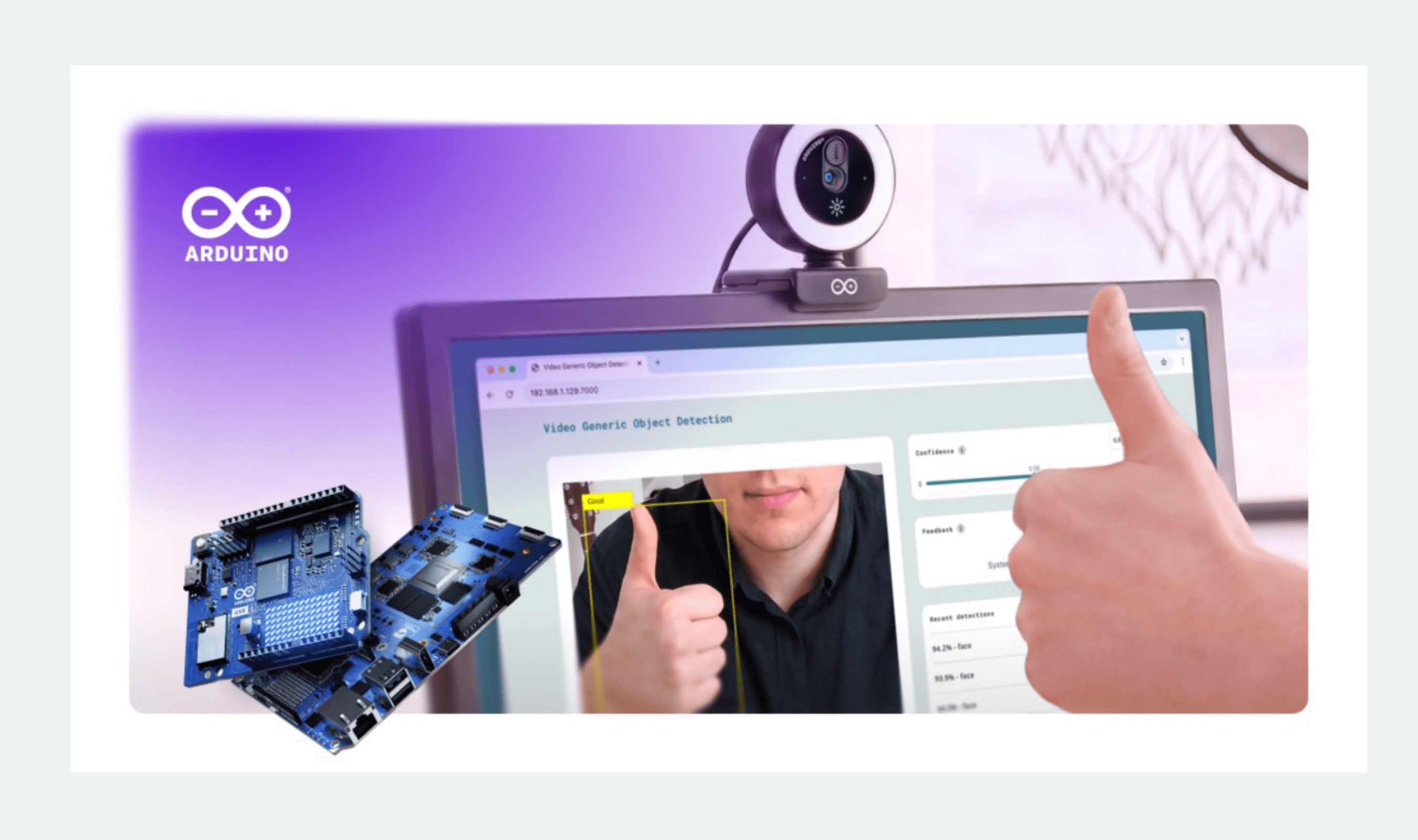
Arduino has introduced the Arduino USB Camera, its first official standalone camera, combining HD imaging, a microphone and adjustable ring lighting for computer vision projects. Designed to connect by USB to UNO Q or VENTUNO Q, the accessory is intended to supply video and audio to AI models running locally on those boards. Arduino did not include pricing in the announcement.
Arduino says the camera is designed to work with those boards without extra driver installation or the need to compile a custom kernel, reducing the setup work before developers can start processing images and sound. Its intended software pairing is Arduino App Lab, whose available AI models provide the basis for the camera’s local processing workflows. The integrated HD microphone also gives projects an audio input without requiring a separate piece of sound-capture hardware.
The lighting controls let users adjust the LED ring’s color temperature and change its brightness by touch. Arduino says that lighting is intended to help keep images consistent as surrounding light changes. For placement, the camera comes with a clip for a monitor, a stand for a desk and a standard thread for attaching a tripod.
One proposed use puts Qwen VLM on VENTUNO Q to turn live camera input into descriptions of a scene, generated locally in natural language. Another combines the camera’s images and microphone input with local speech recognition and language models for desktop companions or automated kiosks. Arduino also points to MediaPipe as a way to convert recognized hand gestures into commands for robots or interfaces.
For object recognition, Arduino identifies YOLO-X and MobileNet as options on either UNO Q or VENTUNO Q. Suggested tasks include detecting faces and counting objects, with the board’s real-time microcontroller handling physical responses. In a recent online workshop, Andrea Richetta, Senior Product Evangelist at Arduino (Qualcomm Europe), built a face recognition project using UNO Q and Arduino App Lab.
USB camera projects already feature in Arduino’s UNO Q examples: September’s Reflexes Machine used a USB camera to spot a player’s face and initiate an interaction. That community project, built by LucaDilo, combined UNO Q with 12 Arduino Modulino nodes for an arcade-style reaction game.