
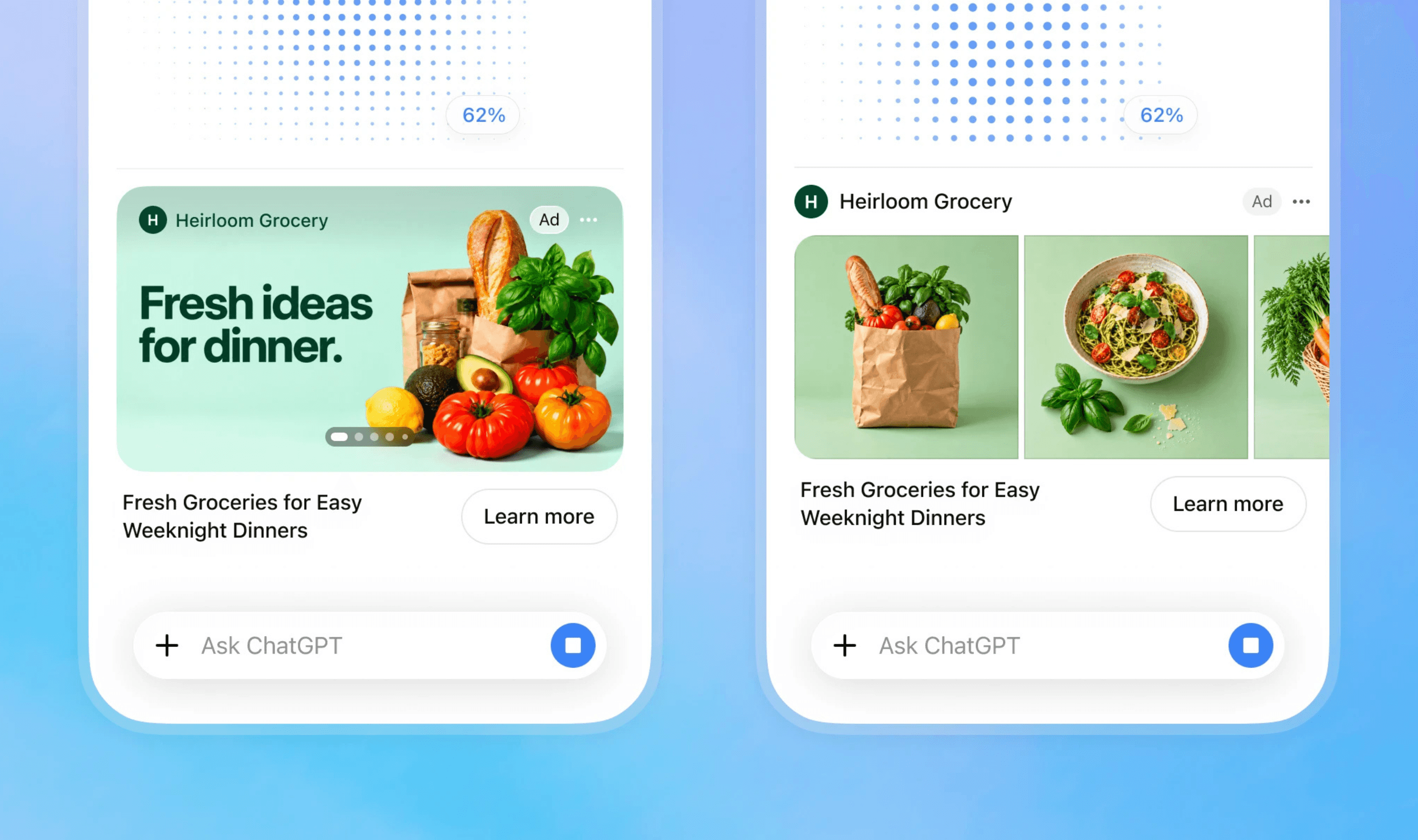
OpenAI will begin testing visual ads during image generation in ChatGPT later this month, initially in the US with a first set of advertisers. The format will use pictures to show products in use, suggest ideas or depict experiences associated with a service, bringing advertising into another part of ChatGPT. OpenAI says the ads will carry clear labels and appear separately from the pictures users generate.
The company says advertising will have no effect on ChatGPT’s answers and that conversations will remain private. The visual format’s initial US test has a narrower geographic scope than the expansion of ChatGPT Ads to Southeast Asia and Taiwan announced in September, when OpenAI described availability for eligible businesses across more than 60 countries. OpenAI puts ChatGPT’s weekly audience at 1.2 billion people and says advertising lets it reach a larger market than subscriptions alone.
Read more: OpenAI, OATS from AARP Host Free ChatGPT Workshops for Older Adults
For businesses, OpenAI is expanding options for connecting ad campaigns to customer actions through existing measurement systems. LiveRamp and Hightouch are among the integrations that let advertisers pass conversion data to ChatGPT Ads, while attribution partners include AppsFlyer and Branch. OpenAI is also working with WorkMagic, Haus and Measured on experiments across geographic areas to assess whether advertising causes additional business activity, though it describes that work as preliminary.
The early results come from measurement partners: DV Rockerbox says WeightWatchers’ attributed acquisition cost through ChatGPT Ads came in 15.3% below its combined paid-search benchmark. WorkMagic reports a statistically significant lift for Dose, with customers new to the brand accounting for 67% of incremental purchases. Triple Whale says 93% of visitors reaching Portland Leather through ChatGPT Ads were new.
Qualifying advertisers can now use Negative Phrases to accommodate placement restrictions set by their brands. OpenAI says its placement checks assess conversations for suitability and seek to exclude advertising from sensitive situations or moments of emotional vulnerability. It is developing evaluation pilots with Integral Ad Science (IAS) and DoubleVerify (DV), allowing outside assessment of its safeguards in controlled tests without access to users’ private conversations.
The advertising business has been taking shape since OpenAI launched its pilot on February 9, with Criteo subsequently becoming its first advertising technology partner for the effort covering US users on ChatGPT’s Free and Go tiers. In March, OpenAI hired David Dugan, who had spent more than 12 years at Meta, as vice president of global ad solutions.