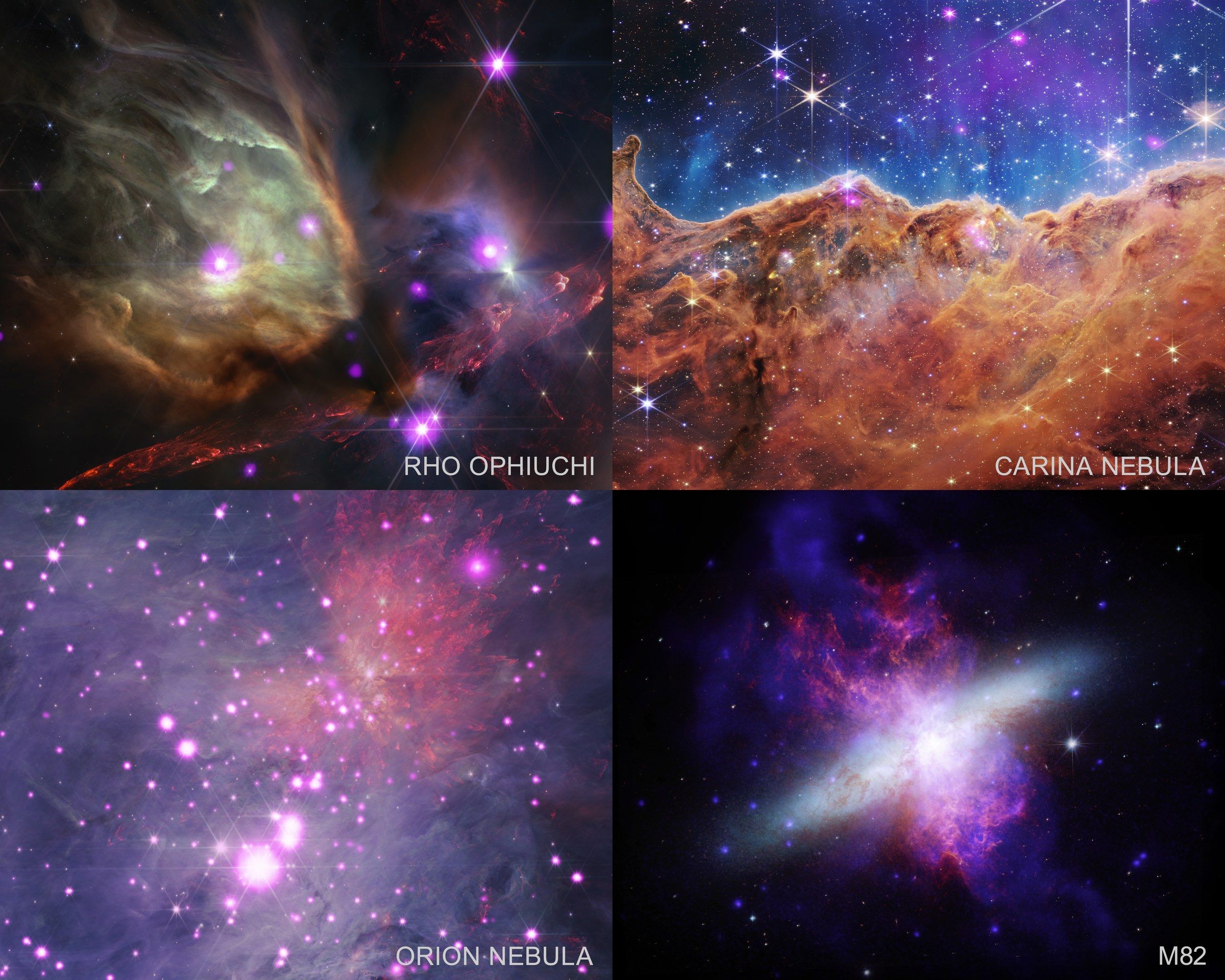
NASA shared four new soundtracks on November 17 that let listeners hear telescope data from places where stars are being born, within our galaxy and beyond it. The collection from NASA’s Chandra X-ray Observatory translates observations into sounds, including a digital harp and metallic plucks.
These pieces are sonifications, with telescope measurements assigned audible counterparts. They draw on observations from Chandra and other NASA telescopes, connecting the collection to regions astronomers study to understand how stars develop, including the Sun.
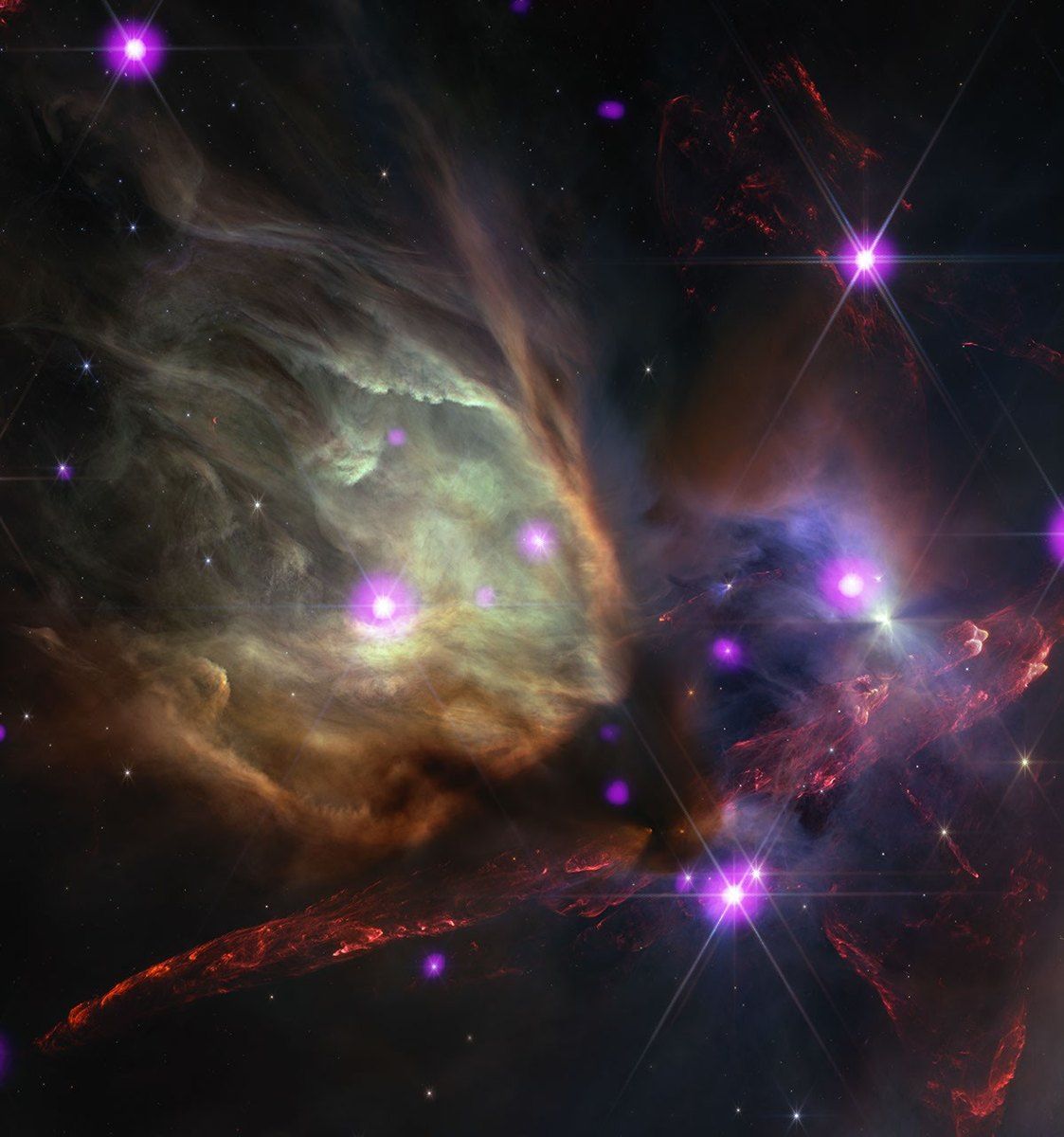 Image: NASA
Four Places You Can Hear
- M82 pairs a scanning sweep with brightness-controlled volume.
- Orion Nebula turns young stars into twinkles.
- Carina Nebula gives individual infant stars brief string notes.
- Rho Ophiuchi includes silence linked to dark clouds of dust.
How Light Becomes Music
M82 produces stars tens or hundreds of times faster than the Milky Way, and NASA says a past galactic collision could explain that activity. Chandra detects enormous hot-gas plumes associated with star formation and the rapid explosions of massive young stars.
Its soundtrack combines X-rays with Hubble’s optical observations and infrared measurements from Webb and the retired Spitzer telescope. X-rays occupy the highest audible frequencies, infrared becomes a deep drone with plucked notes, and visible light supplies varied pitches and textures.
The Orion Nebula is among Earth’s nearest busy stellar nurseries, and a small telescope can reveal it beneath Orion’s belt when skies are dark. Chandra detects over a thousand energetic young stars there, while Webb’s infrared observations show the gas and dust supplying material for their formation.
Beyond the individual stellar sounds, Orion’s spread-out X-ray emission becomes clear, high tones. Webb’s contribution occupies lower notes and includes distorted string sounds alongside the harp.
In the Carina Nebula, Webb’s infrared view reveals the distinctive structure behind the nickname Cosmic Cliffs, while Chandra can detect young stars through surrounding gas and dust. The widespread X-ray glow receives longer string notes; Webb’s nebula observations become a held sound, with additional instruments marking stars and ridges.
Rho Ophiuchi brings together stars of differing ages and sizes, including infant stars whose intense flares generate X-rays. Those X-rays become sharp, glasslike notes, while extended bright sources receive sustained sounds and infrared clouds receive different pitches.
The Chandra X-ray Center leads the sonification program, with visualization scientist Kimberly Arcand, astrophysicist Matt Russo, musician Andrew Santaguida and consultant Christine Malec collaborating on the effort. NASA also directs listeners to further sonifications through Chandra’s sound collection.