

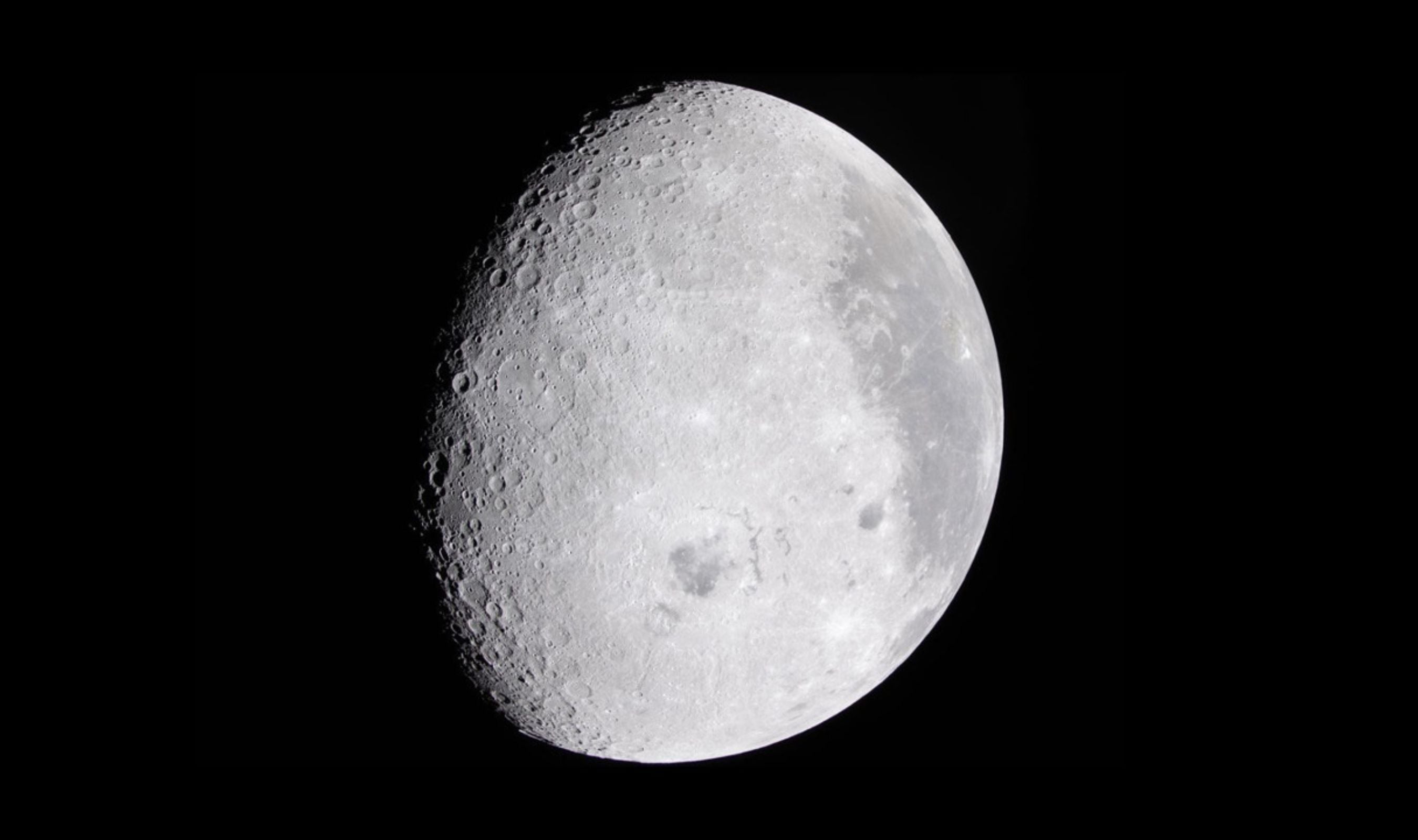
IBM and NASA have released an open-source artificial intelligence model built to study the Moon, and it is available now. The NASA-IBM Lunar Foundation Model is described as one of the first public foundation models for lunar science. It is aimed at supporting a sustained human return to the Moon.
The model predicts where lunar ice may exist, a question that matters because ice is seen as a source of water and oxygen for a Moon base and as a possible ingredient for rocket fuel on missions to Mars. It also maps craters, which helps NASA choose landing sites and steer clear of slopes and boulders, and it studies Irregular Mare Patches, a class of volcanic feature. Crater mapping is also framed as groundwork for long-term lunar infrastructure planning.
IBM and NASA say the model identifies lunar features up to 23% better than common methods. On ice prediction, the announcement cites an error reduction of up to 22% against the SwinV2-B (ImageNet) baseline. It detects craters at context-scale resolution of roughly 100 meters, outperforming that same baseline by nearly 19% while using half the training data. At meter-scale resolution, the announcement points to a paper reporting accuracy on par with SwinV2-B at lower fine-tuning cost.
The training data is itself a first. IBM and NASA built what they describe as the first open-source lunar dataset of its kind, pulling together more than 30 spatially aligned layers. Those layers span nine instruments and four missions, including NASA's Lunar Reconnaissance Orbiter and GRAIL, plus contributions from JAXA's SELENE/Kaguya. The collection holds tens of thousands of images and maps and covers both the lunar surface and subsurface.
Before this, there was no publicly available unified lunar dataset, and scientists sifted through maps and images by hand or relied on low-resolution, task-specific models. The new model combines multimodal, multi-resolution lunar observations. It joins IBM's Prithvi family of open foundation models, which already covers geospatial, weather and heliophysics work and is hosted on Hugging Face.
Juan Bernabe-Moreno, Director of IBM Research Europe, UK and Ireland, said the model "gives scientists a foundation to explore the Moon at scale, connecting observations across instruments, revealing patterns that are difficult to see in isolation, and providing an open platform the global research community can build on".
The announcement does not state a price, licensing terms, hardware requirements or any regional availability limits. IBM trades on the New York Stock Exchange under the ticker IBM. The release follows IBM's work with Red Hat and LTM on Lightwell, an open-source software remediation effort announced a day earlier.