Need the exact iPhone model for a trade-in, repair, case, update, or resale listing? Start in Settings when the phone is unlocked, then use Apple Account, a computer, the box, or the hardware markings when Settings is out of reach.
Here are the current Apple-supported ways to find the model name, A-number, serial number, IMEI, EID, and related identifiers.
Check the model name in Settings first
Use this when the iPhone turns on and you can open Settings. It gives you the plain model name most people need.
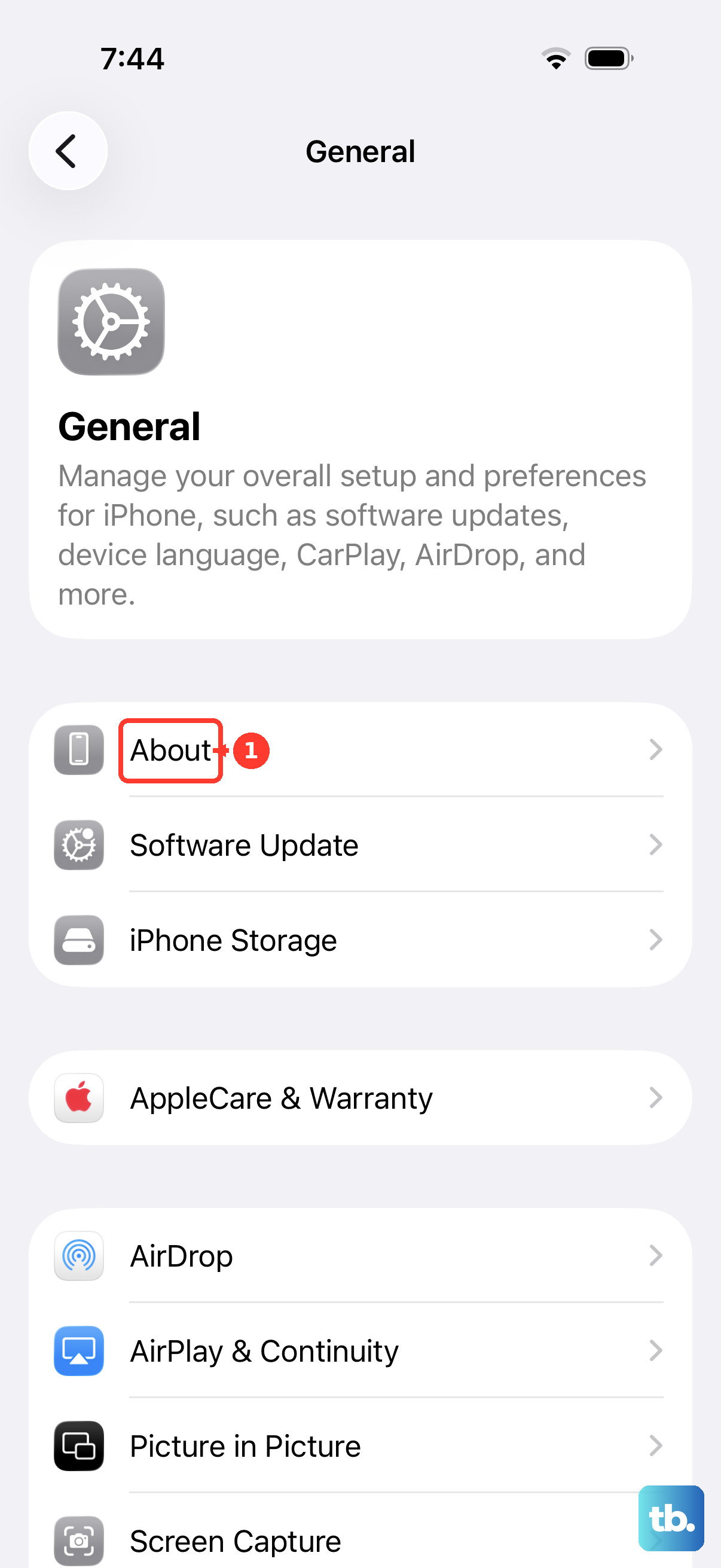
Open Settings.
Tap General.
Tap About.
Read Model Name. Use that name for accessories, support, trade-ins, or resale listings.
Stay on About if you need the model identifier. The Model Number line shows a part number first, and tapping it reveals the A-number.
Reveal the A number in Settings
This fixes the part-number problem when you need the A-number for exact model matching.
Open Settings.
Tap General.
Tap About.
Find Model Number.
Tap the value beside Model Number once to switch from the part number to the A-number model identifier.
Match the A number with Apple’s iPhone list
Get the A-number from Settings, the SIM-tray slot, the connector, or the back of an iPhone 7 or earlier.
Open Apple’s Identify your iPhone model list.
Find the matching entry under Model numbers.
Confirm the exact version with Year introduced, Capacity, Colors, and Details.
Use capacity, color, and physical details when two iPhone models look nearly identical.
Open your Apple Account device list
When the iPhone is not in your hand, a signed-in Apple device or account.apple.com gives you another route. On another iPhone or iPad, open Settings, tap [your name], scroll to the device list, and tap the iPhone name.
On a Mac signed in to the same Apple Account, choose Apple menu, open System Settings, click [your name], scroll to the device list, and click the iPhone name.
From any browser, sign in at account.apple.com, select Devices, and choose the iPhone. If the device list is hidden, click View Details and authenticate.
The device page shows information such as device model, serial number, software version, and trusted-device status, with the exact fields changing by device type.
Use a Mac or Windows PC
Use this when you can connect the iPhone by USB and want its details on a computer. It also works when the phone display is damaged, provided the computer is already trusted, because a first-time connection asks you to unlock the iPhone and tap Trust on its screen.
On a Mac with macOS Catalina 10.15 or later, connect the iPhone.
Open Finder.
Select the iPhone in the sidebar under Locations.
Open General to view the connected iPhone details.
Click the model name under the device name to find the serial number.
Click Phone Number under the device name or device model to find EID, IMEI/MEID, and ICCID.
On Windows, install or open Apple Devices, connect the iPhone with a USB cable, and select the iPhone icon in the app sidebar. To install it, open the Microsoft Store, search for Apple Devices, select Apple Devices, and click Get.
Use Finder on modern Macs and Apple Devices on current Windows PCs. iTunes remains Apple’s older path for macOS Mojave or earlier and PCs where iTunes is still used.
Check before setup or from the box
A new or erased iPhone shows identifiers before setup, so a secondhand iPhone counts only when it is still sitting at the Hello screen. Turn on the device, press and hold the power button until the Apple logo appears, then tap the Info button on the Hello screen to view identifiers such as serial number, EID, or IMEI.
The original packaging gives you another official place to check. Look at the barcode label for the serial number, EID, and IMEI/MEID. Apple Check Coverage takes the serial number only, while the EID and IMEI/MEID are the identifiers to give Apple support or match against your Apple Account device details.
iPhone 14 models and later do not have an IMEI/MEID engraving. For those models, use Settings, the setup Info button, Apple Account, a computer, or the box.
Look on the iPhone itself
Use the hardware markings when Settings is unavailable and you need the A-number directly.
- 1.For an iPhone 8 or later model with a SIM tray, remove the SIM tray.
- 2.Hold the iPhone under bright overhead light.
- 3.Look inside the slot on the upper side, which is the side with the display.
- 4.Read the model number printed inside the slot.
- 5.For an iPhone with no SIM tray, look inside the USB-C or Lightning connector on the upper side facing the display.
Use Check Coverage with a serial number
This fixes the situation where you have the serial number but not the iPhone.
Get the iPhone serial number from Settings, the setup Info button, Finder, Apple Devices, Apple Account, or the original packaging.
Go to checkcoverage.apple.com.
Use Enter a serial number.
Submit the serial number to view the device coverage page.
Ask about managed iPhones at work or school
If the iPhone belongs to an organization, ask the team that manages it. Apple device management services return model-related fields such as Model, Model name, Model number, Product name, Hardware model, and Serial number.
This is an admin route, not a normal consumer setting. Your workplace, school, or IT contact has the model details tied to the managed device record.
If this method fails, use Settings > General > About on the iPhone, or use the Apple Account and computer methods above.
Frequently Asked Questions
What is the fastest way to tell which iPhone I have?
Open Settings > General > About and read Model Name. That gives the plain iPhone name most people need.
Why does my iPhone show a part number instead of an A number?
The Model Number line shows the part number first. Tap that value once to reveal the A-number model identifier.
Can I identify an iPhone without turning it on?
Yes. Use the barcode label on the original box, Apple Account devices, Apple Check Coverage with a serial number, or the supported hardware marking location for that iPhone. The setup Info button is different: it needs the iPhone turned on and sitting at the Hello screen.
Where is the model number on iPhones without a SIM tray?
Look inside the USB-C or Lightning connector in bright overhead light, on the upper side of the connector facing the display.