
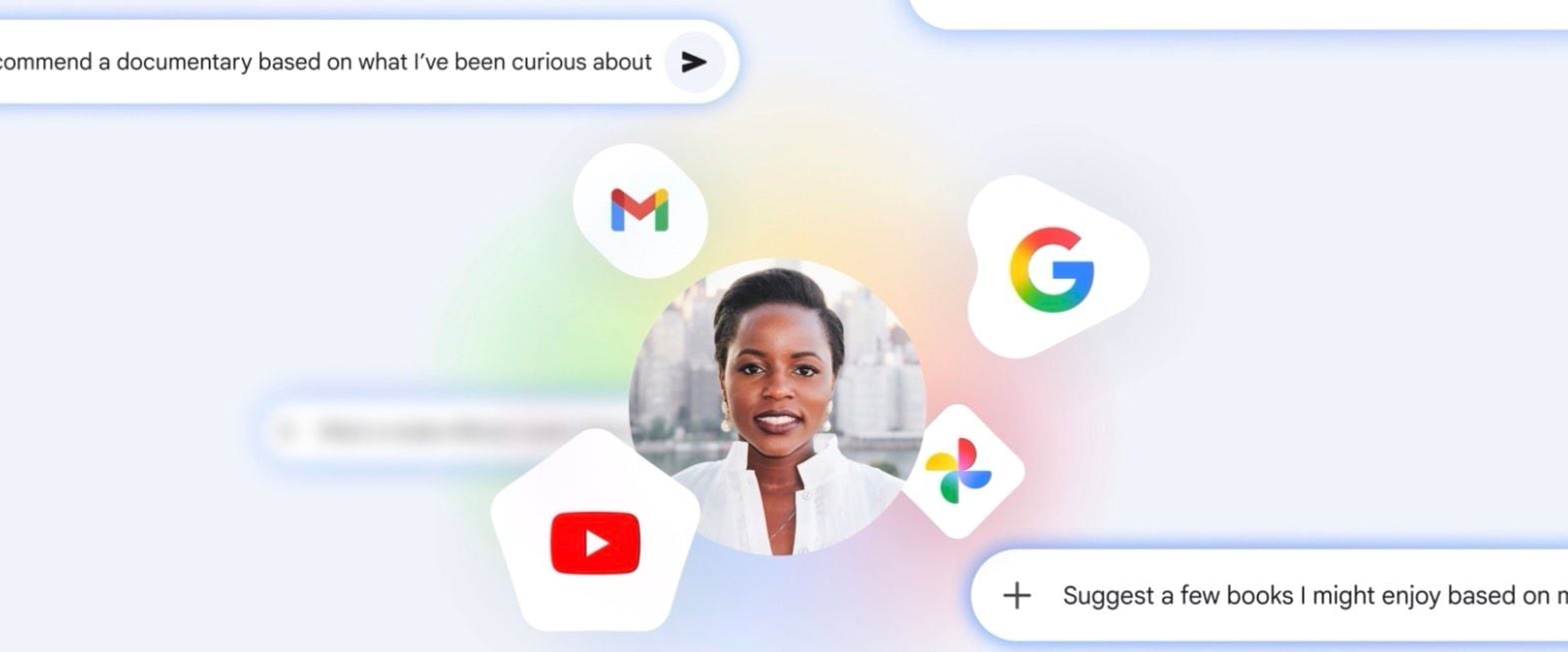
Google launched Personal Intelligence for its Gemini AI assistant today, a beta feature that connects data from Gmail, Photos, Search, and YouTube to deliver hyper-personalized responses. The opt-in capability represents a significant push into context-aware AI, positioning Gemini against Apple's Intelligence system while leveraging Google's ecosystem advantage.
Personal Intelligence rolls out initially to Google AI Pro and AI Ultra subscribers in the United States, with wider availability planned for free users and additional countries. The feature remains off by default, requiring explicit user permission to connect specific Google apps. Users can selectively enable access to Gmail, Photos, Search history, or YouTube activity through Gemini's settings menu.
Powered by the Gemini 3 model family, Personal Intelligence enables cross-app reasoning that previous AI assistants couldn't achieve. Where earlier systems could retrieve individual emails or photos when directly asked, Gemini 3 now analyzes relationships between data points across services. Google demonstrated this with a minivan tire selection example where Gemini identified vehicle trim from photos and license plate details from Gmail receipts.
The feature represents Google's strategic pivot from raw model power to contextual intelligence. While competitors like OpenAI and Anthropic focus on benchmark performance, Google leverages its platform scale and user data access. This approach follows Google's November release of Gemini 3, widely regarded as the current market-leading large language model.
Privacy controls form the foundation of Personal Intelligence's design. Google emphasizes that the system doesn't train directly on Gmail or Photos data, instead using retrieval methods to reference information when answering specific queries. Sensitive topics like health data remain excluded from proactive analysis, though Gemini will discuss these areas if explicitly asked.
Google's Josh Woodward, vice president of Google Labs and the Gemini app, acknowledged the beta status includes potential errors. "Gemini may struggle with timing or nuance, particularly regarding relationship changes like divorces or your various interests," Woodward wrote in a company blog post according to CNBC. Users can provide feedback through thumbs-down responses and regenerate answers without personalization.
The launch coincides with Google's expanding AI partnership with Apple, announced earlier this week. Apple selected Gemini to power its next-generation Siri assistant expected later this year, reportedly paying $1 billion annually for the technology. This deal immediately positions Gemini as the backend for Siri's estimated 1.5 billion daily requests, dramatically expanding Google's AI distribution.
Personal Intelligence will eventually integrate with Google Search's AI Mode, bringing personalized context to the world's most visited webpage. Search Engine Land reports this integration could challenge traditional search tracking methods, as highly personalized results become difficult to monitor consistently across users.
For enterprise users, the feature currently excludes Workspace, business, and education accounts, focusing exclusively on personal Google profiles. Google plans Workspace integration in future updates, suggesting enterprise applications where administrators could control data connections across organizational accounts.
The subscription requirement creates immediate monetization potential, with Google AI Pro priced at $19.99 monthly and Ultra at higher tiers. This gated access follows Google's pattern of introducing premium features to paying subscribers before broader release, similar to its AI Overviews rollout in Search.
Industry analysts view Personal Intelligence as Google's response to Apple's on-device AI strategy. While Apple Intelligence promises local processing for privacy, Google's cross-service integration offers deeper ecosystem connections. The competition reflects divergent approaches to personal AI, with Google betting on cloud-based data synthesis versus Apple's device-focused architecture.
Early user experiences demonstrate practical applications beyond simple queries. Gemini can now recommend YouTube channels based on cooking style inferred from grocery receipts, suggest documentaries aligned with search history, or propose career alternatives by analyzing professional communications. These capabilities move beyond reactive assistance toward proactive personal guidance.
Technical implementation relies on Google's proprietary TPU chips rather than Nvidia's supply chain, providing full-stack optimization advantages. This hardware independence, combined with Google's data ecosystem, creates barriers for competitors attempting similar personal AI systems without equivalent infrastructure.
As beta testing progresses, Google will refine Personal Intelligence based on user feedback before expanding to free tiers and international markets. The feature's success could redefine how AI assistants operate within closed ecosystems, balancing personalized utility against ongoing privacy concerns in the competitive generative AI landscape.