A healthy MacBook usually reaches the desktop in well under a minute. When the Apple logo, a progress bar, or a spinning globe hangs for several minutes with no movement, something is interrupting the startup sequence. The cause can be as simple as a stuck peripheral or as serious as a damaged system file, and the right fix depends on which.
The steps below are ordered from fastest and safest to last resort, so start at the top and stop as soon as your Mac boots. Many of them differ depending on whether you have an Apple Silicon Mac (M1, M2, M3, M4, or newer) or an older Intel model, and those differences are called out at each step. The current release at the time of writing is macOS Tahoe (macOS 26).
Match the Symptom to the Likely Cause
Before you start, look at exactly what is on the screen. The picture your MacBook freezes on is a strong hint about where the boot is failing, which helps you skip steps that will not help.
Use the table below to find the most likely cause and the first fix to try.
| What you see | Likely cause | Where to start |
|---|---|---|
| Stuck on Apple logo, no progress bar | Software or login item hanging early in boot | Force restart, then Safe Mode |
| Progress bar stalls partway | Update or disk issue mid-boot | Wait, then First Aid in Recovery |
| Spinning globe | No bootable system found, trying network boot | Check startup disk, then reinstall |
| Prohibitory sign (circle with a slash) | System cannot be used on this Mac or is damaged | Reinstall macOS in Recovery |
| Question mark folder | Startup disk not found | Select startup disk, then First Aid |
| Black or blank screen, light or fan on | Power, display, or firmware fault | Force restart, then revive firmware |
Force Restart Your MacBook
When the screen is frozen you cannot use the Apple menu, so you need to cut power directly. Press and hold the power button (the Touch ID button on most laptops) for about 10 seconds until the screen goes fully black and the Mac shuts off.
Wait roughly 30 seconds, then press the power button once to start up normally. A single hung boot is often a one-time glitch, and a clean restart clears it more often than any other step.
If the Mac powers back on but freezes at the same point again, move on to the next fix rather than repeating the force restart.
Disconnect Peripherals and Check Power
External hardware can stall a boot. A faulty drive, hub, or accessory may make your Mac wait on it, and a non-bootable external disk can even pull the startup away from your internal one.
Shut the Mac down, then unplug everything except the charger. That includes external drives, printers, USB hubs, docks, displays, and adapters. Wireless dongles count too, so start up with nothing but power connected.
If your MacBook is running on battery, plug in the original Apple charger and a known-good cable, then check that the charging cable and adapter are firmly seated. A drained or barely charged battery can cause a boot to stall before it finishes.
Boot Into Safe Mode
Safe Mode starts macOS with only the components it needs, skips most third-party login items and extensions, and runs a basic check of your startup disk. If a recently installed app or a corrupt cache is blocking startup, Safe Mode usually gets you past it.
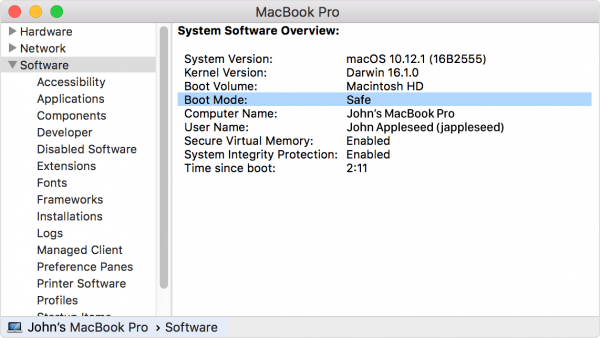
On an Apple Silicon Mac, shut down, then press and hold the power button until you see "Loading startup options." Select your startup volume, hold the Shift key, and click Continue in Safe Mode. On an Intel Mac, turn it on and immediately hold Shift until the login window appears.
When you reach the login screen you should see "Safe Boot" in the menu bar. Log in, then restart normally without holding any keys. If the Mac boots fine afterward, a third-party item was the cause, so remove or update software you installed just before the trouble started. Safe Mode does not delete any of your personal files.
Reset NVRAM or PRAM on Intel Macs
NVRAM (or PRAM on older models) is a small block of memory that stores settings like startup disk selection, display resolution, and time zone. If these values get scrambled, your Intel Mac can hang while looking for a system to boot.
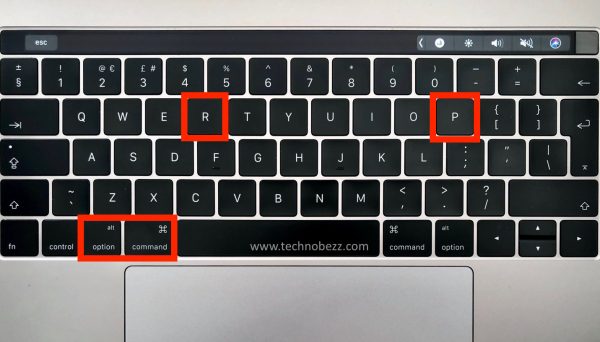
To reset it on an Intel Mac:
- 1.Shut down the MacBook completely.
- 2.Press the power button, then immediately press and hold Option, Command, P, and R together.
- 3.Keep holding for about 20 seconds. On older Macs that play a chime, release after the second startup sound.
- 4.Let the Mac finish starting up, then recheck your startup disk and date settings.
Apple Silicon Macs have no NVRAM reset keys. They test and rebuild this memory automatically at every boot, so a normal shutdown, a 30 second wait, and a fresh power-on does the same job.
Reset the SMC on Intel Macs
The System Management Controller handles power, battery, fans, and other low-level functions on Intel Macs. A confused SMC can stop a Mac from powering on or completing a boot, and resetting it is harmless to your data.
On an Intel laptop with the Apple T2 chip (2018 and later), shut down, press and hold the power button for 10 seconds, release, wait a few seconds, then turn it on. If that does not help, shut down again, hold Control, Option (left side), and Shift (right side) for 7 seconds, then add the power button and hold all four for another 7 seconds. Release everything, wait, and start up.
Apple Silicon Macs do not have a user-resettable SMC. Those functions are built into the chip, so a full shutdown and restart is the equivalent step.
Run First Aid in Disk Utility
Disk errors are a common reason a boot stalls partway, especially after a crash or an interrupted update. Disk Utility's First Aid tool checks the startup disk and repairs many of these problems from the Recovery environment.
Start up in macOS Recovery first. On an Apple Silicon Mac, hold the power button until "Loading startup options" appears, then click Options and Continue. On an Intel Mac, turn it on and immediately hold Command and R until you see the Apple logo or a spinning globe.
In the macOS Utilities window, choose Disk Utility, then:
- 1.Click View and choose Show All Devices.
- 2.Select your main startup disk in the sidebar, then any volumes under it.
- 3.Click First Aid, then Run, and wait for the check to finish.
- 4.Click Done, quit Disk Utility, and restart the Mac.
Choose the Correct Startup Disk
If your Mac is trying to boot from the wrong volume, you may see a spinning globe, a question mark folder, or a hang. Pointing it back at the right system disk can resolve this without any repair.
On an Apple Silicon Mac, hold the power button to reach startup options, then click your internal disk (such as Macintosh HD) and click Continue. This boots from that disk for one session.
To make the choice stick, boot into the system, then go to
Apple menu > System Settings > General > Startup Disk
and select your internal drive. On Intel Macs you can also hold Option at startup to open Startup Manager and pick a disk.
Reinstall macOS Without Erasing
If the system files themselves are damaged, reinstalling macOS over the top repairs them while keeping your apps, documents, and settings in place. This is one of the most effective fixes for a Mac that boots part way and then freezes.
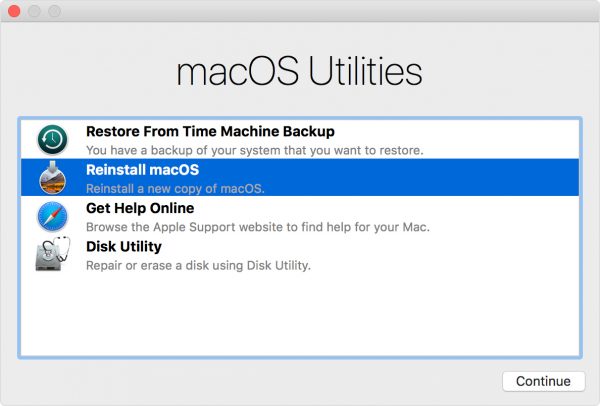
Start up in macOS Recovery (hold the power button on Apple Silicon, or Command and R on Intel). Then:
- 1.In the macOS Utilities window, select Reinstall macOS and click Continue.
- 2.Agree to the terms and choose your existing startup disk as the destination.
- 3.Stay connected to power and Wi-Fi while the installer downloads and runs.
- 4.Let the Mac restart on its own when it finishes.
As long as you do not erase the disk first, this keeps your files. Even so, back up to Time Machine or an external drive beforehand whenever you can still reach your data.
Erase and Reinstall as a Last Resort
When repairs and a plain reinstall both fail, erasing the disk and installing a clean copy of macOS gives you a known-good system. This deletes everything on the drive, so treat it as a last resort and only after backing up.
From macOS Recovery, open Disk Utility, select your startup volume, and click Erase, using APFS as the format. Quit Disk Utility, choose Reinstall macOS, and point it at the freshly erased disk.
If you have a Time Machine backup, you can instead choose Restore from Time Machine in the Utilities window to bring your data back onto the clean system after the install.
Revive the Firmware From a Second Mac
A boot that fails before the Apple logo, or a Mac that shows only a black screen, can point to damaged firmware. You can repair the firmware using a second Mac without touching your data, which Apple calls a revive.
You need an Apple Silicon or T2 chip Mac (the affected one), a second Mac running macOS Sonoma or later, and a USB-C to USB-C cable that supports data and power. On macOS Sonoma and newer the process runs from the Finder, while older helper Macs use the Apple Configurator app instead.
Connect the two Macs, put the affected Mac into DFU mode following Apple's model-specific steps, then choose Revive in the window that appears. A revive reinstalls the firmware and Recovery system while leaving your files intact. For the exact key sequence per model, see Apple's revive and restore instructions.
Restore the Mac From a Second Mac
If a revive does not work, a restore is the firmware-level equivalent of an erase and reinstall. It rewrites the firmware, erases the internal drive, and installs a fresh macOS, so use it only after a revive fails and after you have a backup.
The hardware requirements are the same as a revive: the affected Mac, a second Mac on macOS Sonoma or later, and a data-capable USB-C cable. Put the affected Mac into DFU mode, then choose Restore instead of Revive.
Because a restore wipes the disk, you will set the Mac up as new afterward and bring your data back from a backup.
Contact Apple or an Authorized Provider
If your MacBook still will not get past the loading screen after a restore, the problem is likely hardware rather than software. A failing internal drive, logic board fault, or power issue needs in-person diagnosis.
Back up anything you can still reach, then contact Apple Support or book a visit with an Apple Store or Apple Authorized Service Provider. If your Mac is under warranty or AppleCare, repairs may be covered.
Bring the original charger and note exactly what appears on screen and how far the boot gets, since that detail speeds up the diagnosis.
Frequently Asked Questions
Why is my MacBook stuck on the loading bar?
A stalled progress bar usually means macOS is stuck on a step during boot, often a disk error or an interrupted update. Force restart first, then run First Aid in Disk Utility from Recovery. If the bar still hangs, reinstall macOS without erasing.
How long should a MacBook take to start up?
Most modern MacBooks reach the desktop in well under a minute, and Apple Silicon models are often faster. A boot that takes several minutes with no visible progress is a sign something is wrong and worth troubleshooting.
Will Safe Mode delete my files?
No. Safe Mode only changes how macOS starts up for that session, loading minimal components and skipping most third-party items. It does not remove your apps, documents, or settings.
Does reinstalling macOS erase my data?
Reinstalling macOS from Recovery keeps your files and settings as long as you do not erase the disk first. Only choosing Erase in Disk Utility, or doing a Restore from a second Mac, deletes your data. Back up before either of those.
What do the Apple logo, spinning globe, and progress bar mean?
The Apple logo with a progress bar means macOS is loading normally. A spinning globe means the Mac could not find a local system and is trying to start from the internet or network. A bar that stalls partway usually points to a disk or update problem.
How do I open Recovery on an Apple Silicon versus an Intel Mac?
On an Apple Silicon Mac, press and hold the power button until you see "Loading startup options," then click Options and Continue. On an Intel Mac, turn it on and immediately hold Command and R until the Apple logo or spinning globe appears.
First published October 16, 2025. Last updated June 4, 2026.