
Microsoft just turned Copilot into an operating system for your entire workday. At Build 2026 in San Francisco today, the company unleashed a flood of announcements that collectively transform Copilot from a chat tool into an agentic layer running across Windows, dedicated hardware, and the cloud.
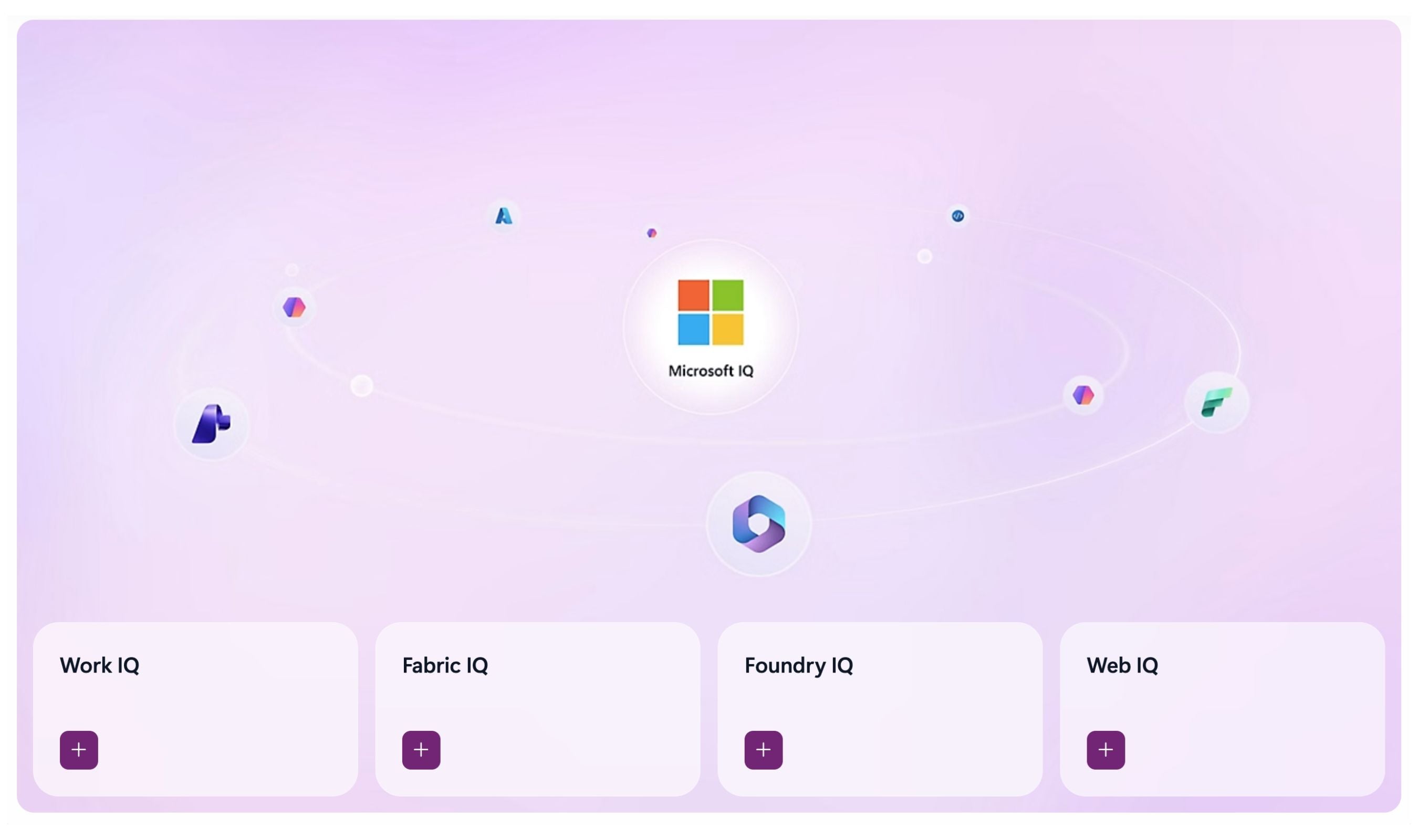
The biggest shift: Work IQ, Microsoft's new agent-first enterprise platform launching June 16. ZDNET's David Gewirtz describes it as Microsoft "completely redesigning how enterprise software works." Instead of humans coding connections between apps, Work IQ lets AI agents dynamically discover data structures at runtime using a capability called getSchema. An agent can ask a database "tell me about yourself" and the database responds, no human developer needed.
Microsoft says it has collapsed thousands of enterprise operations into just 10 generic tools with functions like fetch, create, and update. "Work IQ is built for an agent-first world, where AI agents -- not human developers -- decide in real time which tools to use across systems," the company said.
Then there's the Copilot super app. The Verge's Tom Warren reported ahead of Build that a unified Copilot experience was coming to Windows 11, bundling the assistant's capabilities into a single destination rather than scattering them across Microsoft 365 apps.
It arrives alongside major Windows 11 changes that have already started appearing in preview builds.
Microsoft also introduced Scout, an always-on personal assistant that integrates into Outlook, OneDrive, and Teams. Unlike Copilot's current chat interface, Scout can make phone calls, manage expense reporting, draft emails, and organize calendars autonomously.
"This is a personal assistant, it's the first real personal assistant we've offered customers," Omar Shahine, corporate vice president of Microsoft Scout, told The Verge. "You're going to get a phone call from this assistant, it's a very different type of AI than chat." On the hardware side, Microsoft announced Project Solara, a new chip-to-cloud platform for AI agent devices built on Android, not Windows. Steven Bathiche, who leads Microsoft's Applied Sciences Group, demonstrated two concept devices onstage: a desk-bound MediaTek device for work and an Access Badge wearable built with Qualcomm silicon. The badge unlocks with a fingerprint and responds to voice commands. During the demo, Bathiche asked it to scan the Build audience, find good photos, clean them up, and send them to his team.
Microsoft is already working with AccuWeather, Best Buy, CVS Health, Levi Strauss, and Target on the badge. The desk device, powered by Work IQ, provides access to Microsoft 365 Copilot with facial recognition sign-in and supports handoff between devices. "Just walking up to the device securely signs you in, giving you direct access to your matrix," Bathiche said.
Microsoft did not share a launch date for the desk device.
Under the hood, Microsoft launched MAI-Thinking-1, a new flagship in-house AI model trained "from the ground up on clean data, without distillation from third-party models." The company says it matches leading models on key software engineering benchmarks. Two local Windows AI models also debuted: Aion 1.0 Instruct and Aion 1.0 Plan.
Nvidia CEO Jensen Huang joined Satya Nadella on stage virtually, announcing the Surface Laptop Ultra and Surface RTX Spark Dev Box, both powered by Nvidia's Arm-based RTX Spark chips. The Dev Box packs 128GB of unified memory, capable of running 120-billion-parameter models locally, in a chassis that looks like a flattened Xbox Series X.
Microsoft even addressed the security elephant in the room with Execution Containers, a policed layer that makes it safer to run tools like OpenClaw on Windows. "You can totally run OpenClaw inside your company now," OpenClaw creator Peter Steinberger said. The quantum computing division got an update too. Majorana 2, the next generation of Microsoft's topological quantum chip, contains qubits that are 1,000 times more reliable than the first generation, according to Microsoft, aided by a new material stack and the company's Discovery agentic AI.
For businesses that just want practical Copilot workflows today, NJBIA is hosting a Business Growth Roundtable co-hosted with the NJ AI Hub (a partnership between the State of New Jersey, Princeton University, and Microsoft) covering real Copilot use cases across sales, operations, and leadership. The session promises repeatable prompts and workflows tied to business outcomes, not theory. But after today, "smarter ways to use Copilot" means something fundamentally different than it did yesterday. Copilot isn't just a feature anymore, it's the platform.