
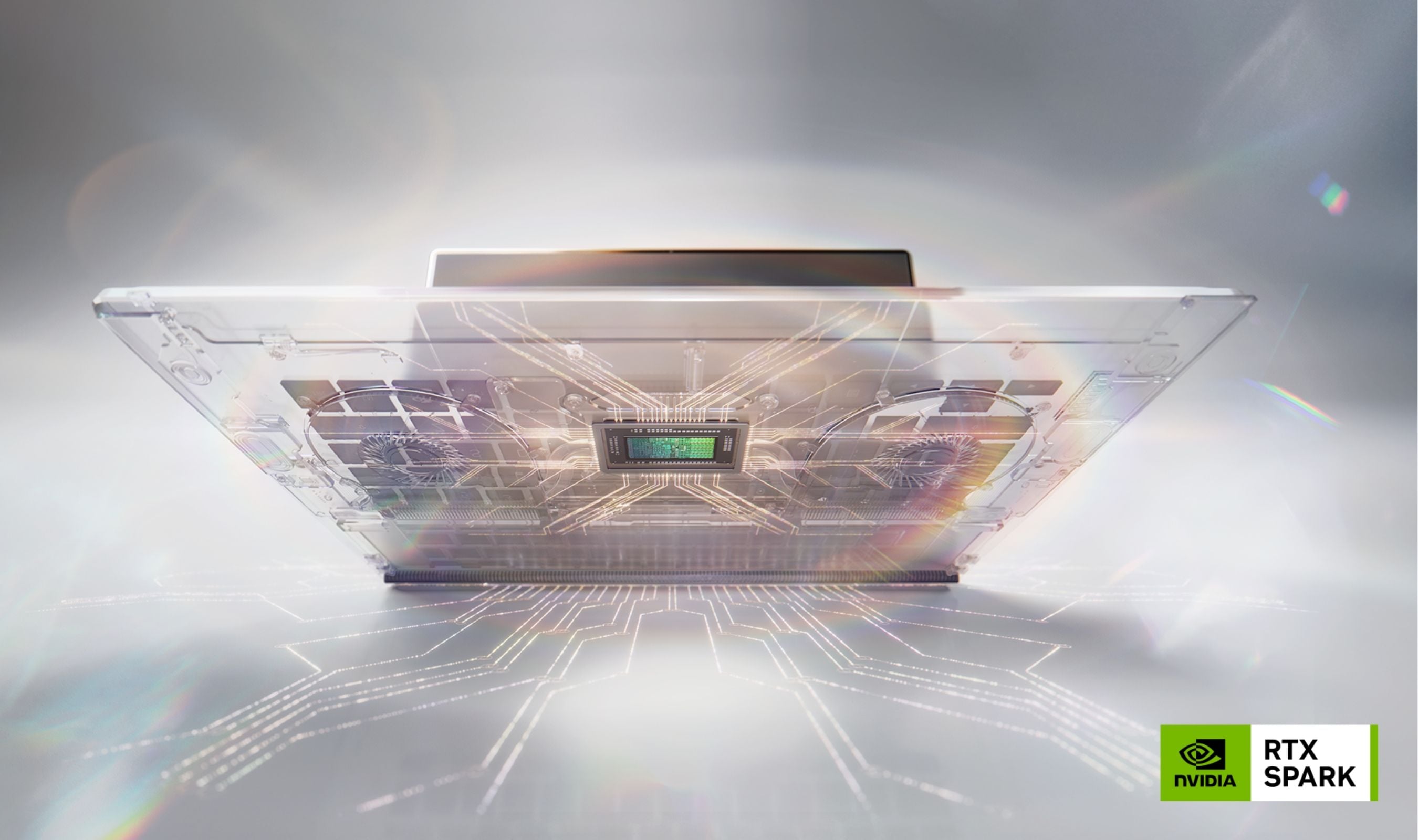
Nvidia declared itself a PC chipmaker on Monday, announcing the RTX Spark processor family at Computex 2026 in Taipei and kicking off what CEO Jensen Huang called "the first completely reengineered, reinvented line of PCs that has happened in 40 years." The RTX Spark combines a 20-core Arm-based Grace CPU (co-developed with MediaTek), up to 6,144 Blackwell GPU cores, and as much as 128GB of unified LPDDR5x memory into a single chip. It is effectively the same GB10 silicon that powered Nvidia's DGX Spark mini-PC last year, now repackaged as a full computing platform for laptops and desktops.
"This reinvention of the computer is as big of a deal as the reinvention of the phone into what we now know as the smartphone," Huang said during his Computex keynote. "Microsoft and Nvidia are going to reinvent the PC."
Eight laptops are confirmed for this fall, including the Microsoft Surface Laptop Ultra (which Surface boss Andrew Hill called "the most powerful thing we've ever made"), the Dell XPS 16, HP OmniBook X14 and Ultra 16, Lenovo Yoga Pro 9N, Asus ProArt P14 and P16, and the MSI Prestige N16 Flip AI. Nvidia says partners are working on more than 30 laptops and 10 desktops total, with Acer, Gigabyte, and others also on board.
This is not Nvidia's first attempt at Windows on Arm. The company's Tegra chips powered the short-lived Windows RT tablets from 2012, a failure that faded alongside that slimmed-down OS. But the market has changed. Microsoft's x86-to-Arm Prism emulator has matured over years of Qualcomm-powered Copilot+ PCs, and many major apps now ship native Arm versions. The gap that once plagued translated software has narrowed significantly for everyday productivity work. The gaming gap is closing too. Nvidia and Microsoft confirmed they are working with Riot Games to bring League of Legends and Valorant to Windows on Arm, with Krafton bringing PUBG. The company is also coordinating with the developers of Easy Anti-Cheat, BattlEye, and Denuvo, anti-cheat systems that have historically blocked Arm-based gaming.
Nvidia senior director of product management Mark Aevermann claimed "all the top games will run on RTX Spark and provide a great experience," though the company declined to share any performance benchmarks or comparison data against Intel, AMD, Apple, or Qualcomm chips. Aevermann said the GPU portion roughly matches an RTX 5070 mobile and the CPU should be "competitive with anything else out there in the Windows space."
The chip scales from "low, low single-digit" wattage up to 80 watts, and Aevermann said battery life should be "much better than anything you've seen before on RTX laptops." Nvidia claims the chip can render a 90GB 3D scene, edit 12K video, or play Indiana Jones and the Great Circle at 100fps at 1440p, all in a 14mm thick laptop unplugged. The AI angle is central. With up to 128GB of unified memory, RTX Spark machines can host 120-billion-parameter AI agents locally. At Microsoft's Build conference this week, the companies are demonstrating "new Windows security and containment primitives" that, combined with Nvidia's OpenShell runtime, let personal AI agents run under full user control. Microsoft CEO Satya Nadella said the goal is "unmetered intelligence to every home and every desk with Windows."
Pricing remains unannounced, though Nvidia confirmed the first wave targets "the more premium price points in the market." CCS Insight research director Ian Fogg said the chips are "likely to come with a price tag" aimed at workstation-class performance. The move directly challenges Intel, AMD, and Qualcomm in their home turf. Forrester analyst Charlie Dai described it as Nvidia's transition from "component supplier" to "architecture owner in the PC market." Arm-based processors continue gaining share against the x86 architecture that Intel and AMD have dominated for decades, and Huang projected the overall CPU market will grow into a $200 billion industry.
Nvidia declined to comment on Linux driver support, gaming handhelds, or whether the chips are manufactured in the US. It confirmed that RTX Spark systems will not support discrete GPUs.