
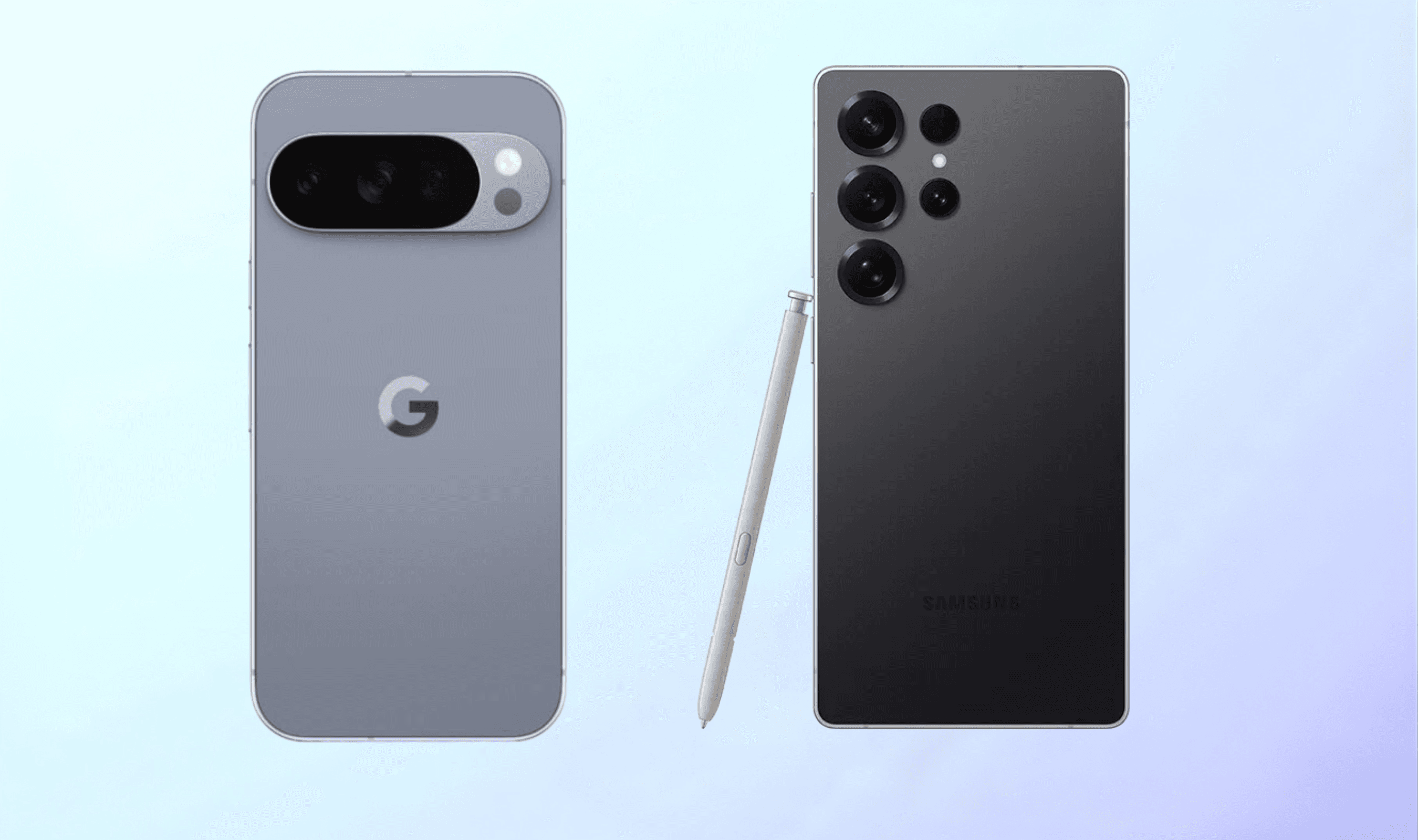
Google's Pixel 10 Pro and Samsung's Galaxy S25 Ultra represent divergent approaches to premium Android smartphones in early 2026. The Pixel 10 Pro features a 6.3-inch LTPO OLED display with 3,300 nits peak brightness, while the Galaxy S25 Ultra offers a larger 6.9-inch Dynamic LTPO AMOLED 2X panel at 2,600 nits. Both support 120Hz refresh rates and HDR10+ content.
The Pixel 10 Pro uses Google's first TSMC-made Tensor G5 processor, a 3nm chip paired with 16GB of LPDDR5X RAM. Samsung's device runs on Qualcomm's Snapdragon 8 Elite for Galaxy with up to 16GB of RAM. In daily use, both phones deliver responsive performance, though the Galaxy S25 Ultra opens apps slightly faster and handles demanding games better.
Battery capacity differs significantly between the two devices. The Pixel 10 Pro includes a 4,870mAh battery supporting 30W wired charging, while the Galaxy S25 Ultra packs a 5,000mAh cell with 45W wired charging. Samsung's device provides 15-20% more screen-on time and charges fully in one hour compared to the Pixel's 90-minute charging time.
Camera systems showcase different philosophies. The Pixel 10 Pro features a 50-megapixel main sensor, 48-megapixel ultrawide, and 48-megapixel 5x periscope telephoto. Samsung's device includes a 200-megapixel main camera, 50-megapixel ultrawide, 10-megapixel 3x telephoto, and 50-megapixel 5x periscope. Both produce strong results with distinct processing styles - Google favors contrast while Samsung emphasizes saturation.
Design differences extend beyond specifications. The Pixel 10 Pro uses an aluminum frame with a prominent camera bar, while the Galaxy S25 Ultra features titanium construction with five separate camera protrusions. Both maintain IP68 water resistance, though Samsung's device is heavier, with the Galaxy S25 Ultra weighing approximately 218 grams compared to the Pixel 10 Pro's 207 grams.
Samsung's broader smartphone strategy faces scrutiny as its mid-range Galaxy A57 reportedly outperforms flagship Galaxy S models in charging efficiency. The Galaxy A56 delivered 45W charging last year, reaching 50% battery in 22 minutes compared to 27 minutes for the Galaxy S25. This mid-range advantage highlights Samsung's segmented approach to feature distribution.
Both phones lack audio jacks but include stereo speakers and support wireless audio through Bluetooth 6.0 on the Pixel and Bluetooth 5.4 on Samsung's device. Display protection varies with Gorilla Glass Victus 2 on Google's phone and Gorilla Armor 2 on Samsung's, the latter offering superior glare reduction.
Samsung continues supporting older flagship models, rolling out January 2026 security updates to Galaxy S22 and S23 series devices. The nearly 400MB update contains 55 security fixes, including 23 from Google (though two don't apply to Samsung devices), 4 from Samsung Semiconductor, and 30 from Samsung Mobile.
The comparison reveals Google's focus on computational photography and AI integration versus Samsung's hardware-first approach with extensive camera hardware and display technology. For consumers, the choice depends on priorities: the Pixel 10 Pro offers Google's software ecosystem and faster updates, while the Galaxy S25 Ultra provides superior gaming performance and faster charging.
As Samsung prepares its Galaxy S26 series, questions persist about innovation distribution across its product lineup. The company's mid-range devices increasingly match or exceed flagship features in specific areas, particularly charging technology where the Galaxy A57 reportedly maintains 45W charging in a slimmer 6.9mm body with 5,000mAh battery capacity.