

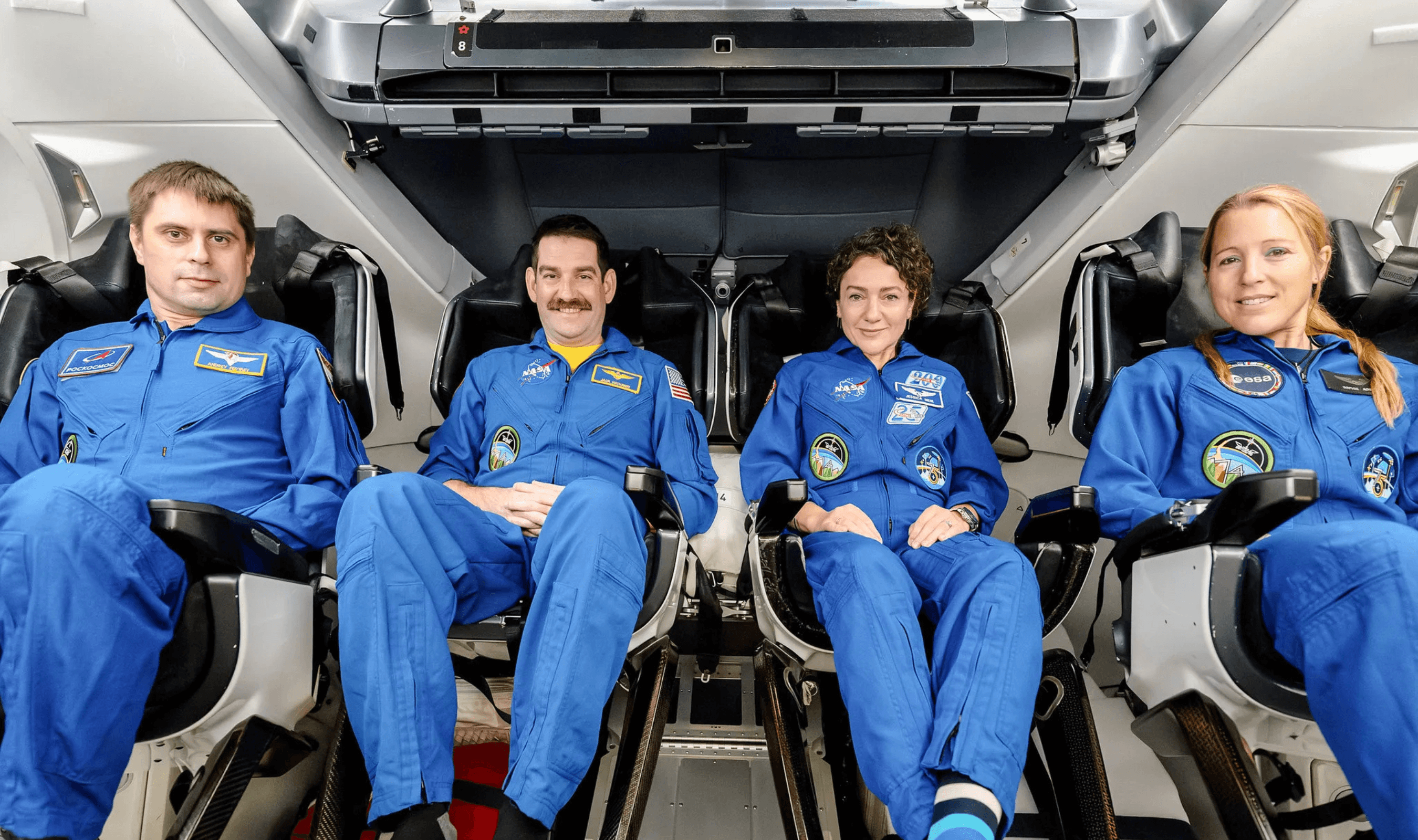
NASA and SpaceX launched a replacement crew to the International Space Station on Friday, February 13, following the first medical evacuation in NASA's 65-year human spaceflight history.
The Crew-12 mission departed from Kennedy Space Center in Florida, sending four astronauts to restore the station to full operations.
The Falcon 9 rocket lifted off at 5:15 a.m. EST, carrying NASA astronauts Jessica Meir and Jack Hathaway, European Space Agency astronaut Sophie Adenot, and Roscosmos cosmonaut Andrey Fedyaev. SpaceX Launch Control radioed, "It turns out Friday the 13th is a very lucky day," after the astronauts reached orbit.
"That was quite a ride."
Crew-12 will replace the Crew-11 team that returned to Earth last month in NASA's first medical evacuation. The previous mission ended more than a month early after NASA confirmed one astronaut had a serious medical condition. All four returning astronauts went directly to hospitals after splashing down in the Pacific near San Diego on January 15.
The medical evacuation marked the first time NASA cut short a human spaceflight mission for health reasons. NASA officials described the situation as a "medical evacuation" rather than an emergency return, but acknowledged the astronaut required ground-based medical care unavailable on the station.
The agency has not revealed the affected astronaut's identity or specific health issue.
Crew-11 astronauts Mike Fincke, Zena Cardman, Japan's Kimiya Yui, and Russia's Oleg Platonov spent 165 days aboard the orbiting laboratory before their early return. They traveled nearly 71 million miles and completed more than 2,670 Earth orbits during their mission, which launched in August 2025.
NASA accelerated the Crew-12 launch timeline to restore normal operations. The space agency had suspended spacewalks and deferred other duties while awaiting the new crew's arrival. Crew-12 will join Expedition 74 members currently maintaining station operations.
The replacement crew will conduct scientific investigations and technology demonstrations during their eight-to-nine-month mission. Their work includes testing a filter designed to convert drinking water into emergency IV fluid and evaluating an ultrasound system that uses artificial intelligence and augmented reality instead of ground-based experts.
They will also perform ultrasound scans on their jugular veins for a blood clot study and demonstrate moon-landing skills in simulated tests. These experiments support preparations for future Moon and Mars missions where healthcare presents greater challenges.
NASA chief Jared Isaacman called Crew-12's launch an "absolutely wonderful start" in orbit. He praised the Falcon 9 rocket's return less than eight minutes after liftoff as "very impressive." The booster landed successfully for potential reuse.
The Crew-12 Dragon spacecraft is scheduled to dock with the International Space Station on Saturday, February 14. Their arrival will restore the station to its normal seven-person crew complement and resume full scientific operations interrupted by the medical evacuation.