Your iPhone hides a handful of dialer shortcuts that pull up information Apple never put in the Settings app. These are known as USSD and MMI codes, and you type them straight into the Phone keypad to check your IMEI, read your true signal strength, or see whether your calls are being forwarded somewhere you did not authorize.
USSD stands for Unstructured Supplementary Service Data, and MMI stands for Man Machine Interface. Both are part of the GSM standard your carrier uses, which is why most of these codes are not Apple features at all. They talk directly to your carrier's network, so a few may behave differently depending on who your provider is.
This guide covers the codes that still work on current iPhones running iOS 18, with the obsolete ones removed. If you use an Android phone, see our companion guide instead.
Read more - Android and Samsung Secret Codes USSD MMI Code List
How to Enter a Secret Code
Every code in this guide is entered the same way. Open the Phone app, tap Keypad, and type the code exactly as written, including each asterisk and pound sign.
Some codes act the moment you finish typing. The IMEI code, for example, shows its result as soon as you enter the final pound sign, so you do not need to press Call. Most others need you to tap the green Call button to send the request to your carrier.
If a code returns a system interrogation failed message or simply does nothing, your carrier likely does not support it or has blocked it on your plan. That is normal and not a sign of a problem with your iPhone.
Check Your IMEI Number
The most reliable code on any iPhone is *#06#. Type it into the keypad and a Device Info panel appears instantly with your IMEI, and on dual SIM models your IMEI2, MEID, and EID.
Your IMEI is the unique hardware identifier for your iPhone. You will need it to report a lost or stolen device, to check carrier eligibility before buying a used iPhone, or to confirm a phone is not blacklisted.
You can also find the same numbers without a code by going to the path below.
Settings > General > About
Read Your Real Signal Strength
The bars in your status bar are an estimate. To see exact numbers, dial *3001#12345#* and press Call to open Field Test Mode. For the clearest reading, turn off Wi-Fi first so the phone reports its cellular connection.
Once inside, tap the menu item for signal measurements to see RSRP, RSRQ, and SINR values. RSRP is the headline figure for signal strength, measured in dBm, and the closer the number is to zero the stronger your signal. As a rough guide, a reading around -80 dBm or higher is strong, the -90s are average, and -100 dBm or lower means a weak connection.
Field Test Mode availability varies by iPhone model and iOS version, and on some 5G devices it may not show every metric. If a screen looks empty, your model may report fewer fields than older iPhones did.
Check Your Caller ID Status
To see whether your number is currently set to show or hide on outgoing calls, dial *#31# and press Call. This only reports the status, it does not change anything.
To hide your number for a single call, dial #31# immediately followed by the phone number you are calling, with no spaces. The other person sees an unknown or private caller for that one call only.
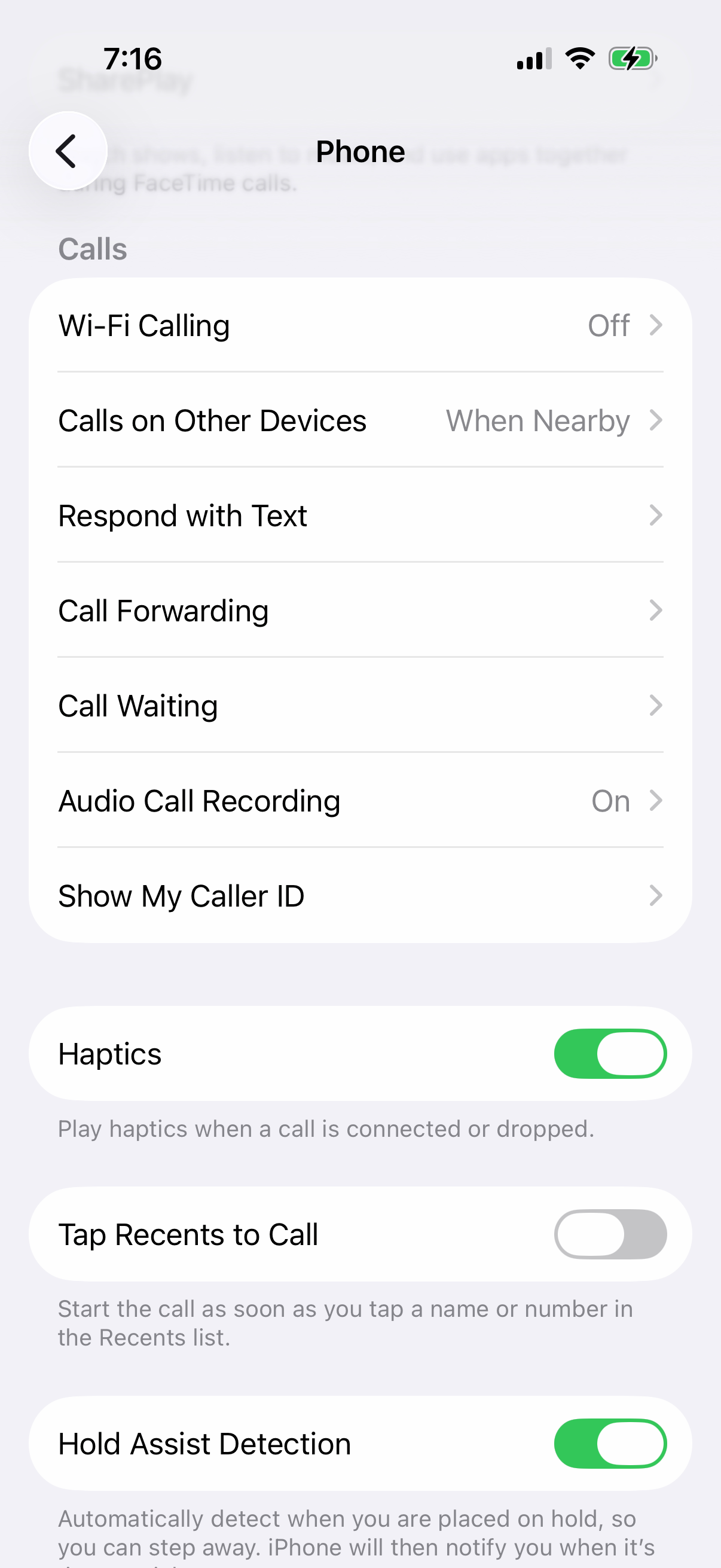
If you want your number hidden on every call, use the setting instead of a code. Support for this depends on your carrier, and if you do not see the option your carrier does not allow it.
Settings > Apps > Phone > Show My Caller ID
Manage Call Waiting
Call waiting lets a second incoming call ring through while you are already on a call. To check whether it is turned on, dial *#43# and press Call.
To switch it on, dial *43# and press Call. To switch it off, dial #43# and press Call. These codes are useful when the in app setting is missing or grayed out on a particular carrier.
If you prefer the menu, you can manage the same feature in the Phone settings at the path below.
Settings > Apps > Phone > Call Waiting
Check Call Forwarding for Security
Call forwarding codes are the most useful security check on this list. If someone gained access to your iPhone, even briefly, they could quietly route your calls to another number. These codes let you confirm nothing is set without your knowledge.
Each code checks a different forwarding condition. Dial the code and press Call to see whether forwarding is active and, if so, which number it points to.
- *#21# shows unconditional forwarding for all calls, plus the status of voice, SMS, and data diversion
- *#61# shows forwarding that triggers when you do not answer
- *#62# shows forwarding that triggers when your phone is off or unreachable
- *#67# shows forwarding that triggers when your line is busy
If any of these returns a number you do not recognize, turn off all forwarding immediately by dialing ##002# and pressing Call, then contact your carrier. Note that iPhone Settings only displays unconditional forwarding, so these codes are the only way to inspect the busy, no answer, and unreachable conditions.
Settings > Apps > Phone > Call Forwarding
Check Privacy and Restriction Settings
A few more interrogation codes report the status of network privacy and call restriction features. Like the others, dial the code and press Call to read the result.
Use *#30# to check the calling line presentation setting, which controls whether the number of an incoming caller is shown to you. Use *#33# to check the status of call barring, the carrier feature that can block certain outgoing or incoming calls.
These are status checks only. Activating or changing barring usually requires a carrier PIN and is safer to handle through your provider than by guessing codes.
Why Some Old Codes No Longer Work
Plenty of code lists online still recommend sequences that did something on 2G GSM phones years ago. Many of them do nothing on a modern iPhone.
The well known *3370# code, which claimed to boost call quality with Enhanced Full Rate, is one example. EFR was a 2G era voice feature, and current iPhones use VoLTE and high definition voice over 4G and 5G instead, so the code has no effect.
Balance, data usage, and minutes codes are another gray area. Those sequences are defined entirely by individual carriers rather than by Apple or the GSM standard, so there is no universal iPhone version. Check your carrier's own app or website for the correct one on your plan.
Frequently Asked Questions
Are iPhone secret codes safe to use
The interrogation codes in this guide only read status information and do not change anything, so they are safe. Be more careful with codes that activate or deactivate a feature, and avoid entering unknown codes you find on social media.
Why does a code work on my friend's iPhone but not mine
Most of these are GSM carrier codes, not Apple features. Whether a given code works depends on your carrier and plan, so the same code can succeed on one network and fail on another.
What does *#21# tell me
It shows whether unconditional call forwarding is active for your voice calls, SMS, and data, and which number they would be sent to. If everything reads as disabled, no forwarding is set for the all calls condition.
How do I turn off all call forwarding at once
Dial ##002# in the Phone keypad and press Call. This unregisters and deactivates every type of call forwarding, including the busy, no answer, and unreachable conditions that the Settings app does not display.
Does *3001#12345#* still work on the latest iPhones
It opens Field Test Mode on most current iPhones, including those on iOS 18, though the exact metrics shown can vary by model. Some 5G iPhones display fewer fields than older models did.
Where do I find my IMEI without a code
Go to Settings, tap General, then About, and scroll to the IMEI line. You can also dial *#06# for the same numbers, and on dual SIM iPhones both methods list each IMEI separately.