Your PC was working fine, then a blue screen appears with the words INACCESSIBLE_BOOT_DEVICE and your computer refuses to load Windows. It is one of the more alarming stop errors because it strikes during startup, often after an update, a driver change, or a hardware swap. The good news is that this error follows predictable causes, and most of the fixes are built right into Windows and require no special downloads. Work through the steps below in order, starting with the safest and easiest, and you will likely get back into Windows without losing your files.
What INACCESSIBLE_BOOT_DEVICE Actually Means
This blue-screen stop code carries the bug check value 0x0000007B. It means Windows lost access to the system partition during startup, the moment it needs to reach the disk that holds your operating system.
The usual triggers are a storage driver or controller problem, file-system corruption, a recent Windows update or driver, or a change to disk hardware or BIOS/UEFI storage mode. A classic example is switching SATA between AHCI, RAID, and IDE in firmware. Knowing the likely cause helps you pick the right fix faster, so keep your most recent change in mind as you read on.
Fix 1: Undo Recent Hardware and BIOS/UEFI Changes
Start here because it reverses the most common trigger and requires no commands at all. If you added hardware right before the error appeared, especially a hard disk, SSD, or storage controller, shut the PC down, remove the new part, and restart.
If you recently changed a UEFI/BIOS setting, such as switching the storage controller mode from IDE/Legacy to AHCI or RAID, revert that change back to what it was. This single step resolves a large share of 0x7B cases and carries no risk to your data.
Fix 2: Get Into the Windows Recovery Environment
Most of the remaining fixes live inside the Windows Recovery Environment (WinRE), so it helps to know several ways in. If Windows still loads sometimes, go to Settings > System > Recovery > Advanced startup > Restart now on Windows 11, or Settings > Update & Security > Recovery > Advanced startup > Restart now on Windows 10.
You can also reach it from the sign-in screen: hold Shift while selecting Power > Restart. If Windows will not start at all, the system enters WinRE automatically after two consecutive failed attempts to start Windows, which brings up the recovery screen for you.
One important note before you continue: if your device uses BitLocker, have your recovery key ready, because several recovery actions will ask for it.
Fix 3: Let Startup Repair Do the Work Automatically
Startup Repair is the safest automated option and it requires no typing. In WinRE, select Troubleshoot > Advanced options > Startup Repair > Restart.
This tool diagnoses and fixes common problems that stop Windows from starting, including damaged boot configuration data. Let it run to completion. If your device is encrypted, you will need your BitLocker key to proceed.
Fix 4: Boot Into Safe Mode to Reload Core Storage Drivers
Safe Mode loads only a core set of storage drivers, which can let Windows reach the disk again when a problem driver is to blame. In WinRE, select Troubleshoot > Advanced options > Startup Settings > Restart, then press 4 or F4 for Safe Mode, or 5 or F5 for Safe Mode with Networking.
Once you reach Safe Mode, restart normally to see whether the storage device is now recognized. While you are in Safe Mode, you can also right-click Start, open Device Manager, and look for any device marked with an exclamation point (!). Right-click that device and choose Update driver to refresh a faulty storage or controller driver.
Fix 5: Uninstall the Update That Started the Problem
If the blue screen began right after a Windows update, removing that update often fixes it. In WinRE, go to Troubleshoot > Advanced options > Uninstall Updates, then choose to uninstall the latest quality update or the latest feature update.
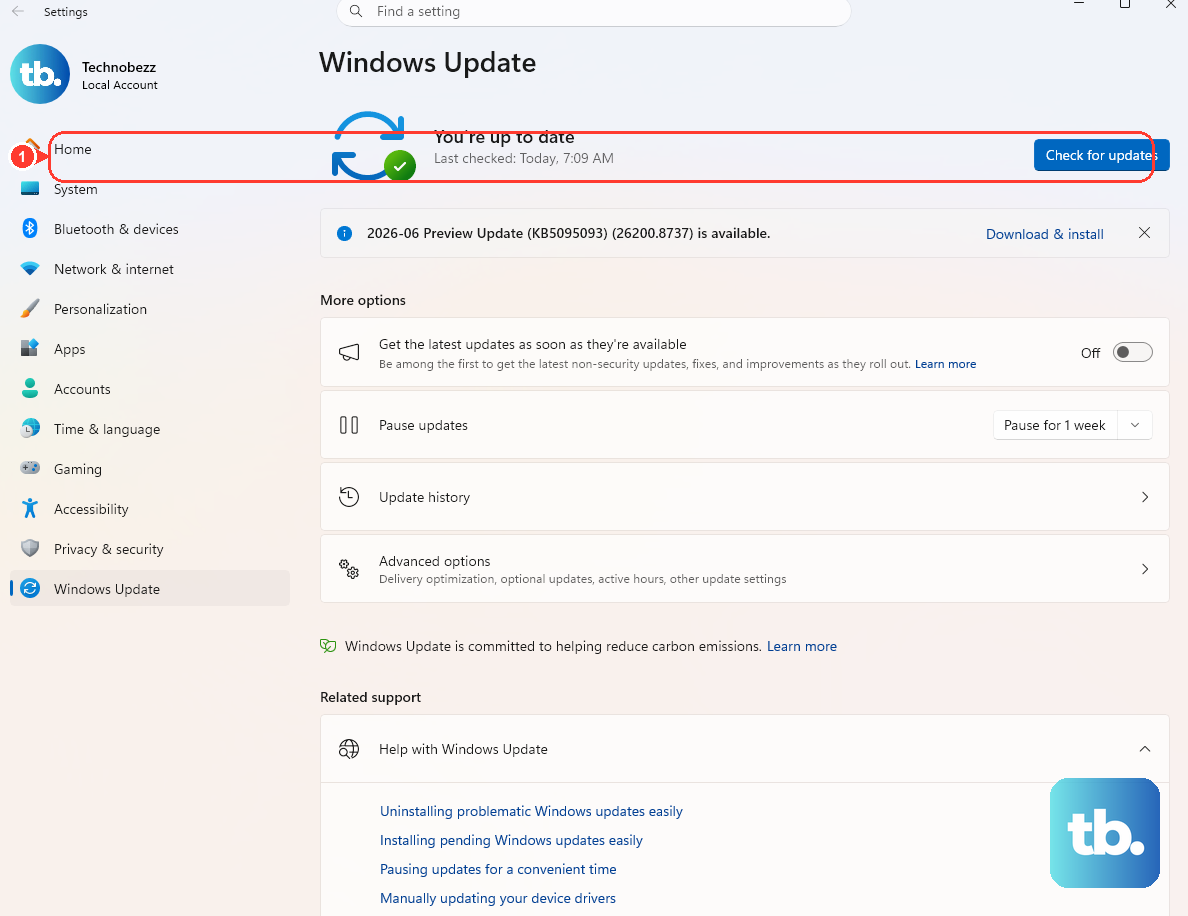
If Windows still boots normally, you can uninstall from inside Windows instead: go to Start > Settings > Windows Update > Update history > Uninstall updates. For a stuck update that will not come off cleanly, advanced users can open the WinRE Command Prompt and revert it with dism /Image:C:\ /Cleanup-Image /RevertPendingActions, replacing C: with your system partition.
Fix 6: Roll Back With System Restore
System Restore undoes recent app, driver, and update changes without deleting your personal files, which makes it a low-risk option. In WinRE, select Troubleshoot > Advanced options > System Restore.
Choose a restore point dated before the error first appeared, then follow the prompts. If a recent change is behind the 0x7B error, this rolls your system back to a state when it was booting normally.
Fix 7: Check the Disk and Repair System Files
File-system corruption is a frequent cause of this stop code, and Windows includes tools to repair it. Open WinRE > Troubleshoot > Advanced options > Command Prompt to get started.
- 1.Run
chkdsk /f /r OsDrive:to repair file-system errors and bad sectors, replacingOsDrive:with your Windows drive letter (for example,C:). - 2.Then run System File Checker offline with
sfc /scannow /offbootdir=OsDrive:\ /offwindir=OsDrive:\Windows, again substituting your OS drive letter forOsDrive:.
If Windows can boot normally, you can repair from inside Windows instead. Open an elevated Command Prompt and run DISM.exe /Online /Cleanup-image /Restorehealth first to repair the component store using Windows Update, then run sfc /scannow. If you need to use a local source instead of Windows Update, the command is DISM.exe /Online /Cleanup-Image /RestoreHealth /Source:C:\RepairSource\Windows /LimitAccess. Do not close the window until each scan reaches 100%.
Fix 8: Verify and Repair the Boot Configuration
If you are comfortable with the command line, you can confirm the disk is detected and repair the boot files directly. At the WinRE Command Prompt, run diskpart, then list disk, and then list vol to confirm the boot disk and the system/boot volumes are detected; a * in the GPT column indicates UEFI.
Inspect the boot entries with bcdedit and check the {bootmgr} and {default} device and path entries. Before changing anything, back up the store with bcdedit /export C:\temp\bcdbackup; you can restore it later with bcdedit /import C:\temp\bcdbackup if needed.
If the Boot Configuration Data is wrong or cannot be opened, rebuild it with bootrec /rebuildbcd. Microsoft also documents bootrec /fixmbr to write a compatible Master Boot Record, bootrec /fixboot to write a new boot sector, and bootrec /scanos to scan all disks for Windows installations not listed in the Boot Manager.
When Nothing Works: Compatibility Checks and a Clean Install
If you have run every fix above and still see the blue screen, turn your attention to hardware and firmware. Make sure your disk, controller, and any storage adapters are compatible with your version of Windows, and check your PC or drive maker for UEFI/BIOS and storage-controller firmware updates.
As a genuine last resort, you can perform a clean install. Use the Windows Media Creation Tool on another PC, available from microsoft.com/software-download, to make a bootable USB or DVD. To boot from that media, use your boot menu key or your BIOS setup key, which varies by manufacturer; check your PC documentation for the exact key. Warning: a clean install replaces your existing Windows installation and can erase your files, so back up any data you can reach first and use this option only when every recovery option has failed.
Frequently Asked Questions
What does the stop code 0x0000007B mean?
It is the bug check value behind the INACCESSIBLE_BOOT_DEVICE blue screen. It means Windows lost access to the system partition during startup, usually because of a storage driver or controller problem, file-system corruption, a recent update or driver, or a change to disk hardware or BIOS/UEFI storage mode such as switching SATA between AHCI, RAID, and IDE.
Will these fixes erase my files?
Most of them will not. Undoing hardware or firmware changes, Startup Repair, Safe Mode, uninstalling an update, System Restore, the disk and system-file repairs, and the boot configuration commands all aim to recover Windows without deleting your personal files. The only step that replaces your installation is a clean install with the Windows Media Creation Tool, which is recommended only as a last resort.
How do I get into recovery if Windows will not start at all?
Windows automatically enters the recovery environment after two consecutive failed attempts to start Windows, which brings up the recovery screen on its own. Keep your BitLocker recovery key handy if your device is encrypted, since recovery actions may ask for it.
Do I need to download a special tool to fix this error?
No. There is no standalone troubleshooter app for this stop code. Startup Repair, System File Checker, DISM, CHKDSK, bootrec, bcdedit, System Restore, and the Uninstall Updates option are all built into Windows and the Windows Recovery Environment. The only download you might need is the Windows Media Creation Tool, and only if you are doing a clean install from bootable media.
Does this guide apply to both Windows 11 and Windows 10?
Yes, the recovery steps apply to both Windows 11 and Windows 10. Keep in mind that Microsoft ended Windows 10 support on October 14, 2025, so while these steps remain documented for Windows 10, that version is out of mainstream support.